
Quick Answer
A missing or broken tooth usually should be restored sooner rather than later. Waiting can let a small problem turn into infection, shifting teeth, bone loss, or a harder repair. The exact timing depends on what’s damaged, so an exam is the safest way to know if it can wait or needs prompt care. If you're dealing with sudden pain or trauma, this guide on dental emergencies and quick relief can help you decide what to do next.
If you're asking this question, you're probably already doing a quiet mental debate. It doesn't hurt that much. It isn't visible. Maybe it can wait.
That hesitation is understandable. But with teeth, "wait and see" is sometimes reasonable and sometimes the exact choice that turns a manageable fix into a bigger problem.
The Hidden Costs of Waiting Why Ignoring a Damaged Tooth Is a Gamble
You notice a cracked corner on a back tooth. It only catches your tongue once in a while. You can still chew if you avoid that side. It is easy to ask, "Is this really bad enough to deal with now?"
That question is reasonable. The hard part is that teeth do not heal the way skin does. A damaged tooth usually keeps facing the same daily stress that caused trouble in the first place: biting pressure, temperature changes, bacteria, and food debris. So "leave it alone for now" is not a neutral choice. It is a choice to let those forces keep working on a weak spot.

A small opening can become a bacterial doorway
A healthy tooth works like a sealed room. Enamel protects the inside. Dentin sits underneath. The pulp contains the nerve and blood supply. Once a crack, cavity, or broken filling creates an opening, bacteria have a path inward.
Early on, you might only notice cold sensitivity or a rough edge. That can create false reassurance. People often expect severe pain to be the first warning sign, but pain often shows up after the problem has already reached deeper layers.
Practical rule: Mild symptoms can still mean active damage. The absence of major pain does not mean the tooth is safe to ignore.
If you are trying to understand what deeper infection can feel like, this plain-language overview of an abscess after root canal explains why pressure, swelling, and lingering discomfort deserve attention.
A missing tooth changes more than your appearance
Many patients look at a missing tooth and judge it by visibility. If it is in the back, it can seem optional. But your bite works like a row of books on a shelf. Remove one, and the ones beside it start to tip into the space. The tooth above or below can drift too because it has lost its partner for chewing.
That movement is slow enough to miss day to day. Months later, though, the change may show up as food trapping, harder brushing and flossing, a different bite, or less room for a straightforward replacement. Bone in the area can also shrink after a tooth is lost, because the jaw no longer gets the same stimulation from chewing there.
In plain terms, your mouth starts adapting to the gap, and those adaptations rarely make treatment simpler.
Delay often turns a repair into a bigger project
This is the part many patients want a straight answer on. If the tooth is broken, loose, decayed, or missing, can waiting make the eventual fix harder?
Yes.
A small chip may only need smoothing or bonding. A cavity may be treatable with a filling while the damage is still limited. A cracked tooth may be protectable with a crown if enough healthy structure remains. Wait long enough, and the same tooth can move into root canal treatment, extraction, or replacement.
The pattern is usually mechanical and predictable:
- Cracks spread under pressure: Every meal puts force on weakened tooth structure.
- Decay reaches deeper layers: Open areas collect bacteria and become harder to clean well.
- You shift your chewing without noticing: That can overload nearby teeth and jaw muscles.
- Gums become easier to irritate: Rough edges and open spaces trap plaque and food.
- Treatment choices narrow: Earlier preservation may no longer be possible later.
If you want a clear explanation of how tooth decay progresses over time, this guide on what happens to a cavity if left untreated walks through the stages.
Older dental work can fail quietly
Sometimes the weak point is not a new break. It is an old filling, crown, or other restoration that has worn down, loosened, or opened at the edges.
That can be easy to dismiss because the tooth was "already fixed." But dental work is more like a patch on a roof than permanent armor. If the patch leaks, the structure underneath is still at risk. A broken filling can let bacteria and pressure reach the tooth again. A loose crown can stop fitting tightly. A rough or open margin can trap plaque where your toothbrush cannot do much.
So if a restoration feels high, moves, catches floss, or looks chipped, it deserves the same attention as a newly damaged tooth.
The cost of waiting often shows up in daily life first
Money is a real reason people postpone care. That concern deserves a direct conversation, not judgment.
Beyond the financial impact, the cost of waiting often appears in small daily workarounds first. You chew on one side. You avoid ice water. You worry about biting into something firm. You keep checking the tooth with your tongue. Smiling, eating, and talking start to require planning.
Those are useful clues from a patient point of view. If a tooth is changing how you eat, clean, sleep, or feel about your mouth, the problem is already affecting your quality of life, even if it has not become an emergency yet.
A damaged tooth rarely stays frozen in place. Your mouth keeps using it every day, and that is why waiting is a gamble.
A Practical Triage Guide How to Assess Your Dental Damage
You don't need to diagnose yourself at home. You do need a basic way to judge urgency.
The simplest question is not "Can I tolerate this?" It's "What signs suggest this tooth is getting worse or affecting surrounding tissue?"

Seek same-day care if these signs are present
Some symptoms move a broken or missing tooth into urgent territory. These are the situations where waiting can put the tooth, or your comfort, at real risk.
- Facial swelling: Swelling can signal infection spreading beyond the tooth.
- Throbbing pain that doesn't settle down: Constant or escalating pain often means the inner tooth or surrounding tissue is involved.
- Fever or feeling unwell with a dental problem: That combination needs prompt professional attention.
- Uncontrolled bleeding after trauma: Bleeding that doesn't stop normally should be assessed quickly.
- A tooth broken near the gumline: Those fractures are harder to evaluate without an exam.
- A tooth knocked loose or displaced: Position changes matter, even if pain is mild at first.
If you're trying to protect a cracked tooth before you can be seen, these quick tips before your dental visit for a cracked tooth can help you avoid making it worse.
Schedule promptly if the damage isn't dramatic but isn't normal
Most dental problems fall into this middle group. You're not in crisis, but you shouldn't put it off for months.
A visible crack, a larger chip, pain when chewing, a missing filling, or lingering sensitivity to hot and cold all belong here. These are common signs that the outer barrier of the tooth is compromised.
StatPearls notes that minor enamel fractures have an excellent prognosis with simple restoration, while dentin or pulp fractures need more urgent care. It also reports that root canal treatment has over 95% success when the tooth is properly restored with a crown afterward (NCBI StatPearls).
That distinction matters. People often lump all "broken teeth" into one category, but a small enamel chip and a deep fracture are very different problems.
If chewing on a tooth feels risky, treat that as useful information. Teeth are supposed to handle normal chewing without sharp pain.
Bring it up at your next checkup if it stays truly minor
Some issues can wait for a regular visit, especially if they are small, stable, and painless. A tiny chip on a front tooth that doesn't affect chewing is a common example.
Even then, keep an eye on changes. If the edge gets sharper, sensitivity begins, or the appearance of the tooth changes, move it up from "mention later" to "call now."
This quick table can help:
| Situation | Likely timing |
|---|---|
| Swelling, severe pain, trauma, uncontrolled bleeding | Same day |
| Crack, lost filling, chewing pain, strong sensitivity | Prompt appointment |
| Tiny painless chip, no bite change, no sensitivity | Next checkup, unless it changes |
Some mouth pain can be confusing because it doesn't feel like it's coming from a tooth. If you're sorting out symptoms in the upper mouth, this guide to roof of mouth pain can help you understand when discomfort may have a different cause and still needs attention.
If a back tooth is missing, don't assume the answer is always identical
Patients often ask whether every missing molar must be replaced immediately. The honest answer is that it depends on your bite, symptoms, and overall dental condition.
A stable bite with a single asymptomatic missing posterior tooth may sometimes be monitored rather than restored right away. That decision should come from an exam, not guesswork at home, because what feels "fine" can still carry hidden stress on nearby teeth.
Your Restoration Options at West Bell Dental Care
You come in expecting to hear, "Just fix the tooth." Instead, the actual question is more specific. Is this a small repair, a full cover, a rebuild from the inside, or a replacement for something that is already gone?
That choice depends on three things. How much healthy tooth is left. Whether the nerve and root are still in good shape. How the tooth fits into the rest of your bite.

Fillings for smaller areas of damage
A tooth-colored filling usually makes sense when the damage is limited and the tooth still has enough natural structure to carry normal chewing forces.
A filling works like patching a worn spot in a wall before the studs are affected. It seals the opening, restores the shape, and helps stop food and bacteria from collecting in that area. If you are asking, "Is it really bad enough to need more than a filling?" the main issue is not the size of the visible spot alone. It is whether the rest of the tooth is still strong enough to support a simple repair.
Crowns for teeth that need full coverage
A dental crown covers the visible part of a weakened tooth. Dentists often recommend crowns for teeth with large cracks, large failing fillings, or teeth that have lost enough structure that the walls are thin and vulnerable.
Patients often wonder why a dentist cannot place a larger filling. Sometimes that would be like replacing one loose brick in a chimney whose outer walls are already unstable. The patch may fit, but the tooth can still split under pressure. A crown surrounds the tooth and helps it tolerate the repeated force of biting and chewing.
Root canal treatment when the inside of the tooth is involved
If the problem has reached the pulp, the soft tissue inside the tooth, the treatment goal changes.
A root canal removes inflamed or infected tissue from inside the tooth, cleans the canals, and creates a foundation for rebuilding it. That can sound intimidating, so here is the simple version. The root canal addresses the infection source inside the tooth. The restoration placed after it, often a filling or crown, is what helps the tooth work normally again.
Bridges when one or more teeth are missing
A bridge replaces a missing tooth by attaching an artificial tooth to the neighboring teeth. For some patients, it is a practical fixed solution, especially when an implant is not the best fit for health, anatomy, timeline, or budget.
The tradeoff is straightforward. A bridge depends on the teeth next to the gap for support. If those neighboring teeth are already heavily restored or weakened, that matters in the decision.
Implants for replacement from root to crown
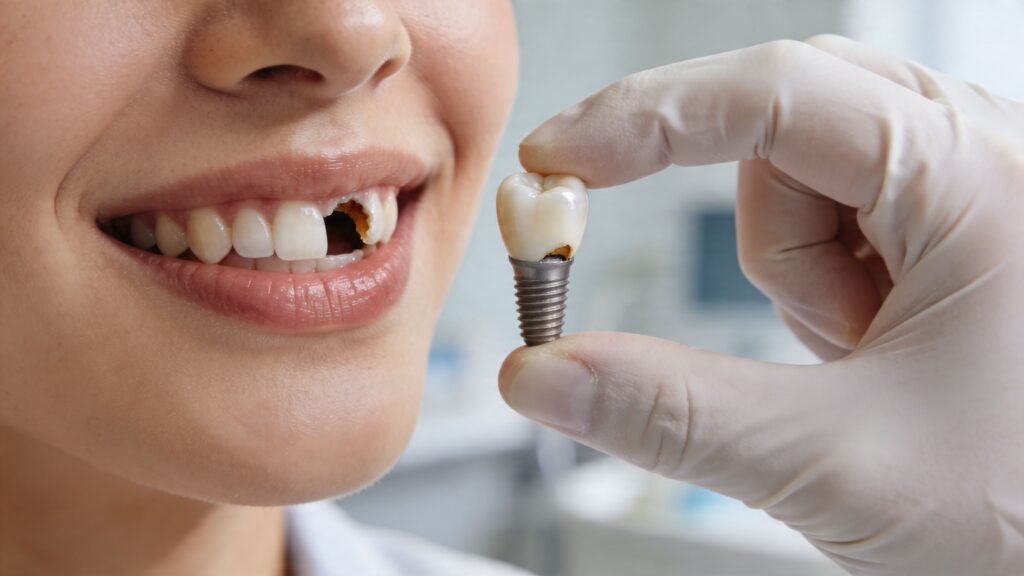
A dental implant replaces the root of a missing tooth and supports a crown above it. For the right patient, that means the chewing load is directed into the jaw rather than shifted onto the teeth beside the space.
This option is often appealing when patients want a replacement that stands on its own. It is not the right answer for every missing tooth, but it is often worth discussing if preserving neighboring teeth is a priority.
Dentures for several missing teeth
When several teeth are missing, dentures or partial dentures may be the most practical way to restore appearance and basic chewing function.
This is often the point where patients worry that choosing dentures means "settling." That is not the right way to look at it. The better question is which option fits the number of missing teeth, the condition of the remaining teeth, and what you want daily life to feel like when you eat and speak.
The best restoration is the one that solves the actual problem and matches what the tooth, the neighboring teeth, and your bite can realistically handle.
If you want a clearer overview of how these treatments fit together, this page on what restorative dentistry includes explains the bigger picture.
Sometimes replacement is better than repair
A failing filling or crown does not always need to be replaced from scratch. In some cases, repairing the weak area is a reasonable conservative choice.
But "smaller fix" does not automatically mean "better long-term fix." Makhija et al., 2015 found that repaired restorations needed additional treatment somewhat more often within one year than replaced restorations, with that difference mattering especially in back teeth.
So if your dentist recommends replacing old dental work instead of patching it, the reasoning is usually mechanical, not cosmetic. The question is whether a repair will effectively protect the tooth, or whether it will leave a weak foundation in place.
The Restoration Journey What to Expect from Start to Finish
A lot of dental anxiety comes from not knowing what's about to happen. The process feels more manageable when you can picture the steps.
Most restorations follow the same broad path. The details change, but the rhythm is familiar.

First comes the evaluation
The first visit is about clarity. The dentist checks the tooth, the gums, your bite, and any surrounding structures that may be affected. Digital X-rays may be part of that visit if they help show what can't be seen from the surface.
Confusion often resolves. A patient may point to one tooth, but the underlying issue may be a crack line, a failing restoration, or pressure from the way the teeth are meeting.
Then you talk through options in plain language
A good treatment plan should answer a few simple questions. What is damaged. What happens if you wait. What are the realistic ways to restore it.
If a tooth is missing, the plan may include restoration or monitoring, depending on the situation. One source summarizing this decision notes that a dentist may recommend watchful waiting for a single asymptomatic missing molar when the bite is stable, and modern diagnostics may avoid unnecessary treatment in up to 40% of such cases in some markets (Moskin Dental Associates blog synthesis).
That kind of nuance matters. Not every recommendation should feel automatic.
The treatment visit depends on the tooth's needs
A small filling appointment is different from a crown, bridge, denture, or implant process. But the purpose stays the same. Remove what's unhealthy, protect what's healthy, and rebuild what's missing.
For anxious patients, comfort planning is part of treatment, not an afterthought. Local anesthetic, calm communication, and sedation options when appropriate can make the visit much easier.
Here is what patients usually want to know before treatment:
- How long will I be there: Timing depends on the procedure and whether more than one tooth is involved.
- Will I need more than one visit: Some restorations can be completed quickly, while others are staged.
- Will I leave with a temporary: Crowns, bridges, and some tooth replacement plans may involve temporary protection.
- What should I expect afterward: Mild soreness, bite adjustment, or getting used to a new contour can be normal.
Most dental visits feel less stressful once the problem has a name and a plan.
Aftercare keeps the work functioning well
Restoring a tooth is not the end of the story. The work still has to live in your mouth every day.
That means brushing, flossing, follow-up visits, and paying attention to any return of sensitivity or bite discomfort. A crown, bridge, filling, implant, or denture does best when the surrounding gums and supporting teeth are also healthy.
For people in Surprise, Sun City, and the West Valley, the biggest relief often isn't cosmetic. It's being able to chew normally again without wondering if that tooth is about to fail.
Navigating Costs and Insurance for Your Dental Restoration
Cost is one of the main reasons people postpone care, even when they know something isn't right. That's understandable. Dental treatment is easier to face when you know what to expect.
The hard part is that no honest office can tell you the exact cost of restoring a missing or broken tooth before an exam. A tiny chip, a deep fracture, a lost filling, and a missing molar may all sound similar to a patient, but they call for very different treatment.
Several factors affect the final plan:
- Type of restoration: A filling, crown, bridge, denture, or implant each solves a different problem.
- Extent of damage: A tooth with surface damage is different from one with nerve involvement.
- Materials used: Restorations are selected based on function, appearance, and where the tooth sits in the mouth.
- Number of teeth involved: One tooth is different from several teeth or a more complex bite issue.
- Insurance benefits: Coverage varies widely by plan and by procedure.
If you have dental insurance, it's worth asking how preventive, restorative, and replacement services are handled under your plan. This guide to understanding dental insurance can help you get familiar with the terms before you call.
A clear consultation should include a diagnosis, treatment options, and a written estimate before work begins. If cost is a concern, say so early. That's not unusual, and it helps the team talk through priorities and payment options without surprises.
Frequently Asked Questions About Restoring Teeth
Can I ignore a broken tooth if it doesn't hurt?
Sometimes a broken tooth stays painless for a while, but that doesn't mean it's harmless. Cracks, chips, and lost fillings can expose weaker tooth structure and let the problem deepen before symptoms become obvious. An exam is the safest way to tell whether it needs prompt restoration.
Is a missing back tooth always a problem?
Not always in the same way, and not always on the same timeline. Some missing back teeth affect chewing, shifting, or bite balance sooner than others. In certain cases, a dentist may monitor a single missing molar if you're symptom-free and your bite is stable, but that decision should follow an exam.
What's usually better for a broken tooth, a filling or a crown?
It depends on how much healthy tooth is left. Small chips or limited decay may do well with a filling, while a tooth with a larger fracture or heavy structural loss may need a crown to hold it together during chewing. The goal is to choose the least invasive option that still protects the tooth.
If I need a root canal, does the tooth still need a crown?
Often, yes. A root canal treats the inside of the tooth, but the outer tooth still needs enough protection to function well. For many back teeth and heavily damaged teeth, the crown is what helps protect the tooth after treatment.
How quickly should I call after losing a filling or crown?
Call soon, even if the tooth isn't hurting yet. A missing restoration can leave the tooth exposed, more sensitive, and easier to damage further. Early evaluation may give you simpler options.
Will restoring a tooth hurt?
Most restorative care is more manageable than patients expect. Dentists use local anesthetic, and many offices offer anxiety-friendly approaches or sedation options for patients who need extra help feeling comfortable. The bigger source of pain is often the untreated dental problem, not the repair.
How do I know whether to repair old dental work or replace it?
That depends on where the defect is, how much of the old restoration remains sound, and whether the tooth can still be sealed predictably. Sometimes a small repair is reasonable. In other cases, full replacement gives the tooth a better chance of lasting.
Take the Next Step Toward a Healthy Smile
If you're still wondering when should a missing or broken tooth be restored instead of ignored?, the safest answer is simple. Don't wait for pain to make the decision for you. A clear exam can tell you whether the problem needs urgent treatment, prompt restoration, or careful monitoring.
For patients in Surprise, Marley Park, Sun City Grand, and nearby West Valley communities, getting answers early can prevent a lot of stress later.
If you have a missing tooth, a crack, a lost filling, or a tooth that just doesn't feel right, West Bell Dental Care can help you understand your options without pressure. Dr. Jennifer Wynn and the team provide exams, fillings, crowns, bridges, dentures, implants, and emergency dental care for patients in Surprise and the surrounding West Valley. Contact the office at 16581 W. Bell Rd., Suite 108, Surprise, AZ or request a visit online through the appointment scheduling page.
Sources
Makhija SK, Gilbert GH, Rindal DB, et al. "Dentist Decision-Making for Defective Restorations." 2015. https://pmc.ncbi.nlm.nih.gov/articles/PMC4663659/
StatPearls. "Tooth Fracture." 2024. https://www.ncbi.nlm.nih.gov/books/NBK551650/
Novel Smiles. "How Missing Tooth Requires Dental Restoration." 2024. https://www.novelsmiles.com/blog/how-missing-tooth-requires-dental-restoration-cip136/
Moskin Dental Associates. "When Does a Broken Tooth Need Immediate Treatment." 2025 synthesis page referenced in brief. https://www.moskindentalassociates.com/blog/when-does-a-broken-tooth-need-immediate-treatment