Direct Answer: Fixing a tooth restores function and health. Improving a tooth changes how it looks. Many treatments do both — and knowing the difference helps you make smarter decisions about your care.
Most people come into a dental office with one of two things on their mind: something that hurts, or something they wish looked different. But a lot of patients in Surprise and the surrounding West Valley don’t realize there’s a meaningful distinction between those two goals — and that distinction affects which treatments make sense, which ones insurance might help cover, and what you’re actually getting done to your teeth.
Restorative dentistry and cosmetic dentistry aren’t opposites. They overlap in some real and useful ways. A dental crown can save a cracked tooth and make it look better at the same time. A veneer improves appearance but can also protect a weakened tooth surface. Understanding where one ends and the other begins helps you walk into any treatment conversation with a clearer head.
This article breaks down what each category actually means, where they genuinely overlap, and how to think about your own situation — whether you’re dealing with a damaged tooth, not happy with how your smile looks, or both.
What ‘Fixing’ a Tooth Actually Means
When dentists talk about restorative care, they mean treatments that address damage, decay, infection, or loss. The goal is to get the tooth — or the space where one used to be — functioning properly again.
This is the category that includes:
– Fillings for cavities (tooth-colored composite is the standard now — learn what that process involves)
– Crowns to cover and protect a tooth that’s cracked, worn, or had a root canal
– Bridges and dental implants to replace missing teeth
– Root canal therapy to clear an infected tooth before it becomes a bigger problem
– Extractions when a tooth is too far gone to save
The common thread: something is wrong, and left alone, it gets worse. That’s why waiting for pain before seeing a dentist can backfire — a lot of restorative problems don’t hurt until they’re expensive.
Insurance usually covers at least part of restorative care because there’s a clinical reason for it. That doesn’t mean costs are zero — in the Surprise area, a single crown typically runs $1,200 to $1,800 out of pocket depending on material and location in the mouth. But it does mean there’s a coverage framework worth using.
Restorative work is rarely optional for long. The longer a damaged or missing tooth goes unaddressed, the more the surrounding teeth shift and the bone beneath changes — which can turn a manageable fix into a much larger one.
What ‘Improving’ a Tooth Actually Means
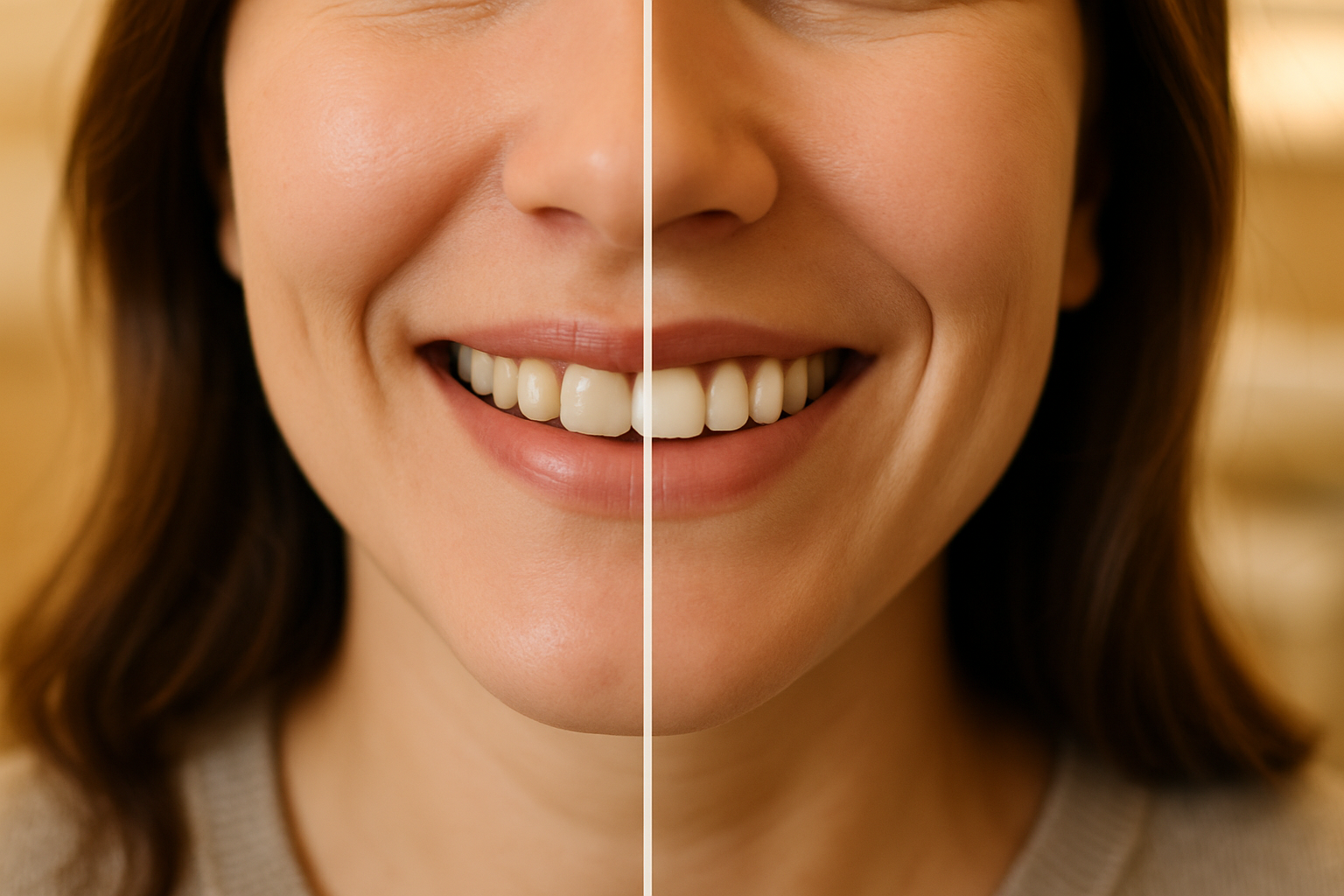
Cosmetic dentistry is about changing how teeth look when nothing is clinically wrong. The tooth works fine — it’s just discolored, chipped, uneven, or not where you want it to be in your smile.
Common cosmetic treatments include:
– Teeth whitening — the most common starting point for most patients (see real before and after results)
– Composite bonding — tooth-colored resin applied directly to reshape or cover a tooth
– Porcelain veneers — thin shells bonded to the front of teeth for a more dramatic or lasting change (how long veneers actually last)
– Invisalign — clear aligners to move teeth into better position over time
– Smile makeovers — a combination of procedures planned together as a single goal
Insurance almost never covers purely cosmetic work. Whitening, veneers, and bonding are considered elective. That’s worth knowing upfront so the cost conversation doesn’t feel like a surprise.
In the Surprise and Peoria corridor, professional whitening runs roughly $400 to $650 in-office. Veneers tend to start around $1,000 to $1,400 per tooth. Bonding is usually the most accessible entry point — often $300 to $600 per tooth — which is why it’s a good starting conversation for patients who want a change but want to be careful about budget.
The important thing to know: cosmetic work done well doesn’t just look better. It can also make teeth easier to clean, more uniform in bite pressure, and less prone to certain kinds of wear.
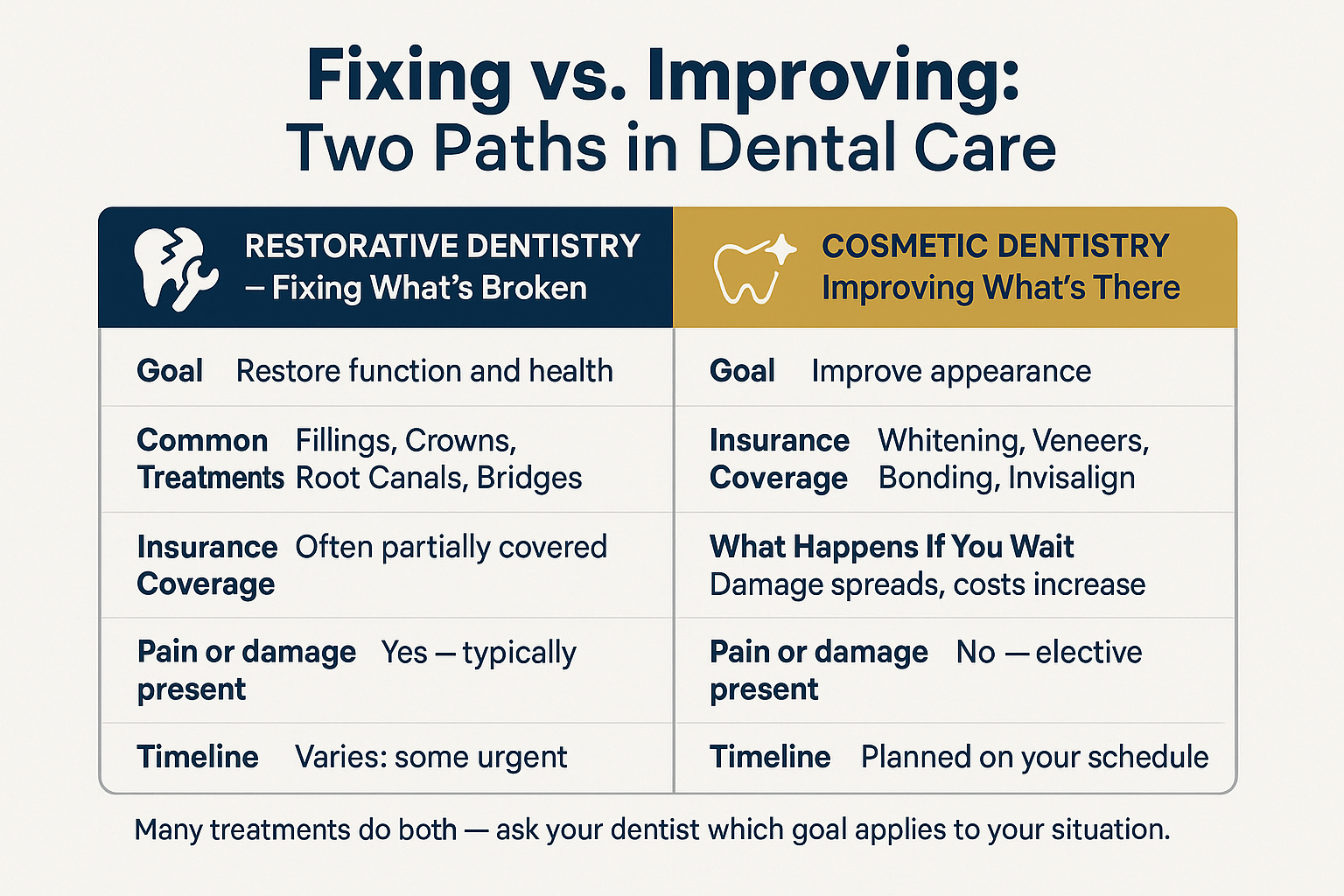
Restorative vs. Cosmetic: At a Glance
This comparison breaks down the key differences between restorative and cosmetic dental care — so you know which category applies to your situation before your next appointment.
Where the Two Categories Actually Overlap
This is where the distinction gets genuinely useful — because a lot of treatments serve both purposes at once, and that changes how you think about the value.
Take a dental crown. If a tooth is badly cracked or has had a root canal, a crown protects what’s left and restores your ability to chew without pain. But crowns are also made to match your surrounding teeth in color and shape. You’re not just fixing the tooth — you’re also leaving with something that looks natural. That’s function and aesthetics in one procedure.
The same goes for dental implants. Replacing a missing tooth prevents the bone loss and shifting that happens when a gap is left open, which is a genuine health reason. But implants also restore the appearance of a full smile in a way that a removable partial denture doesn’t. Patients in Sun City Grand who’ve gone through the implant process often describe feeling like themselves again — not just because they can eat what they want, but because they stop feeling self-conscious about their smile. Understanding how implant healing works helps set realistic expectations before you start.
Composite bonding is another good example. It’s typically classified as cosmetic, but for translucent or thinning teeth — a real structural concern — bonding adds thickness and protection. Dental bonding for translucent teeth is one situation where the line between cosmetic and restorative blurs in a meaningful way.
For patients considering a full smile change, the question of whether you’re fixing or improving — or both — is exactly what a treatment plan is designed to sort out. Understanding how long a smile makeover takes depends heavily on whether restorative work needs to come first.
Common Treatments: Which Category They Fall Into
Most dental procedures lean toward one goal, but several land in both columns. This table gives you a quick reference for where common treatments typically sit.
| Treatment | Primary Goal | May Affect Both? |
|---|---|---|
| Tooth-colored filling | Restorative — removes decay | Yes — matches tooth color |
| Dental crown | Restorative — protects damaged tooth | Yes — shaped and matched to blend in |
| Dental implant | Restorative — replaces missing tooth | Yes — restores appearance of full smile |
| Root canal | Restorative — removes infection | No — internal treatment only |
| Professional whitening | Cosmetic — brightens enamel | No — appearance only |
| Porcelain veneers | Cosmetic — reshapes smile | Sometimes — can protect worn enamel |
| Composite bonding | Cosmetic — corrects shape/color | Sometimes — adds thickness to thin teeth |
| Invisalign | Cosmetic/functional — aligns teeth | Yes — affects bite and hygiene access |
| Tooth extraction | Restorative — removes problem tooth | No — preparation step, not final result |
How to Know Which One You Actually Need
If something hurts, feels loose, is cracked, or has visible decay, you’re in restorative territory. That’s the starting point, and it generally needs to happen before any cosmetic work is considered — you don’t put a veneer on a tooth that needs a root canal.
If nothing is broken and nothing hurts, but you don’t like what you see when you smile, that’s cosmetic. The good news: you can take your time. There’s no clinical urgency when the teeth are healthy. You can plan, budget, and sequence treatments around your schedule.
The trickier situations are in between — teeth that aren’t quite broken but aren’t in great shape either. Patients who’ve avoided the dentist for a few years often find themselves here. They come in wanting whiter teeth and leave having found out there are two cavities to handle first. That’s not a bad outcome — it just means the order of operations matters.
Families in Marley Park or working professionals in Rancho Gabriela who haven’t been in for a while often have this experience. A full exam and updated X-rays give you a clear map of where things stand before any conversation about improving happens. That honest baseline is how good care starts.
Frequently Asked Questions About Fixing vs. Improving Your Teeth
Can I get cosmetic work done if I have existing cavities or gum issues?
Generally, no — not at the same time. Restorative and gum health concerns need to be addressed first. Placing veneers or doing whitening on teeth with active decay or infected gum tissue isn’t something a responsible dentist will do. The good news is that once those issues are resolved, cosmetic work can often move quickly.
Will insurance cover any cosmetic dental work?
Rarely. Most dental insurance treats cosmetic procedures — whitening, veneers, bonding for purely aesthetic reasons — as elective and excludes them. However, if a procedure has a restorative purpose alongside a cosmetic one (like a crown after a root canal), insurance may cover the restorative portion. Always ask your dental team to check coverage before assuming.
What’s the most affordable way to start improving my smile?
Professional whitening is typically the lowest-cost, lowest-commitment starting point — usually $400 to $650 in-office in the Surprise area. Composite bonding is the next step up and can correct shape, chip repairs, or color on individual teeth for $300 to $600 per tooth. Both are reversible or updatable over time, which makes them good options if you’re not ready to commit to veneers.
Is cosmetic dentistry only about looks, or does it actually help your teeth?
It depends on the procedure. Some cosmetic treatments — like aligning teeth with Invisalign — genuinely improve how teeth function and how easy they are to clean. Others, like whitening, are appearance-only. A good way to think about it: cosmetic dentistry isn’t always just about looks, but you shouldn’t assume every cosmetic procedure has a health benefit either.
How do I know if a tooth needs a crown or a filling?
A filling works when decay is limited and the remaining tooth structure is solid. A crown is needed when the tooth is cracked, the decay is too large for a filling to hold long-term, or the tooth has been weakened by a root canal. Your dentist will usually show you the X-ray and explain which situation you’re in. Understanding how long a filling takes can also help you know what to expect for the simpler option.
Can I get a smile makeover if I only want to fix one or two things?
Yes — a smile makeover isn’t always a full-mouth overhaul. It just means planning multiple changes together so the results look intentional and proportional. Some patients in Ashton Ranch or Sierra Montana come in wanting to address two front teeth and nothing else. That’s a completely reasonable goal, and a treatment plan can be built around it.
Ready to Know Exactly Where You Stand?
Whether you’re dealing with something that needs attention or just want to understand what your options are for improving your smile, the clearest next step is a full exam. Our team at West Bell Dental Care works with patients across Surprise, Sun City Grand, Marley Park, and the surrounding West Valley every day — people at all different starting points, with all different goals. You can reach us at 480-795-2420 or visit westbelldentalcare.com to learn more. We’re open Saturdays, so finding a time that works around your schedule is usually easier than you’d expect.