
Quick Answer
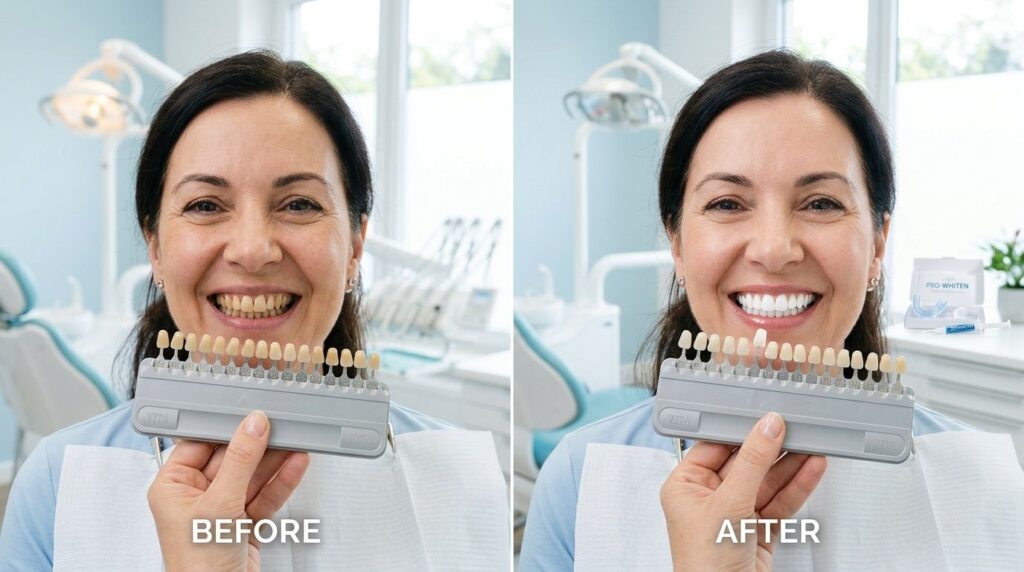
Teeth whitening before and after results can be noticeable, but the outcome depends on the method, your starting shade, existing dental work, and whether a dentist checks your teeth first. Professional whitening usually gives faster, more even results than store-bought products, while also giving you a safer plan for sensitivity and long-term maintenance.
You’ve probably seen teeth whitening before and after photos that look dramatic, then wondered what’s real for your own smile. That’s a fair question, especially if you’ve already tried whitening toothpaste or strips and didn’t see much change.
Real whitening results depend on the kind of stain, how dark the teeth are to begin with, whether you have crowns or fillings in visible areas, and how the treatment is done. In Surprise, AZ, patients usually want a simple answer: what works, what doesn’t, and what’s the safest way to get a brighter smile without guessing. That’s the goal here.
West Bell Dental Care A Professional, Patient-First Approach

If you care about teeth whitening before and after results, start with a dental exam, not a product box. That matters more than is commonly realized. Whitening can improve natural tooth structure, but it won’t lighten crowns, veneers, or tooth-colored fillings, and it’s not the right first step if you have untreated decay, gum irritation, or heavy buildup.
At West Bell Dental Care, whitening is part of a broader cosmetic and preventive conversation. Dr. Jennifer Wynn and the team treat families, retirees, and working adults in Surprise and across the West Valley, so the advice has to be practical. Some patients need fast in-office whitening. Some do better with take-home trays. Some need a cleaning first because surface stain is the issue.
Why the dental office route usually gives better guidance
The biggest advantage of a dental office isn’t just stronger gel. It’s judgment. A dentist can tell whether your staining is likely to respond well, whether sensitivity is a concern, and whether whitening will create a mismatch with older dental work.
That changes expectations right away. Instead of chasing a shade from someone else’s before and after photo, you get a plan based on your enamel, habits, and goals.
Practical rule: If you have visible fillings, crowns, veneers, gum recession, or sensitive teeth, don’t pick a whitening product first. Pick an exam first.
Professional whitening also gives you options. West Bell Dental Care offers both in-office and take-home whitening, which is important because no single method is right for everyone. If you want to compare whitening with other appearance-focused treatments, this overview of cosmetic dentistry options in Surprise, AZ is a useful next step.
What works well and what tends to disappoint
In practice, the strongest before and after results usually come from matching the method to the stain. External stain from coffee, tea, or similar habits often responds well. Deep internal discoloration is a different conversation and may need another cosmetic option.
What tends to disappoint patients is self-treating without knowing the cause of the color problem. Whitening toothpaste may help maintain a result, but it usually isn’t the treatment that creates a major change by itself. Generic trays can fit poorly. Strips can miss edges or overlap the gums. Mail-order systems can work for some people, but they remove the chairside check that often prevents frustration.
A local office also gives you continuity. If sensitivity shows up, if the shade settles unevenly, or if you decide whitening isn’t the right fit and veneers make more sense, the same team can guide you. That’s more useful than chasing online reviews or relying on managing dental practice reputation as a substitute for an actual exam.
In-Office Whitening For Fast, Dramatic Results

If you want the quickest visible change, in-office whitening is the category to look at first. Philips Zoom is one of the best-known examples because patients can see before and after examples and understand that the treatment is designed for a single dental visit under supervision.
A commonly cited range for professional in-chair whitening is about 4 to 8 shades in 60 to 90 minutes, while tray systems usually produce 2 to 6 shades over a longer period, according to teeth whitening effectiveness and sensitivity data. That doesn’t mean every patient gets the same change, but it does explain why people choose this route before weddings, interviews, reunions, or photos.
Who it fits best
This is usually the strongest fit for patients who want speed and professional oversight. It also helps when staining is heavier and you don’t want to spend weeks testing store products.
The trade-off is sensitivity. Temporary sensitivity is common with whitening in general, and that’s one reason dentist supervision matters. If you’ve wondered whether whitening is hard on teeth, this explanation of whether teeth whitening damages enamel covers the issue clearly.
- Best use case: Patients who want a noticeable change quickly.
- Main advantage: Fast, supervised treatment with better gum protection.
- Main limitation: It’s not ideal if your teeth are already very sensitive or if visible restorations would create a color mismatch.
Professional whitening is strongest when speed matters and your teeth are healthy enough to tolerate it comfortably.
Professional Take-Home Kits For Controlled, Gradual Whitening

Professional take-home kits sit in a very practical middle ground. Brands like Opalescence are common in dental offices because they give you custom guidance without requiring you to sit in the chair for the entire whitening process.
In one clinical comparison, at-home whitening with 10% carbamide peroxide produced a mean color change of ΔE = 11.38 ± 1.69 immediately after treatment and 9.19 ± 2.52 at six months, which remained a clinically noticeable change, according to this whitening study summary. That sounds technical, but the practical meaning is simple. Properly selected take-home systems can create strong visible change and still hold up well over time.
Why many patients prefer this route
Take-home kits work well for patients who want more control. You can whiten more gradually, pause if sensitivity shows up, and often get a more even result than with one-size-fits-all retail trays.
This is also a good fit for people who don’t need an immediate result by tomorrow. You trade speed for flexibility.
- Good for: Patients with a schedule that doesn’t allow a longer in-office visit.
- Good for: People who want to ease into whitening instead of doing everything in one session.
- Watch for: Overuse, uneven wear time, or ignoring aftercare instructions.
Aftercare matters more than patients think. This guide on teeth whitening aftercare and maintaining white teeth after treatment is worth following if you want the result to last instead of fading quickly.
At-Home LED Devices A Dentist’s Perspective

LED whitening devices are popular because they feel more advanced than strips and more convenient than office visits. GLO Science is one example patients ask about because it combines a device with whitening gel and gives users a more structured home routine.
My view as a dentist is simple. These products can help some patients, but they’re rarely my first recommendation when someone wants a dramatic teeth whitening before and after result. The main reason isn’t marketing. It’s consistency. Home devices depend heavily on correct use, regular use, and realistic expectations.
Where LED kits can make sense
These systems make the most sense for mild to moderate staining and for patients who are patient enough to follow directions carefully. They can also work as maintenance after professional whitening, depending on the person’s history and sensitivity.
The concern is that people often use them when they should first get an exam. If the actual issue is tartar, old restorations, translucent enamel, or patchy dehydration after whitening, a lighted device won’t solve the underlying problem.
If a product promises a dramatic before and after without first checking your teeth and gums, the promise is doing too much work.
A second issue is self-diagnosis. Patients often assume the blue light is the main reason for whitening, when the gel, wear time, and case selection matter more in real life. That doesn’t mean these products are useless. It means they’re often better as a secondary option than a starting point.
Over-the-Counter Strips What To Expect

Whitening strips are the product most patients have already tried before they ask about professional whitening. That makes sense. They’re easy to buy, easy to store, and simple to use.
They’re also common enough that usage data tells an interesting story. In 2020, 20.59 million Americans used whitening strips, with 18.92 million using Crest 3D White Whitestrips, according to teeth whitening market and consumer statistics. Popularity, though, isn’t the same as suitability.
What strips do well and where they fall short
Strips can help with mild surface stain. They’re a reasonable entry point if your teeth are generally healthy and you understand the limits. For some people, they produce a modest improvement that’s enough.
Their weak spots are fit and coverage. A strip can’t adapt perfectly to every contour, especially near the gumline or between teeth. That’s one reason before and after photos from strips often look less even than professional tray whitening.
- What works: Mild stain, simple home use, accessible starting point.
- What doesn’t work well: Deep discoloration, uneven tooth alignment, visible restorations, and impatient expectations.
- What to remember: If strips haven’t done much after careful use, repeating the same approach usually won’t create a totally different outcome.
If you’re trying to brighten your smile without overspending, this article on getting teeth whitened or straightened without spending a fortune gives a more grounded way to think about your options.
Mail-Order Trays The DIY Approach Vs In-Person Care
Mail-order tray systems appeal to patients who want something more customized than strips without coming into the office first. Smile Brilliant is a common example. The idea is straightforward. You take impressions at home, mail them in, and receive trays with whitening gel.
This can be a real upgrade over one-size trays because custom trays generally place gel more evenly. That part is valid. But the weak link is still the absence of a direct in-person exam before you begin.
The trade-off most patients miss
The tray itself may be more customized, but the diagnosis usually isn’t. If your teeth are sensitive, if one tooth is darker than the others, or if the color issue relates to previous dental work, the tray won’t tell you that.
There’s also the question of longevity. A review of long-term whitening stability noted that both low-concentration and conventional in-office approaches maintained color differences at 12 months with minimal rebound in that study, while also showing psychosocial benefits from treatment, according to this long-term whitening follow-up review. That kind of follow-up is one place professional care still has an advantage. You’re not just buying gel. You’re getting supervision, maintenance guidance, and a plan if the result drifts.
A custom tray is helpful. A custom diagnosis is better.
For some patients, mail-order trays are a reasonable compromise. For others, especially those comparing teeth whitening vs veneers, they can delay the more appropriate treatment because the problem was never likely to be solved by whitening alone.
Before & After: 6 Teeth Whitening Options Compared
| Option | 🔄 Implementation complexity | ⚡ Resource requirements | ⭐ Expected effectiveness | 📊 Typical results / impact | 💡 Ideal use cases & tips |
|---|---|---|---|---|---|
| West Bell Dental Care: A Professional, Patient-First Approach | Medium, clinical appointments, diagnosis and follow‑up | Full dental office (digital imaging, intraoral cameras, staff); financing available | ⭐⭐⭐⭐, high-quality comprehensive care (not a single-product whitening claim) | Improves overall oral health and offers professional treatment paths; outcomes depend on chosen service | Best for family care, emergency needs, and patients seeking personalized plans; call for pricing/insurance |
| In‑Office Whitening (Philips Zoom) | Medium, single‑visit clinical protocol with chairside steps | Dentist, light‑accelerated unit, proprietary gels; higher cost per session | ⭐⭐⭐⭐⭐, fastest and most dramatic shade change | Significant single‑visit whitening; sensitivity risk and shorter prep time to see results | Ideal for event‑driven, time‑sensitive whitening; discuss sensitivity management and cost |
| Professional Take‑Home Kits (Opalescence) | Low–Medium, dentist issues trays/kits and monitors progress | Dentist visit for trays or Boost; PF gels of varying strengths | ⭐⭐⭐⭐, controlled, reliable multi‑week improvement | Gradual, predictable shade change with reduced sensitivity options (PF formulas) | Good for patients wanting dentist oversight with at‑home convenience; select strength based on sensitivity |
| At‑Home LED Devices (GLO Science) | Low, device‑guided home sessions (~30 min) | Device purchase, gel refills, occasional professional kits available | ⭐⭐⭐, moderate effectiveness over days–weeks | Faster than OTC strips but typically less than in‑office; requires maintenance/replacements | Suited for tech‑oriented users wanting faster home results; budget for device and periodic gel |
| Over‑the‑Counter Strips (Crest 3DWhitestrips) | Very low, simple retail application | Retail purchase only; minimal extras; refundable policies on some products | ⭐⭐–⭐⭐⭐, modest, gradual whitening for mild stains | Affordable, gradual improvement; won’t whiten restorations and may need multiple boxes | Best for budget-conscious users with mild discoloration; follow instructions to reduce irritation |
| Mail‑Order Trays (Smile Brilliant) | Medium, DIY impression, mail‑in lab, repeated home use | Impression kit, custom trays fabricated, carbamide peroxide gels | ⭐⭐⭐, better contact than strips, slower than in‑office | Even, custom‑tray whitening over multiple sessions; no chairside monitoring | Good DIY alternative for custom fit and cost savings vs office; allow time for impressions and follow directions |
Ready for Your Own After Photo
The biggest mistake patients make with teeth whitening before and after expectations is choosing a product before they know what their teeth can realistically do. Whitening works well for many people, but not every smile responds the same way, and not every stain should be treated with the same approach.
If you want the fastest visible change, in-office whitening is usually the strongest option. If you want more control and a steadier pace, professional take-home trays are often a very good choice. If you’re considering LED kits, strips, or mail-order trays, they can help in the right situation, but they also create more room for uneven results, missed diagnosis, and frustration when the problem isn’t simple surface stain.
That’s where a professional consultation matters. A dentist can check for cavities, gum irritation, exposed roots, enamel wear, old fillings, crowns, and other factors that change what kind of before and after result is realistic. That step protects your comfort, protects your enamel, and helps you avoid spending time on a method that doesn’t fit your mouth.
At West Bell Dental Care, the goal is to give patients in Surprise, AZ and nearby West Valley communities clear advice, not a sales pitch. Some patients are good candidates for whitening right away. Some need a cleaning first. Some need to know that whitening won’t change the color of existing dental work. That kind of honesty is what leads to better results and fewer disappointments.
If you’re thinking about teeth whitening before and after results for an event, photos, work, or just your own confidence, the next step is simple. Have a dentist look at your teeth and tell you what’s likely to work for you specifically.
FAQs
How white can my teeth realistically get
That depends on your starting shade, the cause of the discoloration, and whether the teeth are natural or restored. Some patients see a very noticeable change, while others get a softer improvement that still looks cleaner and brighter. A dental exam is the best way to set realistic expectations.
Will whitening work on crowns or fillings
No. Whitening changes natural tooth structure, but it doesn’t lighten crowns, veneers, bridges, or tooth-colored fillings. If those restorations show when you smile, your dentist should discuss the risk of shade mismatch before treatment.
Is professional whitening worth it compared with store-bought products
For many patients, yes. Professional whitening gives you a better evaluation, stronger supervision, and a more customized plan for sensitivity and evenness. Store products can help mild staining, but they’re easier to misuse and easier to outgrow.
Will my teeth be sensitive afterward
They can be. Sensitivity after whitening is common, but it’s often temporary and tends to settle down. If you already have sensitive teeth, tell your dentist before treatment so the plan can be adjusted.
How long do results usually last
Results vary with diet, home care, tobacco use, and the whitening method used. Some patients hold their result longer than others, especially if they follow aftercare instructions and use maintenance touch-ups when recommended by their dentist.
Should I whiten before a wedding or big event
Yes, but give yourself enough lead time. That gives room for evaluation, treatment, and any short-term sensitivity to calm down before the event. Don’t leave whitening to the last minute if photos matter to you.
What if whitening toothpaste hasn’t helped much
That usually means the stain may be deeper than a toothpaste can handle, or the issue may not be stain alone. Whitening toothpaste is often better for maintenance than for creating a big change. A dentist can tell you whether professional whitening or another cosmetic option makes more sense.
If you’d like guidance from a local team, West Bell Dental Care can help you figure out which whitening approach fits your teeth, timeline, and comfort level. You can contact the office at 16581 W. Bell Rd., Suite 108, Surprise, AZ or request a visit through the online scheduling page.