Direct Answer: Botox relaxes muscles to soften expression lines for about three to four months. PRF uses your own blood to stimulate collagen and tissue repair, improving skin texture and volume gradually.
A patient wrote in recently asking whether our PRF lip treatment was a stand-alone option or something we only do alongside veneers. Another came in for an aesthetic consult unsure what these treatments even are. Both questions come from the same place: PRF, Botox, and dermal fillers get talked about as if they are interchangeable, and they are not.
They work through completely different biology. One quiets a muscle. One rebuilds tissue from the inside. Mixing them up is how people end up disappointed with a result that was never going to solve their concern in the first place.
So here is the plain-language version of PRF facial rejuvenation vs Botox, written for the folks I actually talk to in Surprise, from retirees in Sun City Grand to working professionals squeezing an appointment in before the Bell Road commute.
What Botox Actually Does, and What It Leaves Alone
Botox is a neuromodulator. In plain terms, it temporarily tells a specific facial muscle to stop contracting so hard. When that muscle relaxes, the crease it was folding into the skin softens.
That makes it well suited to lines caused by repeated expression:
- The vertical creases between the eyebrows
- Crow’s feet at the outer corners of the eyes
- Horizontal forehead lines from raising the brows
Results typically show up over several days and last around three to four months before the muscle gradually returns to normal activity. That timeline surprises people who expected something permanent.
Here is the part that matters most. Botox does not add volume, and it does not change the quality of your skin. If your concern is thinning lips, hollowing under the cheekbones, or the crepey texture that decades of West Valley sun tends to leave behind, relaxing a muscle will not touch it.
I have had patients in their sixties come in frustrated after treatment elsewhere, expecting Botox to fix sun damage on the cheeks. It was never the right tool for that job. Knowing the scope of what a neuromodulator does saves a lot of disappointment before anyone picks up a syringe.
How PRF Facial Rejuvenation Works Differently
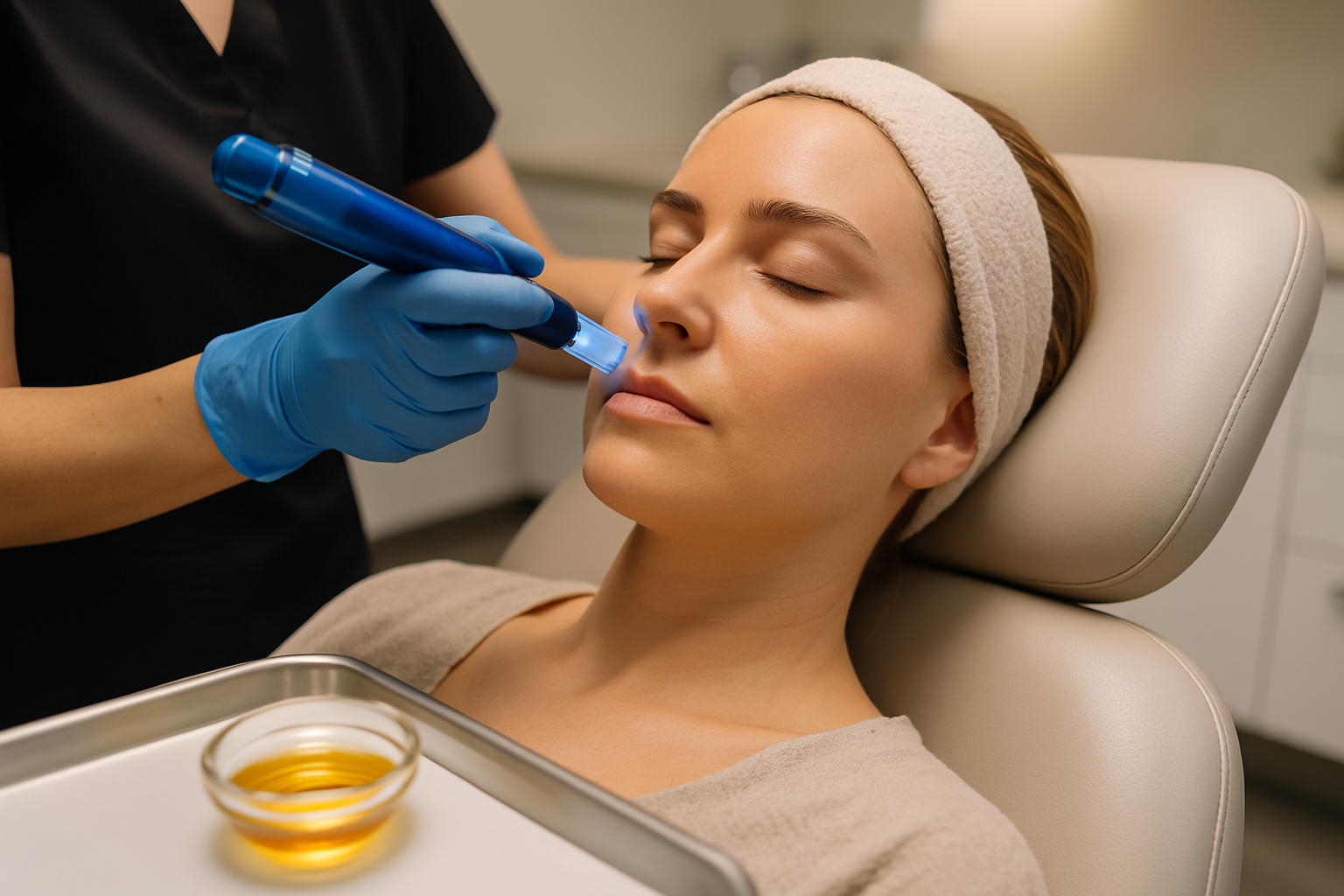
PRF stands for Platelet-Rich Fibrin. It starts with a small blood draw from your own arm. That sample goes into a centrifuge, which spins it to concentrate your platelets and growth factors into a fibrin-rich material.
That material then gets injected into targeted areas or worked into the skin through microneedling. Instead of blocking a muscle, it signals your own tissue to repair itself and build new collagen.
Because the material comes from your own body, there is no risk of an allergic reaction to a foreign substance. For patients who are cautious about what goes into their face, that alone is often the deciding factor.
The trade-off is patience. PRF does not deliver an overnight change. A 2025 systematic review published through the National Library of Medicine found statistically significant wrinkle reduction with PRF that kept improving between three and six months after treatment, which lines up with how slowly growth factors release into tissue.
So PRF tends to fit concerns like:
- Overall skin texture and elasticity
- Sun damage from years of Arizona exposure
- Gradual volume loss in the mid-face or lips
- A refreshed look rather than an obviously treated one
And yes, PRF for the lips can be discussed on its own. It does not have to be tied to veneers or any other dental work. We cover that distinction more closely in our piece on PRF lip enhancement compared to traditional filler.
PRF Facial Rejuvenation vs Botox at a Glance
Same face, two entirely different mechanisms. This is the comparison I end up drawing on paper during most aesthetic consults.
| Factor | Botox | PRF |
|---|---|---|
| How it works | Temporarily relaxes a targeted muscle | Concentrates your own platelets and growth factors to stimulate collagen |
| Source material | A purified neuromodulator product | Your own blood, drawn and spun on site |
| Best suited for | Expression lines from repeated movement | Skin texture, elasticity, and gradual volume loss |
| When results appear | Days after treatment | Gradually, often continuing to improve for months |
| Typical duration | Around three to four months | Varies by patient; research shows improvement continuing at three to six months |
| Allergy risk to material | Product-based, discussed at consult | None, because the material is your own |
| Does it add volume? | No | Yes, gradually, in targeted areas |
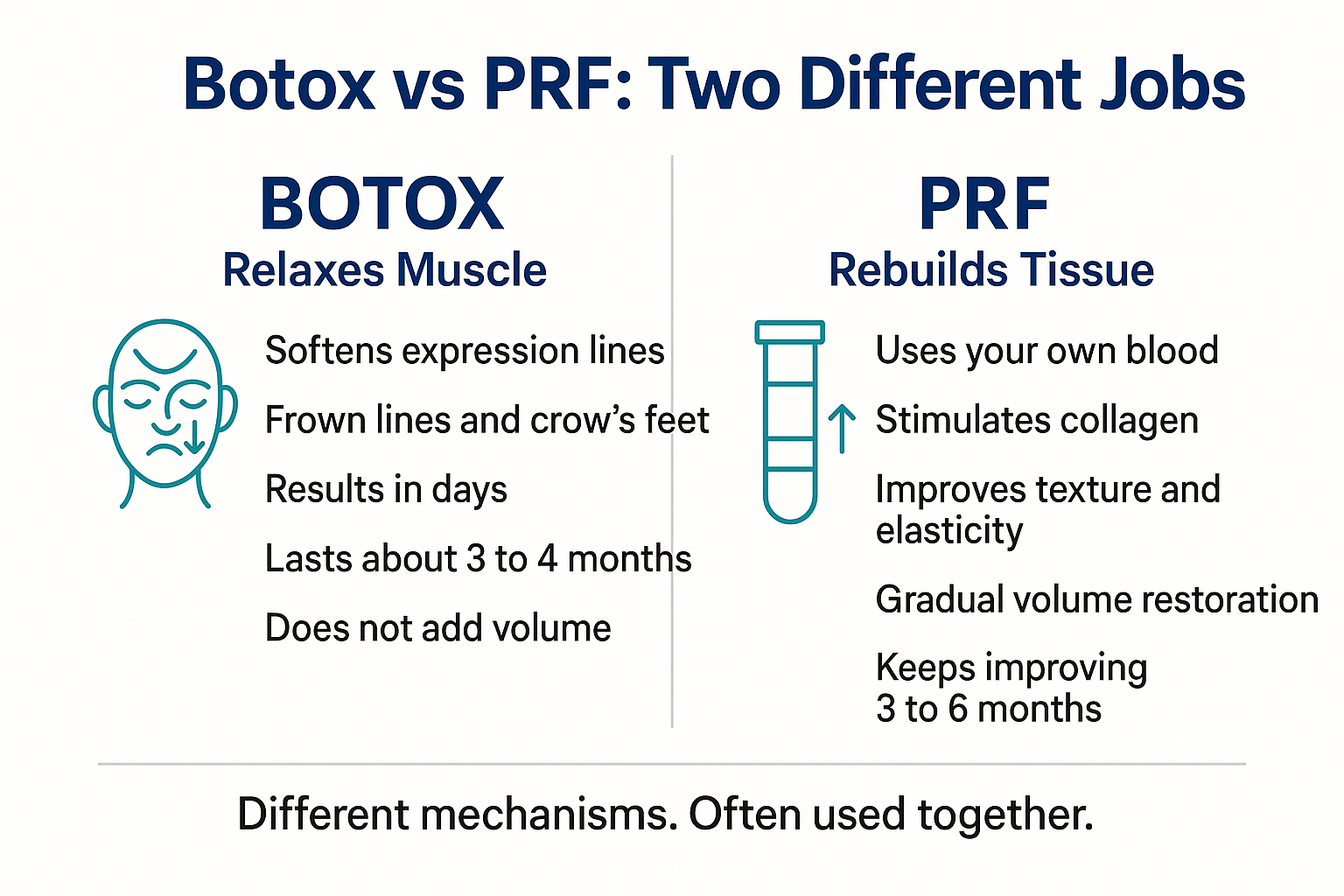
Two Different Jobs on the Same Face
A side-by-side look at where each treatment does its work.
When Patients Consider Using Both
This is where the question usually lands once someone understands the mechanisms. Can you do both?
Yes, and the logic is straightforward. Botox handles the lines being actively creased by muscle movement. PRF works on the skin quality and the volume underneath those lines over a longer stretch of time.
They are addressing different layers of the same problem. Someone with deep frown lines and thinning, sun-worn skin across the cheeks is dealing with two separate issues that no single treatment resolves.
I am not going to prescribe a plan in a blog post, because faces differ and so do goals. But there are a few things worth thinking through before you sit down for a consult:
- Which bothers you more, the lines when you move your face or the way your skin looks at rest?
- Are you looking for a change in weeks or are you comfortable with something that builds over months?
- Do you want to start with one treatment and reassess, or address multiple concerns in the same window?
Most patients I see in Surprise want to look rested, not rearranged. Understanding these two tools before the appointment makes that conversation far more productive than working it out on the fly.
Why the Setting Matters More Than People Expect
PRF is not widely available in the Surprise market. Patients who want it often find themselves choosing between a stand-alone med spa and driving further out of the West Valley.
We offer it inside a licensed dental practice with a clinical team on site. For patients who take blood thinners, manage heart conditions, or are recovering from surgery, that medical oversight is not a small detail.
There is also a practical reason it fits under a dental roof. Dentists work in the face every day, injecting with precision around the lips, cheeks, and perioral muscles. If you want the background on how that overlap developed, we wrote about why some dentists now offer facial treatments.
On cost, I will not quote you a number here, because it depends on the treatment area, how much material is needed, and whether you are combining approaches. Aesthetic treatments are not covered by dental insurance, and consult policies vary between offices, so ask directly what you will be charged before you book. Our team gives written estimates before anything begins.
One more thing worth mentioning for snowbirds arriving in Surprise each fall: PRF results build over months, so timing a first treatment early in a seasonal stay makes more sense than scheduling it the week before you head back north.
Frequently Asked Questions About PRF and Botox
Is PRF a stand-alone treatment or only offered with other dental work?
It is stand-alone. You do not need veneers, whitening, or any other dental treatment to be a candidate for PRF facial rejuvenation or PRF lip treatment. This comes up often enough that we address it in more detail in our article on what patients are actually asking about PRF.
Does PRF hurt more than Botox?
The main difference is the blood draw at the start, which feels like any routine lab draw. The treatment itself, whether injected or applied through microneedling, is comparable to other injectable appointments. Comfort measures are part of how we do everything here, and that includes aesthetic visits.
How soon will I see something after PRF?
Not right away, and that is normal. PRF works by signaling your tissue to build collagen, which takes time. Published research shows improvement continuing between three and six months after treatment. If you need a visible change for an event in two weeks, PRF is not the right timeline.
Can I get Botox and PRF at the same appointment?
That depends on your goals, your health history, and the areas being treated. It is a reasonable question to bring to a consult rather than assume either way. A clinician should map out which concern each treatment is addressing before combining anything.
Will insurance cover any of this?
No. Aesthetic treatments like Botox and PRF are elective and are not covered by dental or medical insurance. If you are sorting out coverage questions on the dental side, our guide on how dental costs work without insurance breaks that down separately.
Thinking Through PRF, Botox, or Both
If you live in Surprise or anywhere across the West Valley and you are weighing these options, the useful next step is a conversation with someone who can look at your face and explain which concern each treatment actually addresses. Aesthetic consults are available at our Bell Road office, including evening slots Tuesday through Thursday and Saturday appointments from 8 to 3. You can reach the team at 480-795-2420 or find more at westbelldentalcare.com whenever you are ready.