
Direct Answer: Yes, PRF lip treatment is a standalone option. It uses your own blood to stimulate collagen gradually — results are softer and more natural than filler, but take several weeks to develop.
A question came through our contact form recently that I suspect a lot of people have been wondering about but haven’t asked. A patient wanted to know whether PRF lip treatment was a standalone option — or whether it was only offered alongside veneers or other dental procedures. That’s a completely fair question, and the short answer is: yes, PRF for the lips is its own treatment. You don’t need any other dental work scheduled to pursue it.
The confusion makes sense. PRF is relatively new to most patients’ vocabulary, and it tends to get mentioned alongside smile makeovers or cosmetic dentistry packages, which can make it seem bundled. But it isn’t. And given how different PRF is from the standard filler experience most people picture when they hear ‘lip treatment,’ it’s worth explaining exactly what it is, how it works, and who it tends to be a good fit for.
If you’ve been considering something for your lips — whether it’s volume, texture, fine lines around the mouth, or just a subtle refresh — this should help you figure out which direction makes the most sense before you ever walk through a door for a consultation.
What PRF Actually Is — and Where It Comes From
PRF stands for Platelet-Rich Fibrin. It’s derived entirely from your own blood — there are no synthetic additives, no foreign substances, nothing introduced from outside your body.
Here’s the basic process:
- A small blood draw is taken — similar to what you’d have at a routine lab visit
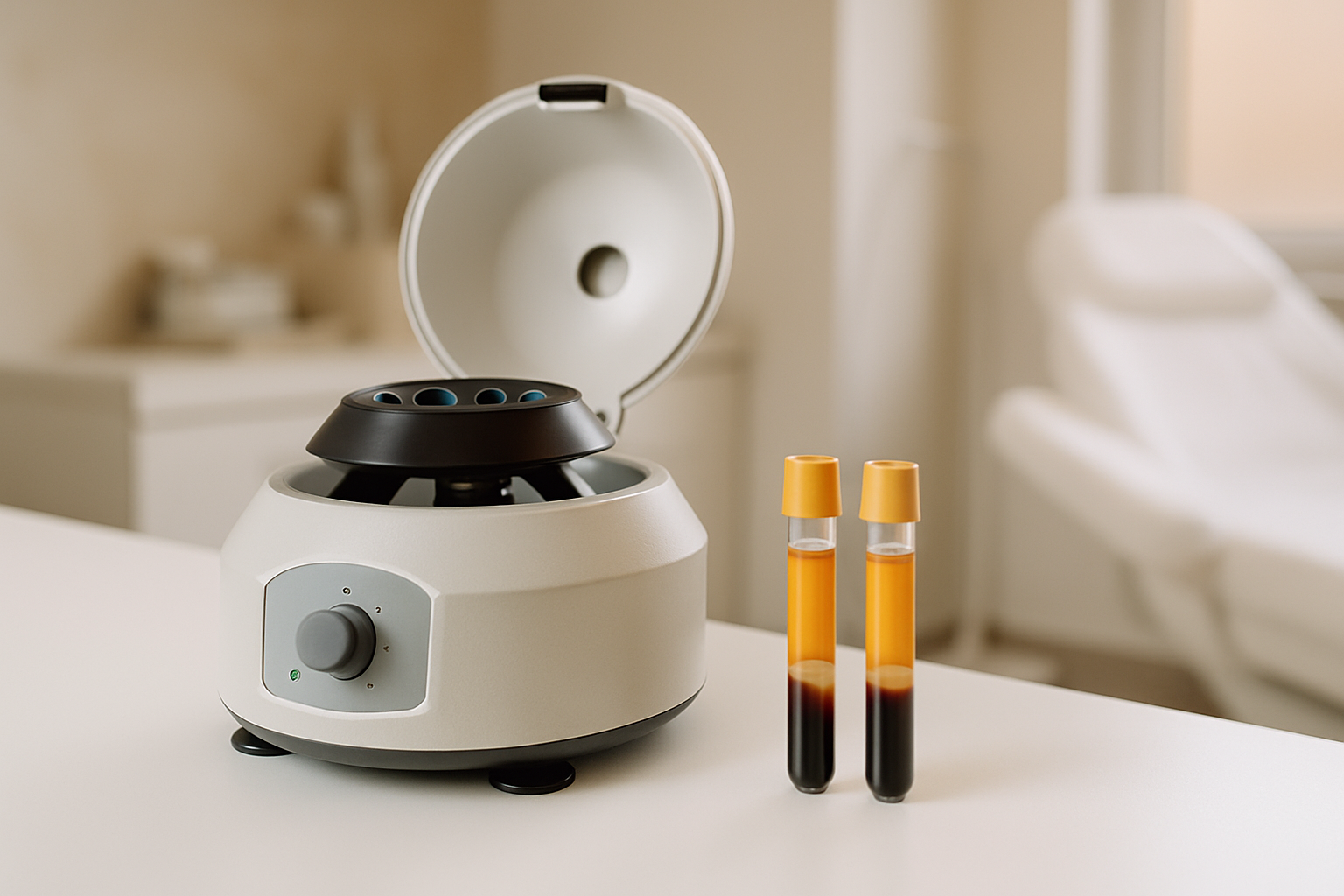
- The vial goes into a centrifuge, which spins it at a specific speed to separate the components
- The resulting concentrate is rich in growth factors and platelets — the materials your body naturally uses to repair and rebuild tissue
- That concentrate is then injected into the lips or the surrounding skin
Because it’s made from your own biology, PRF is well-tolerated even by patients who have had sensitivities or reactions to traditional fillers. There’s nothing foreign for your immune system to respond to.
The biological mechanism is what makes PRF different at a fundamental level. It doesn’t physically fill space the way a filler does. Instead, it signals your body to rebuild collagen and improve tissue quality from the inside. That’s why the results develop gradually — and why the timeline looks so different from what most people expect.
PRF vs. Hyaluronic Acid Filler — The Honest Comparison
Standard lip fillers — the kind most people have heard of — use hyaluronic acid (HA), a substance that occurs naturally in the body but is synthesized for cosmetic use. When injected, it physically fills the space under the skin. You can see results the same day. The lips look fuller immediately after treatment.
That immediacy is a real advantage for certain patients. If someone wants a noticeable, visible change before an event in two weeks, HA filler delivers that. The tradeoff is that hyaluronic acid dissolves over time — typically over six to twelve months — and needs to be repeated.
PRF works on a completely different timeline. Because it’s stimulating your body’s own collagen production rather than physically adding volume, the improvement is:
- Gradual — most patients notice meaningful improvement in texture and hydration within two to four weeks of a session
- Progressive — optimal lip volume and quality usually develops after two to three sessions, spaced several weeks apart
- Natural-looking — the results tend to be softer, not ‘done,’ because you’re rebuilding your own tissue rather than inflating it
Neither approach is better in an absolute sense. They’re designed for different goals. The American Academy of Facial Esthetics has published patient-facing information on PRF that confirms the gradual, collagen-building mechanism I’m describing here — it’s not a new concept, but it is one many patients are encountering for the first time in a dental setting.
I want to be direct with patients who come in expecting filler-speed results from PRF: that’s not what this treatment does. If you need dramatic, immediate lip volume, a traditional filler is probably the more appropriate path. PRF shines when the goal is subtle, lasting improvement — especially when patients want to avoid introducing any synthetic material at all.
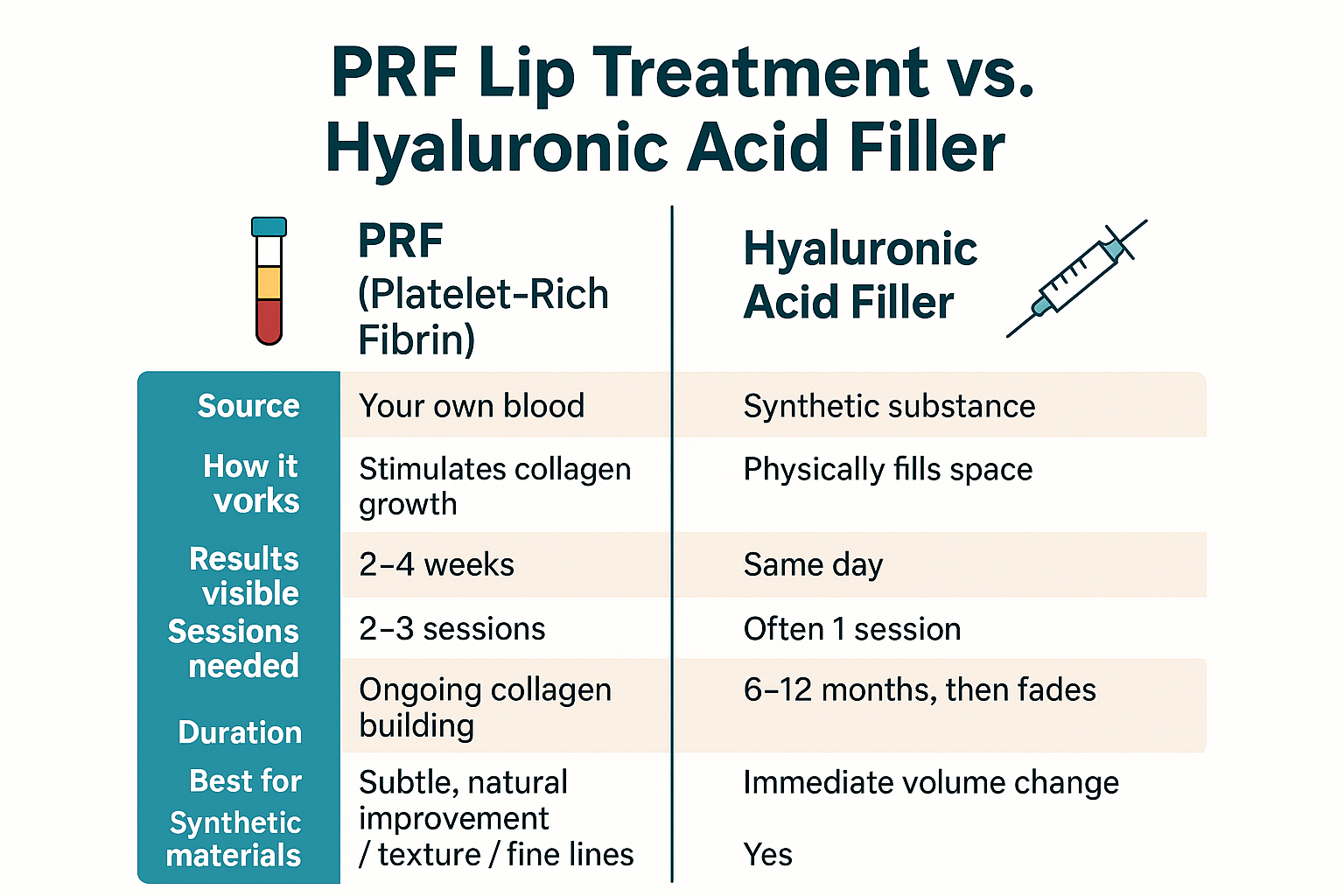
PRF vs. Hyaluronic Acid Filler — Side by Side
This comparison breaks down the key differences between PRF lip treatment and standard HA filler across the factors patients actually ask about.
What the Treatment Experience Actually Looks Like
One of the most common questions we hear is some version of: I don’t want to look swollen or obvious right after — what’s the recovery like?
Here’s the honest, day-by-day picture for PRF:
- During the appointment: The session runs about 30 to 45 minutes, including the blood draw, centrifuge processing, and the injection itself. Most patients find the process straightforward.
- Day 1: Mild pinkness or light swelling at the injection sites is possible. Most patients describe it as subtle — not the pronounced swelling that can follow HA filler in some cases.
- Days 2–3: Any initial pinkness typically resolves. You won’t see dramatic lip volume change yet — that’s expected and normal.
- Weeks 2–4: This is when most patients start noticing real improvement in hydration, texture, and softness. The lips feel different before they look dramatically different.
- After the full series: With two to three sessions completed, the structural collagen improvement becomes more visible. The result is a refreshed, natural appearance — not an inflated one.
Compare that to HA filler, where swelling immediately post-treatment can sometimes be noticeable enough that patients plan around it. Both approaches have a ‘downtime’ consideration — PRF’s is just quieter and more spread out.
One thing I think is worth saying plainly: PRF requires patience. Patients who come in expecting to see a big change the next morning are going to be disappointed. That expectation-setting conversation happens at the consultation, and it matters — because when patients understand the timeline going in, they tend to be far more satisfied with what develops over the following weeks.
Who Tends to Be a Better Fit for Each Treatment
If you’re trying to figure out which direction makes sense for your goals, this breakdown can help you walk into a consultation with the right questions already in mind.
| Your Goal | PRF May Be the Better Fit | HA Filler May Be the Better Fit |
|---|---|---|
| Volume change timeline | Gradual, over weeks and sessions | Immediate, same day |
| Synthetic materials concern | Yes — PRF uses nothing foreign | No — HA is synthesized, though body-compatible |
| Primary concern | Texture, fine lines, hydration, subtle volume | Noticeable fullness, defined lip border |
| Sensitivity history | Sensitive to fillers or prefer biocompatible options | No known filler sensitivity |
| Maintenance preference | Fewer touch-ups long-term as collagen rebuilds | Repeat sessions every 6–12 months |
Why a Dental Setting Is Actually an Advantage for This Treatment
Patients sometimes wonder why PRF facial treatments are offered at a dental practice rather than a med spa. It’s a reasonable question, and I think the answer is more substantive than it might seem.
The clinicians performing PRF lip treatments here have deep, working knowledge of facial anatomy — the structure of the lips, gums, surrounding tissue, and the musculature involved in dental procedures. That’s not theoretical knowledge. It’s the same structural understanding applied every day in procedures involving injections, tissue response, and the oral-facial region specifically.
Patients who’ve had aesthetic consultations with our team consistently mention that the conversation was thorough — that options were explained clearly, and that the team was straightforward about what each treatment could and couldn’t accomplish. That matters especially with PRF, where managing expectations about the timeline is part of good care.
For patients in communities like Sun City Grand or Surprise Farms who are already coming in for dental care, the ability to have that aesthetic conversation with a team they already trust — without going to a separate clinic across the Valley — is a meaningful convenience. And for anyone who is new to PRF or facial aesthetics altogether, starting with a provider who explains things without pressure tends to make the experience a lot less intimidating.
Frequently Asked Questions About PRF Lip Treatment
Can I get PRF lip treatment without having any dental work done at the same time?
Yes, absolutely. PRF facial treatments — including lip enhancement — are standalone services. You don’t need to have a dental procedure scheduled alongside it. The question comes up often because PRF is sometimes mentioned in the context of cosmetic dental work, but they’re separate offerings.
How many PRF sessions will I need before I see results?
Most patients go through two to three sessions, spaced several weeks apart, to reach optimal results. Some improvement in texture and hydration is typically noticeable after the first session within two to four weeks, but the full benefit — including any visible lip volume improvement — builds progressively across the series.
Is PRF painful? I’m nervous about injections near my lips.
Most patients describe the discomfort as mild. The lips are a sensitive area, and everyone’s threshold is different — but the injection process itself is brief, and topical numbing can be applied beforehand to reduce sensation. The blood draw beforehand is typically the part patients feel least certain about, and it’s a very small amount — comparable to a routine lab draw.
What’s the cost difference between PRF and standard lip filler?
Pricing for both treatments varies depending on the provider, the amount of product or sessions involved, and the specific goals being addressed. PRF typically requires multiple sessions, while a single HA filler appointment may have a lower upfront cost. For a clear picture of what your specific treatment plan would involve — and what it would cost — the best step is a consultation where your goals can be assessed directly. We’re transparent about what each option costs before you commit to anything.
Can PRF help with fine lines around the mouth, not just lip volume?
Yes — this is actually one of PRF’s stronger use cases. Because it stimulates collagen production in the tissue itself, it can improve the appearance of fine lines around the lip border, overall skin quality in the area, and hydration — not just lip fullness. Patients who are primarily concerned with texture or lip aging (rather than wanting dramatically fuller lips) often find PRF a better match for those goals than filler.
I’ve had a reaction to filler in the past. Is PRF safer for me?
PRF contains no synthetic additives — it’s derived entirely from your own blood, so there’s nothing foreign for your body to react to. That said, every patient’s situation is different, and a consultation is the right place to discuss your history and whether PRF is appropriate for your specific circumstances. We don’t make blanket promises about safety without understanding the individual.
Suggested Internal Links — add real URLs before publishing:
- PRF Facial Rejuvenation at West Bell Dental Care — Service page covering the full PRF facial rejuvenation offering, including lip treatment, skin quality, and what patients can expect at a consultation
- Botox and Dermal Fillers — Overview of the practice’s facial aesthetics services including Botox and filler options — useful for patients comparing PRF to traditional approaches
- Cosmetic Dentistry Overview — Overview of cosmetic dental services including veneers, whitening, and smile makeovers — helps patients understand the full aesthetic scope of the practice
- New Patient Information — What new patients can expect at their first visit, including consultation process, insurance, and scheduling
- Sedation Dentistry — For patients with anxiety about any procedure — including aesthetic treatments — this page covers comfort and sedation options available at the practice
Thinking About PRF for Your Lips? Start With a Conversation.
If you’ve been curious about PRF lip treatment — whether as an alternative to filler, an add-on to existing care, or something completely new — the best place to start is a consultation where your goals and timeline can be talked through honestly. West Bell Dental Care offers PRF facial treatments as a standalone service, and our team takes time to explain what each option can and can’t do before you make any decisions. You can reach us at 480-795-2420 or visit westbelldentalcare.com to request a time that works for you — including Saturday appointments for those with weekday scheduling constraints.