
Direct Answer: Without insurance, dental costs are billed by service, not as a bundle. A new-patient exam, X-rays, and cleaning are three separate line items, and calling ahead for a range removes the guesswork entirely.
We hear some version of the same question almost every week at our practice: ‘I don’t have dental insurance, what would it cost me?’ One person who filled out our contact form put it plainly: ‘I don’t have insurance and was wondering how much an exam and X-rays would be out of pocket.’ Another longtime patient asked what a cleaning would run without coverage before deciding whether to reschedule.
These are not people hunting for the cheapest possible price. They want to know what they are walking into before they commit. And that is a completely reasonable thing to want to know.
If you are living in Surprise, Sun City Grand, Arizona Traditions, or anywhere else in the West Valley without dental coverage, this is the honest breakdown you have been looking for. We will explain how uninsured dental costs are actually structured, what drives the price up or down, and what options exist to make care more predictable.
Why Your First Visit Is Billed as Separate Line Items, Not One Fee
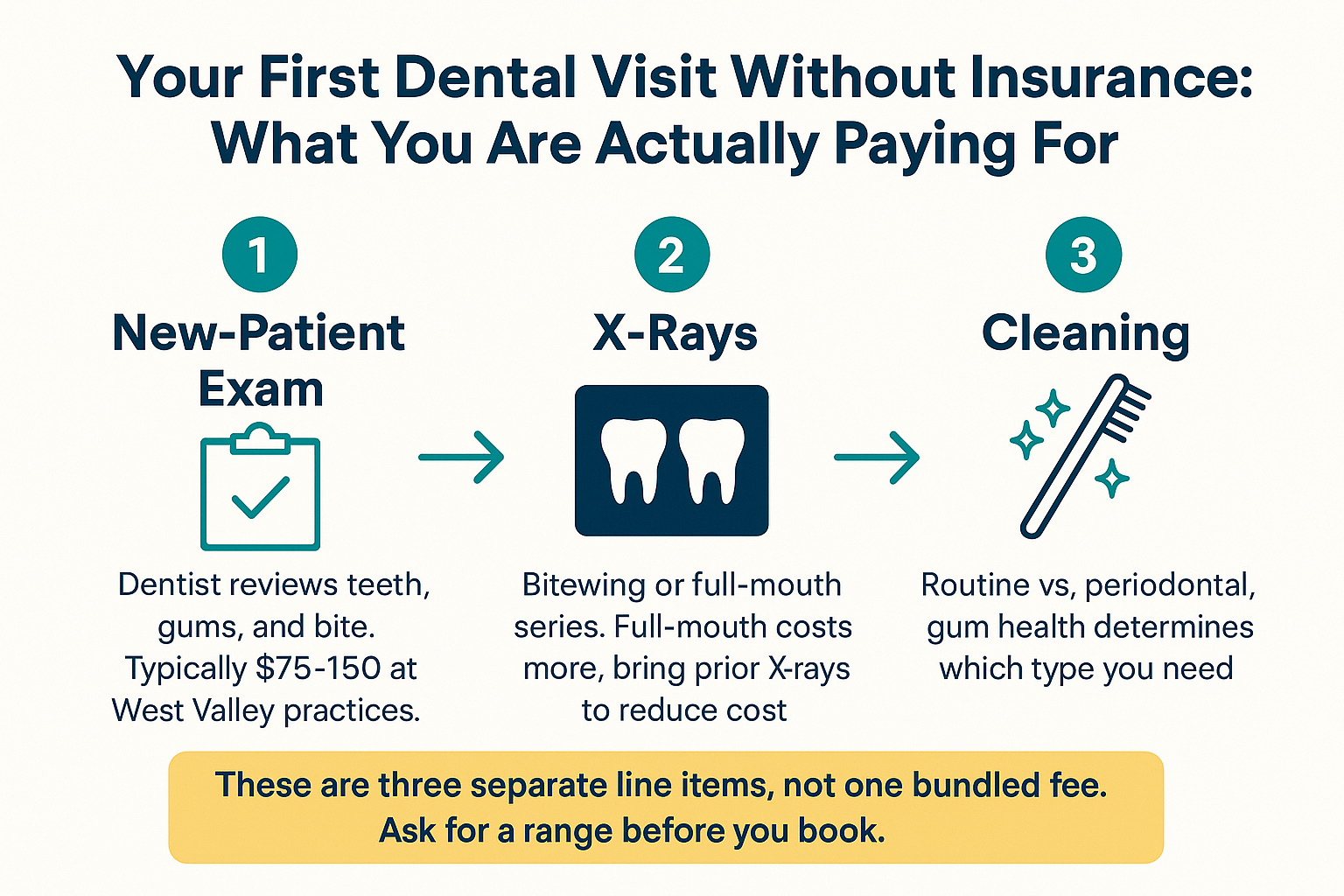
The most common assumption we hear is that ‘a dental visit’ is one charge. In reality, a first appointment typically involves three distinct services that are billed separately:
- New-patient comprehensive exam, the dentist’s clinical review of your teeth, gums, and oral health
- X-rays, the scope varies and changes the cost significantly (more on that below)
- Cleaning, which is not always the same type of cleaning for every patient
Understanding these as separate items helps you ask smarter questions before you come in. If budget is a concern, you can have a real conversation with the front desk about what is medically necessary on the first visit versus what can be phased across appointments.
X-rays are where patients often get surprised. A full-mouth series, which gives the dentist a complete picture of all your teeth and bone levels, costs more than a standard set of bitewing X-rays, which focus primarily on the back teeth where cavities tend to develop between the teeth. For a new patient, a full-mouth series is often recommended because the dentist has no prior records to reference. But if you have recent X-rays from another practice, ask whether those can be transferred, it may reduce what you pay on day one.
The type of cleaning also matters. A routine prophylaxis cleaning is appropriate when your gums are healthy. If the hygienist finds signs of gum disease, deeper pockets, bone loss, significant buildup below the gumline, a periodontal cleaning (sometimes called scaling and root planing) may be recommended instead. That is a more involved procedure and is priced accordingly. Knowing this ahead of time helps you plan, not panic.
What a Reasonable Range Looks Like in the West Valley
We want to be straightforward here: dental prices in the Surprise area vary by practice, and we are not going to post a price list that may not reflect what you are quoted on the day you call. What we can tell you is how the range tends to work for uninsured adults in this market.
For a new-patient exam, costs at most private practices in the West Valley fall somewhere in the range of $75 to $150, depending on the depth of the exam and whether a dentist or a hygienist conducts the initial review. Bitewing X-rays for an established patient tend to run less than a full-mouth series, which can range from $100 to $200 or more at many offices. A routine cleaning for a patient with healthy gums generally runs somewhere in the range of $80 to $150 without insurance.
When there is restorative work identified during the exam, such as a cavity or a tooth that needs a crown, that is quoted separately, it does not get added to your cleaning visit without your approval first. You always have the right to receive a written estimate before any treatment begins.
The most useful thing you can do before your first appointment is call and ask for a range. When our team gives a specific starting number over the phone, patients stay on the call and make decisions. When the answer is vague or kicks the question to a callback, people move on. You deserve a real answer, and any office worth going to should be able to give you one.
How an Uninsured New-Patient Visit Breaks Down
This infographic walks through the three core components of an uninsured first visit and what drives cost in each one.
The Option Most Uninsured Adults in Surprise Have Never Heard Of
Dental membership plans, offered directly by the practice, not through an insurance company, are one of the most underused tools for uninsured adults in the West Valley. And yet they are often the clearest path to affordable, predictable care.
Here is how an in-office membership plan typically works: you pay an annual fee directly to the practice, and in return, your routine preventive care is covered at no additional charge. That usually means two exams and two cleanings per year, plus X-rays on a normal schedule. You also receive a discount on any restorative or cosmetic work you need during the year.
What makes this different from traditional insurance:
- No waiting periods, you can use your benefits from day one, not six months from now
- No annual maximums, insurance plans cap how much they pay per year; a membership plan does not work that way
- No claim denials, there is no third party deciding whether your treatment is approved
- Predictable cost, you know what your preventive care will cost before the year starts
This type of plan tends to work especially well for specific groups we see regularly in our community. Retirees in Sun City Grand or Arizona Traditions who are on Medicare only, with no dental supplement, often go years without care because they assume it is out of reach. Gig workers, tradespeople, and people between jobs who have no employer benefits are in the same boat. And young adults whose jobs simply do not offer dental coverage have often never heard that this option exists.
According to the American Dental Association’s research on dental coverage and access, more than 65 million Americans have no dental insurance, and cost is the primary reason they delay care. A well-structured membership plan removes the two biggest barriers at once: the upfront cost of routine visits and the fear of being surprised by a bill.
If a caller has told us they were quoted a high price somewhere else and wanted a second opinion before committing, the membership plan is usually the first thing we walk them through. It reframes the entire conversation from ‘can I afford the dentist?’ to ‘here is what your year of care actually costs.’
Traditional Dental Insurance vs. In-Office Membership Plan
Here is a side-by-side look at how the two approaches differ for an uninsured adult.
| Feature | Traditional Insurance | In-Office Membership Plan |
|---|---|---|
| Waiting periods | Often 6-12 months for major work | None, benefits start immediately |
| Annual maximum | Typically $1,000-$1,500 per year | No annual maximum on plan benefits |
| Claim approvals | Insurance company decides | No claims, agreement is direct with the practice |
| Preventive care cost | Covered at 80-100% after deductible | Included in the annual membership fee |
| Restorative work | Covered at a percentage after deductible | Discounted rate off regular fees |
| Monthly cost | Varies widely by plan and employer | Set annual fee paid directly to the practice |
| Best for | Employer-sponsored group plans | Retirees, gig workers, self-employed adults, uninsured patients |
How to Plan Treatment in Stages When You Are Paying Out of Pocket
One thing we encourage uninsured patients to remember: you do not have to do everything in one appointment. If the exam reveals that you need a filling, a crown, and your routine cleaning, you can work with our team to prioritize.
In most cases, we address what is urgent first, active pain, infection, or a tooth that is at risk of getting significantly worse, and schedule restorative work across future visits as your budget allows. Knowing your out-of-pocket range ahead of time is what makes that planning possible. You cannot stage treatment you do not understand.
This is exactly why calling ahead matters. A brief phone conversation where you explain that you are uninsured and want to understand your costs before you come in will get you further than showing up and finding out at checkout. Our front desk can walk you through the estimate before a single instrument is picked up.
Frequently Asked Questions About Dental Care Without Insurance in Surprise
Can I get a price estimate before I come in for my first appointment?
Yes, and you should. Any reputable practice should be able to give you a starting range for a new-patient exam and X-rays over the phone. When our team gives specific numbers, patients can plan, and that is better for everyone. Call ahead, explain that you are uninsured, and ask for the range on each service you expect to need.
What if I only need a cleaning, do I still have to pay for an exam?
For a new patient, a dentist needs to examine your mouth before a hygienist cleans it. This is standard practice and also protects you, a cleaning that skips the exam might miss something that needs attention. The exam and cleaning are separate charges, but both are part of a responsible first visit.
I am on Medicare only and have no dental coverage. Is care actually affordable for me?
More often than people expect. Original Medicare does not cover routine dental care, which leaves a lot of retirees in communities like Sun City Grand and Arizona Traditions feeling like they have no options. But a focused exam plus a routine cleaning is often far more accessible than people assume when they call and ask directly. An in-office membership plan can also lock in your preventive care at a predictable annual cost with no waiting periods.
What is the difference between a routine cleaning and a deep cleaning, and does it cost more?
A routine prophylaxis cleaning removes plaque and tartar above and just at the gumline. A periodontal cleaning (scaling and root planing) goes below the gumline to address gum disease. The hygienist determines which one you need based on measurements taken during your exam. A periodontal cleaning does cost more because it is a more involved procedure, and sometimes it is split across two appointments. You will always be told which type you need and why before any work is done.
I was quoted a high price at another office. Is it worth getting a second opinion?
Absolutely. Treatment plans can vary between practices in terms of what is recommended, how it is sequenced, and how it is priced. If you were quoted a number that felt out of reach and you want to understand whether there are alternatives, a second opinion is a smart move, not a sign of distrust.
How does an in-office dental membership plan work if I need a filling or crown during the year?
Restorative work like fillings, crowns, or extractions is not included in the base membership fee, but members typically receive a percentage discount off the regular fee for those services. The exact discount depends on the specific plan the practice offers. The combination of free preventive visits and discounted restorative work is where membership plans save the most money for people who need both.
Suggested Internal Links — add real URLs before publishing:
- dental membership and savings plan options — Overview of the in-office membership plan available at West Bell Dental Care, including what is included and how to enroll
- what to expect at your first dental visit — New patient guide explaining the exam, X-ray, and cleaning process step by step for adults visiting for the first time
- sedation dentistry for anxious patients — Options available for patients with dental anxiety, including comfort amenities and sedation services offered at the practice
- dental crowns and restorative care in Surprise — Plain-language explanation of when crowns, fillings, and other restorative work are needed and what the process looks like
- same-day emergency dental care — What to do when you have tooth pain, a lost crown, or a dental emergency in the Surprise and West Valley area
Ready to Know Your Numbers Before You Book?
If you are in Surprise, Sun City Grand, Marley Park, or anywhere nearby and you have been putting off dental care because you are not sure what it will cost, the best first step is a quick phone call. Our team at West Bell Dental Care can walk you through starting ranges, explain our membership plan, and help you figure out what your first visit would actually look like. We are open Monday through Saturday, reach us at 480-795-2420 or visit westbelldentalcare.com to learn more.