Direct Answer: Dentists are uniquely trained in facial anatomy, which makes them well-qualified to administer Botox and dermal fillers safely alongside cosmetic dental treatments.
If you’ve noticed that some dental offices now offer Botox and facial fillers alongside cleanings and crowns, you’re not imagining a trend. It’s a real shift happening in practices across the country — including right here in the West Valley.
For a lot of patients in Surprise, the first reaction is something like: why would my dentist do that? It’s a fair question. But once you understand the training involved and how these treatments connect to dental care, the overlap starts to make a lot of sense.
This article explains what’s actually driving this change, why dentists are often well-suited for these procedures, and what you should expect if you’re considering facial treatments at a dental office.
The Anatomy Connection Most People Don’t Think About
Dentists spend years learning the face — not just the teeth. Dental school covers the nerves, muscles, blood vessels, and soft tissue of the entire head and neck region in significant depth. That’s the same anatomy involved in facial aesthetic treatments.
When a dentist gives you a local anesthetic, they’re making precise injections into very specific anatomical structures. That’s exactly the skill set required to place Botox and dermal fillers safely. The precision required isn’t new to them — the application just shifts slightly.
Many dentists pursue additional post-graduate training in facial aesthetics through accredited programs. Common certifications include courses through the American Academy of Facial Esthetics (AAFE) and similar organizations that teach injection technique, patient assessment, and complication management specifically for dental professionals.
This background actually gives dentists some advantages over other providers:
- Deep familiarity with facial nerve pathways reduces injection risk
- Experience managing patient anxiety in a clinical setting
- The ability to see how facial treatments interact with dental work like veneers or a smile makeover
- Existing patient relationships built on trust over time
It’s not a stretch — it’s a natural extension of what dentists already do.
What Treatments Are Actually Being Offered — and Why
Not every dental office offering facial treatments provides the same menu. The most common options fall into three categories:
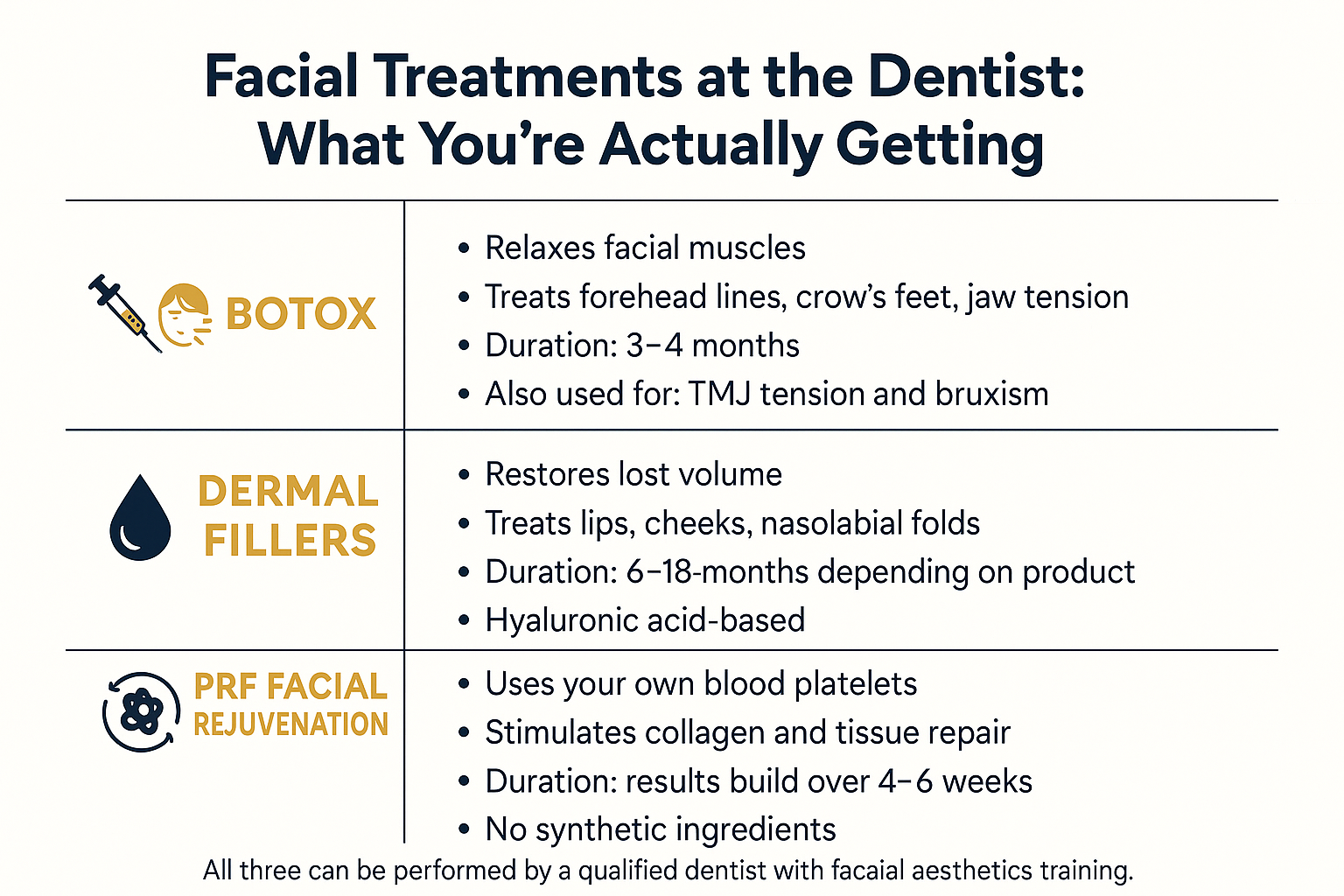
Botox (botulinum toxin): Used to relax specific muscles in the forehead, around the eyes, and along the jaw. At a dental practice, this sometimes has a functional purpose beyond cosmetics — treating TMJ-related jaw tension or chronic teeth grinding (bruxism) by reducing the force of the masseter muscle. Results typically last 3 to 4 months.
Dermal fillers: Hyaluronic acid-based fillers used to restore volume in areas like the cheeks, lips, and nasolabial folds. These are separate from Botox — they add volume rather than relax muscle. Results vary by product and area but often last 6 to 18 months.
PRF Facial Rejuvenation: This one is less widely known. PRF stands for platelet-rich fibrin, derived from a small sample of the patient’s own blood. It’s processed to concentrate growth factors, then injected to stimulate collagen and tissue regeneration. Because it uses the patient’s own biology, there’s no synthetic filler involved.
For patients in communities like Sun City Grand or Marley Park who are already coming in for cosmetic dental work — whitening, veneers, or bonding — adding a facial treatment during the same visit is genuinely convenient. You’re already in the chair. You already trust the provider.
How Dental Facial Treatments Compare at a Glance
This infographic breaks down the three most common facial treatments offered at dental practices — what each one does, how long it lasts, and who it’s typically best for.
The Real Reason This Makes Sense for a Smile-Focused Visit
Here’s something patients don’t always consider: dental cosmetic work and facial aesthetics affect the same visual area. If you’re improving your smile with whitening or cosmetic dentistry, the overall impression of your face changes — and some patients find that the areas around the mouth or the lower face draw more attention afterward.
A dentist who offers both services can look at the full picture. They can discuss whether subtle lip volume or softening the lines around the mouth would complement the dental work, rather than treating those two things as completely separate decisions.
This coordination matters more than it sounds. Patients who’ve had veneers or cosmetic bonding and then pursued fillers elsewhere sometimes come back wishing they’d had that conversation with one provider first. The results can look uneven when different providers are working in the same small area without communicating.
That’s one practical reason why the dental office — not a spa or a med-spa with no dental context — can actually be a smart place for these treatments. The provider already knows your oral structure, your bite, and the work that’s been done.
Dental Office vs. Med-Spa: What’s Different
For patients weighing where to get facial treatments, here’s a straightforward comparison of what a dental provider brings versus a standalone med-spa setting.
| Factor | Dentist with Facial Aesthetics Training | Standalone Med-Spa |
|---|---|---|
| Facial anatomy knowledge | Extensive — part of dental training | Varies by provider credentials |
| Injection experience | Daily clinical injections already part of practice | Depends on specific training and volume |
| Coordination with dental work | Yes — same provider knows your full oral picture | No — no access to dental records or history |
| Patient anxiety management | Routine — built-in protocols | Varies |
| PRF Rejuvenation availability | Offered at select dental practices | Sometimes available |
| Existing patient relationship | Often yes, over years of care | Typically starting fresh |
What Patients in Surprise Should Ask Before Booking
If you’re curious about facial treatments at a dental office, a few questions are worth asking before you commit.
What training does the provider have? Ask specifically about post-graduate facial aesthetics certification. Completion of a reputable program like AAFE or similar is a reasonable baseline to expect.
Do they offer a consultation first? A good provider won’t book treatment without first reviewing your facial structure, discussing your goals, and explaining what’s realistic. If the answer is no, that’s a red flag.
How do they handle complications? Rare, but worth asking. A dentist’s clinical training includes managing adverse reactions to injectables — the same way they manage complications from anesthesia or other procedures.
For patients in Ashton Ranch, Rancho Gabriela, and the surrounding communities who are already established with a dental provider they trust, adding a facial treatment conversation to a regular visit is low-pressure. You’re not starting from scratch with a stranger — you’re expanding the conversation with someone who already knows your health history.
And if you’ve been exploring cosmetic options more broadly, it’s worth knowing that facial treatments are often priced comparably to what you’d pay at a med-spa — typically $10 to $15 per unit for Botox and $500 to $800 per syringe for standard fillers — while offering the added context of a dental provider who understands your full facial picture.
Frequently Asked Questions About Dental Facial Treatments
Is it actually safe to get Botox or fillers at a dental office?
Yes, when the provider has proper training. Dentists are among the most injection-experienced clinicians in any medical field — they give precise injections daily. The key is confirming that the provider has completed post-graduate facial aesthetics training, not just watched a tutorial. Ask before you book.
Does insurance cover facial treatments done at a dental office?
Generally no. Cosmetic Botox and dermal fillers are not covered by dental insurance or medical insurance in most cases. The one exception that sometimes applies is Botox used specifically for diagnosed TMJ disorder — that may have partial coverage depending on your plan. Always verify with your insurance before assuming.
Can facial fillers affect my dental work?
In most cases, no. But this is exactly why having the same provider handle both is an advantage. Lip fillers, for example, can subtly change how the lips frame the teeth — which matters a lot if you’ve recently had veneers or cosmetic bonding. A dentist who’s done your dental work already knows those details.
How is PRF different from a regular filler?
PRF (platelet-rich fibrin) uses a concentrate made from your own blood — drawn during your appointment and processed in a centrifuge — rather than a synthetic or hyaluronic acid product. Because it’s derived from your own biology, there’s no foreign material involved. It stimulates your body’s natural collagen production over several weeks, rather than immediately adding volume the way a traditional filler does. Results build gradually and tend to look more natural.
Will getting facial treatments at the dentist feel different from going to a med-spa?
The clinical experience is similar — a brief consultation, topical numbing if requested, the injections themselves, and aftercare instructions. One difference patients often mention is comfort level. If you’ve been seeing the same dentist for years, the familiar setting and established relationship can make the experience feel less intimidating than walking into a new spa environment.
I’m a retiree in Sun City Grand. Is this something people my age do?
Absolutely. Facial aesthetic treatments are increasingly popular among adults in their 50s, 60s, and 70s — not for dramatic changes, but for subtle refreshes that complement a healthier, more active lifestyle. Botox for softening forehead lines or PRF for overall skin quality are both well-suited to that goal. The aim is to look like a well-rested version of yourself, not a different person.
Curious Whether Facial Treatments Are Right for You?
West Bell Dental Care offers Botox, dermal fillers, and PRF Facial Rejuvenation for patients who want to explore facial aesthetics in the same comfortable, familiar setting where they receive their dental care. If you have questions or want to talk through your options, our team is available Monday through Saturday — call us at 480-795-2420 or visit westbelldentalcare.com to learn more and request an appointment.