
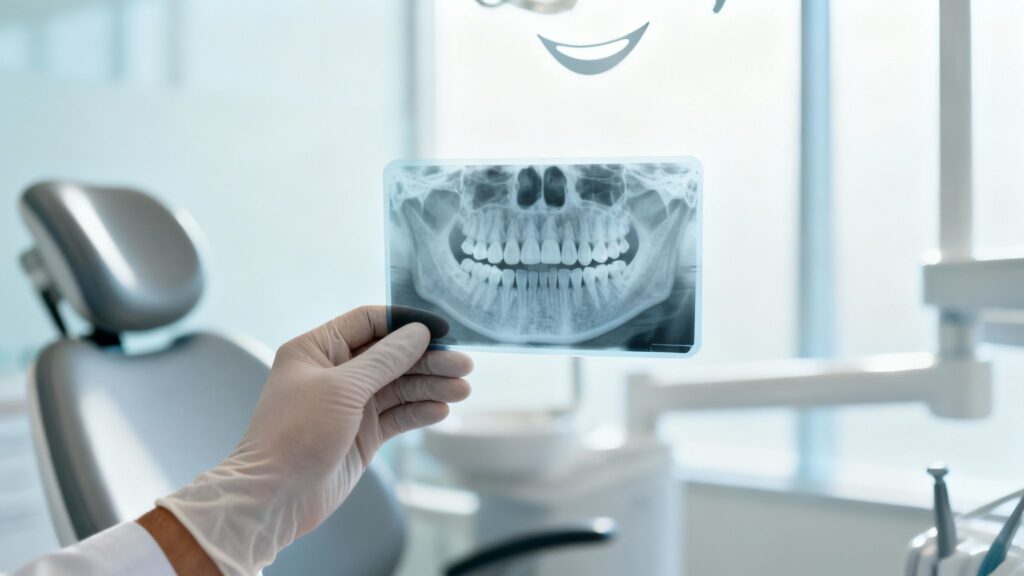
Have you ever felt like you’re trying to read a foreign language when your dentist shows you your X-rays? You’re definitely not alone. Think of those black-and-white images as a secret map to your oral health.
They show us what’s really going on, like tiny cavities starting between your teeth or wisdom teeth hiding below the gums. They can spot issues long before you would ever feel any pain. Learning to see what your dentist sees can empower you to be an active partner in keeping your smile healthy.
Why Your Dental X-Rays Are So Important
When you settle into the dental chair at our Surprise, AZ, office, you might wonder why we need those images. The simple truth is, a visual check-up only shows us the tip of the iceberg. Many serious dental problems start in places we just can't see with our eyes.
Dental X-rays are one of the most powerful tools we have for finding problems early. They let Dr. Wynn see the unseen, giving him a crystal-clear view of your teeth, roots, and jawbone. This is a key part of our approach to preventive dentistry because it helps us catch small issues before they become painful and expensive.
A Deeper Look at Your Smile
At West Bell Dental Care, we use an advanced digital X-ray system that gives us an immediate, high-definition look at your mouth. This technology is incredibly valuable for a few key reasons:
- Early Detection: We can spot the first signs of decay, find hidden infections at the tip of a root, and see cysts or tumors that are otherwise impossible to detect.
- Comprehensive Planning: For treatments like crowns or implants, X-rays give Dr. Wynn the essential blueprint he needs to plan your care with precision.
- Monitoring Your Health: Regular X-rays allow us to track changes over time, like the progression of gum disease or how a child’s adult teeth are developing.
These images are a standard part of modern dentistry. According to recent research, the radiation from a digital dental X-ray is extremely low—often less than what you get on a cross-country flight. You can learn more about dental radiography safety and usage from scientific studies.
By learning to read your dental X-rays, you can have more informed talks with Dr. Wynn and feel confident in your health decisions. It transforms you from a patient into an empowered health advocate.
Decoding the Shades of Gray on Your X-Ray
At first glance, a dental X-ray can look like a confusing jumble of black, white, and gray shapes. But every shade tells a story about what's happening inside your mouth. Learning this simple visual language is the first step to understanding your own X-rays.
The idea is pretty straightforward. When the X-ray beam passes through your mouth, different parts absorb it differently. Dense things like bone and enamel block the beam, so they show up as bright, light colors. Softer areas let more of the beam pass through, which makes them look darker.
Radiopaque: The Bright and White Stuff
The brightest white spots you see on an X-ray are the densest materials. In dental terms, we call this radiopaque.
- Tooth Enamel: This is the hard, outer layer of your teeth. It’s the densest natural substance in your body, which is why it appears as a bright white shell.
- Metal Fillings and Crowns: Dental work like amalgam fillings or metal crowns are extremely dense. They show up as solid, brilliant white shapes.
- Jawbone: The bone supporting your teeth is also dense and appears as a lighter gray, forming the foundation around the tooth roots.
This infographic gives you a simple visual guide to how these different densities appear on the digital X-rays we use in our office.
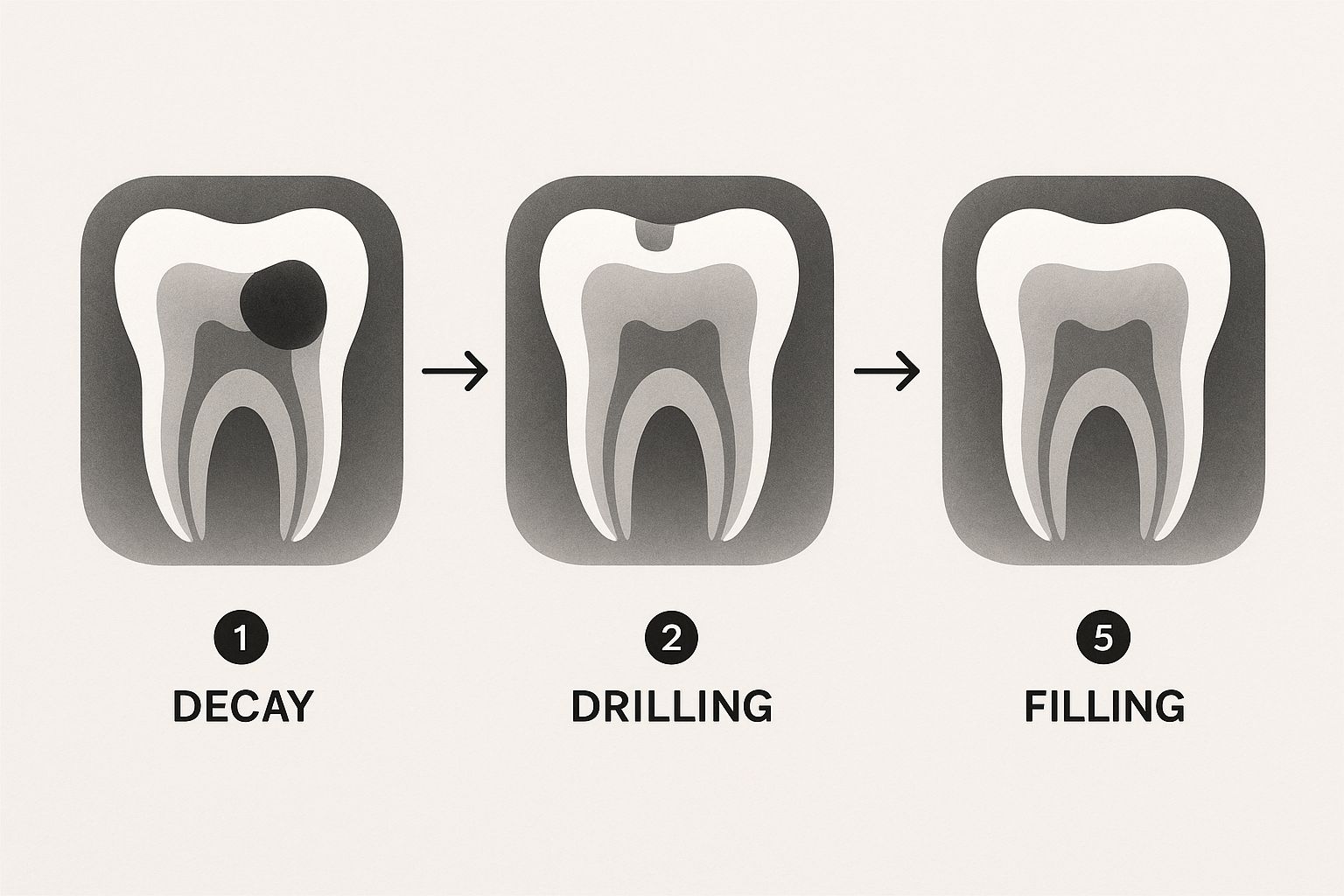
As you can see, the healthy enamel forms a bright, protective layer. That darker area beneath it, however, shows where the tooth structure has become less dense—a classic sign of decay.
Radiolucent: The Dark and Gray Areas
On the other side, the darker areas on an X-ray are called radiolucent. These are less dense parts of your mouth that let the X-ray beam pass through easily. Spotting these dark areas is critical for catching problems early.
- Pulp (Nerve): The center of your tooth contains soft tissue, nerves, and blood vessels. This "pulp chamber" shows up as a dark line running down the middle of the tooth.
- Infections (Abscesses): An infection at the root of a tooth often looks like a small, dark circle at the tip of the root. This indicates bone loss in the area due to the infection.
- Cavities (Tooth Decay): Decay eats away at the tooth, making it less dense. A cavity will appear as a dark spot, often between teeth or on the chewing surface.
Here's a quick cheat sheet to help you remember the basics.
A Quick Guide to X-Ray Shades
| Shade | What It Represents | Common Examples |
|---|---|---|
| Bright White | Very dense materials; often man-made | Metal fillings, crowns, dental implants |
| Light Gray | Dense natural tissues | Tooth enamel, jawbone |
| Dark Gray | Less dense areas or early problems | Tooth dentin (under enamel), small cavities |
| Black/Darkest Gray | Soft tissues, air, or significant issues | Nerve/pulp, abscesses, large cavities, empty space |
This table is a great starting point for making sense of the different shades you'll see. When Dr. Wynn reviews your X-rays, he’s looking for these subtle changes. Finding a small dark area early can be the difference between a simple filling and a more complex procedure.
If you're curious, you can explore our guide on what cavities look like for a closer look.
Getting to Know the Landmarks on Your X-Ray
Alright, you understand the basics of light and dark. Now, let’s map out the landscape of your smile. Think of this as a guided tour where we point out the key landmarks of your teeth and jaw.
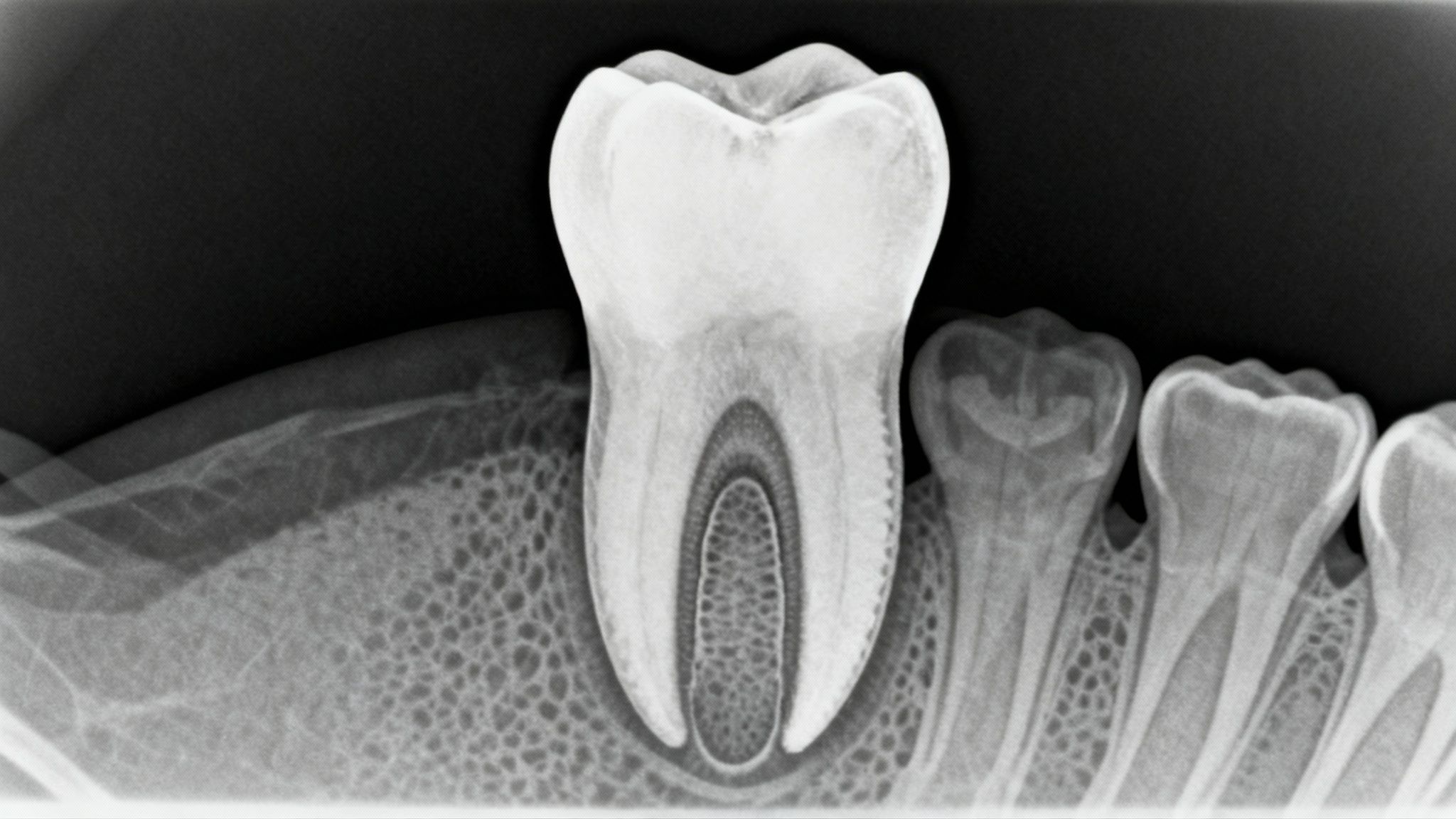
When Dr. Wynn pulls up an image, you’re looking at several parts of each tooth. We’ll start from the top and work our way down to the foundation holding everything together.
The Main Parts of a Tooth
A healthy tooth has just a few key parts that are easy to spot once you know what to look for. These are the building blocks of every tooth in your mouth.
Here’s a quick breakdown:
- The Crown: This is the part of the tooth you see above your gums that does all the chewing. On an X-ray, it's protected by a bright white layer of enamel.
- The Root: Tucked below the gums, the root anchors your tooth into your jawbone. It makes up about two-thirds of the tooth's total length.
- The Pulp: Look for a dark, thin line running through the center of the tooth. This is the pulp, the living tissue that contains the tooth's nerve.
- The Jawbone: The whole structure is held by your jawbone, which shows up as a lighter gray area. In a healthy mouth, the bone should come up high along the roots of your teeth.
Knowing what a healthy tooth looks like is our baseline. It’s what allows us to immediately spot something that looks out of place.
Different X-Rays for Different Jobs
Here at West Bell Dental Care, we use different types of X-rays for different jobs. For our patients in Surprise, AZ, and neighboring areas like Sun City and Peoria, this helps us provide specific and targeted care.
Here are the most common types you’ll see:
- Bitewing X-rays: You bite down on a little tab, and the image captures the crowns of your upper and lower teeth. They are the gold standard for finding cavities that hide between teeth.
- Periapical X-rays: This type gives us a view of the entire tooth, from the crown to the end of the root. We use these to find problems below the gum line, like an abscess.
- Panoramic X-rays: This is the big machine that rotates around your head. It produces a single, sweeping view of your entire mouth, perfect for checking on wisdom teeth or planning for dental implants.
Each type of X-ray is a specific tool. By choosing the right one, Dr. Wynn can tailor your care with a more accurate diagnosis and a better treatment plan for you.
How to Spot Common Dental Issues on an X-Ray
Now that you know the landmarks of a healthy tooth, we can get into the interesting stuff. Let's walk through what Dr. Wynn looks for when diagnosing common dental problems. By comparing a healthy tooth to one with issues, you'll learn to spot the signs of trouble yourself.
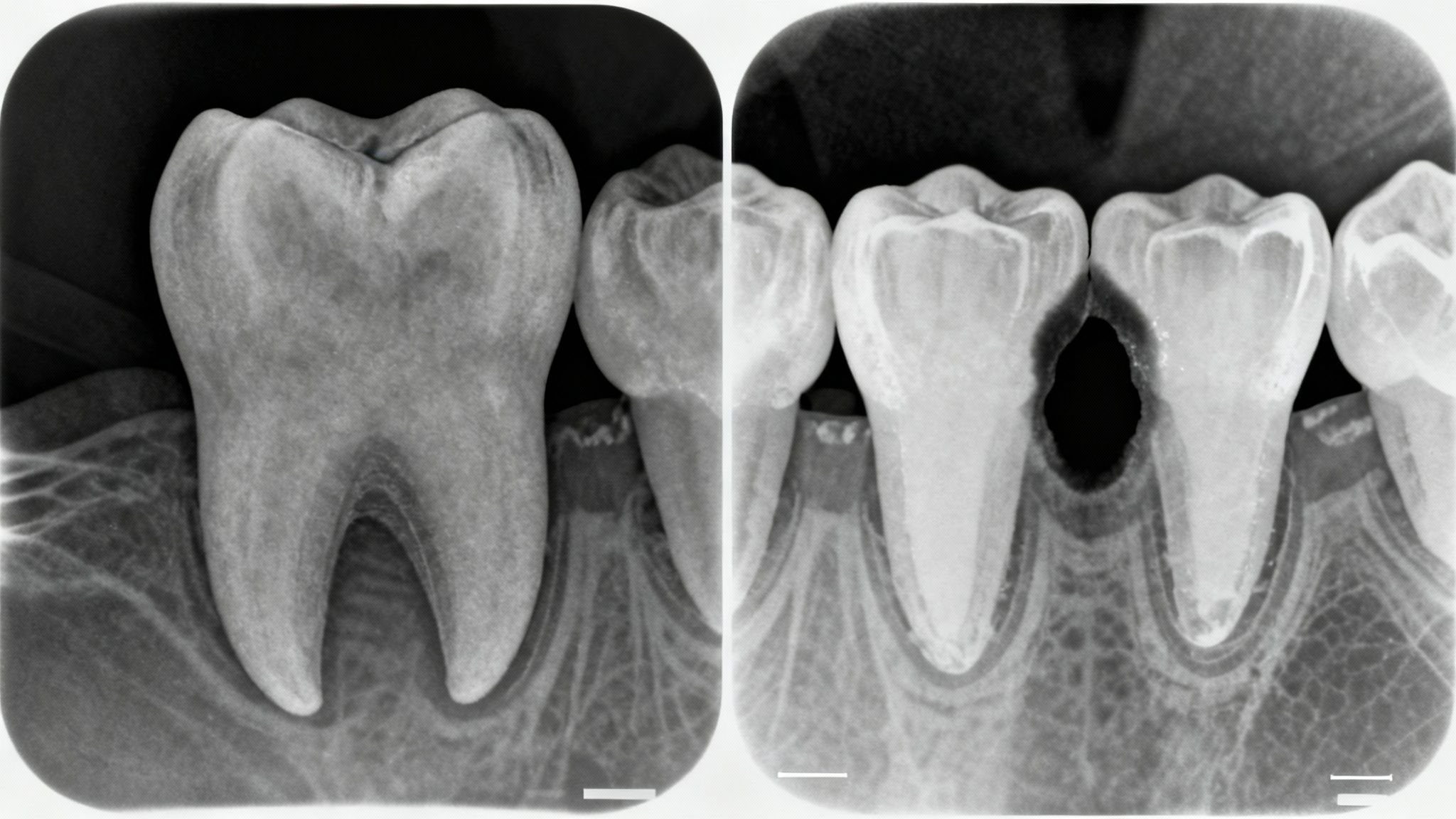
Seeing these examples will help you understand how catching something early on an X-ray can save you from complex and costly treatments down the road.
Finding Cavities: The Dark Shadows of Decay
Cavities are one of the most common problems we find on X-rays. Because decay makes the tooth less dense, it shows up as a dark shadow. Bitewing X-rays are especially great for catching cavities in those tight spaces between your teeth.
When Dr. Wynn reviews your images, he's looking for:
- Small, triangular dark spots just below the enamel where two teeth touch.
- Darker, shadowy areas under the chewing surfaces of your molars.
Catching these early is key. A small shadow can often be fixed with a simple filling. To learn more, check out our guide on how long a cavity can go untreated.
Identifying Bone Loss From Gum Disease
Gum disease is often called a "silent" disease because it can sneak up on you without pain. On a dental X-ray, however, the evidence is clear. In a healthy mouth, the jawbone comes up high on the roots of your teeth.
When gum disease is present, that bone level starts to drop. This bone loss will look like the bone line is lower than it should be.
At West Bell Dental Care, Dr. Wynn uses X-rays to monitor your bone levels over time. Catching bone loss early allows us to create a plan to stop the progression of gum disease and protect your smile.
Spotting Infections and Abscesses
An infection at the tip of a tooth's root, known as an abscess, is another problem that X-rays reveal perfectly. When the nerve inside a tooth dies, bacteria can cause an infection that eats away at the surrounding bone.
This shows up as a small, dark circle right at the tip of the root. It’s a clear sign that the infection has created a pocket in the jawbone. This is a serious issue that often requires a root canal to fix.
Working With Your Dentist For Better Health
Getting familiar with your dental X-rays is a great start. But the most important step is using that knowledge to have a collaborative conversation with Dr. Wynn. This is where you become a true partner in your own care.
An X-ray is a critical tool, but it's just one piece of the puzzle. At West Bell Dental Care, we always pair these images with a thorough clinical exam. Dr. Wynn will look at the X-ray, then check that exact tooth to get the full story before recommending treatment.
Empowering Your Dental Visits
We want every patient from Surprise, Sun City, and Peoria to feel confident and informed. One of the best ways to do this is by asking good questions. It helps you understand what's going on and makes you more comfortable with your care plan.
Here are a few easy questions you can ask during your next visit:
- "Can you show me the area of concern on the X-ray?" This makes the conversation visual and lets you see what Dr. Wynn is seeing.
- "What does a healthy tooth look like for comparison?" This gives you a clear baseline, making it easier to spot the difference.
- "What are the next steps, and what happens if we wait?" This helps you understand the urgency and the consequences of delaying treatment.
This collaborative approach is at the heart of how we practice dentistry. When patients understand their X-rays, they feel more confident in their treatment decisions.
Key Takeaway: Your X-rays aren't just for your dentist; they are for you. Use them to start a conversation that puts you in the driver’s seat of your oral health journey.
This partnership is possible thanks to incredible advancements in dental technology. The global market for dental imaging was valued at USD 3.14 billion in 2024 and is growing. You can discover more insights about dental imaging technology to learn why it's so important.
If you're looking for a new provider in the Surprise area, take a look at our guide on how to choose the right dentist for your family.
Frequently Asked Questions
It's completely normal to have a few more questions. Here are answers to some of the most common things we hear from our patients right here in Surprise, AZ.
How often do I really need dental X-rays in Surprise, AZ?
This depends on your age, oral health history, and risk for dental issues. For most adults with a healthy history, we recommend check-up X-rays (bitewings) once a year at West Bell Dental Care. A more complete set of X-rays might be suggested every 3 to 5 years to get a long-term view of your jawbone and roots.
Are digital dental X-rays safe?
Yes, they are incredibly safe. Our Surprise office uses an advanced digital X-ray system with an exceptionally low radiation dose—often less than what you’d get on a short airplane flight. The benefit of catching a serious problem early far outweighs the minimal risk.
Can I get X-rays if I am pregnant?
Please let us know if you are pregnant or think you might be. We typically postpone routine X-rays until after delivery. However, if you have a dental emergency like severe pain or an infection, we can safely take necessary X-rays with extra precautions to protect you and your baby.
Will my dental insurance cover X-rays?
Many insurance plans cover preventive X-rays, like annual bitewings, as part of a routine check-up. The cost depends on the type of image and your specific plan. Our team is happy to discuss any costs with you beforehand so you feel fully informed. You can learn more by reading our guide to understanding dental insurance.
Can I refuse to have dental X-rays taken?
You always have the right to refuse any treatment. However, without X-rays, serious issues like hidden cavities, bone loss, and infections are invisible. Declining X-rays can limit Dr. Wynn's ability to give you a complete and accurate diagnosis, which might allow a small problem to become more complex and painful later.
At West Bell Dental Care, we believe an informed patient is an empowered one. Dr. Wynn is dedicated to using advanced tools like digital X-rays to tailor care for each unique patient, ensuring issues are detected early to reduce future costs and discomfort. If you have more questions or you're ready to schedule your next check-up in Surprise, AZ, please contact our friendly team.
You can book your appointment online at https://westbelldentalcare.com.