
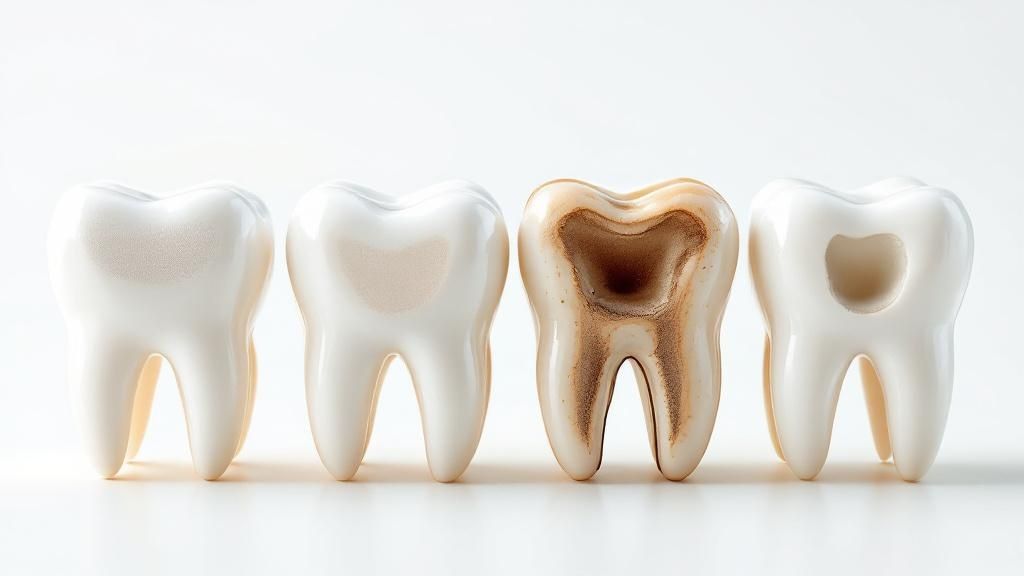
Ever wondered what a cavity actually looks like? Many of us picture a small, dark hole, but the truth is often much more subtle. A cavity is really a process, not just a single event.
It often begins as a faint, almost chalky white area on your tooth's surface. From there, it can progress to a light brown stain, a darker spot, and eventually, the noticeable hole many people imagine.
The Visual Stages of Tooth Decay
Thinking about how cavities form is a lot like watching rust develop on a car. It starts as a tiny, nearly invisible blemish but can grow into a serious problem if you don't address it. Understanding this progression is the key to catching tooth decay early on.
The journey from a minor issue to a major problem happens in stages, each with its own visual signs. At West Bell Dental Care, we want our patients here in Surprise, AZ, to feel confident spotting these signs on their own teeth or their children's.
A Timeline of How a Cavity Appears
This simple visual guide shows how a cavity develops, from that initial mineral loss to more advanced decay that reaches the inner layers of the tooth.
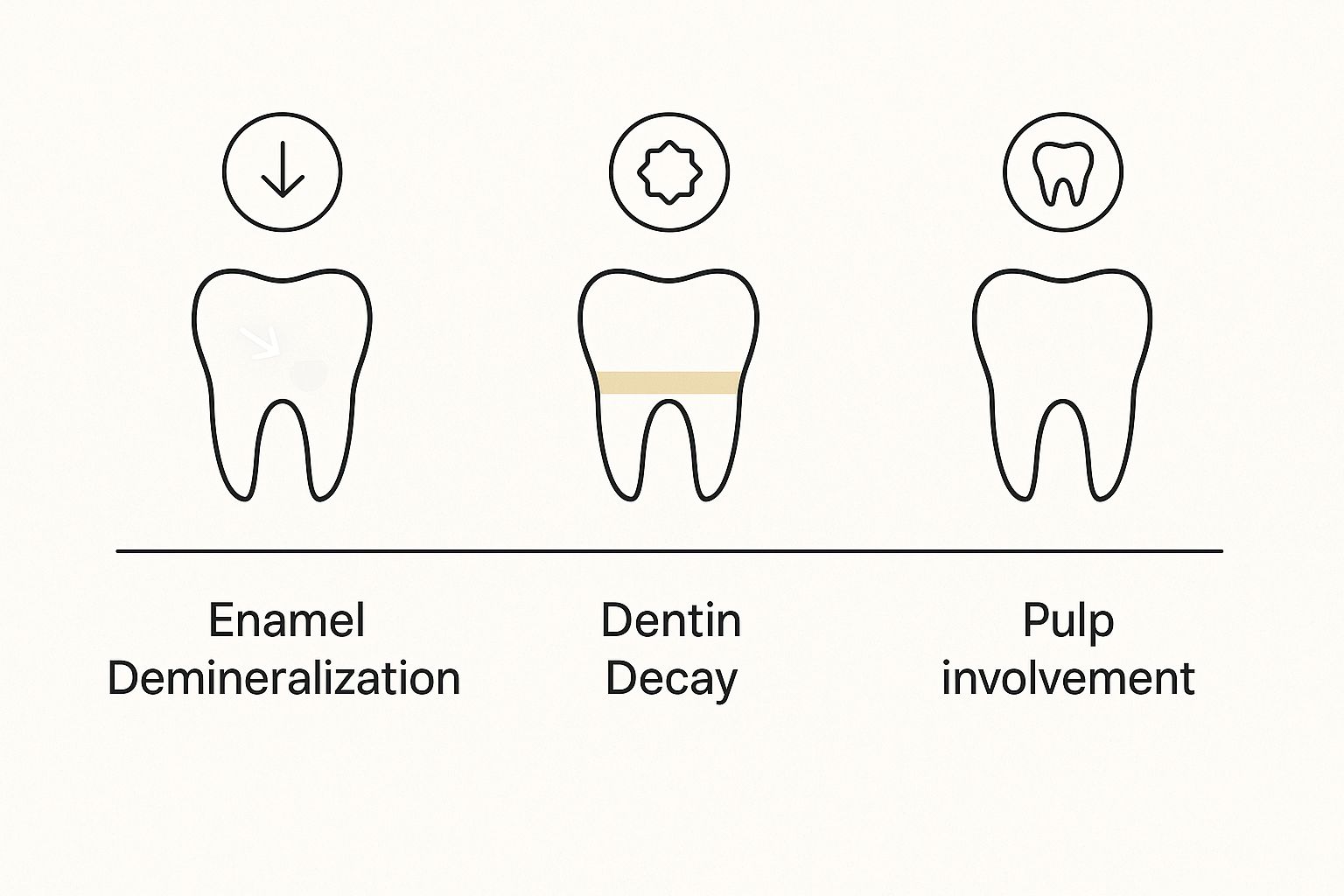
As you can see, what starts as a simple loss of minerals in the enamel can eventually dig its way into the tooth's core. That’s why catching it early is so critical. Every stage is an opportunity for our team in Surprise to step in and protect your smile.
The earliest sign of a cavity is often called a "white spot lesion." This is a patch of demineralized enamel that is sometimes reversible with the right care. This is the absolute best time to take action.
Recognizing these different appearances helps you know when it’s time to call a professional. Think of these visual clues as your body's way of telling you that a tooth needs help. Once the decay becomes more obvious as a brown or black spot, it means the enamel has been permanently damaged.
At this stage, the cavity needs professional treatment to fix the problem. Thankfully, modern procedures make this a very straightforward process. If you think you might have a cavity, learning more about dental fillings in Surprise, AZ, can show you the simple and effective solutions available to get your tooth's health and appearance back on track.
The First Sign: A White Spot
Of all the things people picture when they think of a cavity, a dark, painful hole is usually at the top of the list. But the truth is, cavities don't start that way. They creep in silently, almost invisibly, with a first sign most people completely miss.
This earliest stage of tooth decay is a process called demineralization. It happens when acids, usually from plaque bacteria feasting on sugars, start to pull essential minerals out of your tooth's hard, protective outer layer—the enamel.
The first visible sign of this mineral loss is a faint, chalky, or dull white spot on the tooth's surface. These spots are totally painless and incredibly easy to overlook, especially on your back molars, unless a dentist's trained eye spots them during a check-up.
Why Early White Spots Matter
Catching tooth decay at this "white spot" stage is a game-changer because the damage is often still reversible. It’s your tooth’s first real warning signal that a much bigger problem is just around the corner. When we find these areas early, we can often step in with simple, non-invasive treatments to stop the cavity.
This initial demineralization stage is the only point where a cavity can be stopped and even reversed without needing a drill and a filling.
Proactive care, like a professional fluoride treatment, can actually put those lost minerals back into the enamel. This strengthens the tooth and effectively stops the decay process, helping you completely avoid a filling later on.
Finding a team you trust for this preventative care is a huge part of staying ahead of decay. If you're looking for a local provider in the Sun City or Peoria area, our guide on how to choose the right family dentist can help you know what to look for.
When a Cavity Becomes a Visible Brown or Black Spot
If you miss the early warning of a white spot on your tooth, the next stage of decay is much harder to ignore. This is when you might see a light brown, dark brown, or even black spot appear on the tooth's surface.
This color change is a clear signal that the decay has broken through the tough outer enamel and is now moving into the softer, more sensitive layer beneath it, known as the dentin.
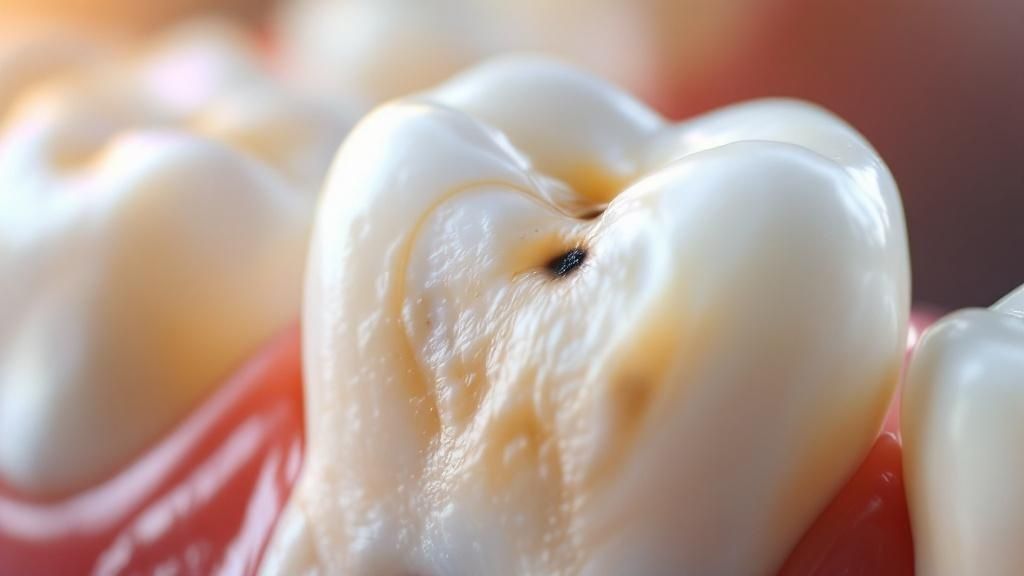
Think of it like a bruise on an apple—once the skin is broken, the inside quickly starts to brown. When the protective enamel is compromised, the decaying organic material inside gets stained, leading to these darker colors. This is what a more established cavity looks like.
Where You Might See These Dark Spots
A cavity can form anywhere on a tooth, but these brown or black spots tend to pop up in specific areas that are tough to clean. Knowing where to look can help you catch the problem quickly.
- On Chewing Surfaces: The deep grooves and pits on your back molars are prime real estate for plaque. A small brown or black dot here is a classic sign that a cavity is forming.
- Near the Gumline: Plaque loves to build up right where your tooth meets your gums. A dark area here can mean a cavity is starting at the base of the tooth.
- Between Your Teeth: This one is harder to spot on your own. Sometimes, decay between teeth makes the edges look discolored or shadowed.
At this stage, you may start to feel it, too. Because the decay is now closer to the nerve endings inside the dentin, many people report new sensitivity to sweet, hot, or cold foods and drinks.
The good news is that even when a cavity has become a visible brown or black spot, it is still very treatable. For our patients in Surprise, Sun City West, and the surrounding areas, the solution is typically a straightforward dental filling.
What Happens When a Cavity Becomes a Hole
If you don't catch a cavity in its early stages, it doesn't just stay a small spot. It grows, digging deeper into the tooth and becoming a much more serious problem. What starts as a subtle white or brown mark eventually becomes an unmistakable hole—what dentists call cavitation.
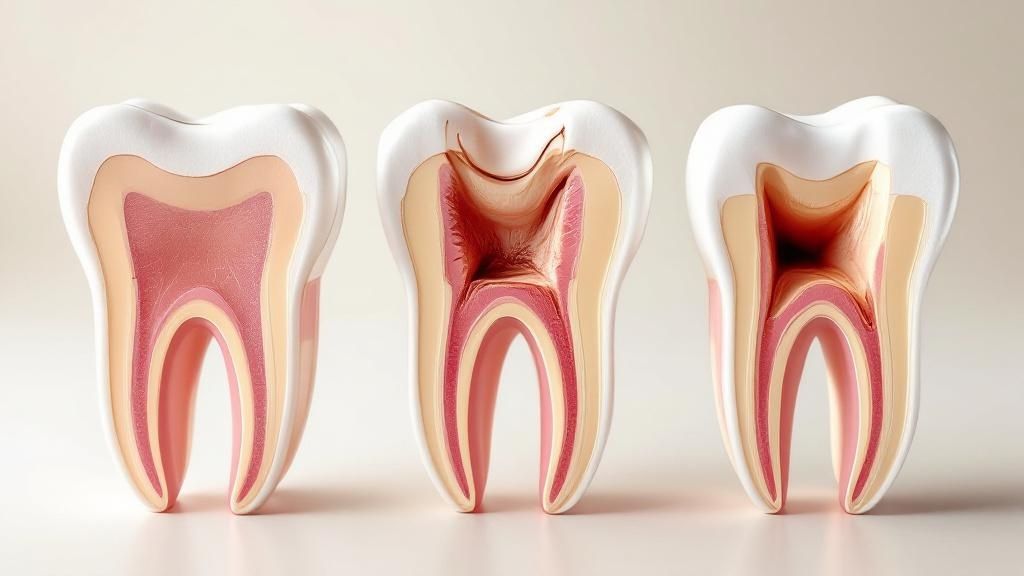
At this point, you can often see the hole when you look in the mirror. You might even feel its rough, crater-like edges with your tongue. This is a sure sign that the decay is getting dangerously close to the tooth's core, where the delicate nerves and blood vessels are.
The Warning Signs of an Advanced Cavity
Once the decay breaches the inner sanctum of the tooth and reaches the nerve, the symptoms get a lot more intense. Your body will start sending some very loud and clear signals that something is wrong.
Watch out for these signs of advanced decay:
- A constant, throbbing toothache that just won't quit.
- Sharp, shooting pain when you bite down on food.
- Severe sensitivity to hot, cold, or sweet foods that lingers.
- Visible signs of an infection, like pus around the tooth or swelling in your gums, cheek, or jaw.
If you're experiencing any of these, it's a dental emergency. The infection is putting the tooth at serious risk, and you need to see a dentist right away to have any chance of saving it.
This level of decay is a massive global health issue. The World Health Organization (WHO) reports that untreated tooth decay in permanent teeth is the single most common health condition worldwide. When a cavity gets this bad, a simple filling won't cut it anymore.
Learning about procedures like root canal therapy can help you understand how we can remove the infection, save your natural tooth, and get you out of pain. For anyone in Surprise, AZ, or the surrounding communities like El Mirage, seeking immediate care is critical.
Why Some Cavities Are Invisible to You
Here’s a critical truth about dental health: not every cavity is something you can see in the mirror. While we’ve talked about what a cavity looks like when it's a visible spot, some of the most sneaky decay happens completely out of sight.
These are what we often call "hidden" cavities, and they love to form between your teeth. These tight spaces, known as interproximal areas, are a perfect hiding spot for plaque because they are incredibly difficult to clean with just a toothbrush.
Since it's physically impossible to see these with the naked eye, these cavities can cause significant damage before you ever feel a thing—no pain, no sensitivity, nothing.
How We Find Hidden Decay
So, if you can’t see them, how do we find them? This is where modern dental technology is absolutely essential. At West Bell Dental Care, we rely on digital X-rays to get a clear picture of what’s happening beneath the surface and between your teeth.
An X-ray lets us see through the enamel to spot the dark shadows that signal decay, checking areas we could never inspect visually. This technology is a game-changer for catching problems early.
Detecting a cavity when it’s small and hidden between the teeth is far better than waiting until it grows large enough to cause a toothache or structural damage.
This is a powerful reminder of why regular dental check-ups are so vital for everyone in the Surprise, AZ, community, even if you think your teeth look and feel perfectly fine. You can discover more tips on avoiding cavities in our helpful guide.
Your Partner in Cavity Prevention and Treatment in Surprise, AZ
Knowing what a cavity looks like is one thing, but stopping them from ever forming is the real win. From those first faint white spots to a dark, visible hole, the signs of decay are a clear reminder of why catching problems early is your family’s best defense.
Here at West Bell Dental Care, we’re proud to be a trusted partner for families in Surprise, Sun City West, Peoria, and our neighboring communities. Our entire practice is built around gentle, proactive care and clear patient education so you feel empowered to protect your smile for life.
Your Best Defense is a Good Offense
The impact of tooth decay is a serious issue. Untreated cavities in permanent teeth are still one of the most common health problems people face, which shows how crucial preventive care really is.
The best time to deal with a cavity is long before it even starts. There's no substitute for consistent care at home and regular professional cleanings—they are the true cornerstones of a healthy, cavity-free smile.
While nothing beats having a professional set of eyes on your teeth, what you do at home every day is just as important. Products like Ayurvedic Natural Whitening Toothpaste can play a part in your routine, but a great routine is about habits. You can learn more about how preventive dental care impacts health in our detailed guide.
Don’t wait until you see or feel a problem. We invite you to schedule a routine check-up with us to keep your family’s smiles healthy and bright for years to come.
Frequently Asked Questions
It's completely normal to have questions about what cavities look like and what to do about them. Here are some of the most common concerns we hear from our patients right here in Surprise, AZ.
Can a cavity just look like a stain?
Yes, it absolutely can. In its early stages, a cavity often shows up as a brown or blackish spot, especially in the deep grooves of your back teeth. It’s so important not to write off any new discoloration. During a check-up at our Surprise office, we can tell you for sure if it’s a simple cosmetic stain or the start of something that needs attention.
If my tooth doesn't hurt, does that mean I'm cavity-free?
Not at all. In fact, cavities are typically painless when they're small and only in the hard, outer enamel. The pain usually doesn't kick in until the decay has worked its way much deeper and is getting close to the nerve. This is exactly why regular dental visits are so crucial—we can find and fix cavities long before they ever start to hurt.
Are the white spots on my child's teeth cavities?
Sometimes. A chalky, dull white spot can be the very first sign of demineralization, which is the first step toward a cavity. However, other things like fluorosis or genetics can cause white spots, too. There's no way to know for sure without a professional look, which is why we encourage families in Surprise to bring their children in for regular check-ups.
How fast does a cavity actually grow?
This is a real "it depends" situation. A cavity's growth rate can vary wildly based on your diet (especially sugar intake), your daily oral hygiene habits, and even the natural flow of your saliva. For some people, a small spot might take years to become a real problem. For others, decay can progress in just a few short months.
Do I really need X-rays to find every cavity?
Yes, digital X-rays are one of the most powerful tools we have for protecting your health. They are absolutely essential for spotting cavities that form between the teeth, where they are completely invisible to the naked eye. Using X-rays helps us catch decay at its earliest and most treatable stage, making any treatment you might need much, much simpler.
At West Bell Dental Care, we believe that understanding your oral health is the key to protecting it for a lifetime. If you've noticed any suspicious spots on your teeth or just have a question, don't put it off. Schedule your appointment with us today and let our friendly Surprise team take a look.
Ready to See a Dentist in Surprise, AZ?
Dr. Jennifer H. Wynn and the West Bell Dental Care team are here to help. Call us at 480-795-2420 or book online below.

Medically reviewed by Dr. Jennifer H. Wynn, DDS — Founder of West Bell Dental Care, Surprise, AZ. Graduate of Loma Linda University School of Dentistry with 30+ years of experience in general, cosmetic, and restorative dentistry. NPI: 1144359720 | AZ License: D009624.