
Let's get right to the big question everyone asks: does teeth whitening damage enamel?
The short answer is no—when it's done the right way, especially with a professional watching over the process, it's a completely safe and effective way to brighten your smile. Modern whitening isn't about stripping away or harming your enamel. It's a much gentler process that lifts away stains to reveal the naturally bright tooth underneath.
Understanding Whitening and Your Tooth Enamel
Many of our patients here in Surprise, AZ, worry that making their smile whiter might make their teeth weaker. It’s a totally normal and understandable concern, but the science behind professional teeth whitening is actually very reassuring.
Think of your tooth enamel as a sturdy, protective shield. Whitening agents don't grind this shield down. Instead, they work more like a specialized cleaner that gets into microscopic pores to lift out deep-set stains.
Dental research backs this up. According to the American Dental Association (ADA), when used as directed, professional whitening with agents like hydrogen peroxide is considered safe for enamel. The active ingredients are designed to break down the molecules that cause stains, not the actual structure of your tooth.
For a deeper dive into how this all works together for a healthy smile, check out our guide to teeth whitening and oral health success.
How We Protect Your Teeth During the Process
The real key to a safe whitening experience is having a professional guide you. At West Bell Dental Care, we make sure your enamel is protected at every single stage.
- Initial Oral Health Check: Before we do anything, we confirm your teeth and gums are healthy and ready for whitening. This is a critical first step for all our patients, from Peoria to Sun City West.
- Controlled Application: Our team uses very precise concentrations of the whitening gel and careful application methods. This protects your gums and makes sure the gel only touches your teeth.
- Personalized Guidance: We give you crystal-clear instructions to prevent overuse, which is a common reason people experience sensitivity with at-home kits.
Key takeaway: The active ingredients in whitening gels temporarily open up tiny pores in your enamel to release stains. This can cause some short-term sensitivity, which is a normal part of the process and not a sign of damage.
Ultimately, the goal is to get you a brilliant smile without ever compromising the strength of your teeth. While that temporary sensitivity can happen, it’s completely different from actual damage. Those tiny pores in your enamel naturally remineralize and close up shortly after your treatment is done, leaving your smile both brighter and just as strong as it was before.
Teeth Whitening Safety at a Glance
To make it even clearer, let's break down the factors that ensure your enamel stays safe during the whitening process.
| Factor | Impact on Enamel Safety | Best Practice |
|---|---|---|
| Whitening Agent Concentration | Higher concentrations can increase sensitivity. | Use a professionally recommended concentration suitable for your teeth. |
| Application Method | Improper application can irritate gums. | A professional application or custom-fitted trays ensure the gel stays on the teeth. |
| Treatment Duration & Frequency | Overuse can lead to prolonged sensitivity. | Follow the exact schedule provided by your dentist; don't overdo it. |
| Pre-existing Dental Health | Not suitable for teeth with decay or gum disease. | Always start with a dental check-up to ensure your mouth is healthy. |
As you can see, when managed correctly, every step is designed with the health and safety of your enamel in mind. It's all about a controlled, professional approach.
How Whitening Gels Safely Brighten Your Teeth
Ever wonder how a simple gel can lift away years of stains from things like coffee, tea, or red wine? It’s not some kind of magic. Instead, it’s a gentle and well-understood chemical reaction that zeroes in on stains without harming your actual tooth structure. The whole process is surprisingly straightforward and incredibly effective when a professional handles it.
At the heart of professional whitening gels are active ingredients like hydrogen peroxide or carbamide peroxide. These are safe, proven compounds that act as gentle oxidizing agents. Once they’re applied to your teeth, they kick off a simple but powerful process.
The Science of a Brighter Smile
Think of your tooth enamel as a smooth surface that, under a microscope, actually has millions of tiny pores. Over time, pigments from the foods and drinks you enjoy get trapped deep inside these pores, and that’s what causes the discoloration. Whitening gels are designed to tackle this exact problem.
The process unfolds in just a few simple steps:
- Activation: The peroxide in the gel starts to break down, releasing highly reactive oxygen molecules.
- Penetration: These tiny oxygen molecules are small enough to travel into the microscopic pores of your enamel and even the dentin layer just beneath it.
- Oxidation: Once they’re inside, the oxygen molecules react with the complex, discolored stain molecules. This reaction breaks the chemical bonds that hold the stains together.
- Lifting: By breaking these bonds, the stains are basically neutralized and lifted away. What’s left behind is your tooth's natural, whiter shade.
The key takeaway here is that this reaction is incredibly specific—it only targets the stain molecules. It doesn’t dissolve, scrape away, or damage the mineral structure of your tooth enamel. It’s a lot like using a specialized stain remover that lifts a spill from a fabric without hurting the fibers themselves.
This visual shows the difference between healthy enamel and enamel that has undergone erosion, which is a very different thing from the temporary changes seen with whitening.
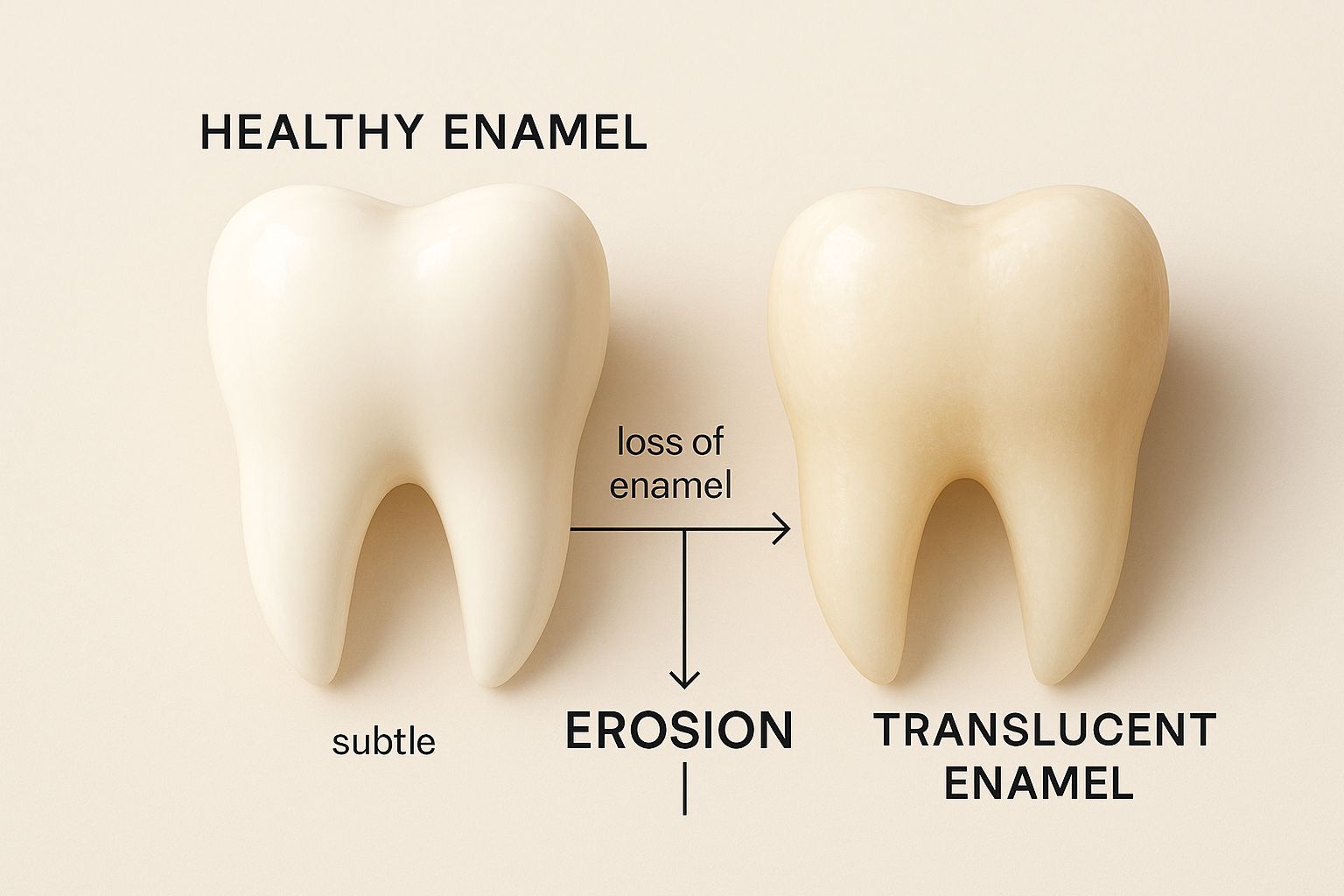
The image really highlights that while whitening works on the surface pores, true enamel damage involves structural loss—a condition we actively help patients in Surprise avoid.
Why Professional Oversight Matters
So, if the science is safe, why is it so important to see a dentist for whitening? The answer comes down to two things: precision and control.
Here at West Bell Dental Care, we make sure the process is safe from start to finish. We use the ideal concentration of whitening gel for your specific needs, and we take care to protect your gums and other soft tissues from any irritation.
This professional oversight helps prevent the overuse and incorrect application that’s so common with store-bought kits. Those issues are often what lead to sensitivity and other problems. By managing the process for you, we can ensure your journey to a brighter smile is both safe and successful, protecting your enamel for the long haul.
Comparing Professional and Over-the-Counter Whitening
When you walk down the dental aisle at any Surprise, AZ, store, it’s easy to get overwhelmed by the sheer number of whitening products promising a dazzling smile. While these over-the-counter (OTC) options are definitely tempting, they're a world apart from the professional treatments we offer here at West Bell Dental Care.
Not all whitening is created equal, and the biggest differences come down to two crucial factors: safety and how well they actually work.
The fundamental issue with most OTC kits is their one-size-fits-all approach. Whitening strips and those generic, boil-and-bite trays simply don't conform to the unique shape of your smile. This poor fit often lets the whitening gel seep out and onto your gums, which can lead to some nasty irritation and even chemical burns.
Worse yet, that uneven contact with your teeth can leave you with a blotchy, inconsistent finish. You might end up with some spots that are brilliantly white right next to areas that are still stained—definitely not the uniform result you were hoping for.
The Dentist's Role in Safe Whitening
Choosing professional whitening means putting an expert in charge of your smile's health. Having a dentist's oversight is the single most important factor in making sure your treatment is both safe and effective, without causing long-term enamel issues.
Here’s a closer look at why the professional approach is just plain safer:
- Custom-Fitted Trays: We start by taking precise impressions of your teeth to create trays that fit like a glove. This custom fit is key—it keeps the powerful whitening gel exactly where it belongs, right on your teeth and far away from your sensitive gums.
- Controlled Gel Concentration: We carefully select the right strength of whitening agent based on your specific level of staining and sensitivity. OTC products use a generic concentration that might be too weak to make a difference or so strong that it cranks up your sensitivity.
- Pre-Treatment Exam: We always start with a thorough check-up. It's vital to make sure your teeth and gums are healthy enough for whitening. Applying bleaching agents to teeth with hidden cavities or undiagnosed cracks can cause some serious pain and bigger problems down the road.
Understanding the Risks of Overuse
It's incredibly easy to overdo it with at-home whitening products when you don't have professional guidance. Many people, hoping for faster, more dramatic results, end up using the kits more often or for longer than the instructions recommend. This overuse is one of the main culprits behind enamel damage and severe tooth sensitivity.
Scientific studies have looked into how different bleaching agents impact tooth enamel. While some research has shown minor surface changes, like a temporary increase in porosity from high-concentration gels, these effects were often similar to the impact of drinking common acidic drinks like soda or fruit juice. You can explore the findings on how whitening affects enamel to learn more.
The takeaway? Under professional supervision, these risks are understood and carefully managed.
A consultation at our Surprise office is the first and most crucial step toward a stunningly white smile that is also completely safe. We ensure your journey to a brighter smile doesn't compromise your long-term oral health.
For anyone thinking about a more permanent fix for discoloration, it’s also helpful to compare all your cosmetic options. Our team can walk you through the pros and cons of different treatments, and you can get a head start by reading our comparison of teeth whitening vs. veneers. Making an informed choice with an expert in your corner is always the best way to go.
Managing Tooth Sensitivity After Whitening
If you feel a little zinger of sensitivity after a whitening treatment, don't worry—it's completely normal and, more importantly, it's temporary. This fleeting sensation isn't a sign of damage. Instead, it’s just a temporary side effect of the whitening process doing its job.
The active ingredients in professional whitening gels need a way to get to those deep-set stains. To do this, they temporarily open up microscopic tubules in your enamel. For a short time, these open pathways can make your teeth more responsive to hot and cold temperatures.
Simple Steps for a Comfortable Experience
The good news is that managing this temporary sensitivity is straightforward. A few simple adjustments can make your whitening experience much more comfortable, and most patients find that any sensitivity fades within a day or two after treatment.
To keep discomfort to a minimum, we recommend a few easy tips:
- Use a Desensitizing Toothpaste: Brushing with a toothpaste made for sensitive teeth for a week before and after your treatment can make a huge difference.
- Avoid Temperature Extremes: For the first 24 to 48 hours, try to stick to lukewarm foods and drinks. Steering clear of ice-cold water or piping hot coffee will help you avoid triggering any sensitivity.
- Stick to Softer Foods: Give your teeth a little break by choosing softer foods for a day. This reduces pressure on your newly whitened smile.
For a deeper dive into what causes these sensations, you can explore our guide on what causes tooth sensitivity.
The Science Behind Enamel Recovery
It's reassuring to know that your enamel is incredibly resilient. The sensitivity you might feel is tied directly to these temporary changes on the enamel's surface, not permanent damage. Your body’s natural remineralization process, helped along by your saliva, quickly goes to work restoring the enamel.
Research confirms that while whitening agents can temporarily alter the surface of the enamel, it is designed to recover. Your smile is left brighter without compromising its long-term strength.
A study on enamel microhardness showed that while some whitening agents caused temporary reductions, the enamel's hardness largely returned to normal after just one week in artificial saliva. These findings highlight why professional, clinical use of whitening products is so important for minimizing any long-term risks. Our goal at West Bell Dental Care is to empower you with this knowledge so you feel confident and comfortable from start to finish.
When You Should Avoid Teeth Whitening
While professional whitening is an exciting way to get a brighter smile, it isn't always the right first step. Think of it like this: you wouldn't slap a fresh coat of paint on a wall that has cracks or damage, right? You’d fix the wall first. The same idea applies to your smile—a healthy mouth is the necessary foundation for any cosmetic treatment, including whitening.
At West Bell Dental Care, putting your oral health first is our main priority. Before we even talk about brightening your smile, we have to make sure the foundation is solid. Trying to whiten teeth when there are underlying problems won't just be ineffective; it can also lead to a lot of unnecessary discomfort.
Pre-Existing Conditions That Need Attention
Some oral health issues absolutely must be taken care of before you can safely whiten your teeth. Applying strong whitening gels to a compromised tooth or gums can make existing problems much worse and cause real pain.
We’ll recommend putting whitening on hold if you're dealing with:
- Active Cavities: Whitening gel can easily seep into decayed areas, reaching the sensitive inner pulp of the tooth. This can cause some seriously intense pain.
- Gum Disease: If your gums are inflamed or receding, they're far more likely to get irritated by whitening agents. Healthy gums are key to a comfortable whitening experience.
- Cracked or Damaged Teeth: Much like cavities, cracks create a direct pathway for the whitening solution to get deep inside the tooth, which can lead to severe sensitivity.
Whitening and Dental Restorations
It’s also really important to understand how whitening works with existing dental work. This is one of the biggest reasons why a professional consultation here in Surprise, AZ, is so critical to getting the even, beautiful results you’re looking for.
Whitening agents are designed to work only on natural tooth enamel. They will not change the color of dental restorations like fillings, crowns, veneers, or bonding.
If you whiten your natural teeth without thinking about your existing dental work, you could end up with a mismatched smile. Our team at West Bell Dental Care will help you map out a full plan. This might mean replacing older restorations after you whiten to make sure everything blends together perfectly.
Protecting Your Enamel for a Lasting Bright Smile
You’ve got that beautiful, white smile you wanted—so, how do you keep it? The truth is, maintaining your whitening results and protecting your tooth enamel go hand in hand. It all comes down to simple, consistent habits that will keep your smile both bright and healthy for years.
Think of your newly whitened teeth as a clean slate. The goal from here on out is to stop new stains from settling in. That means being a little more mindful of the common culprits that many of us enjoy every single day.
Smart Habits for Long-Term Brightness
Protecting your investment is actually easier than you might think. Just a few small tweaks to your daily routine can make a huge difference in how long your whitening results last, all while keeping your enamel strong and healthy.
Here are a few simple tips:
- Limit Staining Foods and Drinks: Coffee, red wine, dark berries, and tea are notorious for causing discoloration. You don’t have to cut them out completely, but it’s a great idea to rinse your mouth with water right after you have them.
- Avoid Tobacco Products: Smoking or using other tobacco products is one of the fastest ways to turn your teeth yellow again. Quitting is the single best thing you can do for your oral health and the brightness of your smile.
- Maintain Excellent Oral Hygiene: This one is non-negotiable. Brushing twice a day, flossing daily, and using an antiseptic mouthwash are your best defense against plaque and food particles before they have a chance to stain.
A solid at-home routine is your first line of defense. But even with the best care, some discoloration can eventually creep back in. That's where professional support becomes so important. Regular cleanings at our Surprise office can lift surface stains that brushing just can't tackle on its own.
Your long-term oral health is a partnership. When you combine your daily efforts with regular professional care from our team at West Bell Dental Care, you create the perfect recipe for a brilliant smile and strong enamel.
For more on why teeth can lose their brightness over time, you can read our article about what causes teeth to lose their whiteness. It's also worth noting that other dental accessories, like tooth gems, can affect your enamel. Understanding proper care, including the process of removing tooth gems, is key to keeping your natural tooth structure intact.
Conclusion: A Bright, Healthy Smile is Within Reach
So, does teeth whitening damage enamel? When performed under the care of a dental professional, the answer is a reassuring "no." The process is designed to lift stains safely without compromising the structural integrity of your teeth. The key is professional oversight, which ensures the right products are used correctly for your unique smile.
At West Bell Dental Care, we're dedicated to helping our neighbors in Surprise, Sun City, and El Mirage achieve the radiant smiles they deserve, safely and effectively. We understand your concerns and are here to guide you every step of the way.
Ready to learn more about professional teeth whitening? Contact us today to schedule your consultation at West Bell Dental Care and take the first step toward a brighter, more confident smile.
Frequently Asked Questions
1. How long will my teeth feel sensitive after whitening?
For most patients, any sensitivity after professional whitening is mild and temporary, usually lasting only 24 to 48 hours. Using a desensitizing toothpaste before and after treatment can help minimize this feeling and keep you comfortable.
2. Can I whiten my teeth if I have dental crowns or fillings?
Teeth whitening agents do not change the color of restorations like crowns, fillings, or veneers. At West Bell Dental Care, we can create a comprehensive cosmetic plan for you, which might include replacing old dental work after whitening your natural teeth to ensure a perfect match.
3. What makes professional whitening in Surprise, AZ, safer than store-bought kits?
Professional whitening is safer because it's completely customized. We perform a health check first, create custom-fit trays to protect your gums, and use the precise concentration of whitening gel for your needs. This prevents the gum irritation and uneven results common with one-size-fits-all OTC kits.
4. How often can I safely whiten my teeth?
We typically recommend a professional touch-up every 12 to 18 months, depending on your diet and lifestyle. Following this schedule prevents overuse, which is the biggest risk to enamel health when whitening. You can explore our guide to teeth whitening aftercare and how to maintain white teeth for more tips.
5. Does West Bell Dental Care offer whitening options for people with sensitive teeth?
Absolutely. We understand that tooth sensitivity is a major concern for many of our patients in the Sun City West and Peoria communities. We offer professional-grade whitening treatments specifically designed for sensitive teeth and can take extra steps, like applying a desensitizing agent, to ensure your comfort.