
Direct Answer: Stop arguing the logic and shrink the first step instead. Ask what comfort options the office offers, book an early or Saturday slot, and go together so they are not alone.
You have brought it up three times this year. Maybe more. Every time, you get the same brush off: too busy, nothing hurts, next month.
And underneath the frustration there is a quieter worry. If you finally push hard enough to get them in a chair and the visit goes badly, that door closes for another five years.
I talk to husbands, wives, and adult kids in Surprise almost every week who are stuck exactly there. So this one is written for you, the person doing the asking, not the person refusing. Your instinct is right: pushing harder is not the lever. Making the first step smaller is.
Why your spouse is not being stubborn
Dental fear is not rare and it is not a character flaw. A national survey funded by the National Institute of Dental and Craniofacial Research found that dental fear is common among U.S. adults and that most fearful adults were open to help for it.
That second part matters more than the first. Open to help means this is treatable, not permanent. People do come back. I see it regularly.
What keeps them away is usually not the drill itself. It is three things stacked on top of each other:
- Embarrassment about how long it has been and what their mouth looks like now
- Fear of pain, often anchored to one bad appointment from decades ago
- Dread of the lecture, the assumption that someone is going to tell them they ruined their own teeth
Notice that none of those are solved by reminding them that gum disease is linked to heart health. You can win that argument and still lose the appointment.
One review on our page came from a woman in exactly your position, writing about her husband: “Having someone who suffers severe dentist anxiety and was dealing with a serious situation, Dr. Conderato jumped in and knew exactly what needed to be handled first and foremost and it gave my husband and I relief that he was definitely needing!” What gave them relief was not persuasion. It was someone else taking the weight of the decision.
Separate the excuse from the actual objection
“I’m too busy” and “nothing hurts right now” are almost never the real reason. They are polite exits from a conversation your spouse does not want to have.
So stop debating the exit and address what is underneath it. A few things that tend to land:
- “I’ll go with you and sit in the room.” Offering to physically be there removes the part most people dread, which is being alone and unable to talk.
- “You don’t have to decide anything that day.” Frame the first visit as information only. No commitment to treatment.
- “They’ve seen worse, and nobody is going to lecture you.” Say it plainly. Shame is the lock on the door.
- “Want me to call and ask the questions for you?” Many people will accept a booking they would never make themselves.
And a few that quietly backfire:
- Counting the years out loud. “It’s been eight years” lands as an accusation even when you do not mean it that way.
- Booking it as a surprise. Removing their control is the exact thing they are afraid of.
- Bringing it up during an argument or right after they mention a sore tooth.
- Describing your own easy cleaning. It reads as proof that something is wrong with them.
If they are willing to say anything at all to the office, telling the dentist directly that fear is the reason they stayed away changes how the whole appointment is run.
What to say and what to skip
Same goal, very different results. Here is how the common lines actually land.
| What backfires | What tends to work better | Why the second one lands |
|---|---|---|
| “It’s been eight years.” | “Nobody there is going to keep score.” | Removes shame instead of adding to it |
| “I already booked you Tuesday.” | “Pick a day and I’ll make the call.” | They keep control of the decision |
| “You’re going to lose teeth.” | “Let’s just find out where things stand.” | Information feels safer than consequences |
| “My cleaning took 30 minutes.” | “I’ll sit in the room with you.” | Offers support instead of comparison |
| “You can’t keep ignoring it.” | “You don’t have to agree to anything that day.” | Takes commitment off the table |
Ask about comfort options before the appointment, not in the chair
This is the most useful thing you can bring to the dinner table conversation. “They’re gentle” is an empty promise. A specific list is something your spouse can actually picture.
Patients here name these unprompted in their own reviews, which is how I know they matter:
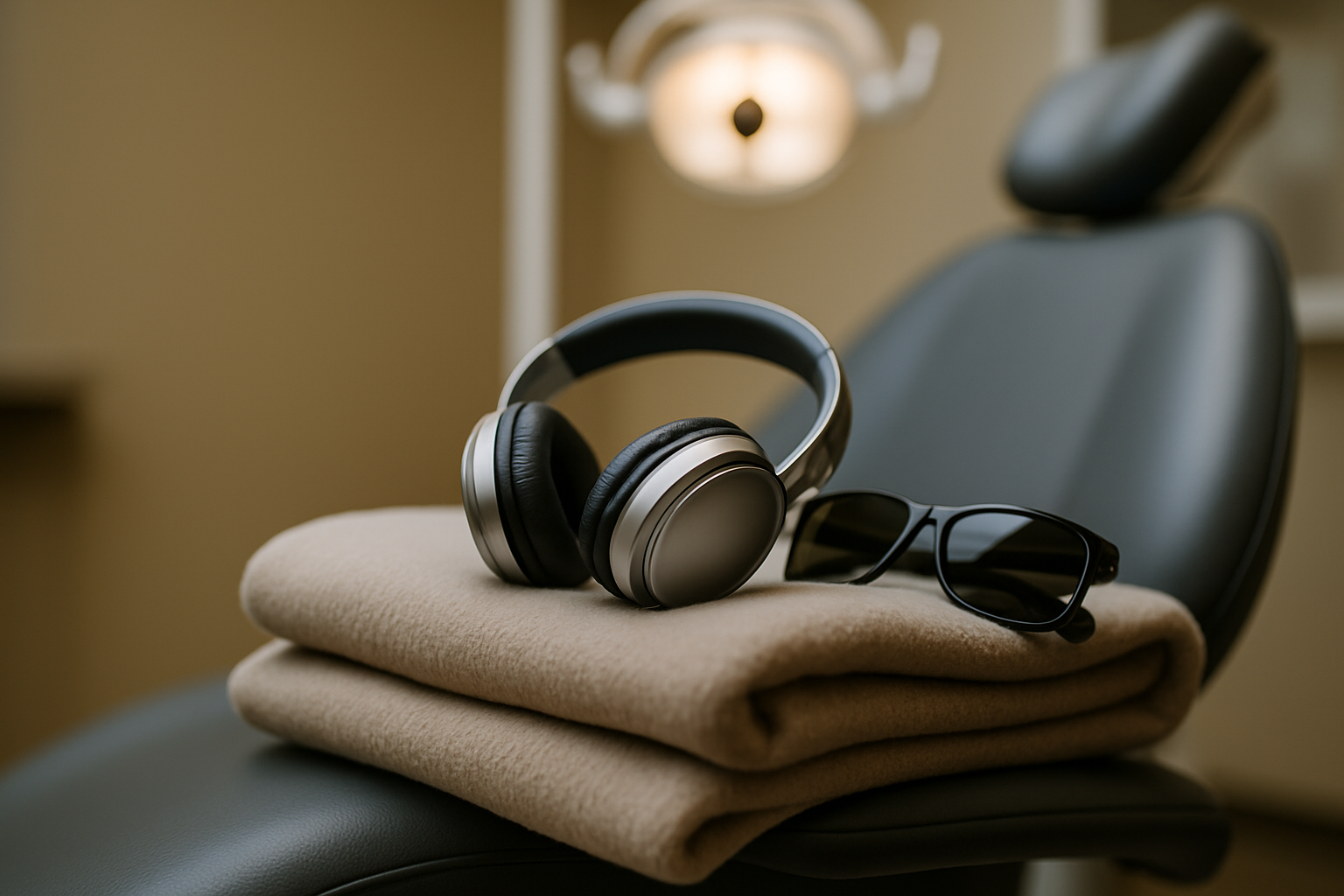
- Blankets, including a weighted one, for people who shake or get cold
- Headphones and Netflix as a distraction so the sounds are not the whole experience
- Dark sunglasses to cut the overhead light, which is a bigger deal than most people expect
- Narration, where the hygienist explains each step before doing it instead of after
- Nitrous oxide or oral sedation for people who genuinely cannot sit through treatment awake
Sedation is part of our standing offering, not a special favor you have to negotiate for. If you are weighing it, the difference between nitrous oxide and oral sedation comes down to how quickly it wears off and whether someone needs to drive them home.
Call and ask what is available before you book. A front desk that can answer that question in detail, without putting you on hold, is telling you something about how the rest of the visit will go.
Shrinking the first step
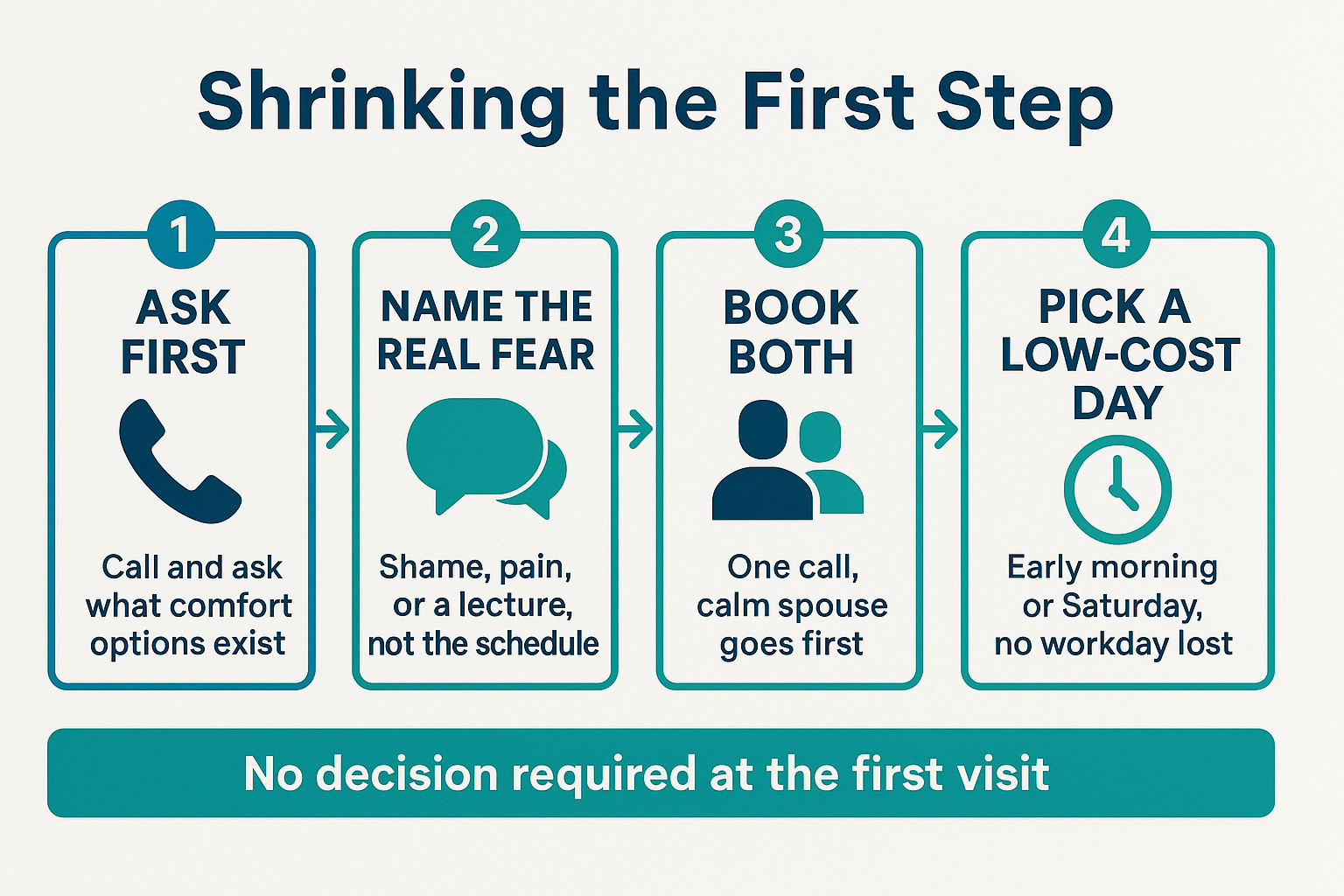
The whole strategy in one picture: four moves that make the first appointment smaller instead of scarier.
Scheduling is where good intentions go to die
A visit that costs someone a workday hands them a built-in reason to cancel at 6 a.m. Remove that reason and you remove half the resistance.
Two scheduling moves do most of the work:
Book both of you in one call. Back-to-back appointments, confident spouse first. The nervous one sits in the waiting room and watches a completely uneventful appointment happen to someone they trust before it is their turn.
Take a slot that nobody has to explain to a boss. Our weekday mornings start at 7:00 AM, weeknights run to 7:00 PM Monday through Thursday, and Saturdays run 8:00 AM to 3:00 PM. A reluctant spouse can go and be back before the day really starts.
If you are coming from Marley Park, Surprise Farms, or anywhere feeding onto Bell Road, the first slot of the day is usually the better drive anyway. The morning crawl past the 303 is not what you want layered on top of someone who is already tense.
For folks in Sun City Grand or Sun City who are not fighting rush hour, a mid-morning Saturday slot often works better. Quieter office, fewer people in the waiting room, and no one rushing off to work afterward.
Money is the other half of the fear
Someone who has avoided care for years is not only picturing pain. They are picturing a long printed treatment plan they cannot pay for, handed to them at the front desk while they nod and plan to never come back.
Know two things before you push.
First, a new patient visit is usually priced as a bundle. Costs vary by office and by what the exam turns up, but around Surprise a first visit typically covers the exam, digital X-rays, and a cleaning together rather than charging for a cleaning on its own. A deeper cleaning, if the gums need it, changes the number. Call for the actual figure rather than guessing, and if there is no insurance in the picture, here is how self-pay dental costs generally work.
Second, good treatment plans get sequenced. Nothing gets dumped on someone all at once. Urgent work first, then the rest staged over months, which is how a catch-up plan gets split into stages.
Worth asking before the appointment:
- Is there a membership plan for people without insurance?
- Do you offer financing, and is there an interest-free window?
- Can we get the plan in writing with the urgent items marked?
Asking those three questions yourself, before your spouse ever walks in, takes the scariest unknown off the table.
If they still wonder why a simple cleaning turns into a longer appointment, this explains why a first visit includes X-rays and an exam.
Frequently Asked Questions About Helping an Anxious Spouse
Can I stay in the room with my husband or wife during the appointment?
Usually yes, and it is worth asking when you book so nobody is negotiating it at the door. For many anxious patients, having someone familiar in the room is the single thing that gets them through it.
My spouse hasn’t been in over ten years. Is the first visit going to be all bad news?
No. The first visit is mostly looking and listening, not drilling. One patient wrote that she went 10 years without going to the dentist and has now made both of her cleanings this year. The exam identifies what is there, and what is actually urgent gets handled first instead of everything at once.
Is sedation only for big procedures, or can it be used for a cleaning?
It can be used for routine care too when fear is the barrier. Nitrous wears off quickly enough that most people drive themselves home, while oral sedation generally requires a ride. Ask which one fits the visit when you call.
What if my spouse agrees to go and then cancels the morning of?
Common, and not a reason to give up. Rebook, pick a time that costs them nothing (early morning or Saturday), and go with them. Riding together instead of meeting there removes the easiest point of escape.
Should I call ahead and warn the office about the anxiety?
Yes. Say it directly when you book. It changes how the appointment is scheduled, how much time is blocked, and how the team walks them through each step.
Thinking about where to send someone who has already said no once
If your spouse has refused before, the practical advantage of a multi-doctor office with sedation, cleanings, crowns, and restorative work in one building is that they never have to rebuild trust with a second office partway through treatment. Our team in Surprise keeps weekday hours starting at 7:00 AM and sees patients on Saturdays, and a fair number of the 1,700-plus five-star reviews on our page were written by people who had avoided dentists for years. If you want to ask about comfort options, sedation, or how a first visit is priced before anyone commits to anything, the office number is 480-795-2420.