
Direct Answer: Tell your dentist you’re anxious and how long it’s been — they’ve heard it before. A good dental team will adjust the entire appointment around your comfort level, not just offer reassurance.
If you’ve been putting off the dentist for two years — or ten — you’re not alone, and you’re not the worst case anyone has seen. Industry estimates suggest over 60% of patients report some level of dental fear, and roughly 40% admit they’ve skipped appointments because of it. In the West Valley, our team hears some version of this story almost every week.
The fear isn’t always about pain, either. A lot of people write to us or call and say something like, ‘I haven’t been in many years’ — and what they mean is: I’m embarrassed, I don’t know what I’ll find out, and I’m not ready to be judged for it. That combination of anxiety and shame is what keeps people away the longest.
This article is about breaking that cycle. Specifically: what to actually say when you call, what happens during a first appointment when you’ve been away a long time, and what sedation options are available — even for routine cleanings. The goal is to make the unknown known, so you can decide when you’re ready.
Why the Shame Spiral Is Harder to Overcome Than the Fear Itself
Most dental anxiety articles focus on the chair, the sounds, the needles. But for patients who’ve been away five, ten, or even more years, the harder thing to say out loud isn’t ‘I’m scared of pain.’ It’s ‘I’m embarrassed about my teeth and I don’t want to be lectured.’
One person who reached out to schedule an appointment described being ‘a very nervous patient’ while also dealing with tooth pain and the possibility of needing an extraction and a bridge. They weren’t just afraid of the procedure — they were worried about how they’d be received. That’s an incredibly common combination, and it’s worth naming directly.
A genuinely judgment-free dental environment isn’t just a phrase on a website. In practice, it means:
- The front desk doesn’t ask uncomfortable questions about why it’s been so long
- The hygienist starts by asking you how you’re feeling before they start any assessment
- Nobody comments on what ‘should have been done sooner’
- The clinical findings are presented as information, not a report card
If you’ve had a previous experience where a dentist made you feel bad about the state of your teeth, that memory is valid — and it’s also not the only kind of dental office that exists. Asking directly, before you book, whether the practice works with patients who’ve avoided care for a long time is a completely reasonable question.
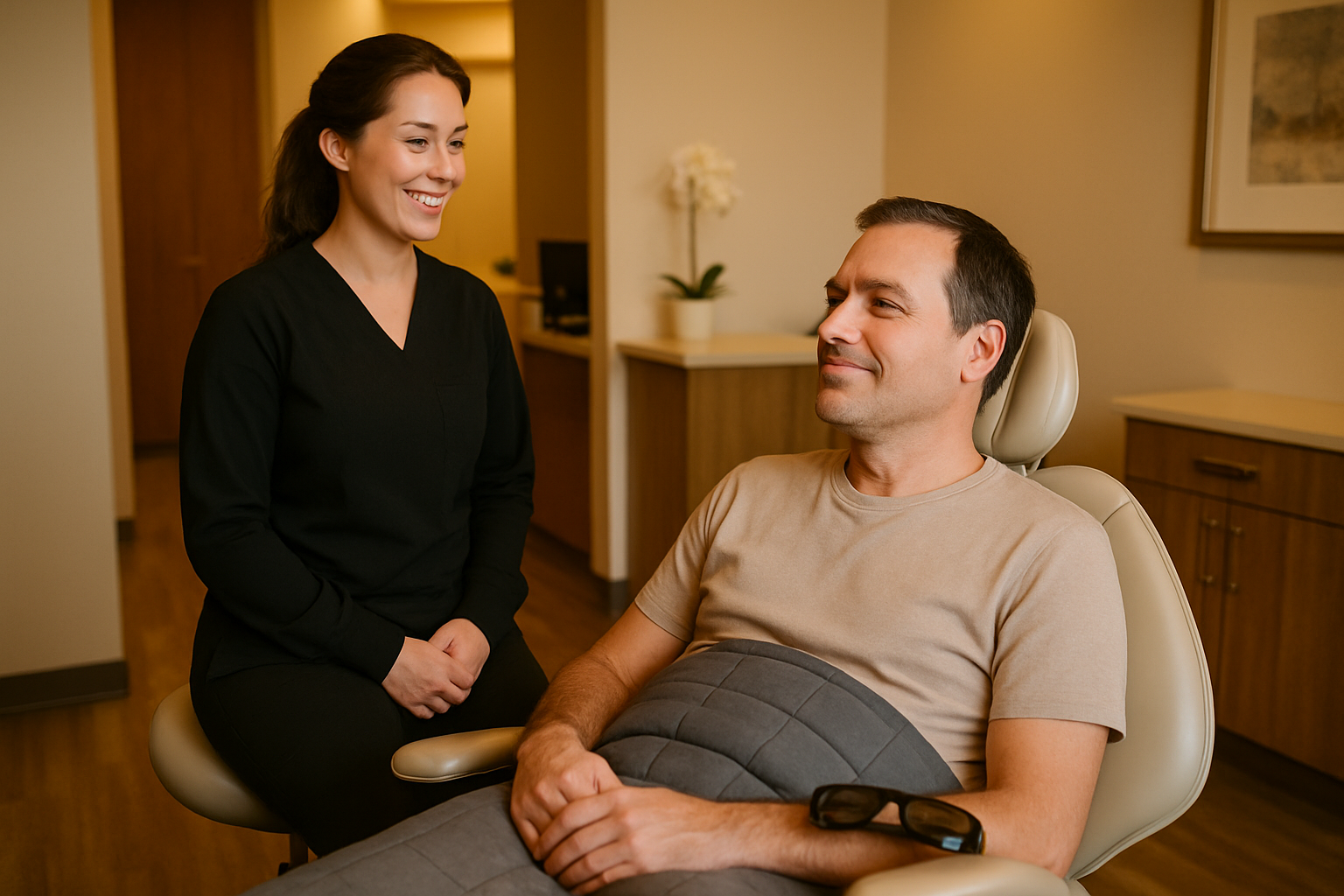
What a First Appointment Actually Looks Like When You’ve Been Away
One of the biggest drivers of avoidance is not knowing what to expect. So here’s what a new-patient exam at a practice experienced with anxious patients typically looks like, from the phone call forward.
The phone call: This is the best place to say it. You don’t need a prepared speech — just mention that it’s been a while and that you have anxiety about dental visits. A good front desk team will note it before you walk in the door, so the entire team knows before they meet you.
The paperwork: Standard health history forms. Many practices now offer them digitally so you can complete them at home before your appointment — which is genuinely less stressful than filling them out in a waiting room.
The first conversation: Before any instruments come out, a hygienist should ask about your concerns, what’s brought you in, and what your comfort level is. This is not a formality. It’s the moment to say, ‘I get really anxious, especially about X,’ or ‘I need you to tell me what you’re doing before you do it.’
The clinical exam itself for a new patient typically includes:
- Digital X-rays — fast, low-radiation images that give the dentist a full picture
- A periodontal assessment — checking gum health by measuring pocket depths around each tooth
- A visual exam — looking at teeth, soft tissues, and bite
What happens with the findings: A dentist working with an anxious patient who’s been away for a long time should present findings as a phased treatment plan — meaning priorities are identified, options are explained, and you’re not handed a list of twelve things that need to happen immediately. That distinction matters enormously. Being overwhelmed by a previous treatment plan is itself a common reason people stop going to the dentist.
For context: many patients who’ve avoided the dentist for years find that their first exam reveals less damage than they feared. That’s not guaranteed, but it’s common — and knowing that in advance can make it easier to walk through the door.
Sedation Options for Anxious Patients: A Plain-Language Comparison
Sedation isn’t just for oral surgery. Both nitrous oxide and oral conscious sedation can be used for cleanings, fillings, and other routine procedures. Here’s how the two options compare.
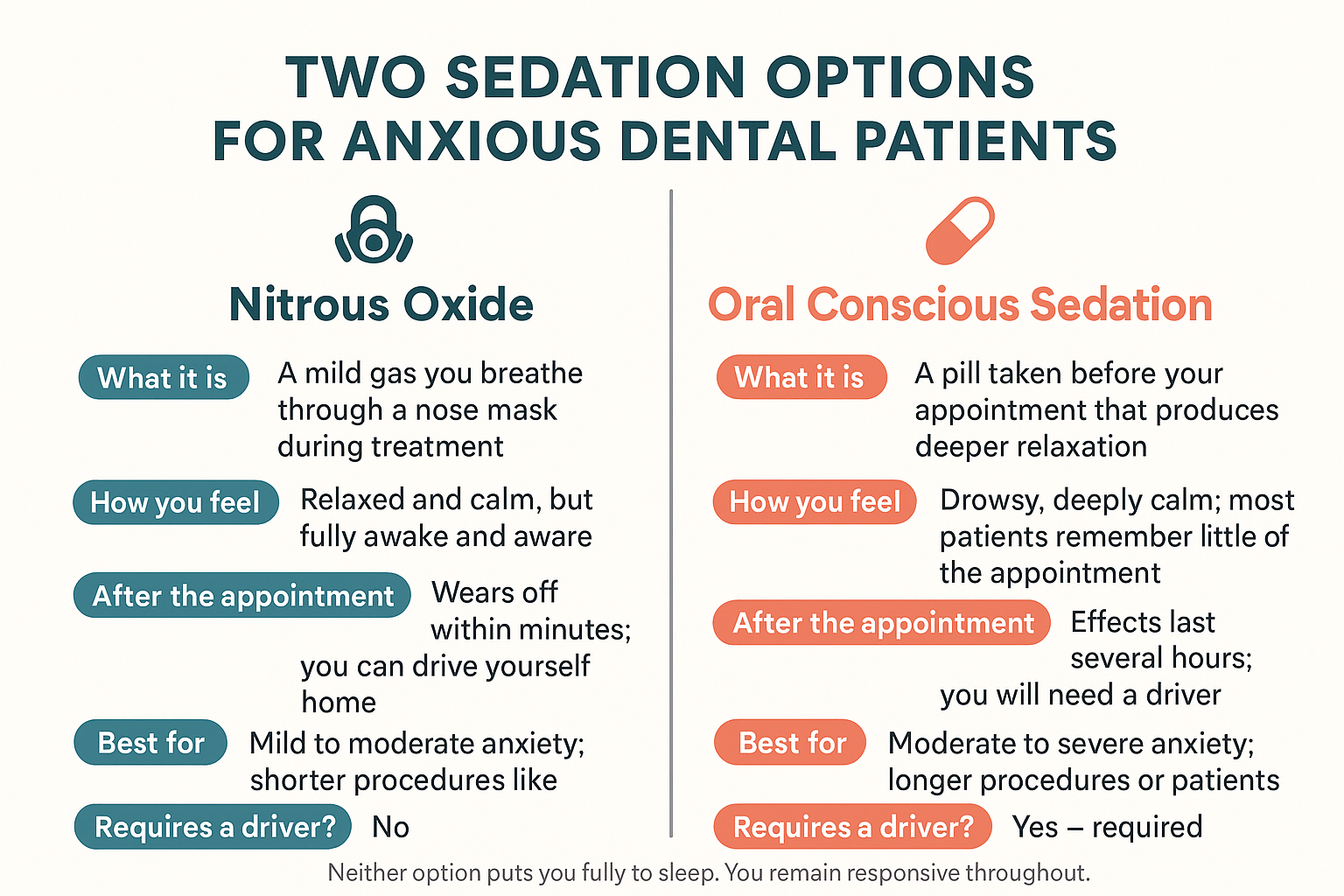
Sedation Isn’t Just for Surgeries — It’s Available for Cleanings Too
One of the most common misconceptions anxious patients carry is that sedation is only for major procedures — extractions, root canals, implants. In reality, both nitrous oxide and oral conscious sedation can be used for routine cleanings and fillings.
Nitrous oxide (sometimes called laughing gas) is the lighter of the two options. You breathe it through a small nose mask during the appointment, it produces a calm, relaxed feeling, and it clears your system within minutes after the mask is removed. You can drive yourself home. It doesn’t put you to sleep — you’re aware of what’s happening, but the edge comes off significantly.
Oral conscious sedation is a step further. You take a prescribed pill before the appointment. By the time treatment begins, most patients are in a deeply relaxed, drowsy state. The experience is still not general anesthesia — you can respond if asked a question — but many patients have little memory of the appointment afterward. You will need someone to drive you home, and the drowsiness can linger for several hours.
For patients in communities like Sun City Grand or Surprise Farms who’ve been managing dental anxiety for years, knowing these options exist for a routine cleaning can genuinely change the calculation about coming in. If you’re not sure which option fits your situation, that’s exactly the kind of question worth asking when you call to schedule.
The Comfort Details That Actually Make a Difference
Reviews from anxious patients consistently mention the same things — and they’re not about clinical skill. They’re about whether the team treated fear as a real thing worth addressing, not something to push past.
Mary, a verified Google reviewer, wrote: ‘I put on a happy face but I was so nervous going in since it had been so long. They reassured me every step of the way. Narrated what they were doing and why.’ That specific detail — narrating before acting — shows up again and again in feedback from anxious patients.
Other comfort accommodations that patients have specifically mentioned:
- Weighted blankets available during treatment
- Netflix playing on a screen overhead as a distraction
- Dark sunglasses to soften the overhead exam lights
- Providers who pause and check in throughout the appointment
- A care plan that’s explained in plain language, not dental shorthand
Another reviewer who described a lifelong fear of dentists — decades of avoiding care — said the experience felt like finally landing in ‘a safe place’ after a provider was patient, gentle, and genuinely attentive to their stress level. That kind of feedback isn’t marketing language. It’s what happens when a practice actually builds its workflow around anxious patients instead of just tolerating them.
If these things matter to you, ask about them before your first appointment. Any practice worth your trust should be able to tell you exactly what accommodations they offer — and not make you feel odd for asking.
How to Describe Your Anxiety Level When You Call
You don’t need clinical language to communicate how you’re feeling. Here are some plain phrases that give the team exactly what they need to prepare for your visit.
| What You’re Feeling | What to Say When You Call | What the Team Can Do |
|---|---|---|
| Mild nerves, mostly about the unknown | ‘I get a little anxious at the dentist — I just like to know what’s coming.’ | Hygienist narrates each step; no surprises during the exam |
| Moderate anxiety, especially about pain | ‘I have a low pain tolerance and I tend to tense up during treatment.’ | Team adjusts pacing; nitrous oxide may be offered; numbing is applied gradually |
| Strong fear, long gap in care | ‘It’s been several years and I’m embarrassed about how long it’s been — I get really nervous.’ | Judgment-free intake; phased treatment plan presented; sedation options discussed |
| Severe anxiety, history of trauma or panic | ‘I’ve had bad experiences before and dental visits cause me real panic.’ | Full sedation consultation recommended before scheduling; oral conscious sedation considered |
Frequently Asked Questions About Dental Anxiety in Surprise, AZ
What if I’m embarrassed about how long it’s been since my last dental visit?
You don’t need to apologize or explain the full story. Saying ‘it’s been a while’ is enough. Dental teams who work regularly with anxious patients have heard every version of this — years, sometimes decades. What matters to them is that you came in, not how long the gap was. Nobody at a genuinely judgment-free practice is going to make a comment about your timeline.
Can I use sedation for a regular cleaning — not just a big procedure?
Yes. Both nitrous oxide and oral conscious sedation can be used for routine cleanings and fillings, not just surgeries or extractions. If the sounds, sensations, or anticipation of a cleaning are what trigger your anxiety, that’s a completely valid reason to discuss sedation options when you call to schedule.
I’m afraid the dentist will find a lot of problems and overwhelm me with a long treatment list. What actually happens?
A dentist experienced with anxious patients will typically present findings as a phased plan — meaning the most pressing priorities come first, and everything else is explained over time. You won’t be handed a list of ten things that need to happen next week. You’ll be given information, options, and a timeline you can actually work with. And for what it’s worth: many patients who’ve avoided care for years find the exam reveals less than they feared.
What’s the difference between nitrous oxide and oral conscious sedation?
Nitrous oxide is a gas you breathe during the appointment. It relaxes you but wears off quickly — you can drive yourself home. Oral conscious sedation is a pill taken before your appointment that produces deeper drowsiness; most patients remember little of the visit, but you’ll need a driver. Neither option puts you fully to sleep. Which one fits your situation depends on how strong your anxiety is and what procedure you’re having.
What if I need to stop in the middle of an appointment because I’m overwhelmed?
Tell the team before you start that you’d like a signal — a raised hand, for example — that means ‘stop and give me a moment.’ Any team worth trusting will honor it without hesitation. Establishing that signal at the start of the appointment is one of the most practical things an anxious patient can do.
I’m a snowbird arriving in Surprise this fall. Can I get a new-patient exam even if I only spend part of the year here?
Yes. Many seasonal residents from Sun City, Sun City Grand, and communities like Arizona Traditions become long-term patients and schedule both a fall and spring visit each year. The key is getting your records transferred from your previous provider before your first appointment so the team has your full history to work from.
Suggested Internal Links — add real URLs before publishing:
- sedation dentistry options — Overview of nitrous oxide and oral conscious sedation services offered at West Bell Dental Care
- new patient information — New patient forms, what to expect at a first visit, insurance accepted, and how to transfer dental records
- dental exams and cleanings — What a preventive exam and cleaning includes, how often to come in, and what the hygienist checks
- emergency dental care in Surprise — Same-day emergency appointments, what qualifies as a dental emergency, and how to reach the practice quickly
- dental crowns and restorative care — What crowns, bridges, and other restorative treatments involve for patients returning after a long gap in care
Ready to Take the First Step Without the Pressure?
If any part of this article felt familiar — the embarrassment, the long gap, the worry about being judged — that’s exactly the kind of patient West Bell Dental Care is built to serve. You can reach the team at 480-795-2420, or visit westbelldentalcare.com to learn more about new patient appointments and sedation options. Extended hours and Saturday availability mean you don’t have to rearrange your whole week to come in.