Direct Answer: For adults 21 and older, AHCCCS covers emergency dental only, up to $1,000 per contract year for severe pain or infection. Routine cleanings, fillings, crowns, and dentures generally are not covered.
Someone wrote to us through the website in the middle of a bad night, asking one thing: could they get an emergency appointment, and did we take any AHCCCS plans? No small talk. Just a person with a painful tooth trying to find out if their card would get them through a door.
I want to answer that honestly and early, because five phone calls in a row of “sorry, we’re not contracted” is a miserable way to spend a morning when your face hurts. Our office is not contracted with AHCCCS plans, and a lot of private practices across Surprise, Sun City, and the wider West Valley aren’t either.
So here is the part that actually helps: what Arizona’s adult dental benefit really covers, the October 1 date almost nobody knows about, and the plain steps to find out where your specific plan is accepted.
Does your office accept AHCCCS?
No, we are not an AHCCCS contracted office. I would rather you read that in ten seconds here than find out after driving across Bell Road.
That said, “we don’t take it” and “you have no options” are two different sentences. Plenty of people who call us with an AHCCCS card end up in one of these situations instead:
- The plan on the card turns out to be a Medicare Advantage plan, not AHCCCS, which changes everything about what’s covered
- The AHCCCS emergency benefit is already used up for the contract year, so the visit would be self-pay anywhere
- The treatment they need was never covered by the adult benefit in the first place
That last one catches the most people off guard. Most folks assume Medicaid dental works like a regular dental plan with cleanings and fillings built in. For adults in Arizona, it doesn’t.
If you’re still not sure which kind of plan you’re holding, our breakdown of in-network, out-of-network, or neither walks through how to read what’s on the card before you start dialing offices.
What does AHCCCS adult dental coverage actually include in Arizona?
For members age 21 and older, AHCCCS policy provides an emergency dental benefit of up to $1,000 per member per contract year. That figure comes from AHCCCS itself, not from any office’s fee schedule, and you can read it in the AHCCCS Medical Policy Manual.
The key word is emergency. AHCCCS defines emergency dental as acute problems causing severe pain or infection. So the benefit is built around stopping pain and clearing infection, not around keeping your teeth maintained over the years.
What that generally means in practice:
- Usually inside the benefit: extractions, and treatment for acute pain or an active infection
- Usually outside the benefit: routine cleanings, maintenance exams, standard fillings, crowns, bridges, and dentures
I say “generally” on purpose. Your benefit is administered by whichever plan you’re enrolled in, such as a Mercy Care or UnitedHealthcare Community Plan product, and that plan is the only place that can tell you what applies to your case and how much of the $1,000 is left.
Children under 21 are covered differently and more broadly. This article is about the adult side, which is where the confusion lands.
Adult AHCCCS Dental: What Usually Counts and What Usually Doesn’t
A quick reference for adults 21 and older. Confirm anything on this list with your own plan before you count on it.
| Type of care | Typically covered for adults 21+? | What to expect |
|---|---|---|
| Treatment for severe pain or active infection | Generally yes, as emergency care | Applies against the $1,000 contract-year limit |
| Tooth extraction for an acute problem | Generally yes | Solves the pain, leaves a gap to address later |
| Routine cleaning and maintenance exam | Generally no | Usually self-pay or through a membership plan |
| Standard fillings | Generally no | Often paid out of pocket |
| Crowns and bridges | Generally no | Self-pay or financed |
| Full or partial dentures | Generally no | Separate decision after the extraction heals |
| Dental implants | Generally no | Self-pay, quoted case by case |
Why does October 1 matter so much?
This is the detail almost nobody knows, and it’s genuinely useful. The AHCCCS contract year runs October 1 through September 30.
That means the $1,000 emergency dental benefit resets on October 1, and unused dollars do not roll over into the next year. If you’ve already used the benefit this contract year, waiting isn’t a strategy, it’s just a date on the calendar.
A couple of ways that plays out for real people:
- If it’s August and your benefit is spent, October 1 is when it starts fresh
- If it’s September and you haven’t touched it, dollars sitting unused will simply disappear
- If you’re managing an ongoing problem, knowing your reset date helps you plan the sequence of care instead of reacting to it
This is calendar awareness, not a reason to panic. Private dental insurance works on a similar clock, which is why we also wrote about unused dental benefits that expire December 31 for folks on commercial plans.
If AHCCCS pays for the extraction, will it pay to replace the tooth?
Almost never, and I’d rather be straight with you about it than let it be a surprise six weeks later.
Arizona is one of only a handful of states that still limits adult Medicaid dental to emergency care. The practical result is that a covered extraction can end the pain and still leave you with a gap where a tooth used to be, plus no coverage for replacing it.
Here’s what that sequence actually looks like:
1. Pain relief now. The infected or broken tooth comes out, the infection gets addressed, and you can sleep again.
2. Healing time. A few weeks, sometimes longer, depending on the site and your health.
3. A separate decision later. A partial denture, a bridge, or an implant, and that part is self-pay.
Those three options land in very different price territory, and quotes vary a lot based on bone, healing, and how many teeth are involved. We break down what drives those numbers in what goes into the cost of a dental implant, and anyone quoting you a replacement should give you a written estimate before treatment starts.
None of this is a reason to keep a painful tooth. It’s a reason to know the full road before you start walking it.
The Plain Sequence for Figuring Out Your Own Coverage
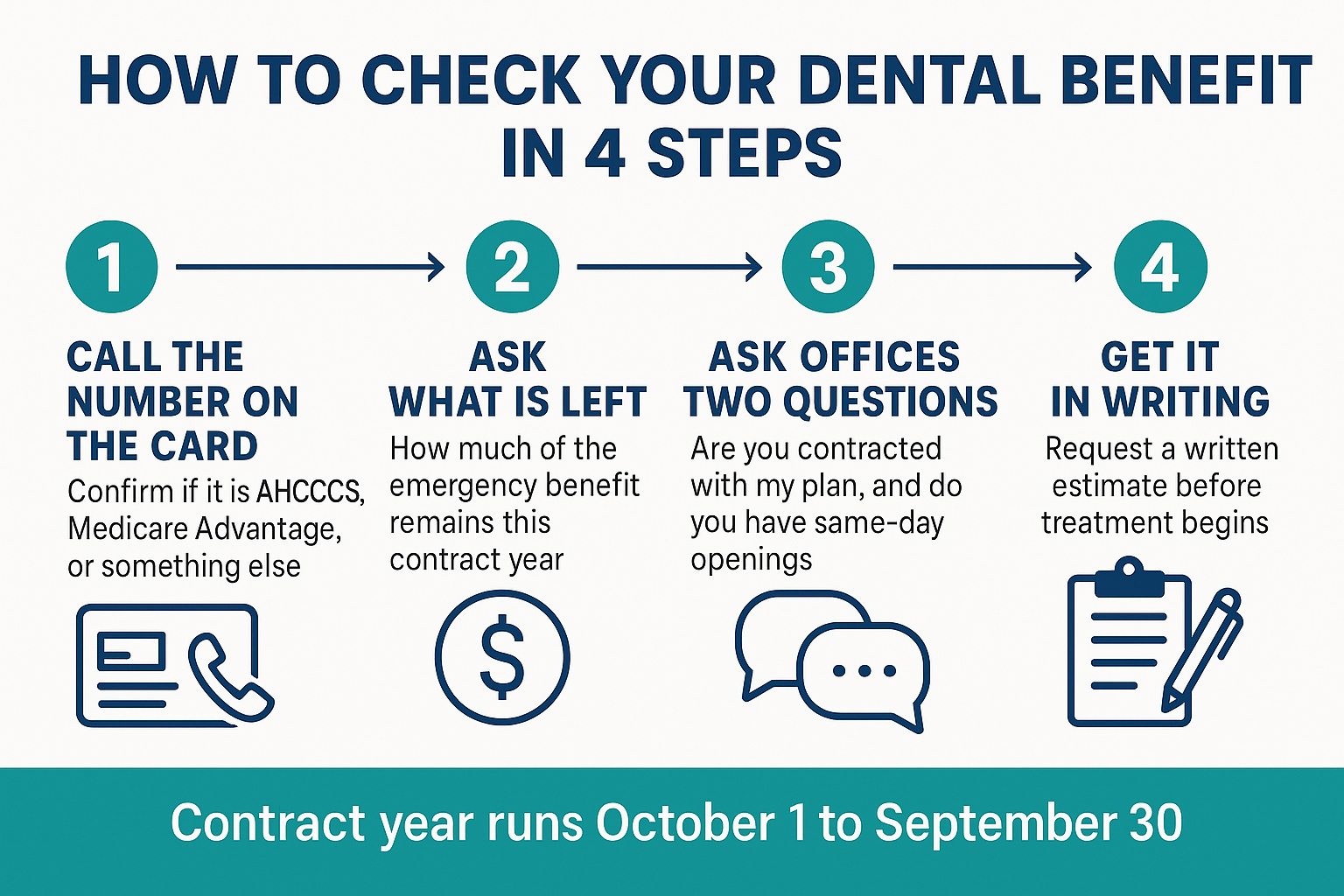
Instead of calling five offices and getting five different answers, work through these four steps in order.
How do I find out what my plan covers without calling ten offices?
Start with the member services number on the back of your card. That one call answers two things no dental office can answer for you:
- Whether your plan is AHCCCS, a Medicare Advantage plan, or something else entirely
- How much of the emergency benefit is left this contract year
Then, when you call a dental office, ask two separate questions, because they are not the same question:
1. “Are you contracted with my specific plan?” Not the brand name on the card, the actual plan product.
2. “Do you have same-day availability?” An office can take your plan and still be booked out three weeks.
Callers here ask us the availability question constantly, usually some version of “do you have anything this week, I’ve been putting this off.” Asking both questions up front saves you a bad afternoon and a wasted drive.
And if your card turns out to be a Medicare Advantage plan rather than AHCCCS, that’s a completely different set of rules. Our piece on Medicare and your dental bills covers what those plans tend to include.
What if no office near me takes my plan?
This is where most people give up, and it’s the point where a couple of options are worth knowing about. Neither is insurance, and neither is magic, but both make costs more predictable.
Self-pay dental memberships. Many offices, including ours, run an in-house membership: a flat monthly or yearly fee that bundles preventive visits, plus a discount on other treatment. There’s typically no deductible and no waiting period, which suits people who need predictable costs more than they need a plan card. We explain the structure in what a dental membership plan is and who it actually helps.
Third-party financing. CareCredit and similar programs split a larger treatment cost into monthly payments. Approval and terms depend on the lender, not the dental office.
Wherever you go, ask for these three things before anyone picks up an instrument:
- A written estimate of the full treatment, not a verbal ballpark
- What happens if the plan changes once treatment starts
- Whether a membership or payment option would cost less than the self-pay rate
For a fuller look at how out-of-pocket numbers tend to work around Surprise, our guide on dental care without insurance goes deeper than I can here.
Frequently Asked Questions About AHCCCS Adult Dental Coverage
Does AHCCCS cover cleanings for adults in Arizona?
Generally no. For members 21 and older, the benefit is built around emergency care for severe pain or infection, so routine cleanings and maintenance exams usually fall outside it. Confirm with your plan, since they administer the benefit.
How much does AHCCCS cover for emergency dental work?
AHCCCS policy sets the adult emergency dental benefit at up to $1,000 per member per contract year. How far that goes depends entirely on what treatment you need, and your plan can tell you how much is left.
When does the AHCCCS dental benefit reset?
October 1. The contract year runs October 1 through September 30, and unused dollars do not carry over. If you spent the benefit in, say, March, it starts fresh on October 1.
Will AHCCCS pay for dentures or an implant after a covered extraction?
Almost certainly not for adults. Arizona limits adult Medicaid dental to emergency care, so the extraction may be covered while the replacement is a separate self-pay decision. That’s worth knowing before the tooth comes out, not after.
I’m in pain right now and nobody takes my plan. What do I do tonight?
Call your plan’s member services line first, because many plans have a nurse or urgent care line that can direct you to a contracted office or an urgent care setting. If it’s a weekend and you’re just trying to get through to Monday, we put together options for tooth pain on a weekend in Surprise. Severe swelling, trouble breathing, or trouble swallowing is an emergency room situation, not a wait-and-see situation.
Is AHCCCS the same thing as a Medicare Advantage dental plan?
No, and people mix them up all the time, especially in Sun City and Sun City Grand where both come up. AHCCCS is Arizona’s Medicaid program. Medicare Advantage plans are private plans with their own dental rules, networks, and annual maximums.
Still Not Sure What Your Card Actually Covers?
If you’re in Surprise or anywhere in the West Valley and you’re trying to sort out the difference between what a plan covers and what an in-house membership covers, our team is glad to talk it through before you commit to anything. Our schedule includes 7 AM weekday starts, evening hours midweek, and Saturday hours for people who can’t take time off work. You can reach us at 480-795-2420 or read more at westbelldentalcare.com.