Direct Answer: Dental implant cost in Surprise, AZ varies because most cases involve multiple separate procedures, the implant post, abutment, crown, and possibly an extraction or bone graft, each priced individually.
We get this question all the time, sometimes through a phone call, sometimes through our website contact form. Someone asks for a ballpark on implant cost before they have ever come in for a visit. And honestly, that makes complete sense. People want to know if treatment is even in the realm of possibility before they take time out of their day to schedule a consultation.
The frustrating reality is that there is no single honest number to give without examining your mouth first. But that does not mean we cannot explain exactly what drives the cost, and why two quotes for ‘the same thing’ can look very different on paper.
If you are sitting in Surprise, Sun City Grand, or Marley Park trying to figure out what a dental implant is actually going to run you, this breakdown is for you. We will walk through every piece of a typical implant case, explain where costs can grow, and give you the questions to ask so you are not caught off guard.
The Three Parts of a Dental Implant (And Why Each One Has Its Own Cost)
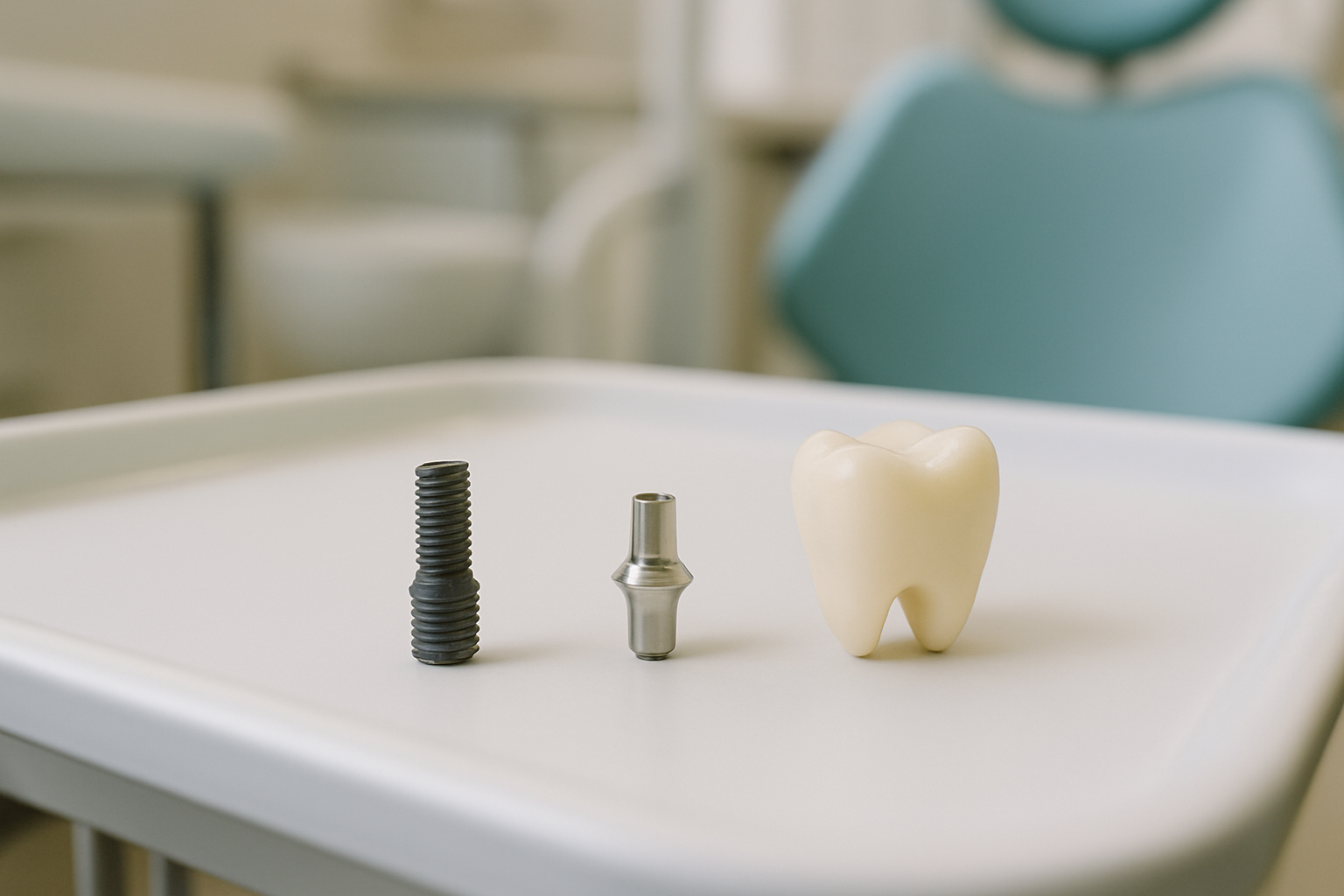
A dental implant is not a single product, it is a three-part restoration, and each part is typically billed separately. Understanding this is the first step to making sense of any quote you receive.
The three components are:
- The implant post, a small titanium screw that a dentist places surgically into the jawbone to act as the new tooth root. This is the piece most people picture when they hear the word ‘implant.’
- The abutment, a small connector that attaches to the top of the implant post after the bone has healed around it. It is what the final tooth crown sits on.
- The dental crown, the visible tooth portion, custom-made to match your surrounding teeth in shape and color.
When someone gives you a quote that sounds low, ask whether all three components are included, or just one or two of them. Some offices quote the surgical placement fee alone. Others quote the crown separately. A complete implant restoration, from post to crown, generally runs in a range that can vary widely depending on your specific anatomy, the materials used, and how many additional steps your case requires.
The American Academy of Implant Dentistry offers patient-facing education on implant treatment that can help you understand what a complete case involves before your first appointment.
The Steps That Add Cost Before the Implant Even Goes In
This is where most patients are surprised. A case that sounds simple, one missing molar, can involve several procedures before an implant post is ever placed. Each one adds both cost and time.
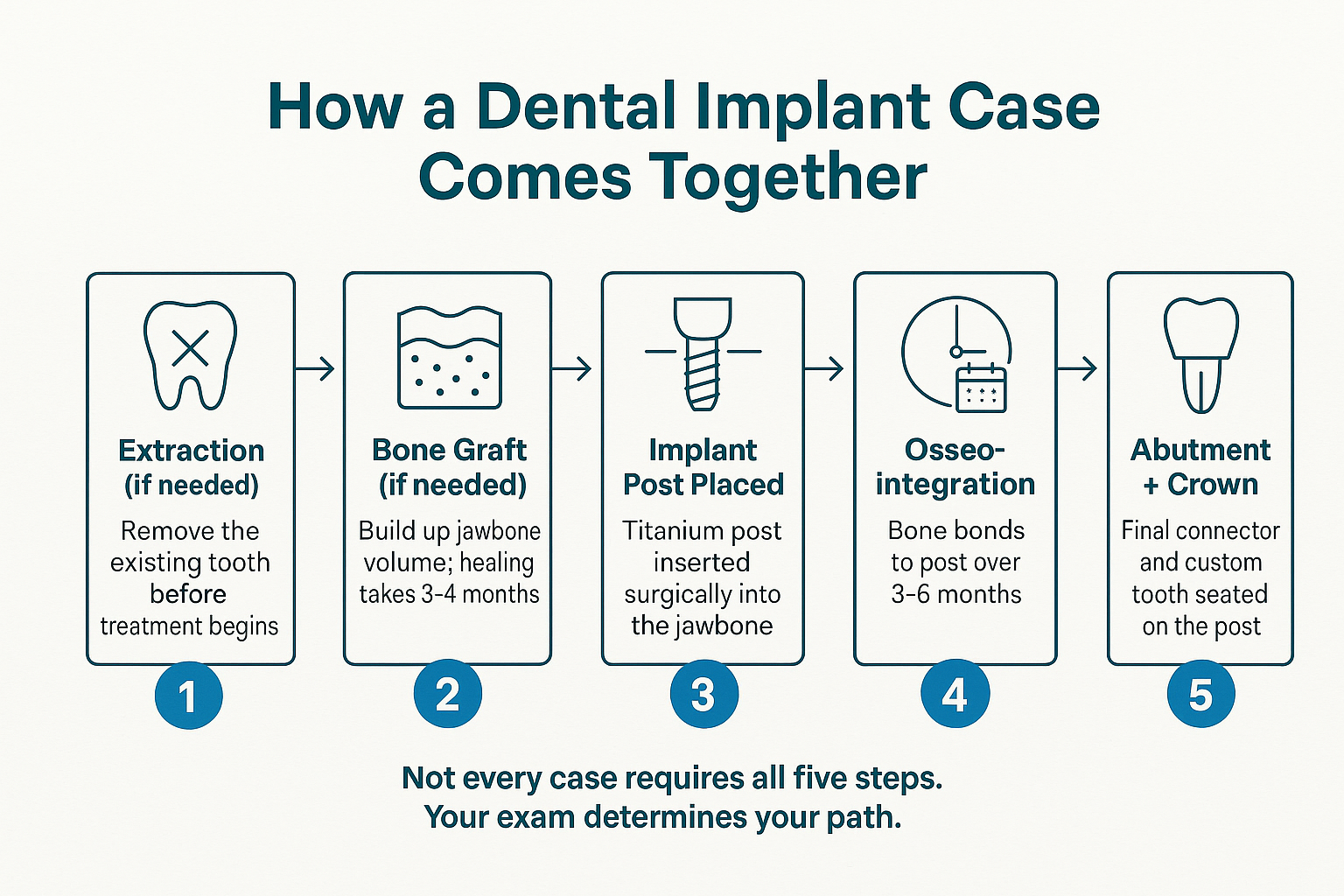
Tooth extraction: If the tooth is still present and needs to come out first, that is a separate procedure. Depending on how complex the extraction is, this can meaningfully affect your overall case cost.
Bone grafting: When a tooth has been missing for a while, the jawbone beneath it begins to shrink. If there is not enough bone volume to support an implant post securely, a bone graft is needed first, and the graft has to heal before placement can proceed. This adds months to the timeline and its own line item to the treatment plan.
Healing time: Implant treatment is not a one-visit process. Between surgical placement and the final crown, there is a healing period, often three to six months, while the post bonds with the surrounding bone. That gap is a normal part of treatment, not a complication.
These steps are why two people asking about ‘an implant for one tooth’ can receive quotes that look nothing alike. One person may need only placement and a crown. Another may need an extraction, a bone graft, a healing period, placement, another healing period, and then the abutment and crown. When our team reviews X-rays and examines the site, we can map out exactly which steps apply to you, and that is the only way to give you an honest number.
A Typical Implant Case from Start to Finish
Most implant cases follow a predictable sequence of steps, though not every patient needs every one. This overview shows how a full case can unfold.
What Insurance Actually Covers (And What It Usually Does Not)
Insurance coverage for implants is genuinely inconsistent, and frequently misunderstood in both directions. Some patients assume they have no coverage when they actually do. Others assume they are covered and are surprised when the explanation of benefits arrives.
Here is how coverage tends to break down in practice:
- The crown portion is the most commonly covered component. Some plans categorize it under major restorative benefits and pay a percentage after the deductible.
- The implant post itself is often excluded, categorized as a non-covered ‘elective’ procedure even when it is clinically the best long-term option.
- Bone grafts may fall under a different benefit category than the implant, and some plans cover grafting that they will not cover for implant placement itself, so it is worth asking separately.
- Medicare does not cover dental implants. For our patients in Sun City Grand and The Grand who are on Medicare with a supplemental dental plan, coverage depends entirely on which supplemental plan they carry, and many supplemental plans have annual maximums that may not cover a full implant case in a single benefit year.
FSA and HSA funds are typically eligible for implant procedures. If you have money in a flexible spending account or a health savings account, those dollars can often be applied across the full scope of treatment, post, abutment, crown, and related procedures.
The questions worth asking your insurance provider before your consultation:
- Is implant placement (procedure code D6010) a covered benefit under my plan?
- Is the implant crown (D6065 or similar) covered under major restorative?
- Is bone grafting covered, and under what benefit category?
- What is my annual maximum, and how much has been used this year?
Your dental office can also verify benefits on your behalf before treatment begins.
Implant Cost Components at a Glance
This table shows the main pieces of a typical implant case, whether they apply to every patient, and how insurance tends to treat each one.
| Procedure | Always Required? | Typical Insurance Status |
|---|---|---|
| Implant post (titanium root) | Yes | Often excluded or not covered |
| Abutment (connector piece) | Yes | Coverage varies by plan |
| Dental crown (visible tooth) | Yes | Most commonly covered component |
| Tooth extraction | Only if tooth is present | Usually covered under basic/surgical benefits |
| Bone graft | Only if bone volume is insufficient | May be covered under a separate benefit category |
| Sedation (if needed) | No, patient preference | Rarely covered; some plans allow partial credit |
Phased Treatment: A Real Strategy for Patients on Fixed Incomes
For patients in communities like Sun City Grand or Sun City who are managing a fixed income and a dental plan with an annual maximum, there is a practical approach worth knowing about: phased treatment.
Phased treatment means spreading your implant procedure across two separate calendar years so that your annual insurance benefit resets between steps. In practical terms, this might mean having the extraction and bone graft completed late in one benefit year, then waiting until January when the new benefit year begins to proceed with implant placement and the final crown.
This is not a workaround, it is a legitimate planning strategy that dental offices do every day. It takes longer, but it can bring a large case into a much more manageable financial range without sacrificing quality of care.
If you have been putting off an implant consultation because you assumed the cost would be impossible, it is worth having that conversation before making up your mind. The only way to know what your specific case looks like, what steps are needed, what your insurance will actually cover, and whether phasing makes sense, is to come in for an exam. A consultation does not commit you to anything.
Why Being Seen in One Office Matters More Than You Might Think
One detail that does not always come up in online research: some practices require patients to visit a separate specialist for the surgical portion of an implant case, then return to their general dentist for the crown. That means two sets of records, two offices, two billing systems, and a coordination gap that can slow everything down.
Our team handles implant cases from start to finish, from the initial exam through the final crown, under one roof. If an extraction is needed first, we can do that here. If sedation helps you get through treatment more comfortably, we offer that too.
For patients in Ashton Ranch, Copper Canyon Ranch, or Rancho Gabriela who do not want to chase referrals across the West Valley, that continuity matters. Your treatment plan stays with one team that knows your full history, your comfort needs, and your insurance situation from day one.
Frequently Asked Questions About Dental Implant Cost in Surprise, AZ
Can you give me a ballpark cost for a dental implant before I come in?
I understand why people ask this, nobody wants to drive in for a consult only to find out treatment is out of reach. The honest answer is that the cost depends on which steps your specific case requires. A single implant involving only placement and a crown will cost significantly less than a case that also needs an extraction, a bone graft, and sedation. What I can tell you is that our team will give you a complete, itemized treatment plan with cost estimates before any work begins, no surprises.
Does dental insurance cover implants?
It depends on your specific plan. Some plans cover the crown portion but not the implant post. Others exclude implants entirely. And a small number of plans do cover implant placement, especially newer employer-sponsored PPO plans. The best move is to call your insurance provider and ask specifically whether procedure code D6010 (implant placement) and D6065 or similar (implant crown) are covered benefits. We can also verify your benefits before your appointment.
I’m on Medicare. Does that help with implant costs?
Traditional Medicare does not cover dental implants. If you have a Medicare Advantage plan or a supplemental dental plan, coverage depends on what that specific plan includes. Many of our patients in Sun City Grand carry supplemental plans with an annual maximum in the $1,000-$2,000 range, which may cover part of the crown but leave the surgical fees out of pocket. Phased treatment across two benefit years is one way to stretch that coverage further.
Can I use my FSA or HSA for dental implants?
Yes, in most cases. FSA and HSA funds are generally eligible for implant procedures, including the post, abutment, crown, bone graft, and related surgical fees. If you have funds in either account that will expire at year-end, implant treatment is often a qualified use. Confirm with your plan administrator, but this is a commonly available option that does not get talked about enough.
How long does the full implant process take?
A straightforward implant case, no extraction, no bone graft, typically takes four to eight months from placement to final crown, because the bone needs time to bond with the implant post before the crown can be seated. Cases that require an extraction and bone graft first can take twelve months or longer from start to finish. It is a process, but the result is a permanent tooth that functions and looks like a natural one.
What if I need multiple implants or implant-supported dentures?
Implant-supported dentures, sometimes called implant-retained dentures, use a smaller number of implant posts to anchor a full or partial arch of teeth. The cost structure is different from single-tooth replacement, the number of posts, the type of denture, and whether bone grafting is needed all factor into the final number. We see patients ask about this frequently, and the answer really does require an in-person exam and X-rays to give you anything meaningful.
Suggested Internal Links — add real URLs before publishing:
- dental implants in Surprise, AZ — West Bell Dental Care’s dental implants service page explaining the three-part restoration and candidacy
- dental crowns and bridges — Overview of crown and bridge options for patients weighing implants against other restorative solutions
- sedation dentistry for anxious patients — How the practice accommodates patients with dental anxiety, including for surgical procedures like implant placement
- Dental Membership Club — The practice’s in-house membership plan for uninsured or underinsured patients as an alternative to traditional dental insurance
- restorative dentistry options — Overview of all restorative services including fillings, crowns, bridges, dentures, and implants
Ready to Find Out What Your Implant Case Actually Involves?
If you have been holding off on a consultation because you were not sure what to expect on cost, our team at West Bell Dental Care is happy to walk through your specific situation, no pressure, no jargon, just a clear picture of what treatment would look like and what it would cost. We serve patients throughout Surprise, Sun City Grand, Marley Park, and across the West Valley, with appointments available Monday through Saturday. Call us at 480-795-2420 or visit westbelldentalcare.com to request an appointment.