Direct Answer: Ask four things: how much of your annual maximum is left, the exact date it resets, whether any of it rolls over, and which services you have already used up for the year.
Every fall I have some version of the same conversation with patients across Surprise. Someone finds out in late December that they had hundreds of dollars in unused dental benefits, and those dollars vanished at midnight on the 31st.
It is not a scam and nobody did anything wrong. Most dental plans just hand you a yearly allowance, and whatever you do not use, you lose.
So this article is the phone call I wish more people made in October instead of December. I will walk through the exact questions to ask your insurer, why your reset date may not be January 1 at all, and what to do when treatment lands right on top of the changeover.
The Four Questions That Actually Matter
You do not need to understand your whole policy. You need four numbers, and a person on the insurer’s phone line can give you all of them in about ten minutes.
Call the member services number on the back of your card and ask:
- How much of my annual maximum is left right now? Most plans in our area sit somewhere in the $1,000 to $2,000 range for the year, though that varies a lot by employer and plan type. Ask for the remaining balance, not the total.
- What is my exact reset date? Say the date out loud back to them. Do not assume January 1.
- Does any unused amount roll over into next year? A handful of plans carry a small amount forward if you visited that year. Most do not.
- What have I already used, and what frequency limits am I up against? Two cleanings a year, X-rays once a year, one crown per tooth every five to seven years. These limits are separate from the dollar maximum.
Write the answers down with the date of the call and the name of the person you spoke with. When something gets disputed later, that note is worth more than anyone’s memory.

Your Benefit Year May Not End December 31
This is the part that trips up the most people, and it comes up constantly with our patients in Sun City Grand and Sun City.
A lot of dental plans do run on the calendar year. Plenty do not.
- Employer plans often follow the company’s fiscal year. I have seen benefit years that reset in July, September, and October.
- Medicare Advantage dental allowances usually follow the plan year, and the amounts and rules can change every January after open enrollment. If you switched plans during fall enrollment, your dental allowance almost certainly changed with it.
- VA and military-adjacent dental coverage runs on its own track entirely. The VA Dental Insurance Program, for example, works on enrollment-based terms rather than the calendar you are used to with a civilian plan. You can read the basics straight from the VA’s own dental care page.
We get form messages fairly often from veterans asking whether their VA Delta Dental coverage works here alongside a spouse’s plan. If you have two plans, ask each one separately for its reset date. They rarely line up, and knowing both gives you two windows instead of one.
If you are on a Medicare Advantage plan and still fuzzy on what it actually pays for at the dentist, our breakdown of Medicare and your dental bills in 2026 covers that in plain language.
A Simple Script for the Call
Print this or keep it on your screen while you are on hold. Each answer changes a decision you are about to make.
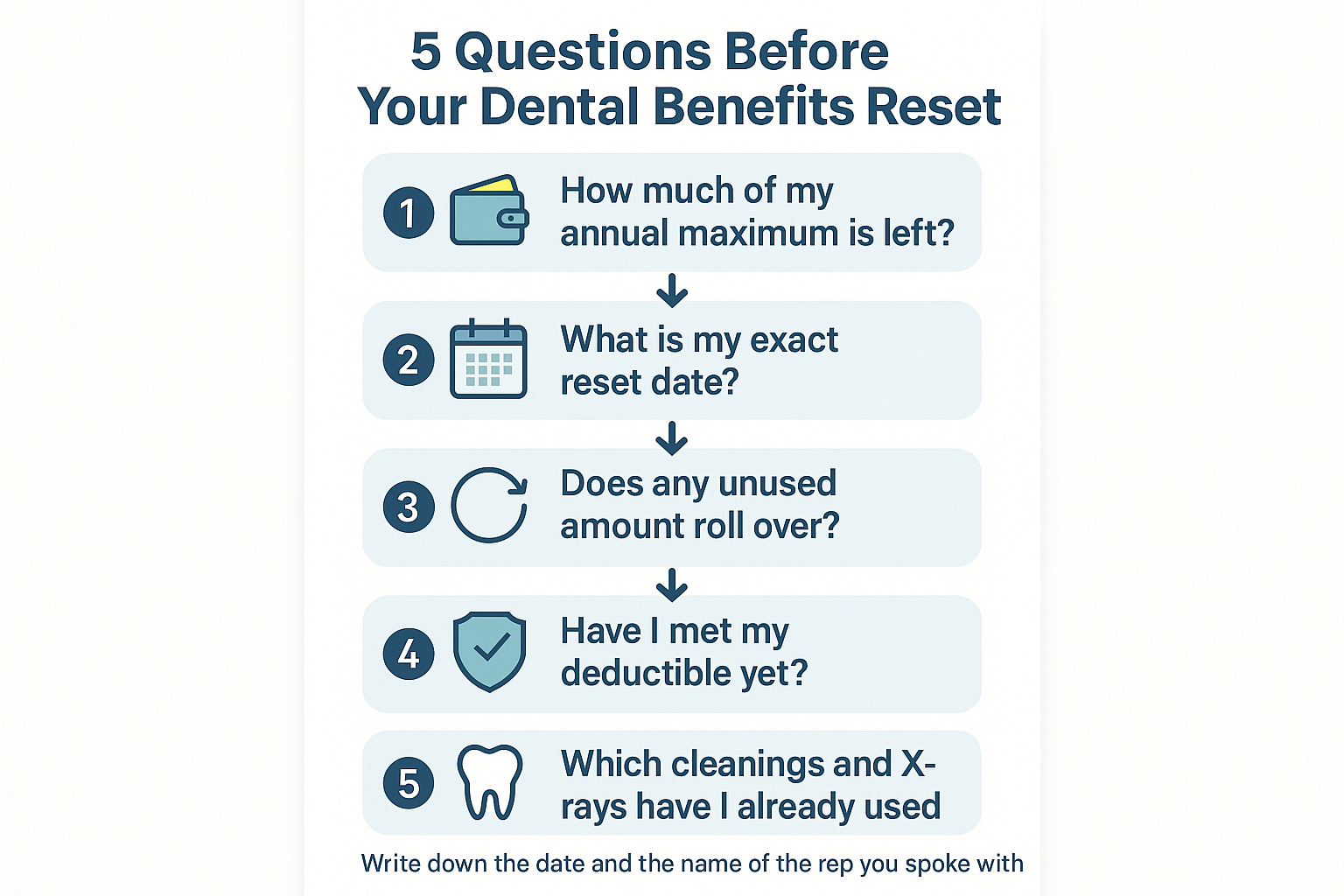
| Ask This | Why It Matters | Write Down |
|---|---|---|
| What is my remaining annual maximum? | Tells you how much treatment your plan will still help pay for this year | Dollar amount and today’s date |
| When exactly does my benefit year reset? | Sets your real deadline, which may not be December 31 | Month and day |
| Does anything roll over? | A few plans carry a small amount forward if you had a visit that year | Yes or no, plus the cap |
| Have I met my deductible? | If it is already met, treatment costs less now than it will after the reset | Amount met and amount owed |
| How many cleanings and X-rays have I used? | Frequency limits are separate from the dollar maximum | Dates already used |
| Is my dentist in network on this specific plan? | PPO and HMO versions of the same brand behave very differently | Plan name and network type |
Your Benefit Year Checklist at a Glance
Here is the same call, boiled down to five steps you can knock out during a lunch break.
When Treatment Crosses Two Benefit Years
Say you need a crown and a couple of fillings, and your remaining maximum only covers part of it. This is where timing turns into real money.
A crown is often two appointments. If the first visit lands in December and the second in January, the work can be billed across two separate benefit years, which means two annual maximums instead of one. That is not a loophole, it is just how benefit years work, and any dental office can walk you through whether it applies to your case.
The other move is sequencing. If you have several things that need doing, the order matters:
- Handle anything actively painful or infected first, regardless of benefits.
- Use this year’s remaining dollars on the next most urgent item.
- Schedule the rest for the first weeks after your reset, while the new maximum is untouched.
We do this planning constantly for patients who have been putting off a longer list of work. If that sounds like you, our guide on how a catch-up plan gets split into stages shows how that sequencing usually looks.
One request worth making before you commit to anything big: ask for a pre-treatment estimate. Your dentist submits the planned work to the insurer, and the insurer responds with what it expects to pay. It typically takes a couple of weeks, so start it well before your deadline.
The Leftover Dollars Nobody Thinks to Spend
When patients find out they have benefits left, they usually think cleanings. Those may already be used up for the year.
A few things worth asking your plan about instead:
- Replacement retainers. Patients who finished Invisalign ask us about Vivera retainer sets fairly often. Coverage is uneven, but some plans contribute something toward orthodontic retention, and a partial benefit is still a benefit.
- Night guards and occlusal guards. Often covered at least in part when there is documented grinding or wear.
- Periodontal maintenance. If you have had gum treatment, this is billed differently than a standard cleaning and follows its own frequency schedule.
- Sealants. Usually covered for kids up to a certain age, and families in Marley Park and Surprise Farms miss this window more often than you would think.
A fair warning on the cosmetic side. Whitening, veneers, and facial aesthetic treatments like PRF or Botox are almost never covered by dental insurance. Patients do ask us about pricing for those, and they are worth considering, just not as a way to use up expiring benefits. Budget for those separately.
What If You Do Not Have Insurance at All?
This question comes through our website constantly. One person recently wrote in asking flat out what a root canal would cost with no coverage at all.
Without insurance, the reset date stops mattering, but timing still does. January is the busiest stretch of the year at almost every dental office in the West Valley, because everyone with fresh benefits calls at once. Getting seen and getting a written quote in late fall means you are budgeting on your own schedule instead of waiting behind that rush.
Costs for the same procedure vary based on the tooth, the condition of the root, whether a crown follows, and what imaging is needed. Anyone who quotes you a firm number before looking at an X-ray is guessing. Our article on how dental costs actually work without insurance explains what drives those differences.
It is also worth understanding what a dental membership plan is and who it helps. These in-house plans are not insurance, but for uninsured patients they remove deductibles and waiting periods, which changes the math for some households.
Frequently Asked Questions About Expiring Dental Benefits
Do unused dental benefits really disappear?
For most plans, yes. The annual maximum is a use it or lose it allowance that resets on your plan’s renewal date. A small number of plans offer limited rollover, usually only if you had at least one visit during the year, so it is worth asking rather than assuming.
How do I find out how much of my maximum is left?
Call the member services number on your card, or log into your insurer’s member portal. A dental office can also run a benefits check for you, though the insurer’s own number is the fastest source of truth on a remaining balance.
Is a PPO the same as an HMO if the brand name matches?
No, and this catches people. Callers tell us all the time that they have had problems before because they assumed the plan name was the whole story. A PPO and an HMO version of the same insurer can have completely different networks and rules, so ask your insurer for the plan type, not just the brand. Our in-network versus out-of-network guide breaks down why that distinction changes your bill.
I have both VA dental coverage and a plan through my spouse. Which do I use?
Ask both about coordination of benefits. In many cases one plan pays first and the other may pick up a portion of the remainder. Since VA and military-adjacent dental programs often run on a separate cycle from civilian plans, checking both reset dates gives you two planning windows instead of one.
How late in December is too late to use my benefits?
For a cleaning or a filling, a few weeks of notice is usually workable. For anything involving a lab, like a crown or a bridge, plan on starting by early November so the pre-treatment estimate and the lab turnaround both fit before your reset.
Sorting out what is left on your plan?
Our team works with traditional PPOs, Medicare Advantage dental allowances, and VA and VADIP coverage every week, so we are used to untangling which reset date applies to which plan. If you want a second set of eyes on your remaining benefits before the year turns over, you can reach the office at 480-795-2420 or find us at westbelldentalcare.com. Evening appointments through the week and Saturday hours make it easier for folks around Surprise and the West Valley to get in without rearranging a workday.