
Direct Answer: In Arizona, your former dentist has 15 business days after a written request to send legible copies of your records. They cannot hold them back over an unpaid balance.
A version of this call comes in almost every week. Someone just landed in Surprise, the boxes are still stacked in the garage, and now the whole family needs a dentist. Or it is October, the seasonal residents are back, and someone realizes their longtime dentist is 1,500 miles away.
One new patient wrote in asking if she could send over records from two previous dentists in Oregon before her Friday appointment. A couple who had just moved into Arizona Traditions sent a list of questions before they were willing to book anything at all. Both were doing the right thing.
So here is what I tell people to handle in the two or three weeks before that first visit, not after. It covers records, X-rays, and the insurance side, which is honestly the part that stalls people the longest.
Arizona Has a Rule for This, and Most Patients Never Hear About It
Transferring dental records when switching dentists in Surprise, AZ is not a favor your old office does for you. It is spelled out in state law.
Under Arizona Revised Statutes 32-1264, a dentist has 15 business days after receiving a written request to transfer legible, diagnostic quality copies of your records. Those copies can go to your new office or straight to you.
Two details in there matter more than the rest:
- The request has to be in writing. A verbal ask over the phone is where most transfers quietly stall. Nobody is being difficult, it just never makes it into anyone’s task list.
- Records cannot be withheld over an unpaid balance. If you left an old office owing money, that is a separate conversation. It is not a reason to keep your chart.
- The office may charge a reasonable cost for copying and forwarding. Fees vary by office and by how much is in your file, so ask up front rather than being surprised.
Write it, date it, sign it, and keep a copy. Email counts at most offices. That one step does more than anything else to get your file moving.

What Carries Over, and What Usually Gets Redone
This is the part that surprises people. Patients often assume that once old X-rays arrive, they will never be imaged again. That is not quite how it works.
Treatment notes, periodontal charting, and digital images generally transfer fine. But a new office often takes its own bitewings (the small side images that show between the teeth) or a panoramic image that captures the whole jaw.
Whether we repeat imaging depends on a few things:
- How old the last set is. Bitewings taken more than a year ago are commonly repeated as part of routine care, though the right timing varies by patient and risk level.
- File quality. A scanned copy of a printed copy is not diagnostic. If we cannot see decay between teeth clearly, the image does not help us.
- What the exam turns up. A sore spot or a cracked filling can change what imaging is needed that day.
The honest reason: a dentist is comparing what your mouth looks like today against a baseline. Blurry or two-year-old images are not a usable baseline. Old records are still worth having, because they tell us what was watched, what was treated, and what someone already flagged as a concern.
Old Records vs. New Imaging: What to Expect
Here is a general breakdown of how a transferred file usually gets used at a new office.
| What’s in your old file | Typically transfers | Often repeated at the new office |
|---|---|---|
| Treatment and clinical notes | Yes, and genuinely useful | No |
| Periodontal (gum) charting | Yes | Re-measured at your exam to compare |
| Bitewing X-rays under 12 months old | Yes | Sometimes, depending on risk and image quality |
| Bitewings older than 12 months | Yes, as history | Usually yes |
| Panoramic image | Yes | Depends on age and what the exam shows |
| Unfinished treatment plan | Yes, ask for it specifically | Reviewed and re-quoted, since fees and plans differ |
The Insurance Handoff Is the Part That Holds People Up
Verifying coverage is far and away the biggest thing new patients contact us about before they will book. Almost one in five calls starts with some version of “I want to make sure you’re in-network before I come in.”
One thing worth knowing: your benefit history follows the plan and the plan year, not the office. A cleaning done at your previous dentist in April still counts against what your plan will pay later that same year. Your new office cannot see that history until it is verified or you tell them.
Have these four things in hand before you call:
- Plan name and member ID (a photo of the card front and back is fine)
- Date of your last cleaning
- Date of your last full set of X-rays
- Any treatment your old dentist recommended but never started
That last one matters most. If you moved mid-plan with a crown or a couple of fillings still pending, that is real information, not a confession. If you are sorting out network questions, our breakdown of in-network versus out-of-network dental plans walks through how the math actually changes.
A Simple Three Week Runway Before Your First Visit
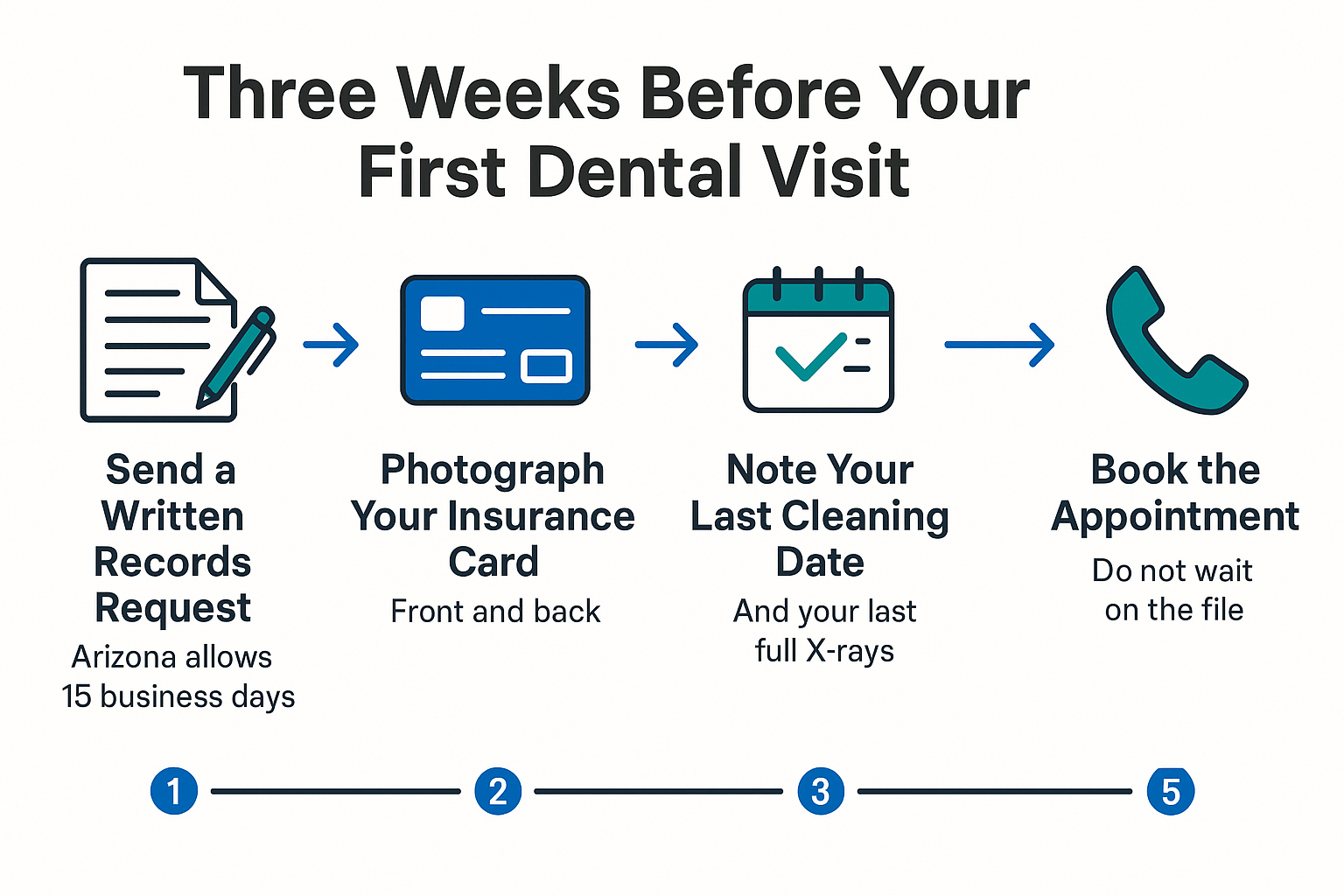
If you space these five steps across the two or three weeks before your appointment, nothing gets rushed.
Do Not Let the Paperwork Delay the Appointment
Fifteen business days is roughly three calendar weeks. So if you request records the day before your appointment, you will almost certainly walk in before the file does.
Here is the practical answer: the first visit does not have to wait on paperwork. A new exam and current images stand on their own. When the old file shows up, it simply adds history to what we already know.
For working families in Marley Park or Surprise Farms trying to schedule around jobs and school, early morning, weekday evening, and Saturday windows exist. A first visit does not have to cost anyone a workday. If you want to know what that appointment actually involves, we walked through it step by step in our plain-language new patient visit guide.
If It Has Been Years, the Record Request Is Not a Report Card
Some people stall on this step for a reason they never say out loud. They think requesting old records will hand a new office a written history of every appointment they skipped.
A records transfer is administrative. It is a chart moving from one filing system to another. A new team reads history to plan care, not to comment on the gap.
One patient put the emotional side of a move plainly in her review: “I just relocated from CA and had a great dentist I saw for years so it was tough to find new providers.” Leaving a dentist you trusted is genuinely hard, and starting over feels like more exposure than it actually is.
And if there is real catch-up work waiting, it does not all happen at once. Care usually gets split into stages over months, starting with whatever is uncomfortable or urgent. For patients who dread the chair itself, comfort options like nitrous oxide or oral sedation are on the table for routine visits too, not only big procedures.
Why One Building Makes a Move Easier
There is a quiet advantage to landing at a practice that handles general, restorative, cosmetic, and sedation care under one roof when you are mid-transition.
Fewer outside referrals means fewer separate record requests to chase down a year from now. A treatment plan that starts in one chair does not get split across three offices, three schedules, and three billing departments.
That matters most for retirees in Sun City Grand and The Grand who are already managing several providers, and for anyone who arrived here carrying an unfinished crown plan from another state. If you are still deciding what to look for, our guide on choosing a dentist after you retire covers the questions worth asking before you commit.
Frequently Asked Questions About Transferring Dental Records
Can my old dentist refuse to send my records because I still owe them money?
No. Arizona law specifically prohibits withholding record copies over an unpaid balance. The bill is a separate matter you will still need to settle with that office, but it cannot block the transfer.
Do I have to go in person to request my records?
Usually not. Most offices accept a signed written request by email or fax, and many have their own form. The key word is written with your signature on it. A phone call alone is where these requests tend to disappear.
Will I be charged for copies?
Possibly. Arizona allows a dentist to charge a reasonable cost for copying and forwarding records. The amount depends on the office and how large your file is, so ask when you submit the request rather than assuming it is free.
My old dentist retired and the office closed. Now what?
Records usually stay with whoever took over the practice, so start by calling the number you have and asking who holds the charts now. If that leads nowhere, the Arizona State Board of Dental Examiners can point you in the right direction. And if the file is truly gone, a current exam and new images give a new dentist everything needed to start.
Should I wait for my records to arrive before booking my first appointment?
No, and I would not recommend it. Fifteen business days is about three weeks. Book the visit, send the written request the same day, and let the file catch up. The exam does not depend on it.
Getting Settled in Surprise and Sorting Out Your Dental File?
New arrivals and seasonal residents across the West Valley go through this same handoff every fall, and none of it needs to be complicated. Our team keeps extended weekday hours and Saturday appointments so a first visit fits around work and school. If you want to ask what to bring or how the records piece works, westbelldentalcare.com and 480-795-2420 are both there when you are ready.