
Direct Answer: Vivera retainers are usually sold as multiple sets of trays made from one digital scan, not as a single tray. Cost depends on arches, sets ordered, and whether current records exist.
You searched for a price on Vivera retainers, found a number on a forum, and then got a very different number from a dental office. That gap frustrates people, and it is not because anyone is hiding the ball.
The short reason: Vivera is usually sold as a set of trays made from one digital scan, not as one single retainer. So the online “price per retainer” and the office quote are measuring two different things.
I get this question a lot from people who are paying cash and calling around the West Valley to compare. One prospective patient wrote in over the summer asking what a full kit of four upper and four lower arches would run, and whether there were extra fees for the exam or the 3D scan. Fair questions. Here is how I answer them.
What You Are Actually Buying When You Order Vivera
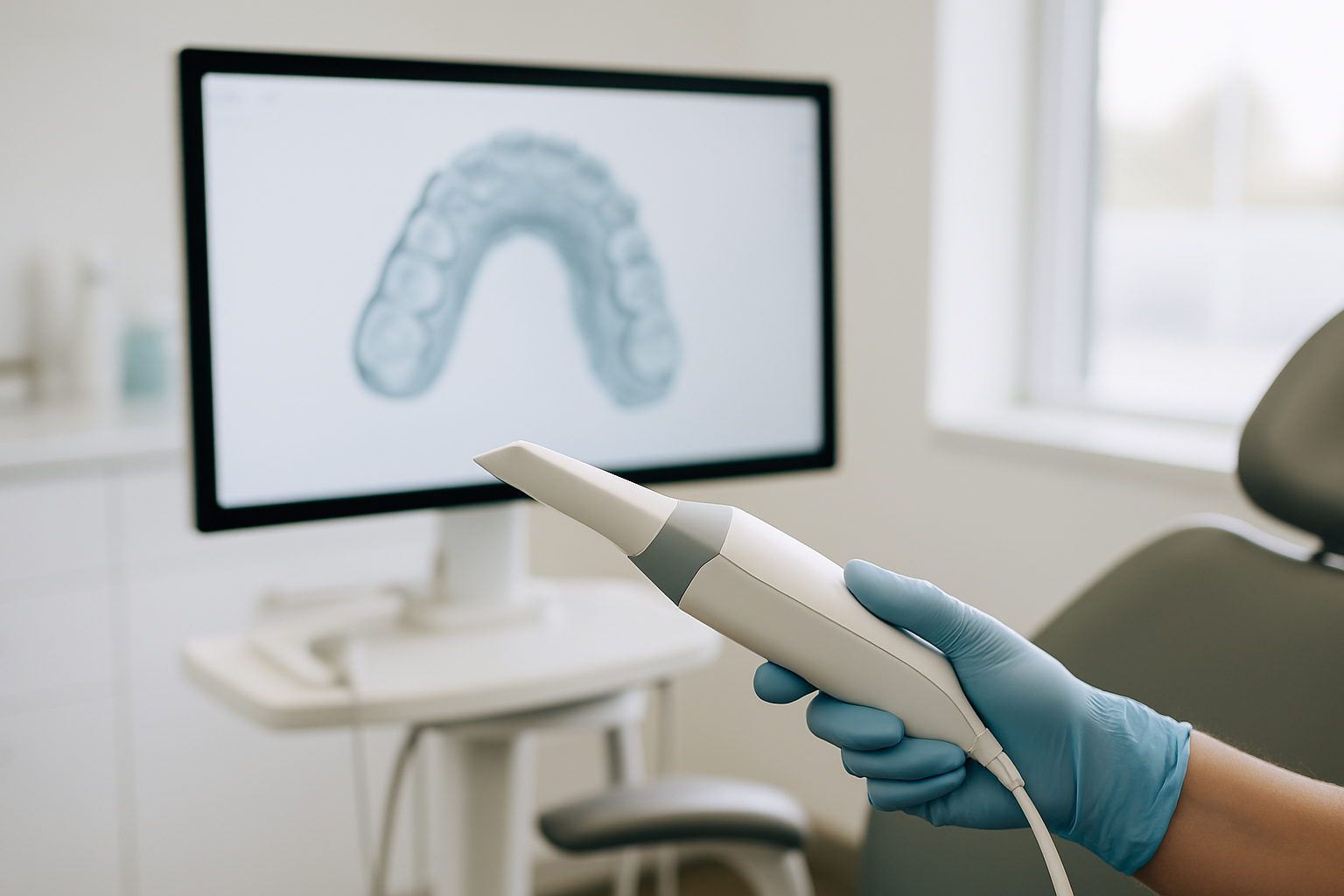
A Vivera order is built from one digital scan of your teeth as they are today. From that scan, the lab produces trays, and they typically ship in multiples rather than one at a time.
Most orders are quoted this way:
- By arch. Upper only, lower only, or both. Two arches costs more than one.
- By number of sets. A common order is four sets per arch, so you have replacements on hand when one cracks or goes missing.
- By scan status. If a usable scan already exists in your file, a reorder is a different conversation than starting from scratch.
That last point is where most of the price confusion lives. A reorder from existing records skips the scan appointment entirely. A brand new order does not.
How long does a set last? It depends on how you treat it. Nighttime wear, a case instead of a napkin at lunch, and no hot water rinses will stretch a tray a long way. Grinders in the dry Arizona heat who also run a nightly clench tend to wear through faster.
When someone tells me they “just need a retainer,” my first question is whether they want one tray or a set that carries them a few years. The answer changes the number.
The Hidden Fee Question, Answered Straight
The real worry is rarely the retainer itself. It is the line items stacked on top before anyone touches a retainer.
Out of pocket cost questions make up roughly 10 percent of the calls our front desk takes, and some of those callers push back on a quoted fee before they hear what it covers. I would push back too.
So here is what can appear on a retainer invoice, and why:
- An exam. If it has been a while since anyone looked in your mouth, a dentist needs to check gum health and existing dental work before trays go in.
- X-rays or records. Only if what is on file is stale or nonexistent.
- The 3D scan. Sometimes bundled with the retainer order, sometimes billed separately.
- The trays themselves. Priced by arch and by number of sets.
For general market context, a new patient exam with X-rays in the Surprise area commonly lands somewhere in the $145 to $225 range depending on scope, and our office quotes within that band. Your situation may be different, so treat that as context, not a quote.
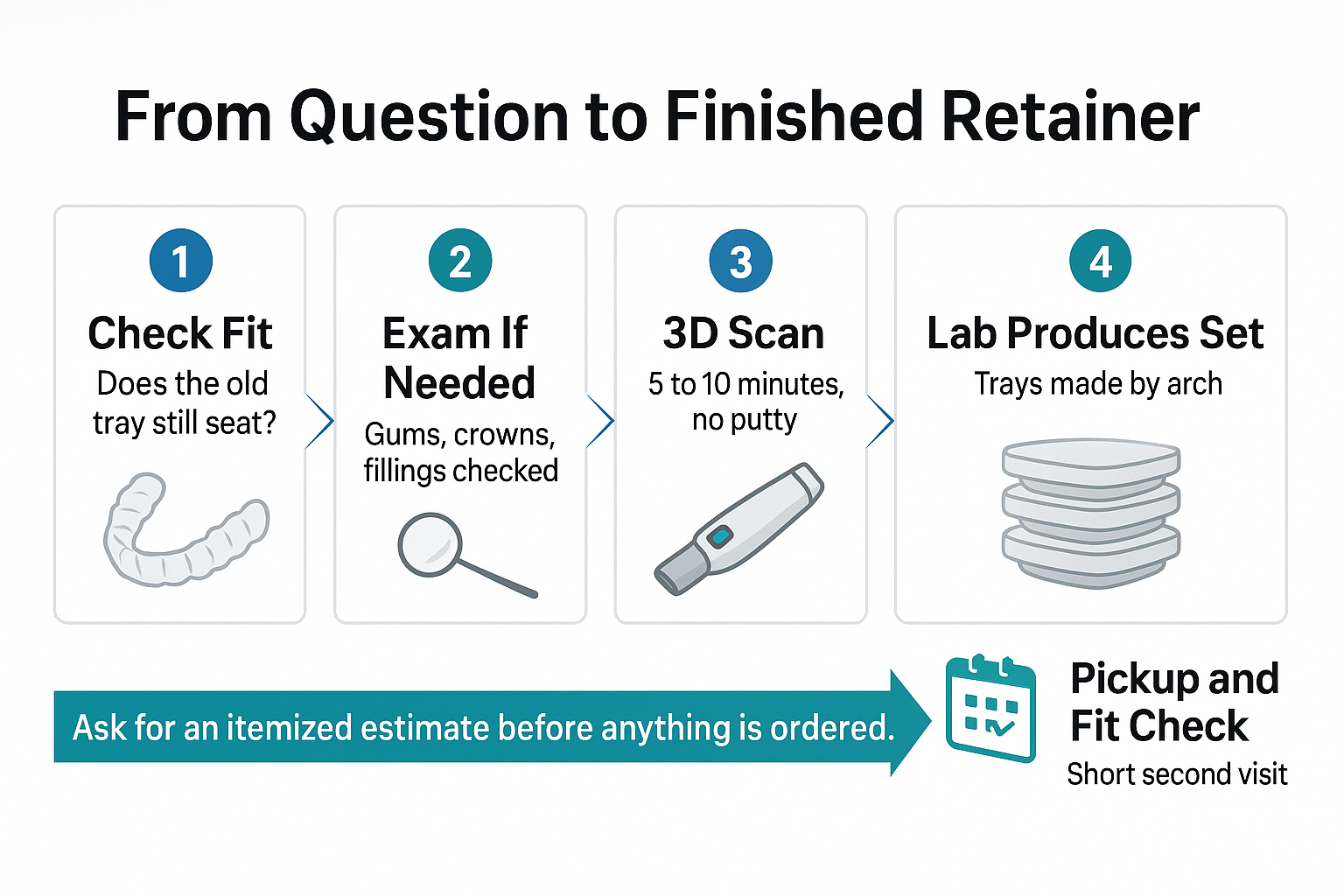
Asking for an itemized estimate before anything is ordered is completely reasonable. A good office hands you lines, not one mystery number. If you are paying cash, it is also worth reading up on how dental costs actually work without insurance before you start comparing offices.
What Moves the Price Up or Down
These are the variables that explain why two people in the same neighborhood get two different quotes for what sounds like the same thing.
| Factor | Why it shows up on the bill | What lowers it |
|---|---|---|
| Number of arches | Each arch is a separate tray made from your scan | Order only the arch you actually need retained |
| Number of sets ordered | Labs produce and ship trays in multiples | A smaller order now, though cost per tray usually rises |
| Existing scan on file | A new scan means a scan appointment | Reordering while your records are still current |
| Exam needed first | Required if it has been a while or something feels off | Staying current on cleanings and exams |
| Tooth movement since treatment | Shifted teeth may need realignment before retention | Wearing your current retainer consistently |
A Retainer Holds Teeth Where They Are Now. It Does Not Move Them Back.
This is the single most useful thing I can tell you before you spend money.
A retainer is a holding device. It keeps teeth in their current position. It is not designed to walk teeth back to where they sat the day your aligner treatment ended.
So if your old retainer has been in a drawer since 2021 and your teeth have drifted, a new tray made from a fresh scan will hold the drift. You will have paid to lock in the thing you were trying to undo.
The quick fit test at home:
- Feels snug and seats fully in a few seconds. You are probably fine. A reorder makes sense.
- Feels tight and takes real effort but goes on. Some movement has happened. Worth having checked.
- Will not seat at all, or rocks and lifts. A new retainer alone is likely the wrong purchase.
A scan tells that story in about five minutes, faster than anyone can guess from across the room. And sometimes the honest answer is a short round of realignment first, which is a different conversation than a retainer order. If that applies to you, here is what changes about Invisalign for adults in their 40s and 50s.
Hearing “a retainer is not the right purchase for you yet” is a good outcome. It means nobody sold you a tray that will not seat.
The Path From Question to Finished Retainer
Here is the realistic sequence, start to finish, so you can see where each cost attaches.
Why Retainers Are a Prescription Product, Not a Mail-Order Accessory
If you are shopping on price, you will find cheaper trays online. You deserve to know what the difference buys.
The FDA’s consumer resource on clear dental aligners states that it has not authorized clear aligners marketed directly to consumers without a prescription and supervision by a dentist or orthodontist, and notes that unsupervised use can raise the risk of complications. The same resource points to retention after treatment as the step that keeps teeth from shifting back.
It also flags something most people never think about: existing crowns, fillings, and implants can loosen during tray treatment.
That is what an in-person look adds:
- A check on the dental work already in your mouth before anything squeezes your teeth
- A look at gum health, since pressure on inflamed tissue is a bad trade
- A scan that fits the tray to your mouth as it is today, not as it was years ago
None of that is a scare tactic. It is just the part of the price that does not show up in an online cart.
Timing It So You Do Not Pay for the Same Scan Twice
Retention is the stage where a delay costs real money. Teeth do not wait for your calendar.
The appointment load here is light. A scan visit runs short, and a pickup and fit check is shorter. Two visits, neither one eating a full morning.
If you work, the practical slots are:
- A 7 AM weekday start before the Bell Road traffic builds
- A weekday evening midweek, since we run until 7 PM Monday through Thursday
- A Saturday between 8 AM and 3 PM
One patient who recently moved to Surprise mentioned in a review how much it helped that the office is open six days a week. That is mostly who uses the early and late slots.
If you are a seasonal resident in Sun City Grand or Sun City and only here fall through early spring, the timing matters more. Ordering while your records are fresh and while you are still in town keeps you from repeating the scan next season. Discovering in June that the window closed is an expensive way to learn that lesson.
Frequently Asked Questions About Vivera Retainer Cost
Is there an extra fee for the initial exam or the 3D scan?
Sometimes, and it depends entirely on what is already in your file. If you are brand new to an office and have not had an exam recently, expect an exam and possibly X-rays as separate lines. If current records and a usable scan already exist, those lines can drop off. Ask for the estimate broken into lines before you commit to anything.
Can I just order one replacement retainer instead of a whole set?
Often yes, but the cost per tray usually goes up when you order one at a time. A set spreads the scan and setup across more trays. Which makes more sense depends on how hard you are on retainers and how long you plan to keep wearing them.
My old retainer feels really tight. Can I force it back on?
I would not. Forcing a tray that no longer fits can stress teeth and existing dental work in ways you will not notice until something hurts. A tight-but-seats retainer is usually fine with consistent wear. One that will not seat is telling you something moved, and that needs a look before you buy a new tray.
Do I need to be an established patient to ask about retainer pricing?
No. People call and email about this without ever having been seen, and that is a normal question to ask before you book. Just know that a firm number depends on your actual mouth, so any figure given over the phone is a range until someone sees you.
What if I do not have dental insurance?
Retainers are often a cash purchase anyway, since many plans treat retention as part of completed orthodontic coverage you may have already used. Our office also runs an in-house membership plan as an alternative for uninsured patients, and financing options exist for larger treatment. Ask what applies to your case before you assume.
Want a Straight Answer on What Your Retainer Order Would Include?
Questions about what shows up on a retainer invoice can be answered over the phone or at a visit, and our team will break it into lines rather than hand you one number. As one patient put it in a review, “Friendly knowledge staff who take care of my teeth without inflating my care.” If midday never works, West Bell Dental Care keeps early morning, evening, and Saturday times open for people across Surprise and the West Valley, and you can reach the office at 480-795-2420 or at westbelldentalcare.com.