
Direct Answer: There is no upper age limit for Invisalign. Adults in their 40s and 50s are routinely good candidates, as long as gum health and bone support are stable before treatment starts.
You had braces as a teenager. The retainer disappeared somewhere around your second apartment. And now your bottom front teeth overlap in a way they never used to, or a gap opened up that you keep noticing in every photo.
I hear this constantly from patients here in Surprise. Working parents in Ashton Ranch, folks who just closed on a place in Sun City Grand, snowbirds who show up every October and finally have time to deal with it.
The question underneath is almost always the same: is 47 too late? Is 58 too late? No. But a few real things change once you are past 40, and they are worth understanding before you sit down for a consultation.
Adults Are a Much Bigger Share of Aligner Patients Than People Think
There is a stubborn assumption that clear aligners are for people in their twenties. That idea quietly keeps a lot of good candidates from ever asking about it.
Roughly one in three orthodontic patients today is an adult. And Align Technology’s own patient resource confirms there is no upper age limit for Invisalign treatment as long as overall oral health is stable.
Here is the part most people were never told: teeth keep moving your whole life. Your jaw structure changes as you age, and the pressure from your bite slowly nudges things out of place.
That is why the shifting shows up when it does:
- Lower front crowding that creeps back in your 30s and 40s, years after braces
- New spacing between upper teeth as gum tissue and bone remodel
- Neighboring teeth drifting into a spot where a tooth was pulled years ago
- A bite that feels different than it did a decade ago, especially when chewing on one side
None of that means something went wrong. It means you have a mouth that has been working hard for fifty years.
At This Age, the Health Reason Is Usually Stronger Than the Cosmetic One
Most patients bring it up because of how their smile looks. That is a completely fine reason. But when I look at a crowded lower arch on someone in their late 40s, I am usually more interested in what the crowding is doing to the tissue around it.
Overlapping teeth are hard to clean. Floss does not slide cleanly between teeth that are rotated or stacked, and a toothbrush cannot reach the surface hiding behind its neighbor.
Over ten or twenty years, that adds up to:
- Tartar buildup in spots hygiene cannot reach, which feeds gum inflammation
- Higher decay risk in the tight contacts between crowded teeth, where cavities often start without any pain
- Uneven wear on the teeth taking more force than they should
- Recession on teeth pushed outside the arch
The other piece matters if you already have dental work. If you have crowns, a bridge, or implants, straightening the underlying alignment spreads bite forces more evenly across the whole arch.
That protects the investment you already made. A crown taking the brunt of a bad bite fails sooner than a crown that shares the load with the teeth around it.
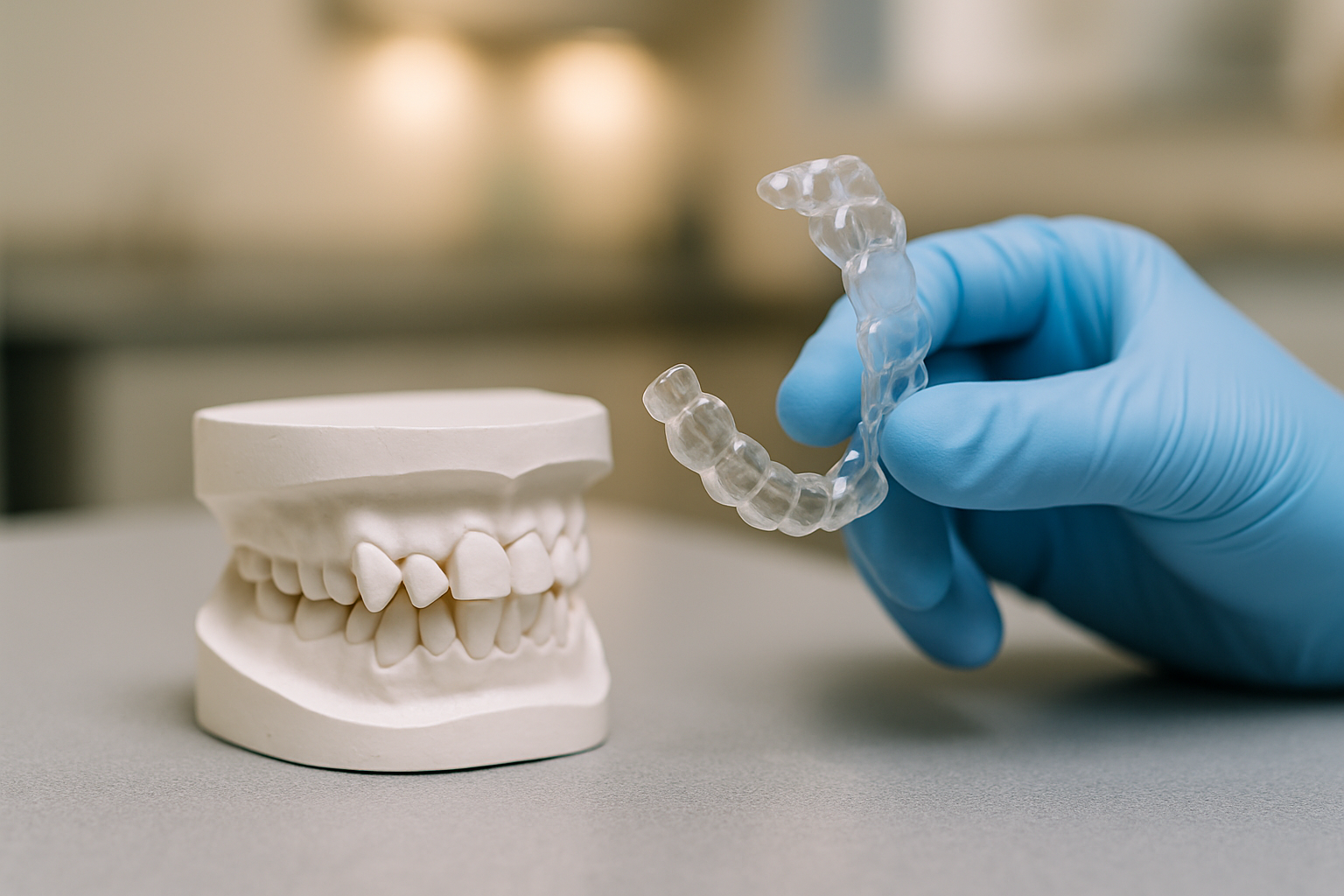
Gum Health Comes First, and This Is the Real Difference After 40
This is the one genuine consideration adults have that a 15 year old does not. Aligners move teeth by applying steady pressure through the bone and ligament that hold each root in place.
If that support is already compromised by active gum disease or significant bone loss, moving teeth is not the right first step. Pressure on an unstable foundation can make things worse instead of better.
So before anything else, we look at:
- Pocket depths around each tooth, measured during a periodontal exam
- Bone levels on digital X-rays, comparing where the bone sits against each root
- Bleeding and inflammation, which signal active disease rather than old damage
- Any mobility in individual teeth, since a loose tooth in an adult usually points to a support problem
Here is what I want to be clear about: finding gum issues does not mean aligners are off the table. It means sequencing.
Periodontal therapy, usually a deep cleaning called scaling and root planing, comes first. We let the tissue heal, recheck the numbers, and then talk about alignment from a stable starting point. I have had plenty of patients go through that sequence and finish treatment just fine.
What Actually Gets Evaluated Before Adult Aligner Treatment
This is the short version of what a consultation looks at and why each item carries more weight after 40 than it did at 16.
| What We Check | Why It Matters More After 40 | If There Is an Issue |
|---|---|---|
| Gum pocket depths | Decades of buildup and inflammation add up | Treat the gums first, then recheck |
| Bone support on X-rays | Bone loss reduces how much movement is safe | Adjust the plan or the amount of movement |
| Existing crowns and bridges | Bonded attachments and bridged teeth behave differently | Plan movement around the restoration |
| Old fillings and worn edges | Wear patterns show where the bite is off | Some work may be better done after alignment |
| Missing teeth and drift | Neighbors tilt into open spaces over time | May coordinate with implant or bridge planning |
| Jaw joint comfort | Clicking or soreness affects bite planning | Evaluate before changing the bite |
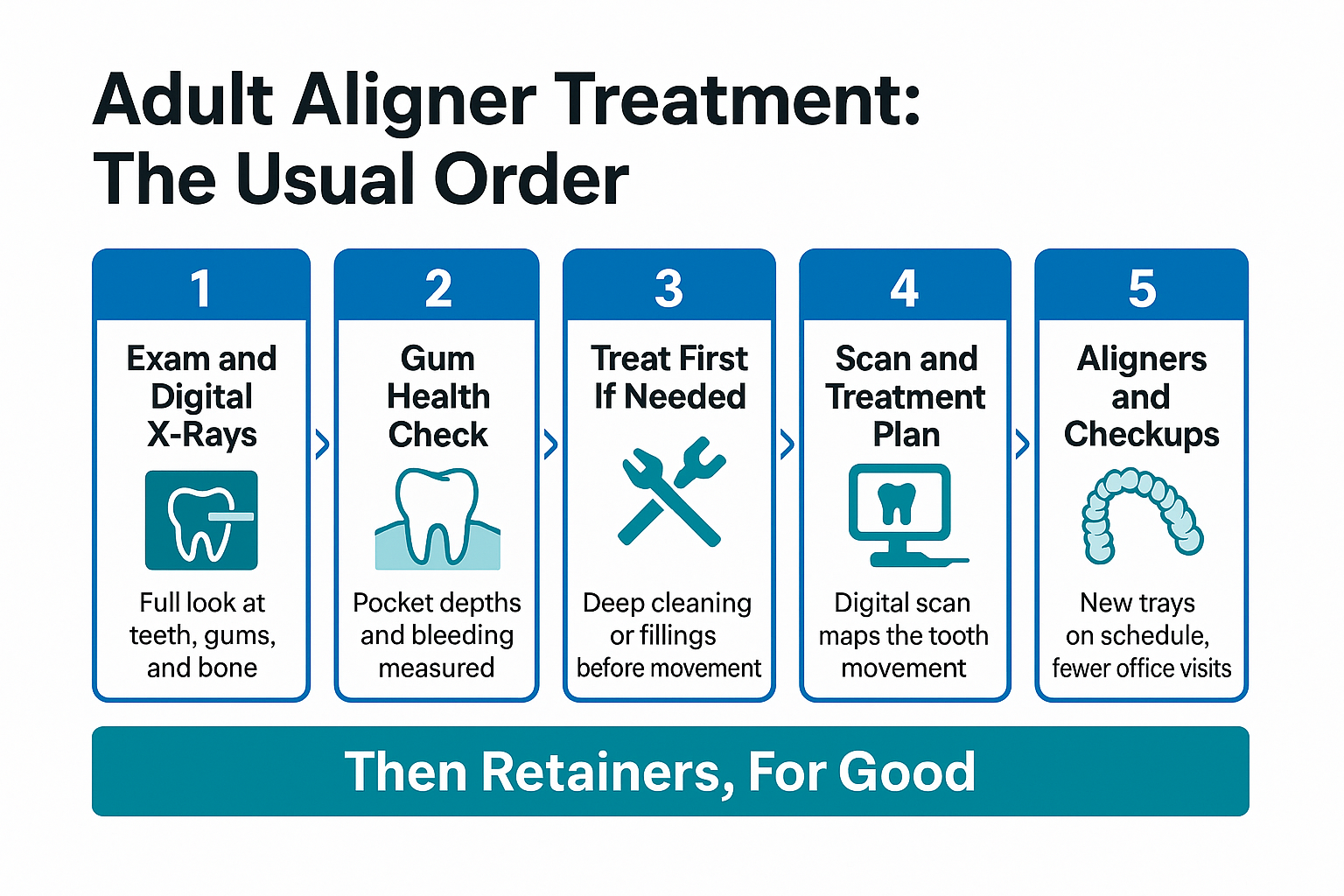
The Order Things Happen In
Adult aligner treatment rarely starts on day one. This is the typical sequence from first visit to retainer.
Why the Removable Design Matters More When You Are 50 Than When You Were 15
A teenager with braces adapts. An adult with a full calendar, a job, and a social life has a different set of problems, and this is where clear aligners earn their keep.
- No food restrictions. Trays come out to eat. Steak, popcorn at the spring training games out on Bell Road, whatever you want.
- Cleaning is simple. Rinse the trays, brush them gently, brush your teeth before they go back in.
- Fewer office visits. Checkups are typically spaced further apart than the monthly wire adjustments braces require.
- They are hard to notice. That matters if you spend your day in meetings or in front of clients.
The honest tradeoff is discipline. Trays need to be in around 20 to 22 hours a day, and a set that spends the afternoon in a coffee cup holder is not moving anything.
One more practical thing. Doing aligner treatment through a general practice with multiple doctors means the other stuff gets handled in the same building.
If a filling needs replacing mid-treatment, if a crown is due, if a cleaning is overdue, you are not coordinating between two offices with two schedules. For patients driving in from Sun City Grand or Marley Park, that alone saves a stack of trips.
What Drives the Cost, and Why Nobody Can Quote You Over the Phone
Callers ask us about price constantly, and I understand why. A fair number of people tell us they were quoted something somewhere else that made them want a second opinion.
Aligner treatment is not one price. What moves the number:
- How much movement is needed. A minor lower crowding case and a full bite correction are not in the same range.
- How many trays and how long. Shorter cases cost less than cases running well over a year.
- Whether prep work is needed first, like periodontal therapy or replacing a failing filling.
- Your insurance. Some adult plans include an orthodontic benefit with a lifetime maximum. Many do not include one at all.
If you do not have coverage, ask about in-house membership options rather than assuming the answer is no. We break down how dental costs actually work without insurance in more detail elsewhere on the site.
And if you are weighing aligners against other ways to change how your smile looks, the guide to cosmetic dentistry options in Surprise walks through the conservative choices first.
Frequently Asked Questions About Invisalign for Adults in Surprise
Am I too old for clear aligners at 65 or 70?
No. There is no upper age limit. What matters is the health of your gums and the bone supporting your teeth, not the number on your license. Plenty of patients in the Sun City communities start treatment well past retirement age.
I already have crowns and a bridge. Does that rule me out?
Usually not, but it changes the plan. Aligner attachments bond differently to porcelain than to natural enamel, and teeth connected by a bridge move as a single unit. That gets mapped out before treatment starts rather than discovered halfway through.
How long does treatment usually take for an adult?
It depends entirely on how far the teeth need to move. Minor crowding cases can wrap up in a matter of months, while bigger bite corrections run considerably longer. Adult bone is a little denser than a teenager’s, so movement can be somewhat slower at the same age-adjusted case complexity.
Will my dental insurance cover it?
Some plans include an adult orthodontic benefit, often with a lifetime maximum rather than an annual one. Many plans exclude adult orthodontics entirely. It is worth calling your carrier before your consultation so you walk in knowing what you are working with.
Do I have to wear a retainer afterward?
Yes, and this is the part I stress hardest with adults in their 40s and 50s. The reason your teeth shifted in the first place is that teeth never stop moving. Retainers are for life, and the ones who skip them end up right back where they started.
What if I have not been to a dentist in years?
That is more common than you would guess, and nobody here is going to make you feel bad about it. We start with an exam and X-rays to see the full picture, then talk through what needs to happen and in what order. Alignment is often further down that list than people expect.
Still Wondering Whether It Makes Sense at Your Age?
The only way to know is to have someone look at your gums, your bone levels, and how your bite is actually working right now. Our team in Surprise sees patients from across the West Valley, with weekday hours starting at 7:00 AM and Saturday appointments for people who cannot get away midweek. You can reach West Bell Dental Care at 480-795-2420 or read more at westbelldentalcare.com.