Direct Answer: For most Surprise households, very little changes. Arizona tap water is naturally low in fluoride already, and daily protection comes mostly from fluoride toothpaste, varnish at cleanings, and saliva.
A patient from Sun City Grand sat down in the chair this spring and asked me something I had not heard before: “If they take the fluoride out of the water, do I need to worry about my teeth?”
Since then I have gotten some version of that question almost every week. It comes from retirees, from parents in Marley Park, from snowbirds who just got back into town. And it deserves a real answer, not a shrug.
So here is what is actually happening with Arizona water fluoride legislation, what fluoride does to enamel in the first place, and which parts of this you actually control.
The Bill Behind the Question, in Plain Terms
Senate Bill 1019 was introduced by Sen. Janae Shamp, who represents Surprise. The bill would bar public water systems and political subdivisions in Arizona from adding fluoride or fluoride-containing compounds to drinking water.
In early 2026 it advanced out of the Senate Government Committee to the full Senate. Utah and Florida have already passed similar bans.
I am not going to argue the politics of it here. A couple of honest notes instead:
- Legislation moves. By the time you read this, SB 1019 may have passed, stalled, been amended, or died in session, so check its current status before assuming anything.
- The bill addresses added fluoride. It does not remove fluoride that occurs naturally in Arizona groundwater.
- Even in a total ban scenario, fluoride toothpaste, rinses, and professional varnish are unaffected.
That last point matters more than most people realize, and it is the piece almost nobody explains clearly. So let me spend some time on it.
How Enamel Actually Works (And Why Contact Beats Swallowing)
Enamel is the hard outer shell of your tooth. It is the toughest substance your body makes, and it has no living cells inside it. Once a piece of enamel is gone, your body does not grow it back.
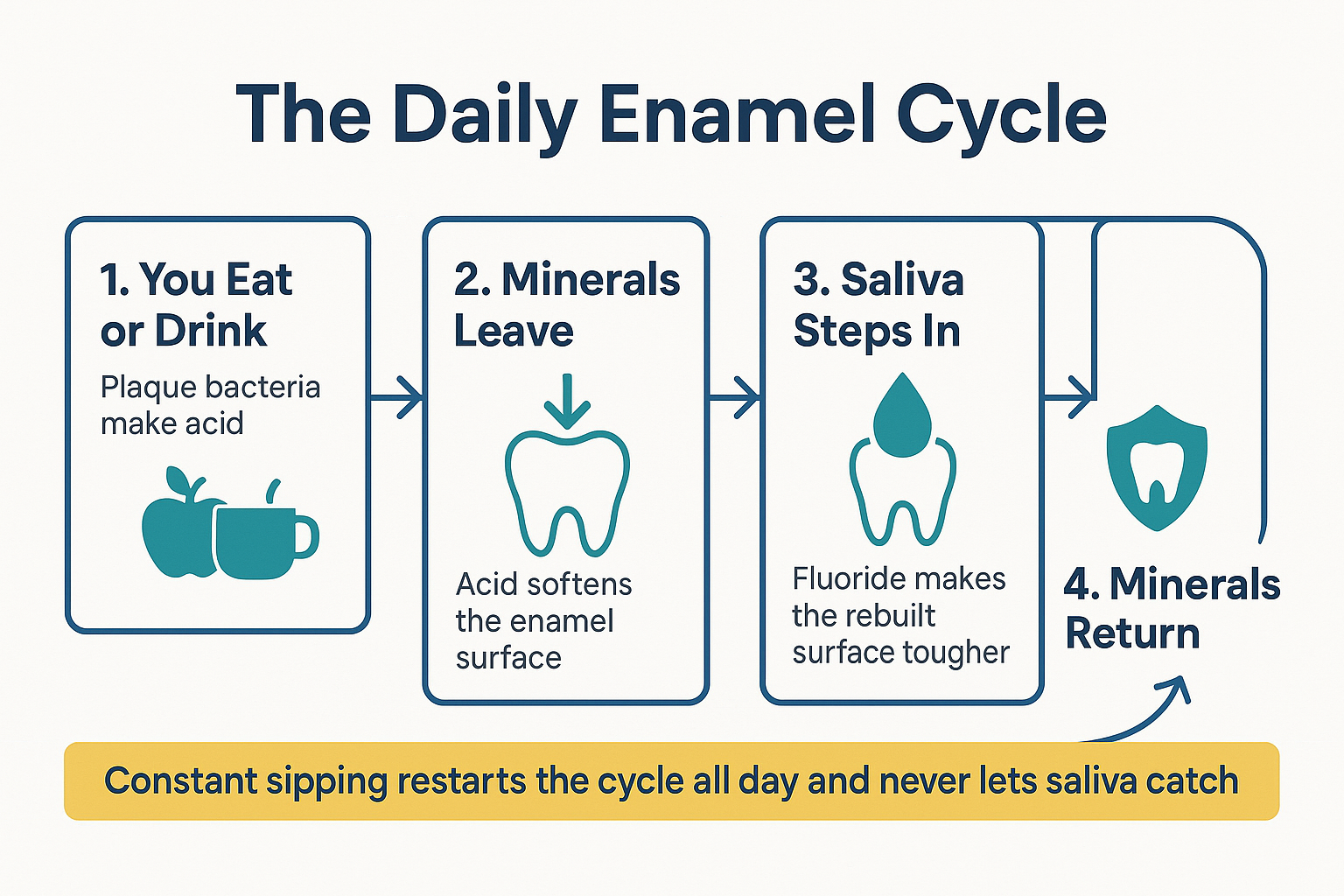
But enamel is not static. All day long it loses minerals and regains them, in a slow back-and-forth cycle.
Here is the cycle in order:
- You eat or drink something. Bacteria in plaque feed on the sugars and produce acid.
- That acid pulls calcium and phosphate out of the enamel surface. This is demineralization.
- Saliva moves in, neutralizes the acid, and carries minerals back into the softened enamel. This is remineralization.
- If step 4 keeps up with step 2, nothing happens. If it falls behind often enough, you get a cavity.
Fluoride helps at step 4. It gets pulled into the enamel surface along with calcium and phosphate, and the rebuilt surface it helps form is more acid-resistant than the original enamel.
Here is the part that changes how you should think about the tap water question. Fluoride does most of its work by direct contact with the tooth surface, not by circulating through your bloodstream. That is why a pea-sized dab of toothpaste sitting on your teeth for two minutes, twice a day, does more day-to-day work than water that passes over your teeth in three seconds on its way down.
What Is Actually in West Valley Tap Water Right Now
This is where a lot of Arizona coverage goes vague, so let me get specific.
The state health department has noted that naturally occurring fluoride in Arizona water commonly runs around 0.2 to 0.5 milligrams per liter. That is below the level communities use when they adjust water for decay prevention. You can read the state’s own background on this in the Arizona Department of Health Services post on fluoride.
The Arizona cities that have historically added fluoride to their supply include Phoenix, Mesa, Chandler, Gilbert, Glendale, Peoria, Tempe, and Yuma. Notice which city is not on that list.
Still, do not take my word for your specific tap. Water providers in the West Valley vary by neighborhood, and a home in Surprise Farms may be on a different system than a home in Sun City.
- Check your water provider’s annual water quality report. Every public system publishes one, and fluoride is listed on it.
- If your household runs a reverse osmosis system, you are already filtering out most of whatever fluoride is there.
- If you drink mostly bottled water, same story. Most bottled water contains little to no fluoride unless the label says otherwise.
So a fair number of families in Ashton Ranch and Copper Canyon Ranch have effectively been living in a low-fluoride-water household for years without knowing it.
Where Your Teeth Actually Get Fluoride
Not all fluoride exposure is equal. Contact time with the tooth surface is what separates a meaningful source from a minor one.
| Source | Contact time with teeth | How much it does |
|---|---|---|
| Fluoride toothpaste, twice daily | About 2 minutes per session | The biggest daily lever most people have |
| In-office fluoride varnish | Hours of slow release after application | Strong short-term boost, typically at cleanings |
| Prescription-strength paste | About 2 minutes per session, higher concentration | Reserved for patients with a decay history or dry mouth |
| Fluoride rinse | 30 to 60 seconds | Helpful add-on, not a replacement for brushing |
| Tap water | A few seconds per swallow | Low but steady background exposure |
| Reverse osmosis or bottled water | Little to none | Effectively removes water as a fluoride source |
The Daily Mineral Tug-of-War on Your Enamel
Enamel is losing and regaining minerals all day. This is the cycle, step by step.
Why This Question Is Bigger for Adults Over 65
Surprise skews older than most Arizona cities. A large share of the patients I see come from Sun City Grand, The Grand, and Sun City. For that group, the fluoride conversation is not theoretical.
As gums recede with age, root surfaces get exposed. And root surfaces have no enamel at all. They are covered by cementum, which is far softer and softens at a milder acid level than the crown of the tooth does.
That is why an 8-year-old and a 78-year-old can eat the same diet and get very different results. Root decay behaves differently and moves faster.
Then there is dry mouth, which I see constantly. Common culprits include:
- Blood pressure medications
- Antihistamines
- Antidepressants
- Certain bladder and Parkinson’s medications
Stack those on a Surprise summer where you are already losing fluid just walking to the car, and saliva volume drops. Less saliva means less natural rinsing and less mineral delivery back into the tooth.
CDC data show that nearly all adults 65 and older have had a cavity, and about 1 in 6 have untreated decay. I share that not to alarm anyone, but because it reframes the question. The issue was never really the tap water. It was recession, dry mouth, and time.
If recession has already gotten your attention, it is worth understanding what separates a deep cleaning from a regular one, since gum health and root exposure travel together.
The Levers You Actually Control at Home
I am not going to hand you a shopping list. Most patients do not need new products, they need clearer instructions about the ones they already own.
One patient put it perfectly in a review: “They tell me exactly what to do to keep my million dollar smile.” That is the whole job. A lot of people walk out of dental visits genuinely unsure what they were supposed to change at home.
So here is what makes a real difference:
- Fluoride toothpaste, twice a day. Non-negotiable, and it matters more if your water is filtered.
- Do not rinse with water right after brushing. Spit, and leave it. Rinsing washes away the fluoride before it can do its work. This single habit change costs nothing.
- Prescription-strength paste if you have a decay history, root exposure, or dry mouth. That is a conversation with your dentist, not a guess.
- Fluoride varnish at your cleaning. It stays on the tooth for hours rather than seconds.
- Sealants. These are not just a kids thing. Adults ask me about this all the time, and deep grooves on adult molars can absolutely be sealed.
And if you are behind on care and unsure where to start, that is more common than you would guess. There is a real process for splitting a catch-up plan into stages so it does not land all at once.
The Acid Side Nobody Brings Up
Fluoride is only half the equation. The other half is how often you are hitting your teeth with acid.
Sports drinks, sparkling water, citrus, iced tea with lemon, wine. All acidic. And the desert makes it worse, because people sip constantly through a hot afternoon.
Here is the part that surprises people. Drinking a sports drink in ten minutes is easier on your enamel than sipping the same drink over three hours.
Why? Every sip restarts the acid clock. Saliva needs roughly 20 to 30 minutes to bring your mouth back to a neutral state. If you sip every fifteen minutes from noon to three, your enamel never gets out of the softened window.
A few practical adjustments:
- Drink acidic things in a defined window, not all afternoon
- Follow with plain water to rinse
- Wait about 30 minutes before brushing after something acidic, since brushing softened enamel scrubs it away
- Keep a water bottle for grazing and save the flavored stuff for meals
Frequently Asked Questions About Fluoride and Tooth Enamel in Surprise
If the bill passes, will my teeth get worse?
For most Surprise households, probably not in any way you would notice. Local water was already running low in naturally occurring fluoride, and if you use a reverse osmosis filter or drink bottled water, your teeth were never getting much from the tap anyway. Your toothpaste habit matters far more than the legislation.
How do I find out how much fluoride is in my water?
Look up your water provider’s annual water quality report, sometimes called a Consumer Confidence Report. It is usually posted online and lists fluoride by the milligram per liter. Do not assume based on what a neighbor in a different subdivision tells you, since providers vary across the West Valley.
Can enamel actually grow back?
No. Once enamel is physically lost, it is gone for good. What can happen is remineralization, where a softened but still intact enamel surface takes minerals back in and hardens up again. That is why very early decay can sometimes be halted, but a real cavity needs a filling.
Are sealants worth it for an adult?
They can be. If you have deep grooves in your back molars that are hard to clean and you have a history of decay, sealants are a reasonable protective step at any age. It depends on the shape of your teeth and your decay history, which is something a dentist can assess at a routine visit.
Does dry mouth from my medication really cause cavities?
It contributes a lot. Saliva is your built-in defense system, and less of it means acid lingers longer and minerals return more slowly. If you take blood pressure medication, antihistamines, or antidepressants, mention it at your cleaning. It changes what we recommend, including whether prescription fluoride paste makes sense for you.
Wondering whether your enamel needs extra support?
This is one of those questions that gets answered best in person. A hygienist looking at your specific wear patterns, gum recession, dry mouth, and decay history can tell you whether you need extra fluoride support or whether what you are already doing is enough, and that conversation normally happens right at a regular cleaning rather than a separate appointment. Our office keeps early morning, evening, and Saturday hours for families and working patients across Surprise and the West Valley, and you can reach us at 480-795-2420 or at westbelldentalcare.com whenever you want to talk it through.