
Direct Answer: A regular cleaning removes buildup at and just above the gumline on healthy gums. A deep cleaning goes below the gumline to clean root surfaces inside gum pockets that measure 4 millimeters or deeper.
You booked what you thought was a routine cleaning. You sat down, the hygienist started calling out numbers, and by the end of the visit you had a plan for something called scaling and root planing split across two appointments.
That surprise is common, especially for people who have been away from a dental chair for a few years. One of the most frequent things I hear on the phone is some version of “I’ve been putting this off too long and I just want to get it all done at once.”
So let me answer the one question that actually matters here: what did the hygienist see that changed the plan? No shame, no scare talk, just the numbers and what they mean.
The Numbers Behind Deep Cleaning vs Regular Cleaning
Those numbers you heard called out are pocket depths. We slide a thin probe between the tooth and the gum and measure, in millimeters, how far the gum has separated from the tooth.
Healthy pockets usually read 1 to 3 millimeters. That space is shallow enough that a toothbrush, floss, and a routine cleaning every six months can keep it clean.
Once readings hit 4 millimeters and up, the picture changes. At that depth, bacteria and hardened tartar sit deeper than any brush can reach, and no amount of at-home effort clears it out.
Pocket depth alone is not the whole story. Before recommending a deep cleaning, I want to see the readings paired with other signs:
- Bleeding when the gums are probed or brushed
- Gum recession, where the gum has pulled back and exposed more of the tooth
- Bone changes visible on X-rays, where the bone that holds the tooth has started to drop away
- Pockets that have gotten deeper since your last set of measurements
When several of those show up together, that is gum disease, and a regular cleaning is not built to treat it.
What Actually Happens in Each Appointment
A routine cleaning shows up on your paperwork as a prophylaxis, usually shortened to “prophy.” It clears plaque and tartar at and just above the gumline, polishes the teeth, and takes one visit on gums that are basically healthy.
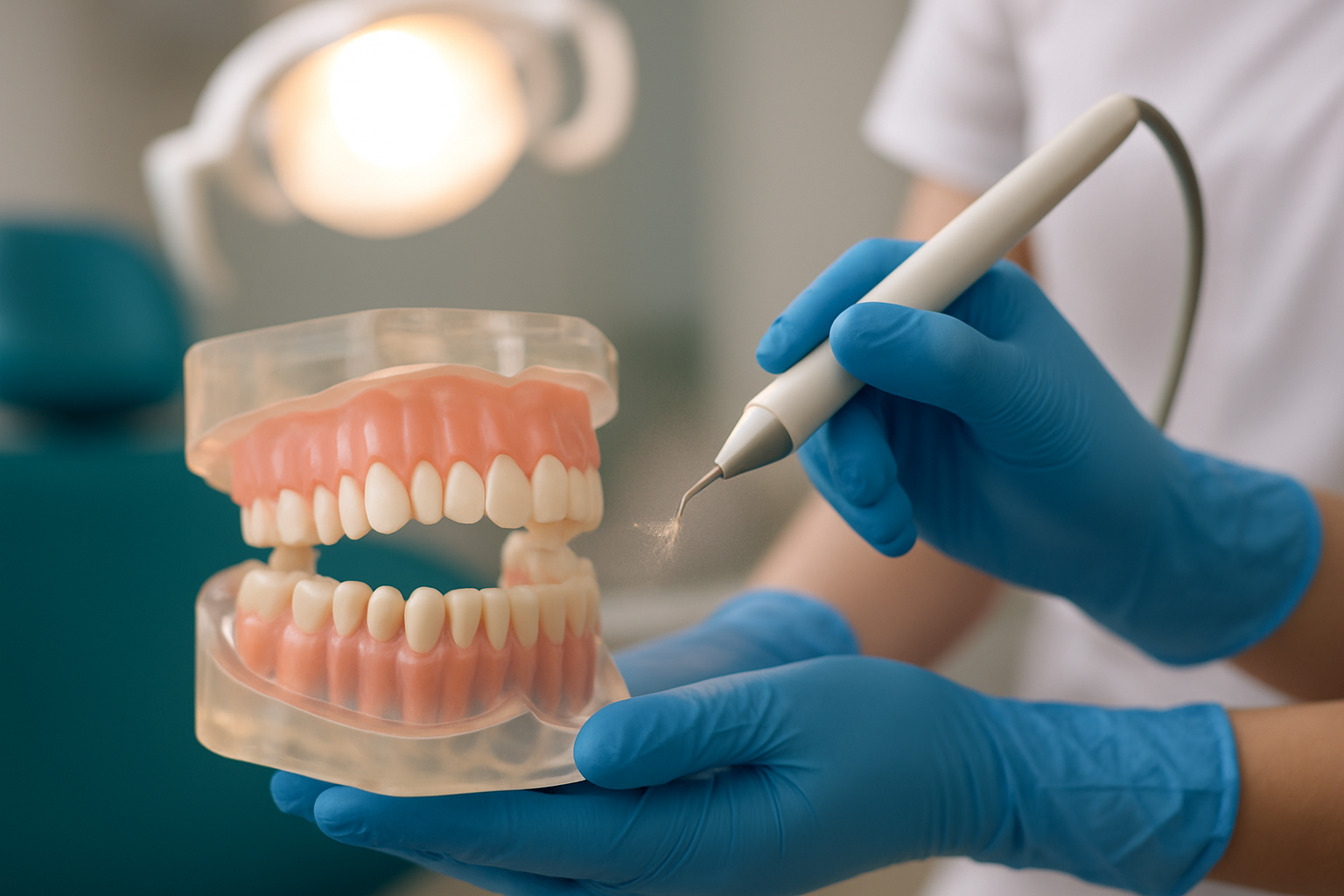
A deep cleaning is a different procedure with a different goal. We are cleaning the root surfaces inside the pockets, below the gumline, then smoothing those roots so the gum tissue has a clean surface to reattach to.
That is why three things usually change:
- You get numbed. Working below the gumline on inflamed tissue is uncomfortable without it.
- It gets split up. Deep cleanings are typically done by quadrant, meaning the mouth is divided into four sections, and most plans handle two quadrants per visit.
- There is a follow-up. A few weeks later we re-measure the same pockets to see how much they tightened up.
So a “two visit plan” is really a three step sequence: two treatment appointments and one check. If you have ever had one before, some tenderness in the days after is expected as the gums calm down.
Side by Side: Routine Cleaning vs Deep Cleaning
Here is the short version of how the two visits differ once you are in the chair.
| Routine Cleaning (Prophylaxis) | Deep Cleaning (Scaling and Root Planing) | |
|---|---|---|
| Pocket depths involved | Generally 1 to 3 mm | 4 mm and deeper, often with bleeding |
| What gets cleaned | At and just above the gumline | Root surfaces below the gumline, inside pockets |
| Numbing | Usually none | Local anesthetic is typical |
| Number of visits | One | Often two, by quadrant, plus a follow-up check |
| How insurance treats it | Preventive benefit | Separate benefit, often billed per quadrant |
| Recall afterward | Every six months for most people | Commonly every three to four months |
Is This Really Necessary, or Is It an Upsell?
Plenty of people wonder this quietly and never say it out loud. Ask it out loud. A good office will not flinch.
Here is what settles the question faster than anything else:
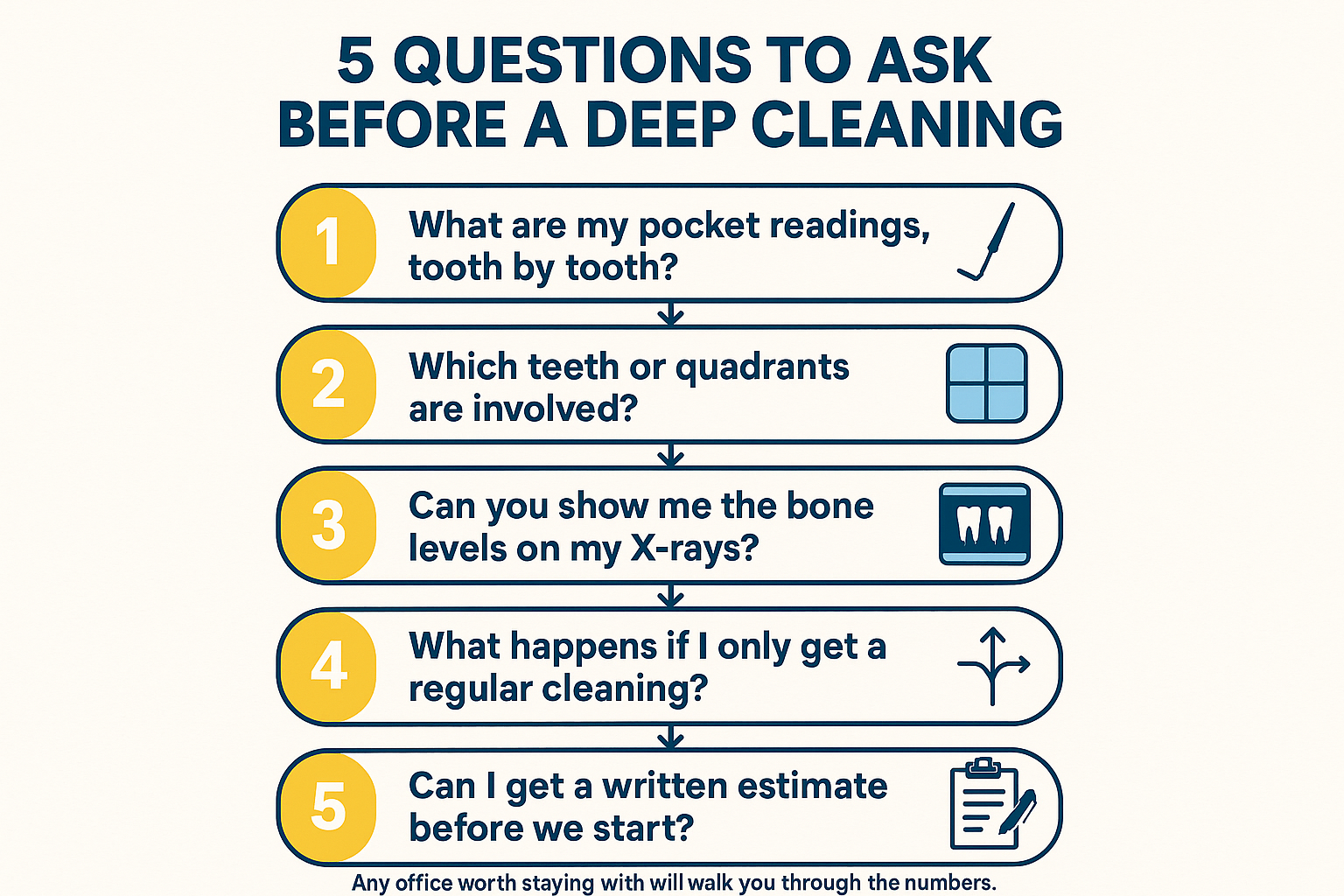
- Ask to hear your pocket readings tooth by tooth. Not a summary, the actual numbers.
- Ask which specific teeth or quadrants are involved. Sometimes it is the whole mouth. Sometimes it is one back corner.
- Ask to see your X-rays and have someone point out what bone loss looks like compared to a healthy area.
- Ask what happens if you do a regular cleaning instead. The honest answer is that a prophy leaves the deep buildup in place, and the pockets usually get deeper over time.
A patient who understands the numbers on their own chart is in a far better spot than one who just says yes or no. One reviewer put it about as well as anyone could: “Friendly knowledge staff who take care of my teeth without inflating my care.” That is the standard to hold any office to.
And for what it is worth, this recommendation is common, not a red flag. NIH MedlinePlus reports that about 47.2% of adults 30 and older have some form of gum disease, and that number rises to nearly 60% of adults 65 and older.
Five Questions to Ask Before You Agree
Screenshot this or write it down before your next visit. These five questions turn a confusing treatment plan into a decision you can actually make.
Why the Cost Looks Bigger Than You Expected
Cost is one of the top questions we hear, especially from people without insurance or out of network. One person wrote in asking simply how much it would cost just for a cleaning without insurance, which is a completely fair thing to want to know up front.
Here is why a deep cleaning plan can look larger on paper than a routine visit. Dental plans almost always treat the two as separate benefits with different coverage percentages, and deep cleanings are commonly billed by quadrant rather than as one flat visit.
The factors that move your number the most:
- How many quadrants actually need treatment
- Whether local anesthetic or sedation is used
- How many follow-up visits the plan includes
- Whether your recall interval shifts to a different visit type afterward
I would not put a dollar figure on any of that in an article, because the honest answer depends on your mouth and your plan. What I will tell you is to ask for a written estimate before anything starts, and to ask what your plan covers per quadrant.
If you do not have insurance, in-house membership plans exist at many practices as a way to make preventive care more predictable without deductibles or waiting periods. Worth asking about before you assume the number is out of reach.
A Surprise, AZ Scheduling Note Worth Reading Twice
Roughly one in five residents here is 65 or older, and gum disease becomes far more common with age. That is why this conversation comes up so often with patients from Sun City Grand, The Grand, and Sun City.
Seasonal residents have a wrinkle worth naming out loud. A deep cleaning is a two-appointment sequence plus a re-check a few weeks later, so if you arrive in October or November, start it early in the season.
I have watched too many snowbirds bring it up in March and run out of runway before heading north. Starting in fall gives you room for both visits and the follow-up without rushing anything.
What Happens After, and Why Your Visits Change
Most articles stop at the procedure. The part that actually protects your teeth long term is what comes next.
Gums usually need a few weeks to settle after scaling and root planing. Tenderness, some sensitivity to cold, and a bit of gum shrinkage as inflammation goes down are all normal in that window.
After that, most patients move to a shorter recall interval, commonly every three to four months instead of every six. That is a different visit type than a routine cleaning, sometimes called periodontal maintenance, and it exists to keep pockets from creeping back open. If you are curious how cleaning intervals get decided in general, that is a separate conversation worth having.
Be honest with yourself about the goal. Gingivitis, the early stage, can be reversed. Periodontitis, once bone is involved, is managed rather than cured. The shorter interval is about holding ground, not repeating deep cleanings forever.
Home care carries more weight after this than before it. If floss has never felt like it does much for you, a few small technique fixes usually matter more than switching products.
If the Below-the-Gumline Part Is What Scares You
A lot of people are not worried about the cost or the visits. They are picturing an instrument working under their gums and deciding they would rather not.
Comfort is what our patients mention most in reviews, and it is not an accident. Blankets, sunglasses for the overhead light, Netflix during treatment, and thorough numbing are all standard parts of how our team handles these appointments.
For people who need more than that, nitrous or oral sedation is available, and yes, sedation can be used for a cleaning, not just major work. Tell whoever is treating you that you are nervous. It changes how the whole appointment is run.
Scheduling helps too. 7 am starts, evening slots Tuesday through Thursday, and Saturday hours make a two-visit sequence a lot easier to fit around a job.
Frequently Asked Questions About Deep Cleanings
Can I just get a regular cleaning instead and see how it goes?
You can decline any treatment, and a good office will still see you. But understand what you are choosing. A routine cleaning does not reach below the gumline, so the buildup inside deeper pockets stays put and the pockets typically get deeper over time. Ask to have your pocket depths re-measured at your next visit so you can see the direction things are moving instead of guessing.
Why does it have to be split into two appointments?
Two reasons. Numbing half your mouth at once is more manageable than numbing all of it, and doing two quadrants at a time keeps the appointment to a reasonable length. Some cases can be done in one longer visit, so ask if that is an option for you.
Does a deep cleaning hurt?
During the appointment you should be numb and not feel the work itself. Afterward, expect some tenderness and cold sensitivity for a few days to a couple of weeks while the gums settle.
Will I need a deep cleaning every time now?
No. Scaling and root planing is usually a one-time reset for the areas treated. What follows is periodontal maintenance on a shorter schedule, commonly every three to four months, to keep things stable.
How does insurance handle a deep cleaning differently?
Most plans put routine cleanings under preventive benefits and scaling and root planing under a separate category with different coverage. Deep cleanings are also often billed per quadrant, which is why the estimate can look larger than you expected. Ask for a written estimate and your per-quadrant coverage before treatment starts.
Still Not Sure What Your Numbers Mean?
If you have a treatment plan sitting on your kitchen table and you are not sure what those pocket readings are telling you, bring it in and ask someone to walk through it with you line by line. Our team in Surprise keeps early morning, evening, and Saturday appointments open, which makes a two-visit sequence easier to work around a job or a seasonal stay in the West Valley. Questions are welcome at 480-795-2420 or westbelldentalcare.com.