Direct Answer: Yes. FSA and HSA dollars cover dental care that prevents or treats disease, like cleanings, X-rays, fillings, extractions, and dentures. Purely cosmetic work such as teeth whitening does not qualify.
Cost is the number one reason people around Surprise put off dental work. I see it every month in our own phone log. Roughly one in ten callers asks what a cleaning, an extraction, or a crown runs without insurance, and some of them hang up after hearing a number instead of booking.
Here is the part almost nobody brings up on those calls: an FSA or HSA balance sitting in an account they already funded. That money is theirs. In a lot of cases it is enough to cover the exact treatment they just decided to postpone.
So this is not an article about spending more. It is about finding money you may have already set aside, knowing what it legally covers, and understanding the deadlines that decide whether it survives into next year.
What Actually Qualifies When You Use an FSA or HSA for Dental Work
The rule is simpler than most people expect. If the care prevents or treats dental disease, the money qualifies. If it only changes how a tooth looks, it does not.
According to IRS Publication 502, dental treatment counts as a qualifying medical expense. The publication specifically lists things like:
- Routine cleanings and exams
- X-rays and diagnostic imaging
- Fluoride treatment and sealants
- Fillings
- Extractions
- Dentures, full or partial
- Braces and orthodontic treatment
And the clear exclusion on the other side is teeth whitening. Whitening is appearance-driven, so those dollars are off the table no matter how much better you feel afterward.
The honest gray middle is where people get tripped up. A crown placed on a cracked molar to save the tooth is treatment. The same crown chosen only because you want a different shade is not.
My practical advice: ask for the procedure codes on your treatment plan. That is what a benefits administrator looks at when they review a claim, not the friendly description. And on any judgment call, your plan administrator has the final say, not your dentist and not the front desk.

FSA and HSA Behave Nothing Alike at Year End
People use these two terms interchangeably and it costs them real money. The difference only shows up in December, which is the worst time to learn it.
FSA dollars follow a use-it-or-lose-it rule. Employers are allowed to soften that in one of two ways: a carryover of up to $680 into the next plan year, or a grace period of up to two and a half months to spend last year’s balance. An employer can offer one or the other, never both, and some offer neither.
HSA balances roll forward indefinitely. The account belongs to you, not your employer. Change jobs, change plans, retire, and the balance follows you.
One more number worth knowing: for 2026 the health FSA contribution cap is $3,400.
Here is the single most useful thing you can do this week. Log into your benefits portal and find your actual plan year end date. Plenty of employer plans do not run on the calendar year, and I have watched patients scramble in late December over a balance that actually expired in September, or relax in December over one that had until March.
FSA vs HSA: The Differences That Matter for Dental Care
Both accounts pay for the same list of qualifying dental care. What changes is the timing pressure and who owns the money.
| Feature | Health FSA | HSA |
|---|---|---|
| Unused balance at plan year end | Forfeited unless your employer offers relief | Rolls over indefinitely |
| Possible employer relief | Up to $680 carryover OR up to a 2.5 month grace period, not both | Not applicable |
| Who owns the account | Tied to your employer | Yours, moves with you |
| 2026 contribution cap | $3,400 for a health FSA | Set separately and tied to a high-deductible health plan |
| After you enroll in Medicare | Not applicable once employment ends | No new contributions, but you can still spend the balance |
| Best planning move | Price out known treatment before you elect in the fall | Treat it as a long-term dental repair fund |
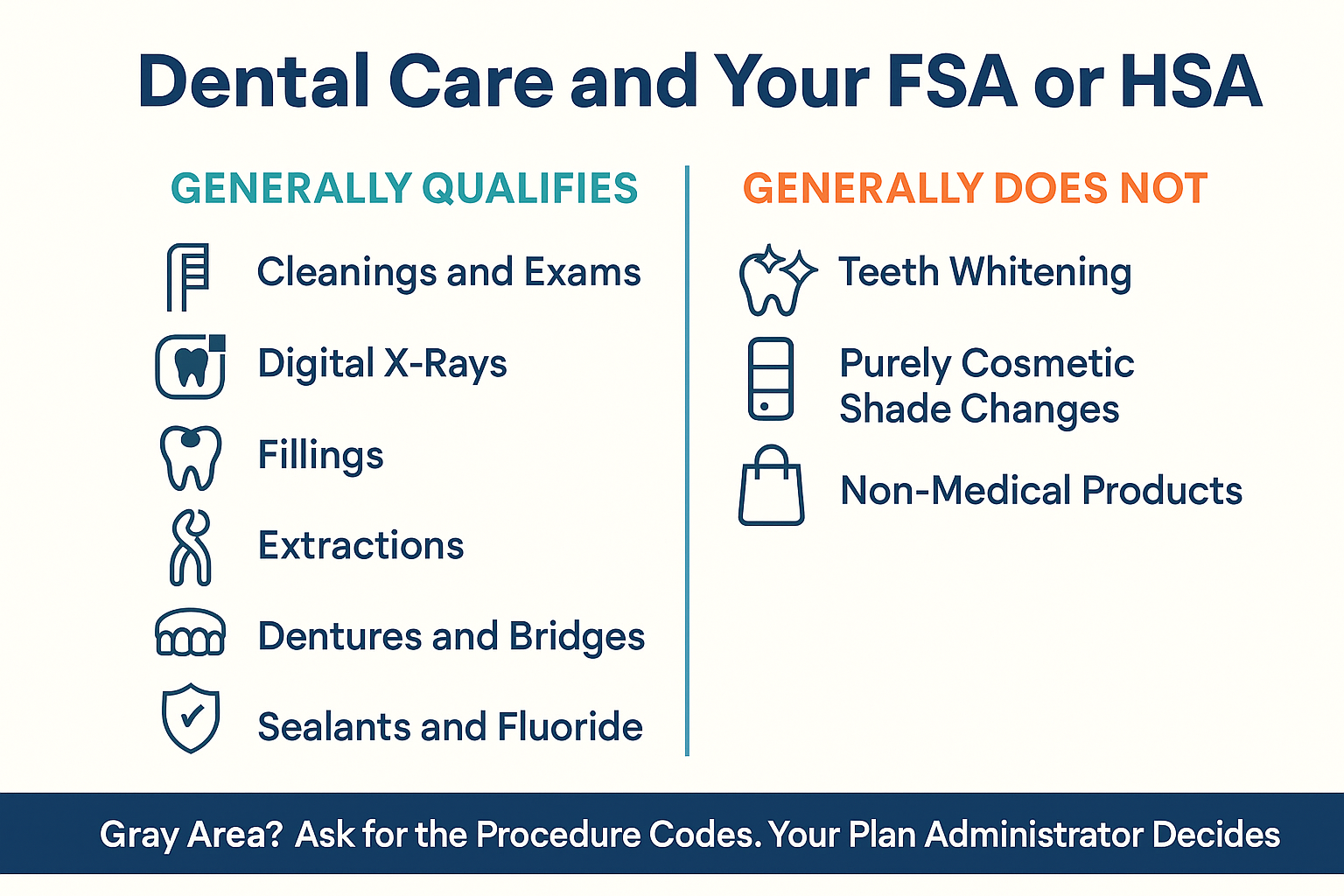
A Quick Sort: Qualifies or Doesn’t
When patients ask me whether something counts, this is the mental sort I walk them through before they call their administrator.
Two Things I See Go Wrong in the West Valley
The generic advice online misses two situations that come up constantly here.
Working professionals under-elect in the fall. Patients from Marley Park, Surprise Farms, and Legacy Parc make their FSA election during open enrollment and pick a number out of the air. They forget to count the crown they already know is coming, or the two fillings someone flagged at their last cleaning.
The fix takes one phone call. Get a written estimate for any pending treatment before you choose your election number, not after.
Retirees get surprised by the Medicare rule. Once you enroll in Medicare, you can no longer contribute to an HSA. A lot of folks in Sun City Grand and Sun City hear that and assume the account is dead.
It is not. You can still spend an existing HSA balance on qualifying dental care, and dental is one of the most useful things to spend it on given how thin most medical plans are on teeth. If you are sorting through what your plan covers, our breakdown of Medicare and your dental bills in 2026 walks through the gaps.
Stacking These Dollars on Top of Insurance
This is where the account earns its keep. FSA and HSA money is built to cover the part insurance leaves behind.
That usually means three things:
- Your deductible before coverage kicks in
- Your coinsurance share, the percentage you owe on a covered procedure
- Anything your plan simply will not pay in a given year
If you have no dental plan at all, the account works the same way, it just covers the whole bill instead of a slice. Patients in that spot often find our guide to how dental costs actually work without insurance useful for setting expectations.
One warning that catches people off guard. When you swipe a benefits debit card at a dental office, the administrator sometimes sends a substantiation request months later asking you to prove the charge qualified.
Keep the itemized receipt and the treatment plan together in one place. A folder, an email to yourself, a photo in your phone. Reconstructing that paperwork in April for a November appointment is miserable, and if you cannot produce it, the charge can get flagged as taxable.
Ask for the Itemized Plan Before You Spend Anything
Before you commit account dollars, ask for a written, itemized treatment plan with the procedure codes on it. That is a reasonable request at any dental office, and any office worth staying with will hand it over without friction.
It does two jobs. It tells your administrator exactly what they are looking at, and it tells you what is urgent versus what can wait until the next plan year.
One of our patients put the posture well in a review: “They explained everything in detail and went through all my options instead of pushing something on me because that’s what they wanted.” That is the conversation you want before you spend down a balance, not after.
If a plan year deadline is closing in, scheduling is usually the real obstacle. Our team keeps early appointments starting at 7 AM on weekdays, evening slots until 7 PM Tuesday through Thursday, and Saturday hours from 8 AM to 3 PM, which is how most working patients get care in before the calendar runs out. If you are looking at a longer list of work, a catch-up plan split into stages can spread treatment across two plan years on purpose.
Frequently Asked Questions About Using an FSA or HSA for Dental Work
Can I use my FSA for Invisalign?
Usually yes. The IRS lists orthodontic treatment as a qualifying medical expense, and clear aligners are orthodontic treatment. Some administrators want a letter of medical necessity for aligner cases, so ask yours before you pay, and keep the treatment plan on file either way.
What about teeth whitening or veneers?
Whitening is specifically excluded. Veneers are a judgment call that depends on why they are being placed, and the plan administrator makes the final decision, not the dental office. If restoring a damaged or worn tooth is the clinical reason, ask for the procedure codes and submit the question in writing.
My FSA year ends soon and I do not know what to do with the balance. What is the fastest use?
A cleaning and exam with X-rays is the quickest qualifying appointment to get on the books, and it often surfaces small problems while they are still small. Just check whether your employer gives you a carryover or a grace period first, because that changes how much hurry you are actually in.
I am on Medicare now. Is my old HSA useless for dental?
No. You cannot put new money in once you enroll in Medicare, but the existing balance is still yours to spend on qualifying dental care with no expiration date. This surprises a lot of people in Sun City and Sun City Grand who assumed the account closed.
Can I use these accounts for a family member’s dental work?
Generally yes for a spouse and tax dependents, even if they are not on your health plan. Rules get specific around adult children and other dependents, so confirm with your administrator before booking multiple people.
Sorting Out What Your Account Will Cover?
If you have a balance sitting in an FSA or HSA and a treatment plan you have been sitting on, an itemized written estimate is the piece that connects the two. Our office in Surprise can put that in writing for you, including the procedure codes your administrator will ask about. Reach us at 480-795-2420 or at westbelldentalcare.com, and early morning, evening, and Saturday times are available if a plan year deadline is closing in.