Direct Answer: Your Annual Notice of Change lists every 2027 cost and coverage change. Compare the dental allowance, coinsurance, and network against your 2026 plan, then act between October 15 and December 7.
Every September, a thick envelope shows up in mailboxes across Surprise and gets mistaken for junk mail. It sits on the counter under the grocery ads until somebody finally recycles it.
That envelope is the Annual Notice of Change, and Medicare Advantage and Part D plans are required to mail it by September 30. It spells out every cost, benefit, and network change taking effect January 1, 2027.
I talk to patients about this every fall, usually in October, usually after something has already changed. So here is the short version: you can read the part that matters in about fifteen minutes at the kitchen table, and you have until December 7, 2026 to do anything about it.
The dates that decide your 2027 dental coverage
There are only four dates worth writing on the calendar, and they do not move.
- September 30, 2026 is the deadline for your plan to mail the Annual Notice of Change.
- October 1, 2026 is when full 2027 plan details become public, so you can compare options against each other.
- October 15 to December 7, 2026 is the Annual Enrollment Period. This is your window to switch, drop, or stay.
- January 1, 2027 is when whatever you chose, or did not choose, starts.
If you do nothing, you are automatically keeping your current plan with its 2027 terms. That is the part people miss. Staying put is a decision, not a pause.
CMS confirms that open enrollment runs October 15 to December 7, that plans are allowed to change costs, coverage, and networks each year, and that you should review both the Annual Notice of Change and the Evidence of Coverage your plan sends.
One more thing I tell people in Sun City Grand: keep the notice. Do not toss it after you read it. You will want it next to the 2027 version twelve months from now.
What industry watchers were saying about 2027 extras
Through the spring and summer of 2026, analysts kept flagging the same pattern for 2027 plans. The advertised $0 premium tends to survive, because that number sells the plan. The supplemental extras are where the trimming happens.
Dental allowances sit on that list right next to hearing, vision, gym memberships, meal benefits, and over-the-counter cards. CMS finalized an average 2.48% payment increase to Medicare Advantage plans for 2027, and insurers have said publicly that funding may not keep pace with rising costs.
I want to be careful here, because this is where bad advice gets handed out at coffee. Nothing is decided plan by plan until the plan documents publish. Your own notice is the only document that tells you what actually happened to your dental benefit.
So treat the industry chatter as a reason to read, not as a prediction. I have seen benefits hold steady and I have seen them thin out, sometimes within the same carrier across two different plan options.

Four lines in the dental section worth reading twice
Pull the 2026 and 2027 versions out and set them next to each other. You are looking for four specific things, in this order:
- The annual dollar allowance for dental. This is the number, not the word. A plan can keep “dental” on the brochure and cut the dollars behind it.
- Whether preventive visits are counted separately from major work. Some plans give you cleanings and exams outside the allowance. Others pull them from the same pot as crowns and extractions.
- The coinsurance percentage you owe on bigger procedures. Going from 20% to 50% on a crown changes your out-of-pocket more than most allowance changes do.
- Whether the benefit requires a specific dental network. A generous allowance you cannot use at your dentist’s office is not a generous allowance.
That last one comes up constantly on our phones. Callers ask whether a plan is PPO or HMO before they will even talk about scheduling, and some of them say straight out that they have run into problems before. They are right to ask first.
If the network language in your notice is confusing, this breakdown of in-network, out-of-network, or neither walks through what each status actually costs you.
A side-by-side worksheet for your dental section
Write your 2026 number in one column and your 2027 number in the other. Four rows is the whole exercise.
| What to find | The question to answer | What a change means for you |
|---|---|---|
| Annual dental allowance | How many dollars per year, total? | A lower figure means fewer procedures covered before you pay in full |
| Preventive visit handling | Are cleanings and exams counted inside the allowance? | If they moved inside it, routine visits now eat into your crown budget |
| Coinsurance on major work | What percentage do you owe on crowns, extractions, dentures? | A jump here raises your cost even if the allowance stayed the same |
| Network requirement | Must you use a specific dental network? | Decides whether your current dentist’s office can bill the benefit at all |
The fifteen-minute kitchen table read
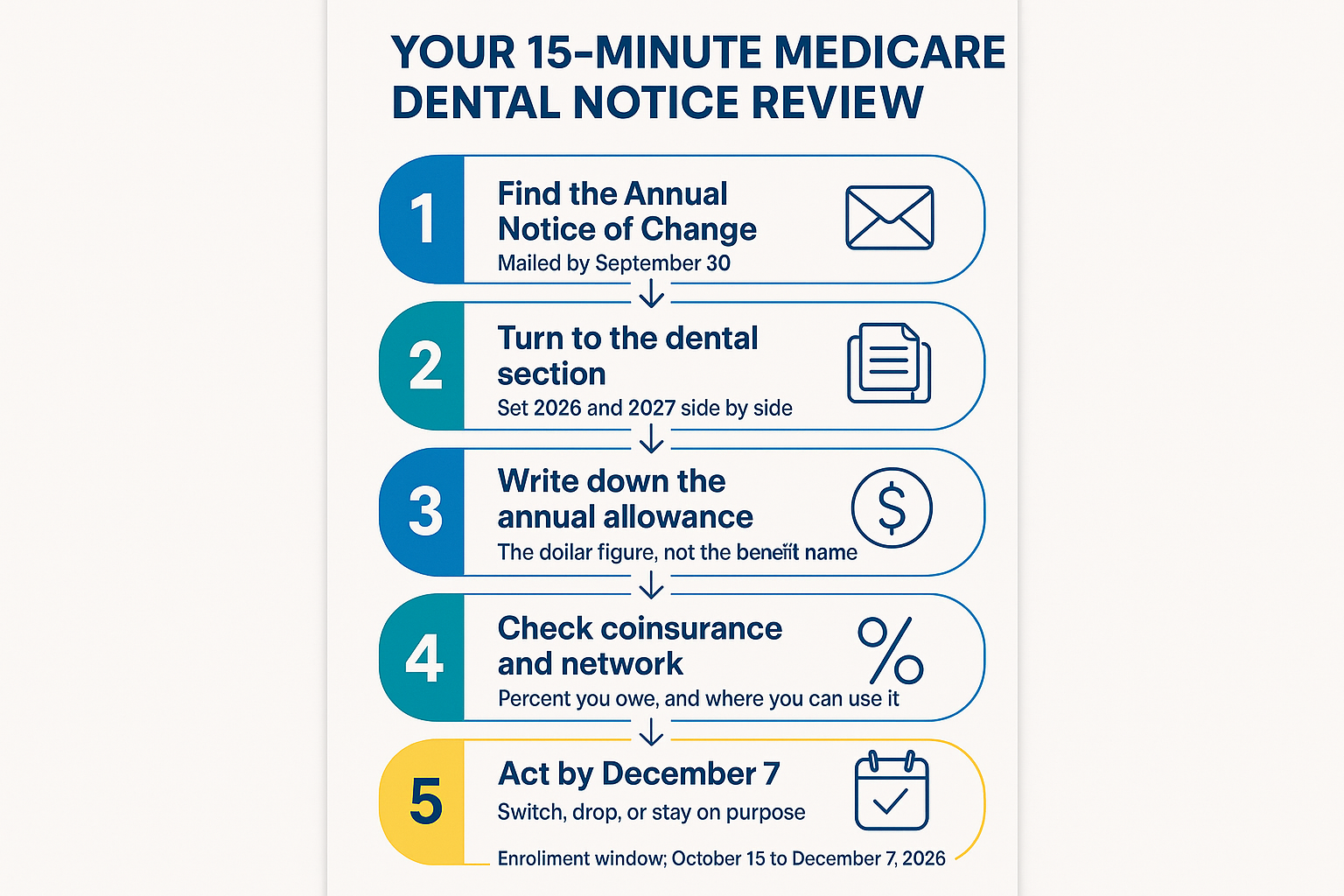
This is the whole process, start to finish, in five steps you can do in one sitting.
The 2027 rule change on those debit-style benefit cards
A lot of plans hand out a card preloaded with dental, vision, hearing, and over-the-counter dollars. Starting in 2027, how those cards work is changing in two ways that matter.
First, the cards will be electronically restricted to plan-approved items and verified at the register in real time. No more guessing at checkout and hoping it goes through.
Second, and this is the one that costs people money: any unused balance expires at the end of the plan year, with nothing rolling over.
If you have been sitting on a recommended crown or a periodontal treatment, that means finding out your remaining balance in October, not discovering in January that it vanished. We see this every single year, and it is a rough conversation.
I have written more about the December 31 reset and how late is too late to start if you are trying to judge whether there is still time.
If you only live here half the year, read the network line first
Roughly one in five Surprise residents is 65 or older, and the households in Sun City Grand, The Grand, and Sun City make this decision every October. But part-year residents have an extra problem nobody warns them about.
Your Annual Notice of Change gets forwarded to a northern address in September, often while you are still packing. Two questions decide your whole season:
- Does your 2027 dental benefit travel with you, or is it tied to a geographic service area?
- Does a Surprise dental office fall inside the network of the plan you are choosing?
That second answer determines where you can be seen during a four to six month stay. I have met snowbirds who arrived in November with an active toothache and a card that would not work at any office within twenty miles.
If you split the year, this guide on keeping dental care on track as a seasonal resident covers the scheduling side of it.
When the paperwork meets a treatment plan you already have
Here is the pattern I see every autumn. Someone had work recommended back in the spring, life got busy, and now the fall mail has them thinking about it again. One caller put it plainly: she had been putting it off too long and just wanted to get everything done at once.
Sometimes that is the right call. Sometimes a treatment plan can be sequenced across December and January so two benefit years each carry part of the cost.
But the honest version of that conversation depends on three things:
- The specific procedures involved and how they depend on each other clinically
- Your plan’s annual maximum and what is left of it
- Clinical urgency, because an infection does not wait for a benefit year
Costs and coverage genuinely vary case by case, which is why I never quote a figure off the top of my head. Ask for an itemized estimate tied to your actual plan before anything gets scheduled.
If your list of needed work is long, this explanation of how a catch-up plan gets split into stages shows how the sequencing usually works.
Frequently Asked Questions About 2027 Medicare Advantage Dental Benefits
What if I never got my Annual Notice of Change?
Call your plan’s member services number and request it. Plans are required to send it by September 30, but mail gets lost and forwarded addresses fail. Most carriers also post it in your online member account, and full 2027 plan details are available for comparison starting October 1.
Does Original Medicare cover routine dental work in 2027?
Routine cleanings, fillings, crowns, and dentures generally are not covered under Original Medicare. That has not changed. Dental benefits usually come through a Medicare Advantage plan, a standalone dental policy, or a self-pay arrangement. We broke down what Medicare actually covers in plain language.
My plan kept the word dental. Does that mean nothing changed?
Not necessarily. The benefit name can stay identical while the annual allowance drops, the coinsurance percentage rises, or preventive visits get moved inside the allowance. The dollar figure is the only reliable signal.
What happens if my 2027 dental allowance shrinks a lot?
You have options during the enrollment window, and you have options after it closes. Some patients switch plans by December 7. Others stay put and cover routine care another way, including an in-house membership arrangement. Here is what a dental membership plan is and who it actually helps.
Can I get treatment started in December and finished in January?
Sometimes, yes. It depends on the procedures, how they build on each other, and whether waiting is clinically safe. Crowns and multi-step restorative work are the most common candidates for splitting. Bring your treatment plan and your plan documents to the same appointment and ask directly.
How do I know if my dentist’s office is in the network I’m considering?
Do not rely on the carrier’s online directory alone, because those listings go stale. Call the office with the exact plan name and plan type, PPO or HMO, and ask them to confirm. It takes two minutes and saves a season of headaches.
Reading your notice with a treatment plan in hand
Our team is used to sitting down with a patient’s plan documents and an itemized treatment estimate before anything gets scheduled, and there is an in-house membership option for people whose 2027 dental allowance shrinks or who move back to Original Medicare. Appointments here in Surprise open at 7 AM on weekdays, run until 7 PM Tuesday through Thursday, and are available Saturdays from 8 AM to 3 PM for anyone trying to fit care in before a benefit year closes. If you want to talk through what your notice says, the number is 480-795-2420, or you can find us at westbelldentalcare.com.