
Direct Answer: Seasonal residents should book their first exam within a week or two of arriving in Surprise. The diagnosis decides whether treatment fits a four to six month stay.
Every fall I start having the same conversation with patients rolling back into Sun City, Sun City Grand, and Arizona Traditions. They are here from roughly October through April, and somewhere in that window they need dental work done.
The problem is almost never the treatment itself. It is the calendar. A four to six month stay does not always line up with care that takes several visits and some healing time in between.
So let me walk you through what realistically fits inside one winter season, what does not, and the two things seasonal patients trip over most: out-of-state insurance and the January benefit reset.
What actually fits inside one winter stay
The single most useful thing you can do is come in for an exam within the first week or two after you arrive, not in March. I say that because the diagnosis is what determines whether a plan fits your calendar at all.
When someone walks in during the second week of March with a cracked molar, my options narrow fast. That same tooth seen in November opens up choices that simply are not on the table in spring.
Here is the rough shape of it:
- Exams, X-rays, and cleanings are one appointment. Easy.
- Tooth-colored fillings are usually one appointment too.
- Crowns are a short project, either one longer visit or two spread a couple of weeks apart.
- Root canal therapy plus a crown generally wraps up inside a few weeks.
- Dental implants are the long one. The post goes in, then the bone needs healing months before the final tooth is placed. The ADA’s patient guidance on implants explains why that healing window is not something anyone should rush.
- Full or partial dentures usually need several fittings and adjustments, so they want a running start early in your stay.
None of that means an implant is off limits for a snowbird. It means we plan the stages around your travel, and that conversation has to happen in November, not April.
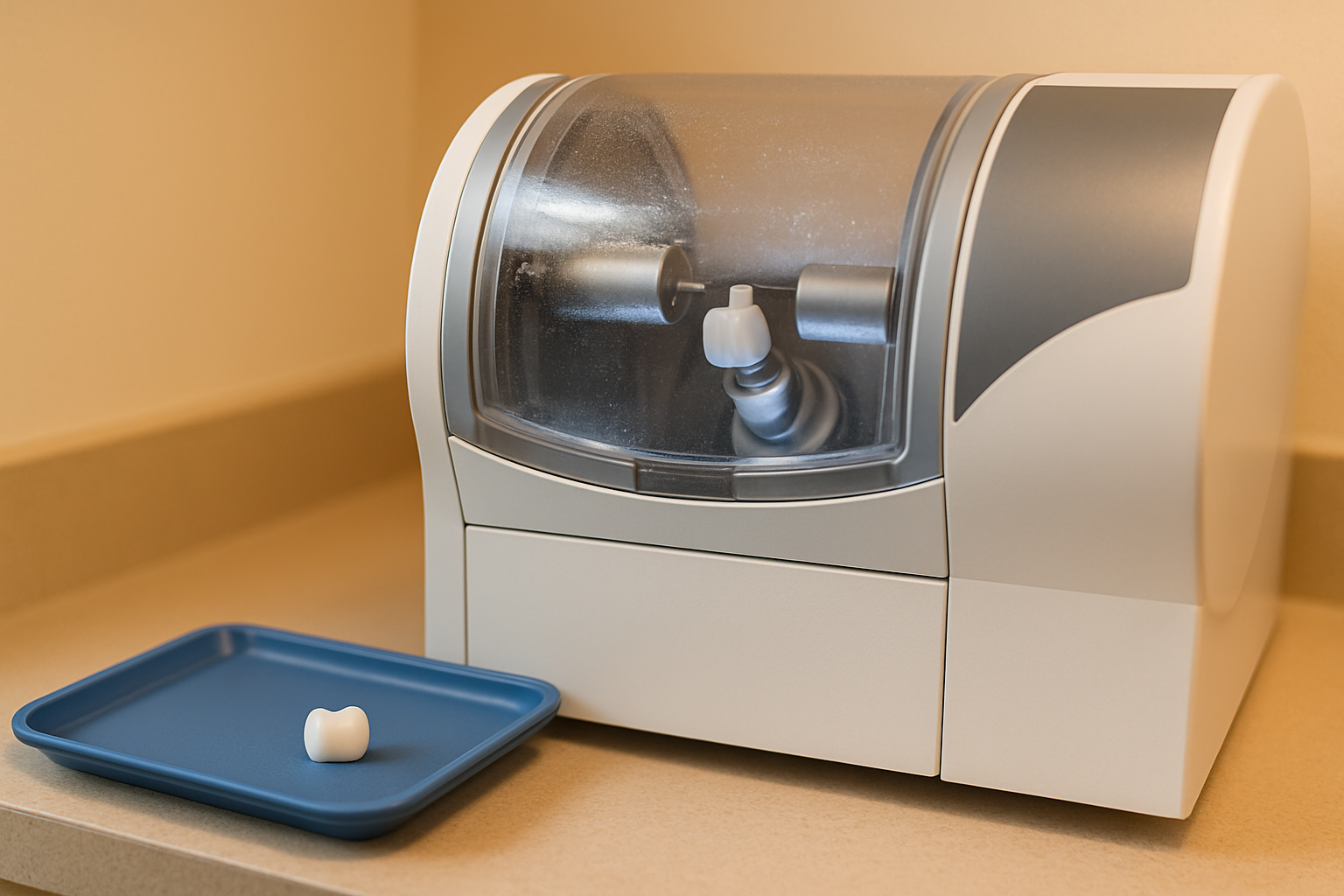
Why a crown made in one visit changes the math
This comes up on the phone constantly. One caller told our front desk she specifically wanted to know about same-visit crowns because she did not want to drive back for a second appointment.
For a year-round resident, two visits is a mild inconvenience. For someone flying out in three weeks, it is the whole decision.
Milling the crown in the office does two things for a seasonal patient:
- One appointment instead of two, so it fits a tight window.
- No temporary crown to babysit on a flight home.
That second point matters more than people expect. Temporaries are glued on with something meant to come off later, and a bagel in an airport terminal at 6 a.m. is exactly when one pops loose.
A patient named Barb S. put it better than I could in her review: “They have a very cool machine that will make your Permanent crown in a little over an hour.”
Not every tooth is a candidate. Some cases still need a lab. But if you are working against a departure date, ask at the planning visit whether yours can be done in one sitting. I cover the mechanics in more detail in how a crown gets made in one visit.
Treatment Timelines Against a Four to Six Month Stay
These are general ranges, not promises. Your own timeline depends on what we find at the exam.
| Treatment | Typical visits | Rough timeline | Fits one winter season? |
|---|---|---|---|
| Exam, X-rays, cleaning | 1 | One appointment | Yes |
| Tooth-colored filling | 1 | One appointment | Yes |
| Crown milled in office | 1 | One longer visit | Yes |
| Lab-made crown | 2 | Usually a couple weeks apart | Yes |
| Root canal plus crown | 2 to 3 | A few weeks start to finish | Usually |
| Implant post to final tooth | 3 or more | Several healing months between stages | Only with planning, start early |
| Full or partial dentures | 4 to 5 | Several weeks of fittings | Yes if started early in the stay |
Insurance across state lines is the real snag
Roughly one in five people who call us open with some version of “do you take my plan.” One caller said it flat out: he wanted to confirm we were in-network before he came in.
For seasonal residents, that question gets more complicated, because the plan was bought in Minnesota or Illinois or Michigan and you are standing in Surprise.
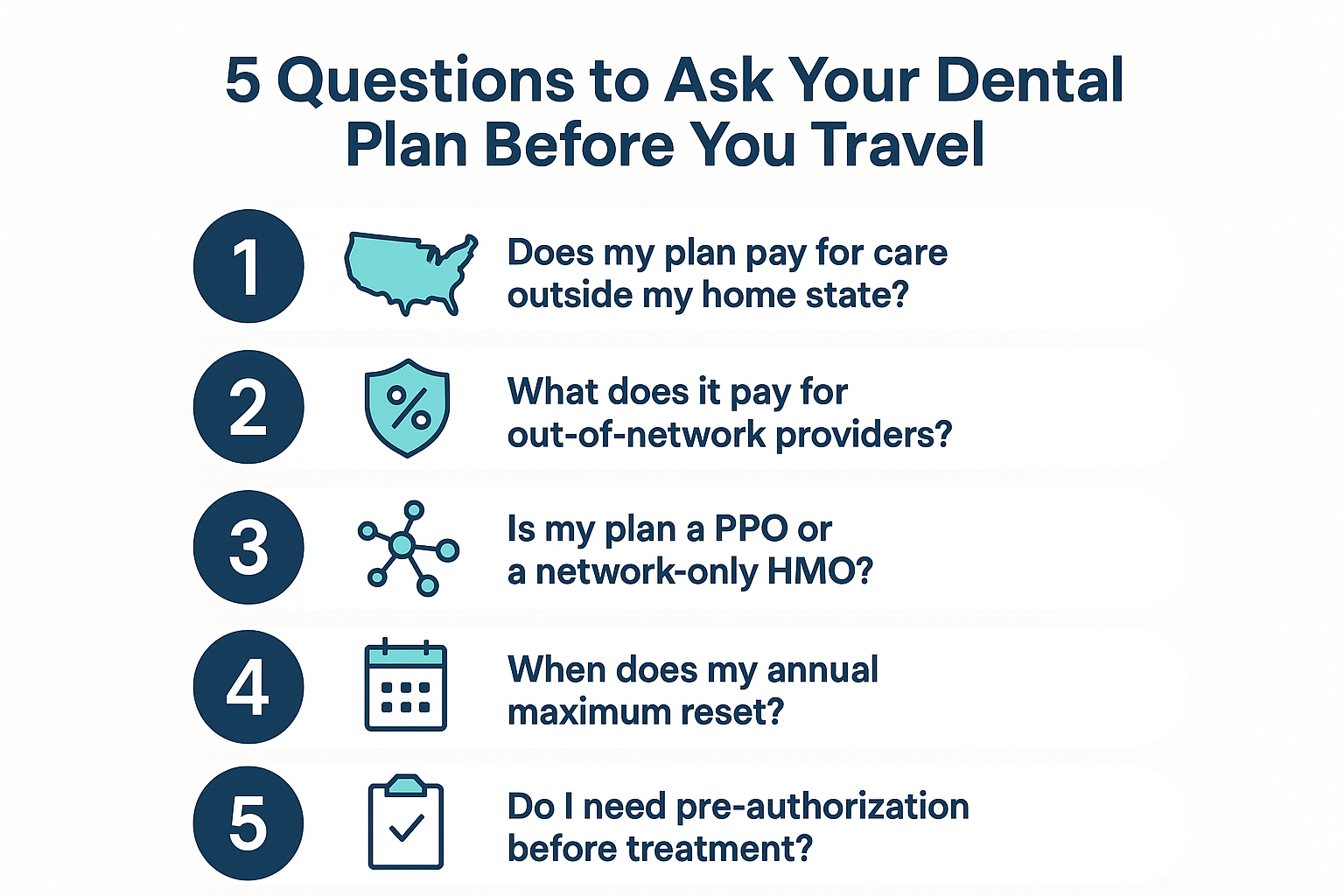
Call your own plan before you fly down and ask these:
- Does my plan pay for care outside my home state?
- Does it pay anything at all for out-of-network providers, and at what percentage?
- Is this an HMO or DHMO built around a network back home? If so, an Arizona office may not be usable at all.
- Do I need a referral or pre-authorization for anything beyond a cleaning?
That HMO question is the one that catches people. PPO-style plans usually travel with some out-of-network benefit. Network-only plans often do not travel at all.
If the answers come back murky, this breakdown of in-network versus out-of-network coverage sorts out what each one actually means for your bill. And if Medicare is part of your picture, that has its own rules worth reading separately.
Five Questions to Ask Your Plan Before You Head to Arizona
Print this list or keep it on your phone. Ten minutes on hold at home saves a wasted appointment here.
The January reset most snowbirds miss
Here is the piece of planning almost nobody brings up on their own. Most dental plans run on a calendar year with an annual maximum that resets January 1.
That reset lands right in the middle of a typical Surprise winter stay. Which is a genuine opportunity if you know about it.
Say you need two crowns and some fillings. Running all of it in December may blow past your annual cap and leave you paying the rest out of pocket. Splitting it, one phase in November or December, the next phase in January or February, can put two separate benefit years behind the same stay.
That only works if someone maps it out at the treatment planning visit. It is not something to figure out alone with a benefits booklet at the kitchen table.
Bring your plan details to that appointment and say plainly that you leave in April. We can sequence around both the reset and your flight. If you are arriving in the fall, what happens to unused benefits before December 31 is worth a read first.
What if you have no dental plan at all
Plenty of seasonal residents do not. A couple who had just moved into a local active adult community wrote in asking what a cleaning would run for the two of them, since one of them had no coverage.
I will not throw a number at you, because the honest answer is that it depends. What drives the cost of a first visit:
- How many X-rays are needed, and whether recent ones can be reused
- Whether you need a regular cleaning or a deep cleaning, which is a different procedure
- How long it has been since your last visit
- Whether the exam turns up anything that needs attention now
In-house membership plans exist as a category for exactly this situation. Generally they work as a flat monthly or yearly fee that covers preventive visits, with a discount on other treatment, no deductible and no waiting period. For a snowbird with no coverage, that predictability can be easier to plan around than a traditional plan bought for a state you only live in half the year.
Two pieces worth reading: how dental costs actually work without insurance and who a membership plan really helps. For an exact figure on your own situation, call the office. Every plan and every mouth is different.
Keeping two dental offices from duplicating each other
This is different from switching dentists for good. You are keeping a provider up north and adding one here, and that takes a little coordination so you are not paying twice for the same X-rays.
What works, in my experience:
- Have recent X-rays and any existing treatment plan sent over before your first winter appointment. Not the day of.
- Ask which images are current enough to reuse. Some are, some are not, and it depends on what we are looking at.
- Make sure whoever placed a crown or implant knows what happened while you were away. If we adjust a restoration another office placed, that office should hear about it.
- Decide before you fly home who handles follow-up. If a crown starts bothering you in July, you want that answer already settled. We hear “I had a crown done and it’s still bothering me” often enough to know it happens.
One more practical note. Tell both offices your travel dates. A cleaning in October up north and another in February here can space out cleanly, or it can accidentally double up in the same eight weeks and waste a benefit.
Why scheduling flexibility matters more than people think
When I ask seasonal patients what mattered most about their experience, two things come up again and again. They wanted to be seen quickly during a short stay, and they did not want to be sent somewhere else halfway through treatment.
Both are scheduling problems more than clinical ones. A stay that is only four months long cannot absorb a six week wait for a referral appointment.
Weekday hours starting at 7 a.m., evening appointments midweek, and Saturday hours from 8 a.m. to 3 p.m. leave room to fit care around travel days, golf, and family visits. Having general, restorative, and cosmetic care in one building means fewer handoffs eating up weeks you do not have.
Patients across the West Valley have left more than 1,700 five star reviews, and a fair number of them are from people who only live here part of the year.
Frequently Asked Questions About Dental Care for Seasonal Residents
When should I book my first appointment after arriving in Surprise?
Within the first week or two. Not because anything is wrong, but because the exam is what tells us whether your treatment fits your stay. Waiting until February or March removes options that were available in November.
Can I get a dental implant if I am only here half the year?
Often yes, with planning. The post placement and the final tooth are separated by healing months, so we look at your arrival and departure dates and decide where each stage lands. Some patients do the post one winter and the final crown the next. Others complete it in one longer stay. It depends on the case and on your bone.
Will my out-of-state dental insurance work here?
Sometimes. PPO-style plans usually carry some out-of-network benefit that travels. Network-only HMO or DHMO plans built around providers in your home state often will not pay anything here. Call your plan before you leave and ask directly.
Do I need to bring my X-rays from my dentist back home?
Ask your northern office to send them ahead of your appointment. Some images are current enough to reuse, which saves you time and money. Others are too old or do not show what we need to see.
What if something breaks after I go back north for the summer?
Sort that out before you leave. Decide which office handles follow-up on work done here, and make sure both offices have the records. A quick note in your chart in April prevents a scramble in July.
Is it worth starting treatment in December if my benefits reset January 1?
That timing can work in your favor. Splitting treatment across the December to January reset can put two benefit years behind one winter stay instead of one. Bring it up at your treatment planning visit so the sequencing gets built in from the start.
Planning your winter stay in Surprise?
If you split your year between Arizona and somewhere colder, an early exam is what makes the rest of the calendar work. Our team at West Bell Dental Care keeps early morning, midweek evening, and Saturday appointments open for exactly this reason, and we are happy to talk through timelines and out-of-state coverage before you commit to anything. You can reach the office at 480-795-2420 or read more at westbelldentalcare.com.