
Direct Answer: Yes. Jaw joint and muscle pain belongs in a dental chair even when no tooth hurts. A dentist checks your bite, joint movement, and chewing muscles, then starts with reversible treatment.
You woke up and the side of your face hurts again. Maybe it is an aching spot right in front of your ear, maybe a headache that starts at the temple, maybe a jaw that catches halfway open. And you cannot tell if it is a bad tooth or something else entirely.
We get this question through our website chat more than people realize, usually typed as three words: do you treat TMJ. The short answer is yes, jaw pain is a dental evaluation. The longer answer is what I want to walk through here.
I will cover how we separate tooth pain from joint and muscle pain, which symptoms should not wait a week, and what a first visit actually looks like. Spoiler for anyone who has been reading scary things online at 2 a.m.: it almost never starts with surgery.
Is it a tooth, or is it the jaw joint?
This is the first fork in the road, and patients in Surprise Farms and Sun City Grand ask me about it constantly. The two problems feel similar from the outside but behave very differently.
Tooth pain usually has a clear trigger. Cold water, biting down on something, a throb that wakes you up and stays put in one spot. You can often point to the tooth with one finger.
Jaw joint and muscle pain is vaguer and more spread out. It tends to show up as:
- Soreness right in front of the ear, sometimes mistaken for an ear infection
- A dull ache along the cheek and temple that builds through the day
- Clicking, popping, or a jaw that catches when you open wide
- Chewing on one side only, because the other side gets tired fast
- Morning stiffness that eases up after you talk and eat for an hour
Here is the overlap that confuses people. A cracked tooth can make you chew on one side, which overworks the muscles on the other side, which then hurts more than the tooth does. The reverse happens too. Months of clenching can make a healthy tooth feel bruised and sore to bite on.
That is why the exam has to look at both. Guessing from symptoms alone is how people end up getting a root canal on a tooth that was never the problem.
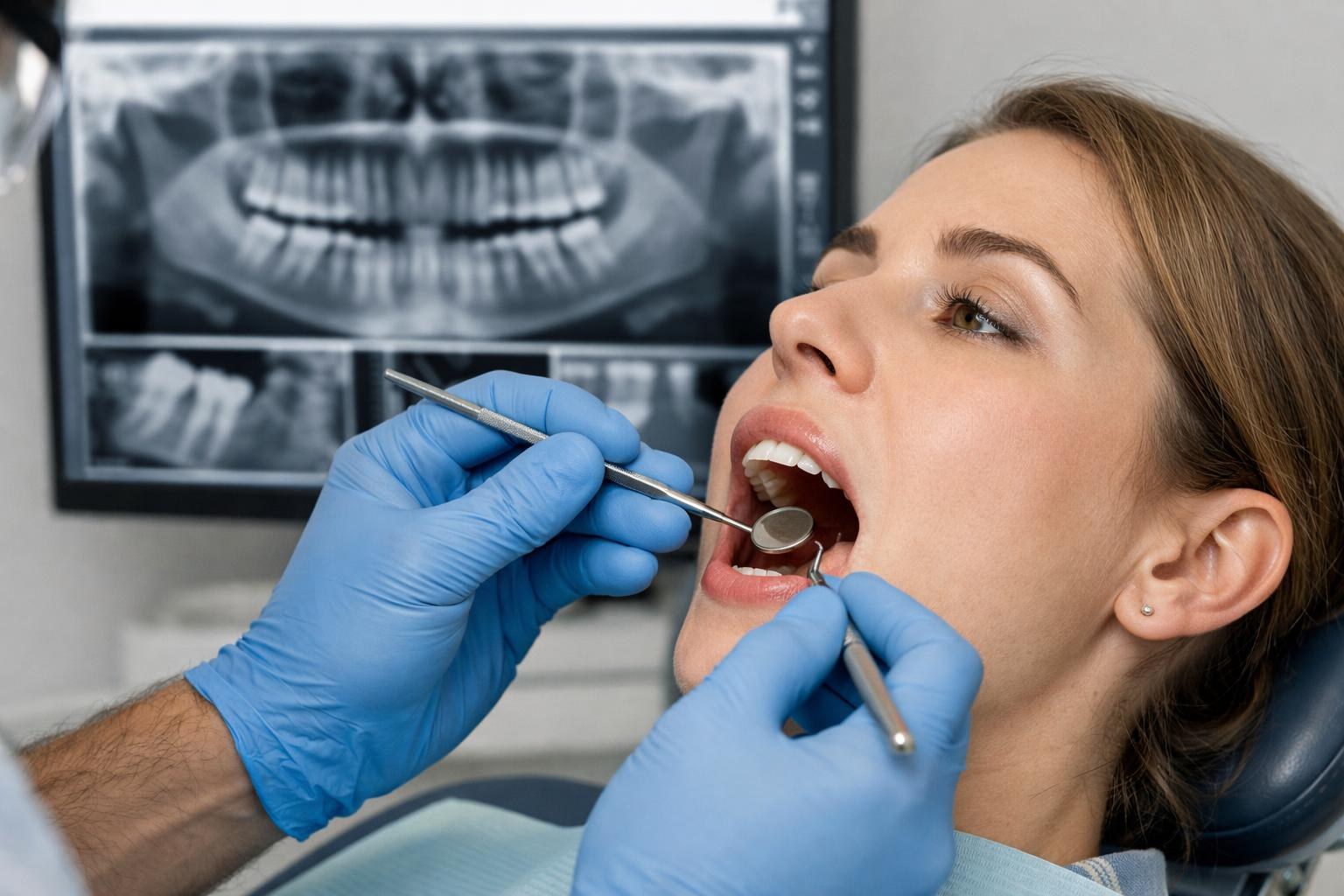
What I actually check at a jaw pain visit
Nothing about this appointment is dramatic. Most of it is hands, questions, and watching how your jaw moves.
A typical jaw evaluation includes:
- Feeling both joints while you open and close, listening for clicking and feeling for a joint that moves unevenly
- Measuring how far you can open, since a limited range is a real clinical finding, not just a complaint
- Pressing the chewing muscles along the cheek, temple, and under the jaw to find the sore spots you did not know you had
- Checking the bite, including worn edges, flattened back teeth, and scalloped ridges on the sides of the tongue, which are classic clenching clues
- Digital X-rays to rule out a cracked tooth, an abscess, or a failing old restoration hiding under a crown
Then there is the conversation, and honestly it does more diagnostic work than the X-rays. I ask about stress, sleep, caffeine, new jobs, recent dental work, chewing gum, nail biting, and whether a partner has ever mentioned grinding at night.
A jaw that hurts on one side after six weeks of a brutal work stretch is a different problem than a jaw that locked suddenly while yawning. Same symptom, different cause, different plan.
Which jaw symptoms justify calling right away
People hate vague advice when they hurt, so let me be direct.
Call to be seen quickly if:
- Your jaw locks open or locks closed and you cannot work it loose
- There is swelling along the jaw or under the ear
- You have jaw pain plus fever, or a bad taste that will not go away
- Your bite suddenly feels off, like your teeth are meeting in a new place
- The pain is bad enough that you are skipping meals or losing sleep
It is usually reasonable to watch for a week or two if: the pain is mild to moderate, it comes and goes, you can still eat normally, and there is no swelling. Soft foods, a break from gum and chewy bagels, moist heat, and gentle jaw rest often take the edge off on their own.
About access, since this is the part that actually decides whether people get seen. Our weekdays start at 7 a.m., we run until 7 p.m. earlier in the week, and Saturday runs 8 a.m. to 3 p.m. That matters for working parents in Marley Park who cannot take a Tuesday off, and for seasonal residents who land in the West Valley in October with a jaw problem that started three states ago. If the pain hits on a weekend, here are your real options for tooth pain outside regular hours.
Jaw Symptom Triage at a Glance
Use this as a rough guide, not a diagnosis. When you are unsure, a phone call costs you nothing.
| What you are feeling | What it often points to | How soon to be seen |
|---|---|---|
| Jaw locks open or closed | Joint disc problem | Same day or next day |
| Swelling, fever, or bad taste | Possible infection, not just muscle | Same day |
| Bite suddenly feels different | Joint, tooth, or restoration change | Within a few days |
| Sharp pain only when biting down | Cracked tooth or failing filling | Within a week |
| Morning soreness and temple headache | Clenching and muscle overuse | Routine visit, try conservative steps first |
| Clicking with no pain | Common joint noise | Mention it at your next cleaning |
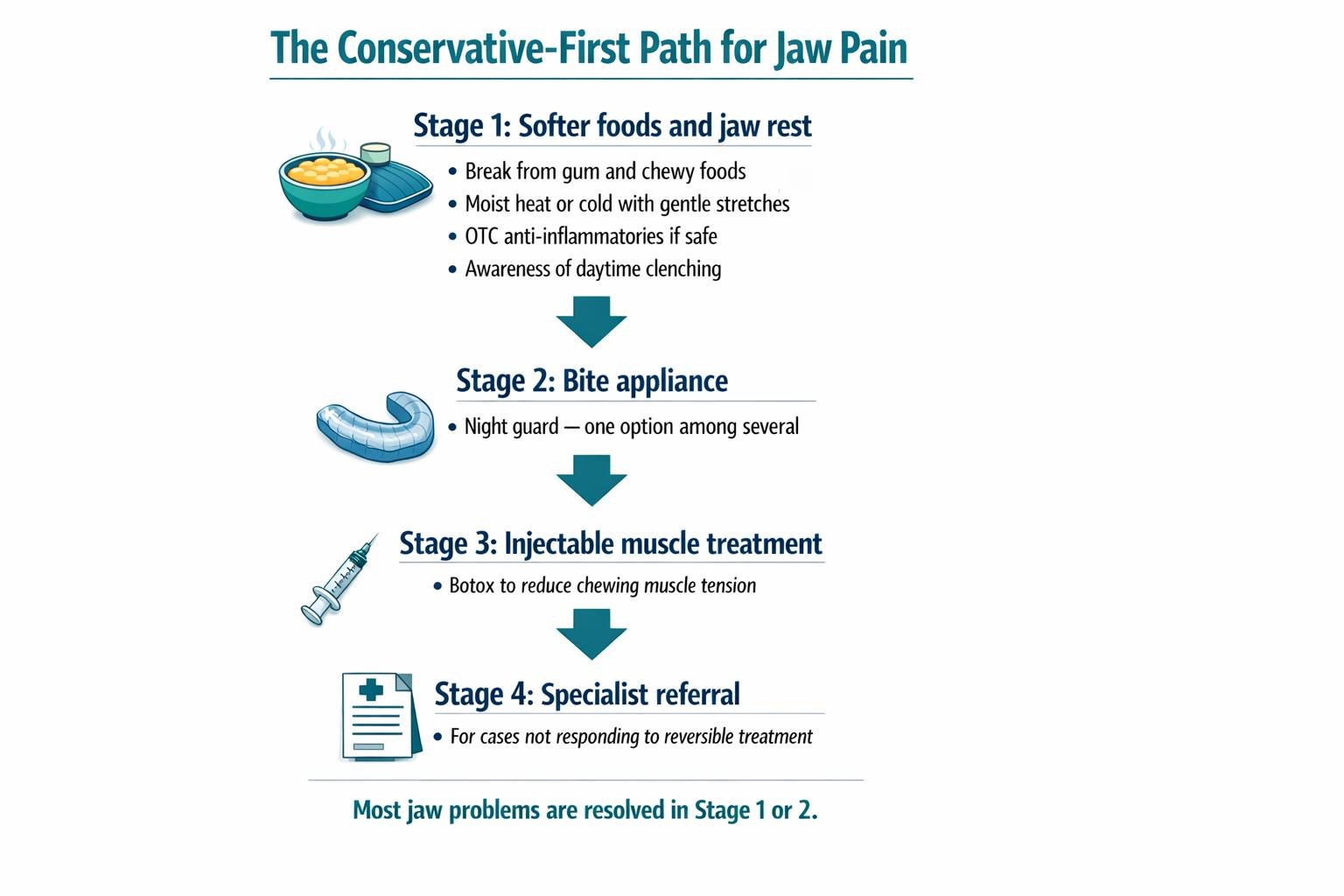
The Conservative-First Path for Jaw Pain
Most jaw problems get handled in the first two stages here. Very few people ever reach the bottom of this list.
Why we start small and reversible
If you have spent any time searching jaw pain online, you have probably seen the worst-case stuff. Surgery. Permanently reshaped teeth. Bite rebuilds that cost more than a car.
That is not where this starts, and for most people it is not where it ends either. The National Institute of Dental and Craniofacial Research notes that most jaw joint and muscle problems are temporary, that conservative care is the recommended first line, and that treatments permanently changing the joint, teeth, or bite should be avoided where possible.
So a first jaw visit is usually an exam, a real conversation, and a short list of things to try that can all be undone:
- Softer foods for a couple of weeks and a break from gum
- Moist heat or cold with gentle, slow opening stretches
- Over-the-counter anti-inflammatories if they are safe for you
- Attention to daytime clenching, which most people do not know they are doing
- A bite appliance in some cases, which is one option among several rather than the automatic answer
I am mentioning appliances only in passing on purpose. We have a separate piece on what a night guard actually does and what it will not fix if that is the road your dentist has already pointed you down.
The point of stage one is relief without changing anything you cannot change back.
Where Botox fits into a jaw conversation
This one surprises people. Most folks only connect Botox with forehead lines, so it catches them off guard when it comes up during a dental exam.
In plain terms, the injections go into the chewing muscles and reduce how hard those muscles can clench. They relax overworked muscle rather than treating the joint itself. For someone whose pain is mostly muscular, that can ease tension and the headaches that ride along with it.
It is not right for everyone. It is not a first move, it is not a substitute for figuring out why you are clenching, and nobody should promise you a specific result.
One of our patients left a review describing how it came up for her: “Learned on my last checkup about Botox for my TMJ. Within a week of having the injections I have noticed a difference in the tension in my jaw.” That is one person’s experience, shared by Y. H., and your mileage may genuinely differ.
The honest framing is that this is a conversation to have after an exam, once we know whether your problem lives in the muscle, the joint, a tooth, or some combination.
Five questions worth writing down before you go in
People leave appointments all the time with the one question they forgot to ask. We had a patient send a message through the website the day after his visit asking whether a recommended guard would interfere with the CPAP machine he uses at night. Good question. Would have been an easier answer in the chair.
Write these down and bring them:
- What do you think is causing this, the joint, the muscles, a tooth, or a mix?
- What are we trying first, and how long before I should expect a change?
- What happens if it does not improve in that window?
- Will this affect anything else I use at night, like a CPAP or a retainer?
- What will today’s visit cost, and what would the next step cost?
On money, I will stay general on purpose because your plan and your situation drive the number. A jaw evaluation is typically billed like any other exam, and imaging, appliances, and injectable options each carry their own separate fee. Coverage varies a lot, and some of this sits in a gray zone between dental and medical benefits.
Ask for a written estimate for your specific situation before you commit to anything. If you are paying out of pocket, this breakdown of how dental costs work without insurance is a better starting point than a number I guess at here. And if you are still deciding where to go, these are the questions worth asking any new office.
Why one building beats three waiting rooms
Jaw pain is one of the few complaints that can bounce a person around for months. The dentist says see your physician, the physician says see your dentist, and somewhere in the middle you get sent out for imaging and come back no clearer than when you started.
Having the exam, the X-rays, appliance options, and injectable muscle treatment available in one place on Bell Road removes most of that back and forth. Nobody has to repeat their story four times.
The other half of it is how the visit feels. The thing reviewers mention most is that our team explains what is happening while it is happening and checks in on comfort along the way, which matters a lot when you already hurt and you are bracing for bad news.
Frequently Asked Questions About TMJ and Jaw Pain
Do you treat TMJ, or do you refer it out?
Jaw pain starts here with an exam. We evaluate the joint, the chewing muscles, and your bite, take digital X-rays if needed, and talk through conservative options. Cases that do not respond to reversible treatment may get referred to a specialist, but that is the exception, not the starting point.
Can jaw pain be caused by a tooth problem?
Absolutely, and it happens more than people expect. A cracked tooth or failing filling makes you chew on one side, and weeks of lopsided chewing can leave the muscles on the other side aching. Treating the tooth sometimes resolves the jaw pain completely.
How long should I wait before calling about jaw pain?
If it is mild and you can still eat and sleep, trying soft foods and jaw rest for a week or two is reasonable. Do not wait if your jaw locks, there is swelling or fever, your bite suddenly feels different, or the pain is keeping you up at night.
Is Botox for jaw tension covered by dental insurance?
Coverage for injectable treatment in the chewing muscles is inconsistent and often falls outside standard dental benefits. Ask for a written estimate before scheduling, and ask whether your medical plan has anything to say about it.
Will a night guard fix my jaw pain?
Sometimes it helps a lot, sometimes it does not touch the problem. A guard protects teeth from grinding forces and can reduce morning soreness, but it does not stop clenching and it will not resolve a joint that is catching. It is one option among several, chosen after an exam.
Can I be seen for jaw pain on a Saturday?
Saturday hours run 8 a.m. to 3 p.m., which is often the easiest slot for working patients and for anyone who does not want to take time off. Weekday mornings open at 7 a.m. as well.
Still Wondering Whether Your Jaw Pain Belongs in a Dental Chair?
If the ache in front of your ear has outlasted a couple of weeks of soft foods and rest, an exam is a reasonable next step, and it does not commit you to anything. Our office on Bell Road keeps weekday hours starting at 7 a.m. and Saturday hours from 8 to 3, which covers most people in Surprise and the surrounding West Valley. You can reach us at 480-795-2420 or read more at westbelldentalcare.com whenever you are ready.