Direct Answer: Many common prescriptions reduce saliva, and less saliva means acid sits on teeth longer. That is why adults over 60 who never had cavities suddenly get several, especially at the gumline.
Someone sits down in my chair who has gone thirty or forty years without a single cavity. We take the X-rays, I do the exam, and they leave with a treatment plan for three or four new ones. Nothing about their brushing changed. Nothing about their diet changed.
What usually changed was a prescription. And the honest explanation starts with saliva, not with willpower.
This comes up constantly in Surprise, where roughly a fifth of residents are 65 or older and whole neighborhoods like Sun City Grand and Sun City are built around active retirees. Below I will walk through why saliva matters so much, why decay after 60 shows up in a totally different spot on the tooth, and what actually moves the needle day to day.
Saliva Is Doing More Work Than You Think
Most people think of saliva as the thing that helps you swallow. It does a lot more than that, and it works around the clock.
Saliva has three jobs that protect teeth:
- Rinsing. It washes food particles off tooth surfaces between meals.
- Neutralizing acid. Bacteria in your mouth produce acid after you eat. Saliva buffers it back toward neutral.
- Remineralizing. It carries calcium and phosphate back into the outer layer of the tooth, repairing tiny soft spots before they become holes.
When saliva output drops, all three of those stop happening at full strength. Acid sits longer. Food sits longer. The daily repair cycle slows down.
So a mouth that is being cared for exactly the same way it always was can start losing ground. The brushing did not get worse. The defense system got quieter.
The National Institute of Dental and Craniofacial Research says the same thing in plain terms in its oral health guide for older adults: medication side effects and dehydration are common causes of dry mouth, reduced saliva raises decay risk, and tooth decay can happen at any age.
The Medication List Is the Part Nobody Connects
Hundreds of common prescriptions and over-the-counter products list dry mouth as a side effect. In the 60-plus patients I see across the West Valley, the usual groups are:
- Blood pressure medications
- Diuretics (water pills)
- Antidepressants and anti-anxiety medications
- Antihistamines, including the ones people take seasonally for desert allergens
- Bladder and overactive bladder medications
The effect stacks. Someone on two or three of these feels it far more than someone on one.
Let me be direct about something, because I know it is the worry: nobody should stop or change a prescription over a dental concern. Those medications were prescribed for real reasons, and your physician is the one who manages them.
My job is to adjust the prevention plan around the medications you need. Not to second-guess your doctor, and definitely not to lecture you about a side effect you did not choose.
Why Decay After 60 Shows Up at the Gumline
This is the part most patients have never had explained to them, and it changes how the whole thing makes sense.
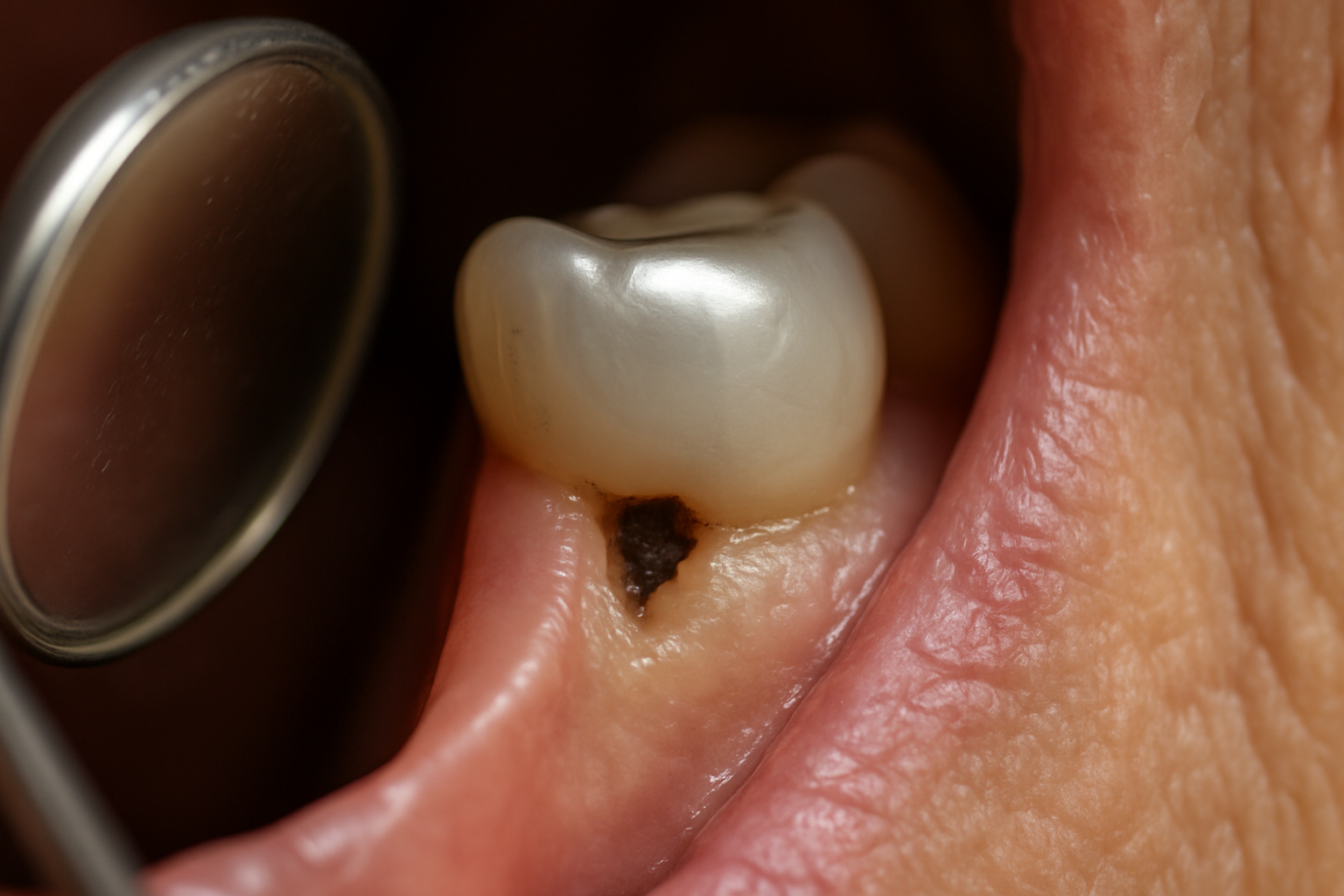
Gums recede a little with age. That exposes root surface, and root surface has no enamel on it. It is covered by a softer tissue called cementum, with dentin underneath.
Enamel is tough. Root surface is not. It starts dissolving at a much milder level of acid than the chewing surface of the tooth does.
So the cavities I find after 60 are usually not in the deep grooves where childhood cavities formed. They show up:
- Right at the gumline, often on several teeth at once
- Around the margins of crowns that have been solid for decades
- At the edges of old fillings, where the restoration meets tooth
- On the tongue side of lower front teeth, where people rarely look
A crown placed in the late nineties almost never fails in the middle. It fails at the margin, where root surface meets the edge of the restoration.
That is also why a tooth can feel perfectly fine and still have a problem. Early cavities do not always hurt, and root decay is especially quiet because it spreads sideways along the gumline instead of straight down.
Common Medication Groups and What We Adjust
This is a general reference, not medical advice about your specific prescriptions. Effects vary a lot from person to person.
| Medication group | What patients usually notice | What we tend to adjust |
|---|---|---|
| Blood pressure medications | Sticky mouth, thicker saliva, waking up parched | Shorter hygiene interval, fluoride review |
| Diuretics | Overall dehydration, dry feeling late in the day | Sipping schedule, gumline check at every visit |
| Antidepressants / anti-anxiety | Persistent dryness, trouble with dry foods | Prescription-strength fluoride, xylitol products |
| Antihistamines | Dryness that comes and goes with allergy season | Timing guidance, rinse choice |
| Bladder medications | Strong dryness, often combined with less water intake | Closer monitoring of crown and filling margins |
The Desert Makes It More Obvious, Not Worse
Surprise sits in a hot, dry stretch of the West Valley, and that matters for how this feels.
Seasonal residents who arrive between October and March from cooler, more humid parts of the country tell me their mouth feels different within the first week. Most assume it is just the desert air.
Usually it is a medication effect the low humidity is making easier to notice. Dehydration and dry air stack on top of an existing side effect. They rarely cause the problem on their own.
I mention this because the assumption leads people to wait. They figure the dryness will settle once they adjust to the climate, and then they are back east by April with decay that started quietly in December.
A Simple Daily Routine for a Dry Mouth
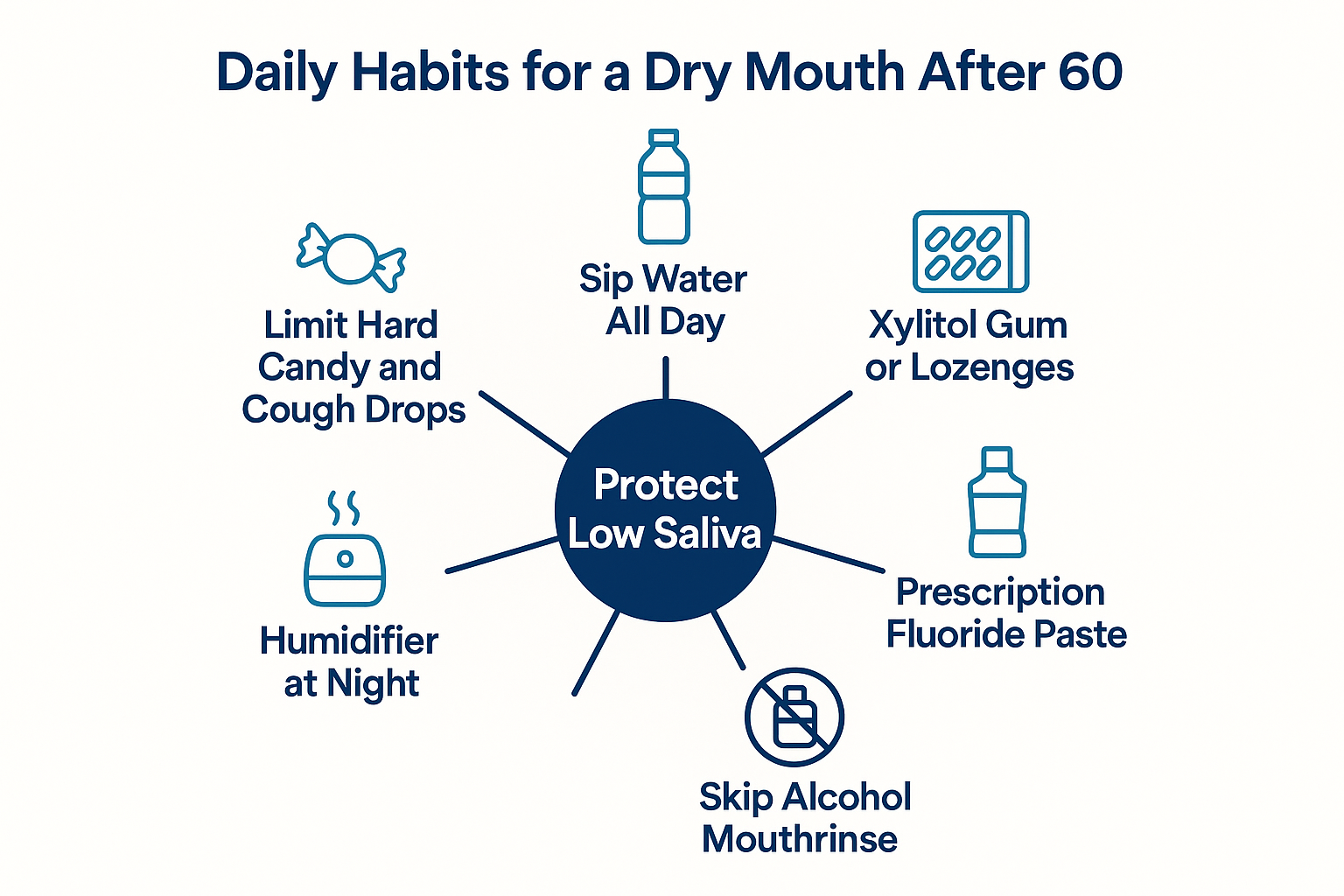
These are the habits I go over with patients whose saliva has dropped off. None of them are expensive, and they work best together.
What Actually Helps, in Order of What I See Working
Here is the practical part, which is probably why you are reading.
- Sip water steadily. A large glass at once mostly passes through. Small sips across the day keep the tissue moist. Keep a bottle in the car, since a drive down Bell Road in July will dry you out fast.
- Sugar-free gum or lozenges with xylitol. Chewing prompts saliva flow mechanically. Xylitol is a sugar alcohol that bacteria cannot ferment into acid.
- Prescription-strength fluoride toothpaste. For patients whose risk has clearly climbed, this is the single highest-value change. It is a different concentration than drugstore paste and needs to be prescribed.
- Drop the alcohol-based mouthrinse. It feels clean for about ten minutes, then leaves the tissue drier than before. Alcohol-free formulas exist.
- Run a humidifier overnight. Mouth breathing during sleep plus low indoor humidity is a rough combination. A bedroom humidifier helps more than people expect.
- Be careful with hard candies and cough drops. Even sugar-free ones sit against the teeth for long stretches. Sugared ones are a slow acid bath on exposed root surface.
One of our patients wrote in a while back simply asking which travel water pick she should buy. I liked that question, because people want a specific recommendation, not a category.
The honest answer is that it depends on grip strength, gum condition, and what you will realistically use every single day. A device that sits in a drawer helps nobody. That is a thirty-second conversation at a hygiene visit, and it is worth having.
Fluoride is also a live topic locally. If you are following the debate over fluoride in Arizona tap water, know that a dry-mouth patient has less margin for error than most.
What to Bring and What to Say at Your Next Visit
Bring a current medication list. Include supplements and anything you take only occasionally, like an antihistamine a few weeks a year.
That list is dental information. With it, our team can explain why your risk level changed and decide whether a three or four month hygiene interval makes more sense than the standard six.
That is a different question from the general “how often should I get a cleaning” question. Here the answer is driven by saliva and exposed root surface, not by habit or an insurance schedule.
And say the thing out loud. “My mouth has felt dry since I started this medication” tells me more in one sentence than a full set of X-rays will.
Patients consistently tell us the visits they value most are the ones where the doctor went through their health history before touching anything. One longtime patient, a man in his late seventies who had avoided dentists for most of his life and had recently been through heart surgery, put it simply: “He discussed in detail my premeds and present health.”
Medication and medical history are not paperwork. They are the explanation.
Frequently Asked Questions About Dry Mouth and Cavities After 60
Should I ask my doctor to change my medication because of dry mouth?
Start by telling your physician that you are experiencing it, but do not stop or adjust anything on your own. Sometimes there is an alternative, sometimes there is not. Either way, the dental side of this is handled by changing the prevention plan, not the prescription.
Is dry mouth just a normal part of getting older?
No. Aging alone does not shut down saliva production. When an older adult has significant dryness, it is usually traceable to medications, a medical condition, or dehydration. That distinction matters because it means something can often be done about it.
Why do I keep getting cavities around my old crowns?
Because the crown itself cannot decay, but the tooth at its margin can. As gums recede, root surface gets exposed right where the crown edge sits, and root surface softens at a much milder acid level than enamel. A thirty-year-old crown that is still solid can sit on top of a tooth that is quietly breaking down at the edge.
I am a snowbird and only here part of the year. Is a shorter cleaning interval even possible?
Usually yes, with some planning. Plenty of our seasonal patients do one visit shortly after arriving in the fall and another before they head back north, then handle the off-season interval with their dentist back home. Sharing records between offices is straightforward.
Will drinking more water fix it?
It helps, but it does not replace saliva. Water rinses. It does not neutralize acid or carry minerals back into the tooth the way saliva does. That is why fluoride and xylitol do heavier lifting than hydration alone for someone with real dryness.
Understanding Your Own Risk Is the Whole Point
If you want a visit where someone reads your medication list before picking up an instrument, that is how our team works, with multiple doctors, comfort options for people who have stayed away a long time, and hours built around retirees and seasonal residents in Surprise and the surrounding West Valley. Weekday mornings start at 7 AM and Saturdays run 8 AM to 3 PM. You can find more at westbelldentalcare.com or reach the office at 480-795-2420.