
Direct Answer: Usually yes. A household can often be booked in one call with consecutive start times, though visits are staggered because a new patient exam takes longer chair time than a routine cleaning.
You are the one who holds the family calendar. You know your daughter needs a cleaning, your husband has not been to a dentist in five years, and your mom in Sun City Grand is due for a checkup she keeps putting off.
What you do not want is to make three separate phone calls and end up with three appointments on three different days. That is the complaint I hear most often from the person doing the booking, and it is a fair one.
So here is how booking back-to-back dental appointments for the whole family actually gets built on our end, what makes it work, and what makes it fall apart. Knowing the mechanics will save you a second phone call.
What makes consecutive family appointments possible in the first place
A back-to-back family block is not a scheduling trick. It is a math problem involving three things: open chairs, how many hygienists are working that day, and how much time each person’s visit actually needs.
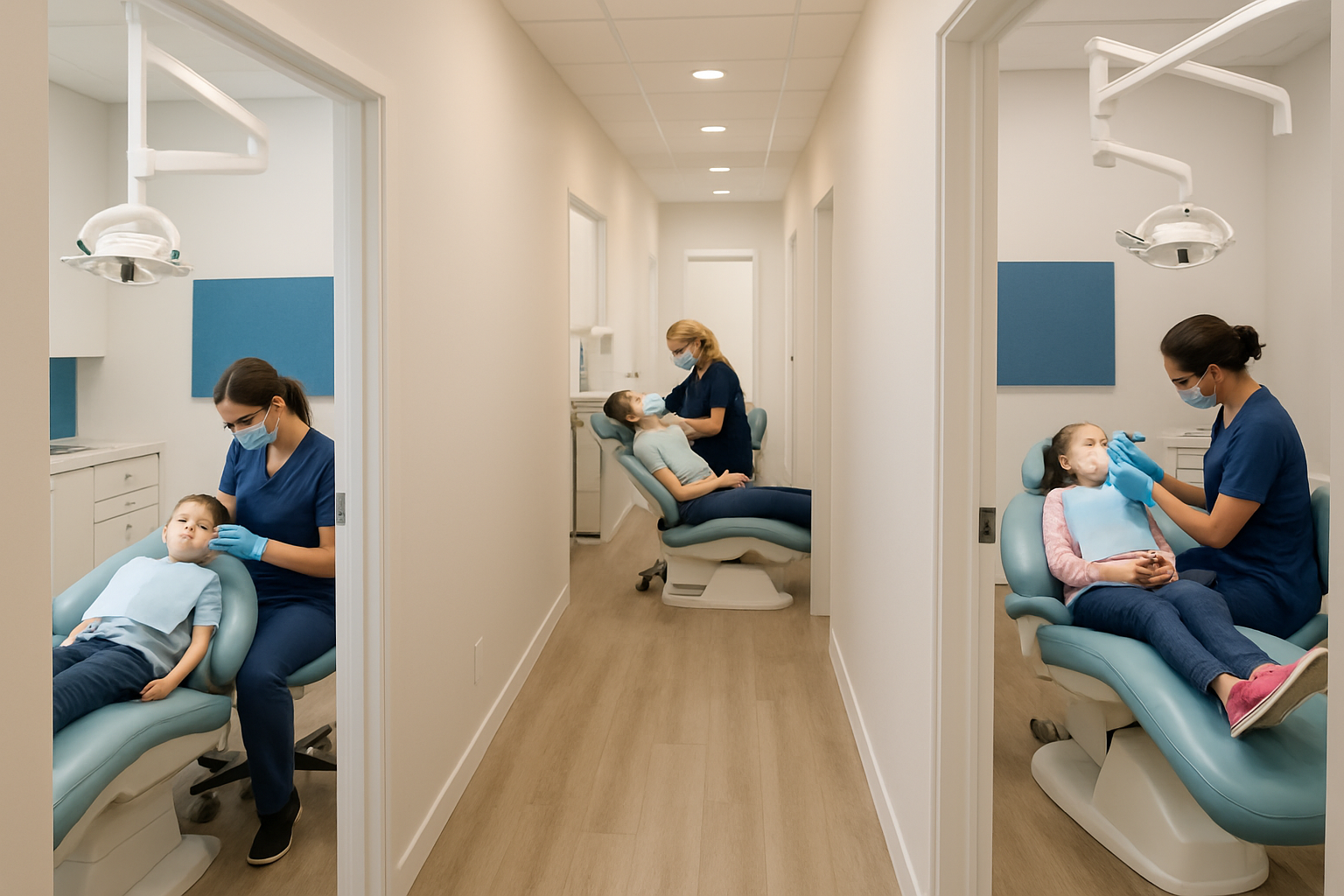
A single-doctor office with one hygienist physically cannot see four people in a row before lunch. A practice running several hygienists at once alongside more than one doctor can, because two or three of your family members can be in different rooms at the same time.
That is the piece most people do not realize when they call. The question is not really “do you have four openings” but “do you have enough chairs and hands at the same hour.”
Here is what changes the shape of your block:
- New patient visits run longer than routine cleanings because they include a full exam and X-rays
- Kids’ cleanings are generally the shortest visit in the group
- Anyone who has not been seen in years needs extra time, sometimes a second visit
- A deep cleaning is a different appointment entirely and often gets split across two visits
Because of that, a household of four usually gets staggered start times, not four identical slots. One person starts at 7:00, the next at 7:30, the next at 8:00. You are in the building the whole time, but nobody is sitting in the lobby for an hour.
Tell the front desk who needs what, up front
The single thing that gets a family block built correctly on the first try is saying out loud what each person needs before any slots get held.
When someone calls and says “I need appointments for three people,” we have to go back and ask who is new, who is a returning patient, and whether anyone is in pain. That back and forth is where the block falls apart.
Try opening the call with something close to this:
- “Two returning cleanings for my kids, one new patient visit for my husband”
- “My mother is new, takes a blood thinner, and has not been seen in about four years”
- “All three of us are new, and one of us has a tooth that is bothering her”
That one sentence lets the scheduler reserve the right amount of chair time for each person and send intake forms to each individual rather than one shared email. Every person needs their own paperwork, including kids.
If you want to understand why the new patient slot is longer, we wrote a plain-language breakdown of why a first visit includes X-rays and an exam rather than just a cleaning.
Roughly How Much Chair Time Each Visit Type Needs
These are general ranges, not promises. Actual time depends on what we find and how long it has been since the last visit.
| Visit type | Typical chair time | Who it usually fits |
|---|---|---|
| Returning cleaning and checkup | About 45 to 60 minutes | Family members already on a schedule |
| Child cleaning and exam | About 30 to 45 minutes | School age kids, often the shortest block |
| New patient exam with X-rays and cleaning | Often 60 to 90 minutes | Anyone new to the practice |
| Someone not seen in several years | Longer, sometimes split in two | Spouses and parents catching up on care |
| Pain or broken tooth visit | Short and focused on one problem | The person who cannot wait |
The hours matter more than the address
For a working household, the real objection is never location. It is that the visit lands on a workday or pulls a kid out of school.
Three slot types tend to solve that, and I would ask for them by name:
- 7:00 AM weekday starts. We open at 7 Monday through Friday. A working couple can be done and back on Bell Road before the commute really builds.
- Evening slots Tuesday through Thursday. We stay open until 7 PM those three days. This is the one I suggest for a parent driving over from Sun City Grand or Sun City who would rather not be out at sunrise.
- Saturday morning, 8 AM to 3 PM. For a family in Marley Park or Surprise Farms juggling weekday sports and work schedules, Saturday is usually the only day everyone is actually free at the same time.
Saturday blocks fill further out than weekday mornings, so if you are aiming for a weekend one-trip visit with three or four people, call earlier than you think you need to.
One patient who moved to Surprise recently put it simply in a review: the office being open six days a week was what made scheduling work for her household.
What to Have Ready Before You Call
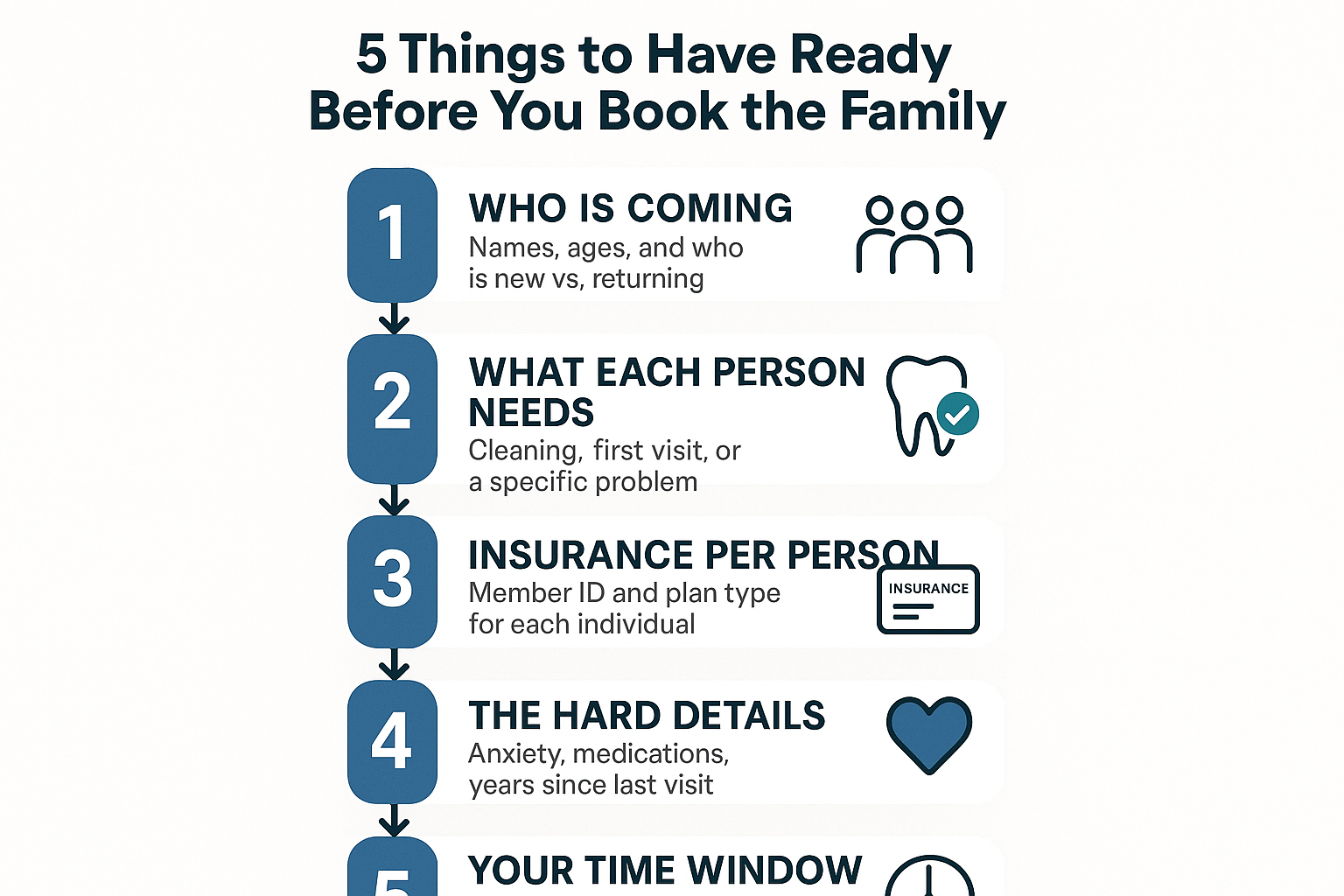
Gathering these five things before you dial is the difference between one phone call and three.
Check coverage person by person, not household by household
This is the step that prevents most of the surprises you are dreading. Insurance has to be verified one person at a time, because a single household can easily be sitting on three different arrangements.
I see it constantly. A kid on a parent’s employer PPO, a spouse on a separate plan through their own job, and an aging parent on a Medicare Advantage plan with in-network-only restrictions. Those are three different verifications, not one.
So bring the member ID and the plan type for every person, not just the policyholder. And know whether each plan is a PPO or an HMO, because that distinction changes everything about what applies. One caller summed up the worry well: she wanted to know whether the plan was a PPO or an HMO because she had run into problems before.
If you are unclear on that difference, this breakdown of in-network versus out-of-network coverage is worth ten minutes.
And if one person’s plan is not accepted, do not hang up and start over at a different office. Ask about self-pay rates and about a dental membership plan in the same call. Membership plans generally run a modest flat monthly or yearly fee covering preventive visits with discounts on other work, and costs vary, so ask for the current numbers directly.
Say the hard part out loud when you book
A lot of the time, the whole reason you are making this call is that one person in the family is frightened, has health conditions, or has avoided a dentist for years out of embarrassment.
Please say so when you book. Nobody is going to react to it, and that information genuinely changes how the appointment gets built: how much time gets reserved, and which provider takes it.
Things worth mentioning:
- “He has not been seen in five years and he is nervous about it”
- “She takes a blood thinner”
- “He was told he needs antibiotics before dental work”
- “She has a hard time with the sound of the drill”
That last category matters more than people expect. Premedication guidance for patients with certain heart conditions or joint replacements is specific, and the American Dental Association’s guidance on antibiotic prophylaxis is what we work from, so we need to know ahead of the visit rather than at check-in.
For the anxious family member, small accommodations do most of the work: blankets, headphones, Netflix, dark sunglasses, and a provider who explains each step before doing it. One patient wrote about bringing in someone with severe dental anxiety during a serious situation: “Dr. Conderato jumped in and knew exactly what needed to be handled first and foremost.”
If that is your situation, this walkthrough of what to expect with dental anxiety at a first appointment is worth forwarding to them before the visit.
What makes a one-trip plan fall apart
I would rather you plan for these than be blindsided on the day.
The most common one: someone expected a quick cleaning and got a longer first visit instead. A new patient appointment includes an exam and X-rays, and that is not optional padding. Build the extra time into your morning.
A short prep list that prevents the rest:
- Request records from the old office about two weeks ahead. Transferring X-rays and visit notes between practices takes longer than people assume.
- Fill out intake forms for every person before you arrive, not in the lobby. Four people doing paperwork at 7 AM wrecks a staggered block.
- Expect a longer window for anyone who has gone years without care. Sometimes that person needs a second visit, and that is normal.
- Ask to go on the cancellation list if the household will not fit into one block. Getting called for a single open morning is often faster than waiting weeks for the perfect four-slot window.
Frequently Asked Questions About Family Scheduling
Can I book everyone in one phone call, or do I have to call separately for each person?
One call. Have each person’s name, date of birth, insurance member ID, and what they need ready, and the whole household can usually be placed in consecutive slots during that single conversation.
Will we all be in the chair at the exact same time?
Usually not, and that is by design. Visits run different lengths, so start times get staggered by 20 to 30 minutes. You are all in the building across one block rather than sitting in the lobby waiting on each other.
What if one family member’s insurance is not accepted but everyone else’s is?
That happens often, especially when an aging parent is on a different plan than the rest of the household. Ask about self-pay rates and the membership option during the same call. There is almost always a straightforward path for that one person without moving the whole family somewhere else.
Can a child and an adult be seen at the same time?
Yes, when enough hygienists are working that hour. Kids’ cleanings tend to be shorter, so a common setup is the child finishing first while a parent is still in the chair.
How far ahead should I book a Saturday family block?
Further ahead than a weekday. Saturday hours run 8 AM to 3 PM and those slots are in demand with working families, so a three or four person block on a Saturday typically needs more lead time than a 7 AM weekday morning.
What if someone in the family is in pain and cannot wait for the group appointment?
Book that person separately and sooner. Pain visits are short, focused appointments aimed at the one problem. Do not delay a tooth that hurts so it can line up with everyone else’s cleanings.
Thinking through a family block in Surprise?
Appointments for more than one family member can usually be arranged in a single conversation, with consecutive slots and forms sent to each person. If you want to look at available dates, or check how a particular plan would work for one member of the household, the team at West Bell Dental Care can be reached at 480-795-2420 or at westbelldentalcare.com.