Direct Answer: A DPPO pays a share of your care whether the office is in or out of network. A DHMO only covers the one office your plan assigns you to, so any other office cannot bill it.
Almost every week, someone calls our front desk and asks the same thing before anything else: do you take my insurance? And most of the time they lead with the carrier name, something like Delta Dental or Cigna or Humana, as if that settles it.
It usually does not. The part that decides whether an office can see you is the two or three letters printed next to the carrier name on your card.
One caller said it better than any brochure could: “Is this a PPO plan you take, or is it HMO? Because I’ve had problems before.” That is the right question, and this article is the answer to it, written for people in Surprise and the rest of the West Valley who are holding a new card and trying to get a yes or a no in one phone call.
The carrier name is not the answer. The plan type is.
Big carriers sell many different products. The same company can sell a DPPO plan to a school district in Surprise and a DHMO plan to a retail employer two miles away, and those two plans behave nothing alike.
Here is the short version of the difference, in plain language:
- DPPO (dental preferred provider organization): the plan pays a percentage of the fee for a covered service. In-network rates are lower for you, and out-of-network care is usually still covered at some level.
- DHMO (dental health maintenance organization): you are tied to a contracted network and, in most cases, assigned to one specific dental office. Care outside that assignment is generally not covered at all.
That split is the whole ballgame. United Healthcare’s own plain-language breakdown describes it the same way: DHMO members are limited to contracted providers, while DPPO members can go in or out of network with partial reimbursement either way.
So when an office tells you no, it is almost never about the carrier. It is about the structure underneath it. If you already know the plan-type letters, a good front desk can usually confirm or rule out your plan in about three minutes.
Why an HMO assignment blocks care, even when the dentist wants to see you
This part trips people up, and I think it is because nobody explains the money behind it.
Under a dental HMO, the insurer pays the assigned office a flat monthly amount per enrolled member, whether or not that person ever walks in. It is called capitation. The office gets that small monthly payment to be responsible for your care, and in exchange it agrees to a set fee schedule.
That is why your benefit follows the office, not you. If you are assigned to one practice and you walk into another, the second office has no contract covering you, no monthly payment for you, and no way to bill your plan for the visit.
So the answer you get is a contract answer, not an opinion about your plan or about you. I say that because a fair number of callers hear “we don’t take that” and go quiet, then hang up, like they did something wrong.
A PPO works the other direction. The plan pays a share of the fee at most offices, which is why PPO patients have real options and why an out-of-network office can still hand you a written estimate. If that distinction is the one you are stuck on, we wrote a separate piece on in-network, out-of-network, or neither that goes deeper on the reimbursement side.

DHMO vs DPPO: What Actually Changes for You
This is the comparison I wish every new patient had in front of them before dialing. Read down the column that matches your card.
| What you’re checking | DHMO | DPPO |
|---|---|---|
| How the plan pays the office | Flat monthly amount per enrolled member, plus a set fee schedule | A percentage of the fee for each covered service |
| Choice of dental office | Usually one assigned primary office | Most offices, with lower rates in network |
| Out-of-network care | Generally not covered | Often covered at a reduced percentage |
| Changing offices | Requires changing your assignment with the plan | You can simply go elsewhere |
| Written estimate from a non-contracted office | Possible, but expect self-pay pricing | Possible, and the plan may pay toward it |
The Medicare Advantage version of this question, for Sun City Grand and Sun City readers
In the West Valley, this is the version most people are actually living. Medicare Advantage dental benefits are set plan by plan and county by county, and the bundled dental piece often carries HMO-style network limits.
We see the confusion in writing all summer. One person asked whether a DentaQuest HMO SNP plan was accepted. Another was checking on behalf of a sister whose Advantage card read “In Network Only, CIGNA DPPO.” Same program, two very different sets of rules.
Two facts live on your plan paperwork, and they change independently:
- The benefit dollars. How much the plan allots for dental each year, and what categories it covers.
- The network rules. Whether you can use that allowance at any office or only at an assigned one.
Read the plan type on the front of the card and the dental section of your Annual Notice of Change together. Both can shift on January 1.
Timing matters right now. Medicare plan details for the coming year become public October 1, and Annual Enrollment runs October 15 through December 7, 2026, for coverage starting January 1, 2027. If you are sorting through plan mail in The Grand or Sun City this fall, our overview of what Medicare actually covers for dental in 2026 pairs well with this one.
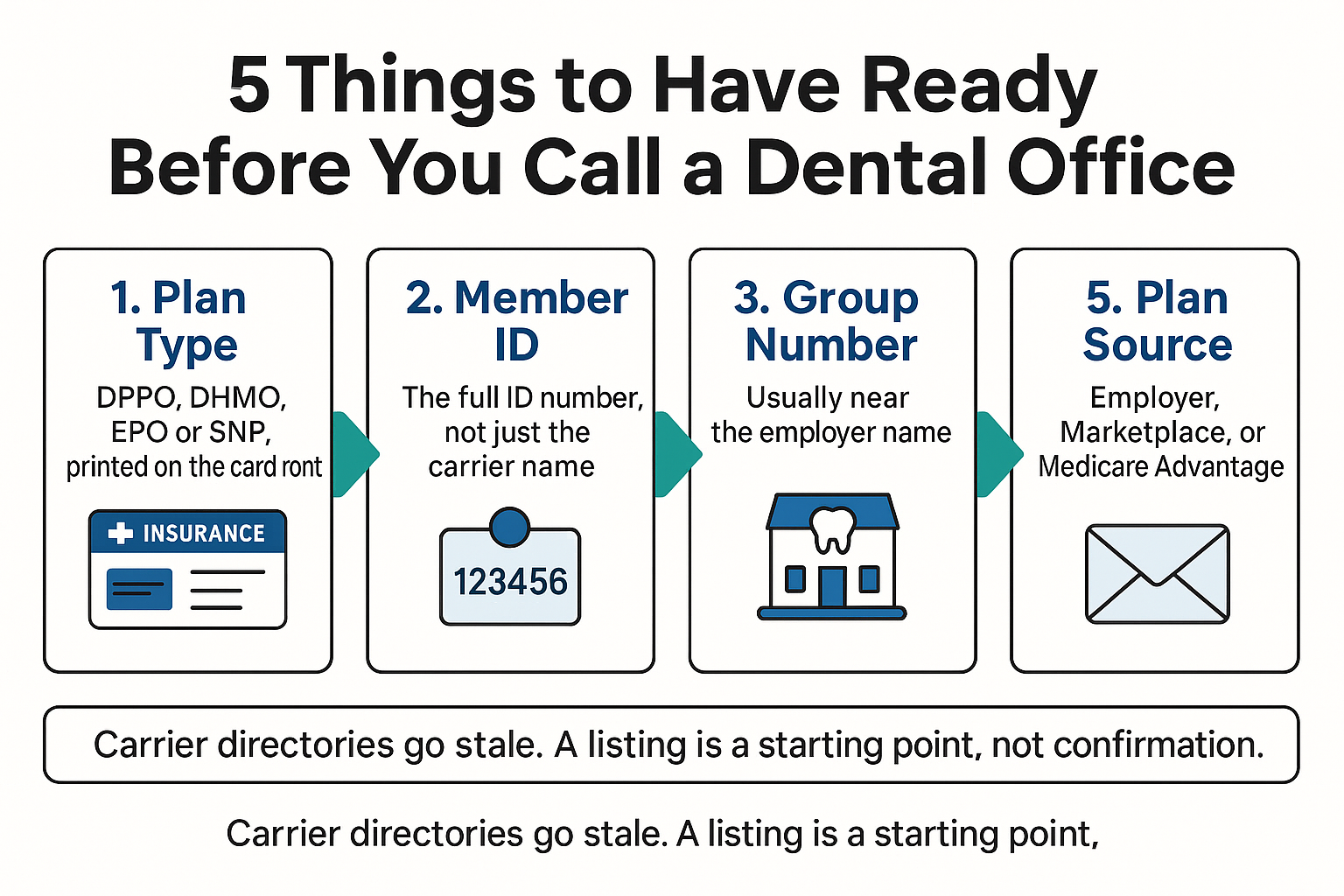
Five Things to Read Off Your Card Before You Call
Have these five details in hand and a front desk can usually give you a straight yes or no in one short call instead of three.
What to do when the answer is no
This is where most people give up, and it is the part worth reading twice. The honest next step depends entirely on which plan type you have.
If you have a DPPO and the office is out of network: ask for a written estimate anyway. The office can usually produce one, and your plan may pay something toward the work. You are comparing two real numbers at that point instead of guessing.
If you have a DHMO: out-of-network care is generally not covered, so there are three realistic paths:
- Change your assigned office during the next enrollment window, or whenever your plan allows an assignment change.
- Pay as a self-pay patient and ask for the full fee in writing before anything is scheduled.
- Look at an in-house membership plan or third-party financing such as a health care credit card with a no-interest period.
A membership plan, in general terms, is a flat monthly or yearly fee that covers your preventive visits and discounts other work, with no deductible and no waiting period. It is not insurance. Ask any office for the monthly figure and, just as important, what it excludes before you sign up. We break down who a dental membership plan actually helps if you want the full picture.
On self-pay pricing, I will not quote you a flat number here, because scope changes everything. A new patient exam with X-rays in the West Valley commonly lands somewhere in the low-to-mid hundreds depending on how many images are needed and whether a cleaning happens that day, and procedures like extractions vary widely by tooth and difficulty. Any office should be willing to give you their actual figure over the phone. Our guide to how dental costs work without insurance walks through what drives those numbers.
One more thing about carrier directories
People find an office in their plan’s online provider search, assume they are set, and then get a surprise at the desk.
Directories go stale. Contracts end, office names change, and the data behind those search tools is not always refreshed on any schedule you can count on.
Treat a directory listing as a starting point and confirm it live. A call that starts with “my plan is a DPPO, here is my member ID and group number, can you verify before I book” gets you a real answer fast.
And if you are brand new here, you are in good company. As one caller put it: “I just moved to the area and need to find a new dentist.” If that is you, it is also worth running through the questions worth asking a new dental office while you have someone on the phone.
Frequently Asked Questions About PPO and HMO Dental Plans
How do I find the plan type on my card?
Look on the front, usually near the carrier logo or under your name, for letters like DPPO, DHMO, EPO, or SNP. If nothing is printed there, check the back of the card or the first page of your benefits booklet. Medicare Advantage cards often print the plan type right under the plan name.
My card says DPPO but also says “In Network Only.” What does that mean?
It means the plan is built on a PPO network but restricts coverage to contracted providers, so it behaves closer to an HMO in practice. That wording shows up fairly often on bundled Medicare Advantage dental benefits. Call the number on the back of the card and ask directly whether out-of-network dental is covered at any percentage.
Can I switch my assigned dental office on an HMO plan?
Usually yes, but on the plan’s schedule, not yours. Many plans let you request an assignment change effective the first of the following month, and others hold you until the next enrollment period. Ask your carrier for the exact process and effective date before you book anywhere.
If an office does not take my plan, is it ever still worth going there?
Sometimes. On a DPPO, out-of-network benefits may cover a meaningful share, and the difference between the two offices can be smaller than you expect once you compare written estimates. On a DHMO, you would be paying full self-pay, so it only makes sense if the membership or financing math works for you.
Does AHCCCS or Mercy Care work the same way?
Arizona’s Medicaid program and its managed care plans have their own network rules and their own limits on what adult dental covers, which is a separate conversation from commercial PPO and HMO plans. The short answer is that not every office contracts with them. Confirm both the network and the covered benefit before scheduling.
Getting a Straight Answer on Your Plan
Patients who have recently relocated to Surprise tell us the same thing over and over, that the scheduling process was quick and easy. Our team can check a plan while you are on the phone and, if it turns out we are not a fit for it, explain the self-pay and membership options in that same conversation rather than leaving you at a dead end. If you are in Marley Park, Sun City Grand, or anywhere in the West Valley and want your coverage sorted out before you commit to anything, the office is reachable at 480-795-2420, with weekday hours starting at 7 AM and Saturday availability from 8 AM to 3 PM.