Direct Answer: No. For plan year 2027, CMS prohibits Marketplace issuers from counting routine non-pediatric dental services as an essential health benefit. Adults can still buy dental coverage, just not as a required medical plan benefit.
Every fall I get the same question at the front desk from patients in Sun City Grand, Marley Park, and Surprise Farms. They are about to pick a health plan and they want to know whether the dental part is finally included.
For 2027, the answer got clearer, and not in the direction a lot of people were hoping. CMS finalized a rule that blocks Marketplace issuers from counting routine adult dental services as an essential health benefit. It takes effect with plan year 2027, which people choose during open enrollment starting in November 2026.
I want to walk through what that actually says, who in the West Valley it touches, and what I would check before clicking “enroll.” This is not the end of adult dental coverage. It just means the coverage has to come from somewhere other than your medical plan.
Is adult dental an essential health benefit in 2027 Marketplace plans?
No. In the HHS Notice of Benefit and Payment Parameters for 2027 final rule, CMS finalized a prohibition on issuers including routine non-pediatric (adult) dental services as an essential health benefit.
That reverses the policy finalized in the 2025 Payment Notice, which would have let states add adult dental benefits to their essential health benefit benchmark plans beginning in 2027. CMS said the reversal better lines up with the statute, which directs that the scope of essential health benefits match what a typical employer plan provides.
A few specifics worth holding onto:
- The rule was announced May 15, 2026 and applies to plan year 2027, starting January 1, 2027
- It covers individual and small-group Marketplace coverage
- You pick those plans during open enrollment beginning November 2026
- Pediatric dental is a separate category and is not what this rule changed
And here is the part people skip. The rule does not say adults cannot buy dental coverage or cannot get dental care. It governs what a Marketplace plan is allowed to treat as an essential health benefit. You can read the CMS fact sheet on the 2027 final rule directly. ADA News reported on the same change in May 2026.
Who this actually hits in the West Valley
Most of my patients are not affected at all. If you have dental through an employer, through a retiree plan, or through a Medicare Advantage plan, nothing about this rule changes your card.
The group I think about is narrower and very common around Surprise:
- Early retirees between 60 and 64 who left work before Medicare and buy their own coverage
- Self-employed and contract workers who shop the Marketplace every November
- People who retired early from out of state and moved into Sun City or The Grand without a retiree dental benefit
- Snowbirds and seasonal residents who carry individual coverage year-round and split time between Arizona and somewhere colder
These are the folks who might assume a 2027 medical plan quietly picks up cleanings, fillings, crowns, and root canals. It will not. Those stay outside the medical plan.
If you are already on Medicare, this rule is not your rule. Your questions belong in the Medicare lane instead, and your annual notice is where the answers live. I wrote separately about what the dental section of your 2027 Medicare notice is telling you, because that is a different set of trims to watch.

What to do during open enrollment instead
If dental matters to you, treat it as its own line item in your November shopping, not as a bonus you hope to find inside the medical plan.
There are really three doors:
- A standalone dental plan bought through the Marketplace or directly from a carrier
- A membership or discount arrangement through a dental office, usually a flat monthly or yearly fee
- Paying cash and budgeting around it, often with financing for larger work
Standalone dental plans are the most familiar option, and they come with the same fine print they always have. Annual maximums, waiting periods for major work, and a percentage split that gets less generous as the procedure gets bigger.
Before you sign up, I would call the carrier and ask the plain questions: what is the annual maximum, is there a waiting period for crowns or root canals, and which Surprise offices are in network. I put together a list of questions to ask your insurance before your dental benefits change for exactly this conversation.
And check the network question specifically. A plan that pays well on paper and pays poorly at the office you actually want to visit is a plan that will frustrate you by March. The difference between in network, out of network, and neither shows up on your bill, not in the brochure.
Where adult dental coverage can come from in 2027
Here is how the main paths compare for a Surprise adult who is not yet on Medicare. Specifics vary by carrier and plan, so confirm details before you enroll.
| Coverage path | What it generally handles | What to verify first |
|---|---|---|
| Marketplace medical plan (2027) | Not routine adult dental. The rule bars issuers from counting it as an essential health benefit | Whether pediatric dental is bundled for kids on the plan |
| Standalone dental plan | Cleanings and exams, with a percentage split on fillings, crowns, and root canals | Annual maximum, waiting periods, in-network offices near Surprise |
| Employer or retiree dental | Usually the broadest coverage, unchanged by this rule | Whether the plan follows you into retirement |
| Dental membership plan | Preventive visits plus a discount on other care, no deductible or waiting period | What is included, what is only discounted |
| Cash pay with financing | Anything, on your own timeline | Written estimate before treatment, and financing terms |
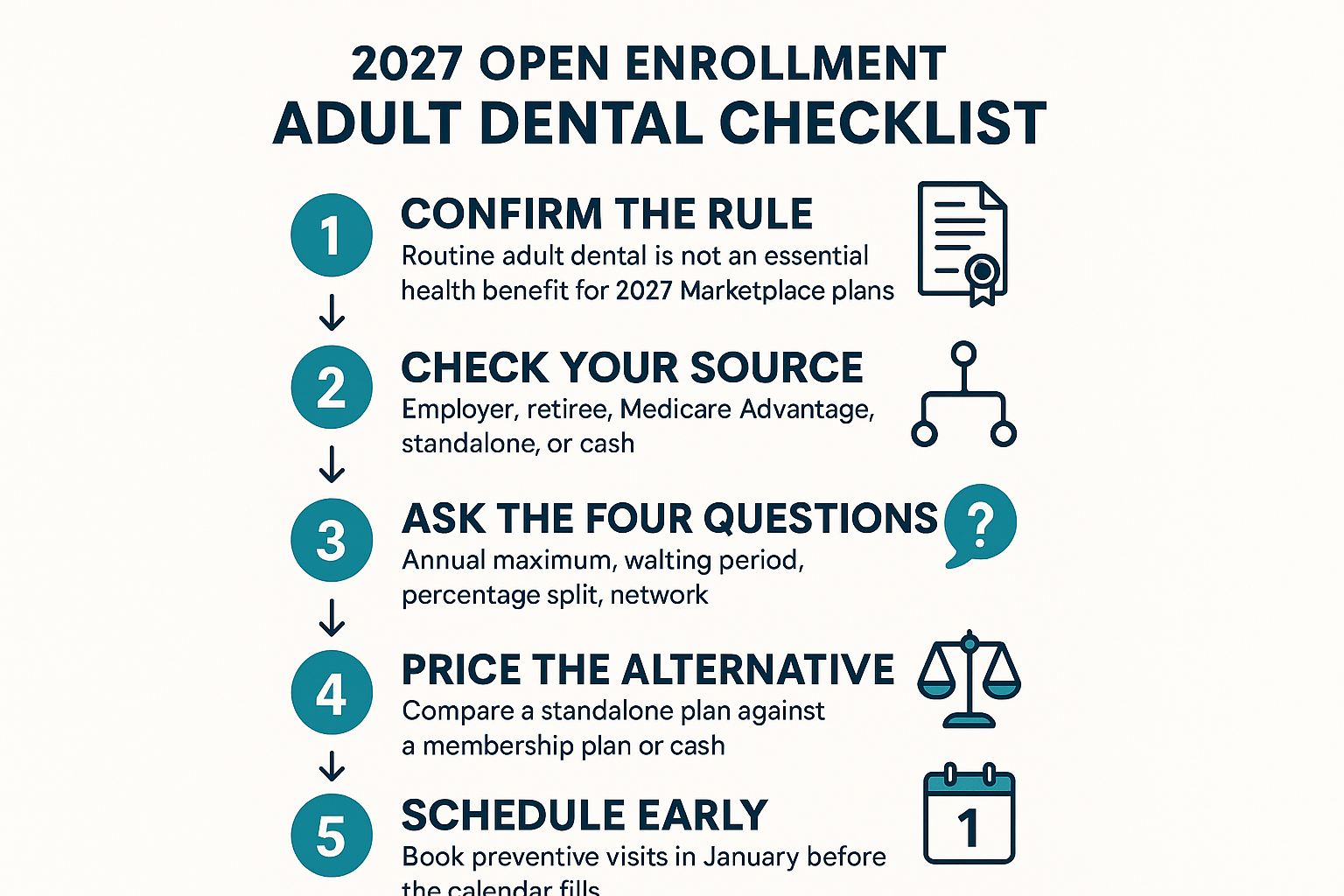
Your 2027 open enrollment dental checklist
Five things I would confirm before locking in a 2027 plan. Run through these in order.
Thinking about cost without guessing
The question I hear most on the phone is not about rules. It is some version of “what does this cost if I am paying myself.”
I will not pretend there is one number. Costs move based on what the exam finds, how many X-rays are needed, and whether a tooth needs a filling, a crown, or a root canal first. But I can tell you the shape of it.
- A new patient exam with X-rays in our office generally lands somewhere in the $145 to $225 range depending on scope
- Extractions typically start around $300, and go up with complexity
- Crowns and root canals vary widely and always need a written estimate first
Those are our general self-pay ranges, not a quote. Call us and we will tell you what your specific situation looks like before you commit to anything.
Two things take the sting out of paying cash. One is a dental membership plan, which covers preventive care for a flat fee with no deductible and no waiting period. The other is an HSA or FSA, which most people underuse. Here is what dental work qualifies for FSA and HSA dollars.
And honestly, the cheapest version of 2027 is the one where you keep going to cleanings. Small problems stay small.
Frequently Asked Questions About Adult Dental and 2027 Marketplace Plans
Does this mean I cannot get dental coverage in 2027?
No. You can still buy dental coverage as an adult. The rule only governs what a Marketplace plan may treat as an essential health benefit, not what you are allowed to purchase. Standalone dental plans, employer dental, and membership plans are all still available.
What about dental coverage for my kids?
Pediatric dental sits in a different category and is not what this change addressed. The prohibition CMS finalized applies to routine non-pediatric, meaning adult, dental services. Check how your specific plan handles the pediatric piece, since it can be bundled or sold separately.
When exactly does this start?
It applies to plan year 2027, effective January 1, 2027. The rule was announced May 15, 2026, and the plans it governs are the ones people select during open enrollment beginning in November 2026.
I am on AHCCCS. Does this affect me?
This rule is about individual and small-group Marketplace coverage, so it is a different program from AHCCCS. Adult dental under AHCCCS has its own limits and its own gaps worth understanding separately.
Is it worth buying a standalone dental plan if I only go in for cleanings?
Sometimes, sometimes not. Run the math on the premium for a full year against what two cleanings and an exam would cost you out of pocket. For patients who mainly need preventive care, a membership arrangement often pencils out closer than people expect, while a standalone plan tends to earn its keep when major work is likely.
Sorting out your 2027 dental coverage in Surprise?
If you are weighing a standalone plan against paying cash and you want a straight read on what your situation would cost here, we are happy to talk it through at 480-795-2420. Our team sees patients across Surprise and the West Valley with weekday hours starting at 7:00 AM and Saturday appointments, so the conversation does not have to cost you a workday. No pressure either way, just clear numbers before you enroll.