
Direct Answer: Find the crown, rinse it and your mouth with warm water, and store it in a small container. Never use super glue. Call a dentist within a few days, same day if there is pain or swelling.
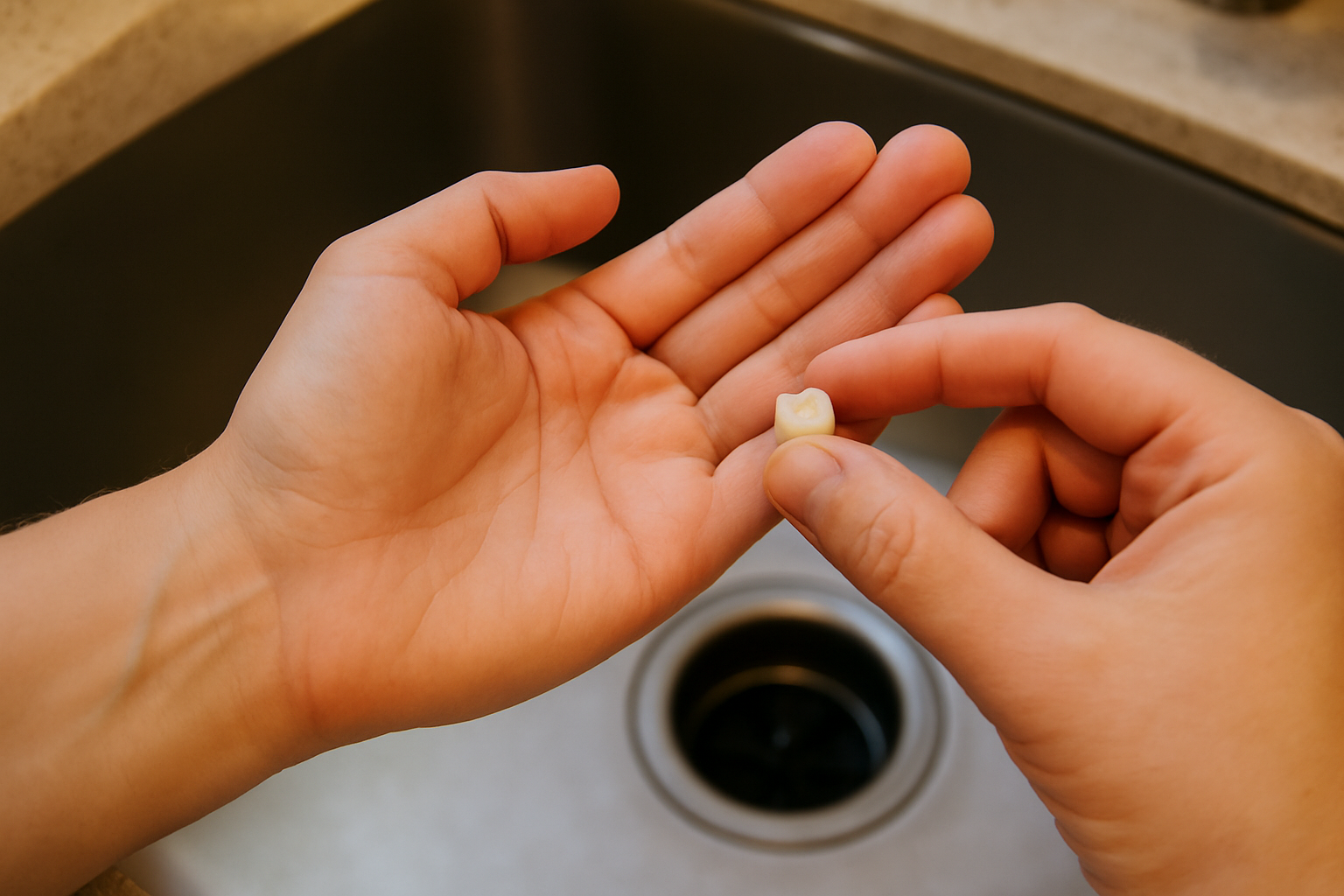
It almost never happens at a convenient hour. You bite into a caramel, a bagel, or a piece of steak, and suddenly there is something small and hard in your mouth that is definitely not food. You spit it into your hand and there it is, your crown.
This is one of the most common urgent calls we take. Roughly one in seven people who call us is in active discomfort, and a lost crown is right at the top of the list alongside cracked teeth and post-extraction problems. Most callers say some version of the same thing: they want to be seen soon and they want to know if they just ruined something expensive.
So this article is not a lesson on what a crown is. It is about the gap between the moment it came off and the moment you sit in a chair, and what you should actually do with the hours in between, whether you live in Marley Park or you just landed in Sun City Grand for the season.
The First Hour: What to Do When a Dental Crown Falls Out
Do these things in order. It takes about ten minutes and it protects your options later.
- Find the crown. This matters more than people think. The two places crowns disappear are down the sink drain and down your throat. Stop, look, and get it in your hand before you do anything else.
- Rinse your mouth with warm water. Warm, not hot. The tooth underneath is going to be touchy about temperature.
- Rinse the crown gently under warm water and pat it dry. Do not scrub it with a brush or toothpaste.
- Store it in a small container or a sealable bag. A pill bottle, a contact lens case, a snack bag. Anything with a lid.
- Bring it with you to the appointment. An intact crown can often be cleaned and re-cemented instead of remade, which is usually the faster and less involved path.
One more thing. If it hurts, a cold compress on the outside of your cheek helps, and over the counter pain relief taken as directed is fine for most people. The ADA’s patient guidance on dental emergencies also warns against a home remedy that still makes the rounds: do not place an aspirin against the tooth or gum. It burns the tissue and does nothing for the pain.
The One Mistake People Make: Reaching for the Glue
I have seen super glue, model glue, and once a dab of household epoxy. Please do not. Those adhesives are not meant for the mouth, they are not safe to swallow, and the real problem is what they do to the crown.
Glue fills the inside of the crown with a hard layer that has to be drilled out. Sometimes it cannot be cleaned up at all, and a crown that could have been re-cemented in one short visit now has to be remade from scratch. That turns a small problem into a big one.
If you need to hold it in place for a day or two, here is the safer route:
- Pharmacy temporary dental cement works for a clean, undamaged crown that seats fully with no pressure.
- Denture adhesive is a reasonable backup if temporary cement is not available.
- If it does not seat easily, leave it out and keep it in the container instead. Forcing it can crack it.
Either way, this is a stopgap and not a repair. A temporarily seated crown can come loose again while you sleep, so take it out at night if you are worried about swallowing it.
In the meantime, chew on the other side, stick to softer foods, and skip anything sticky or crunchy. And keep flossing around the exposed tooth. Go gently and pull the floss out sideways rather than snapping it up, but do not skip it. Exposed tooth structure picks up decay fast.
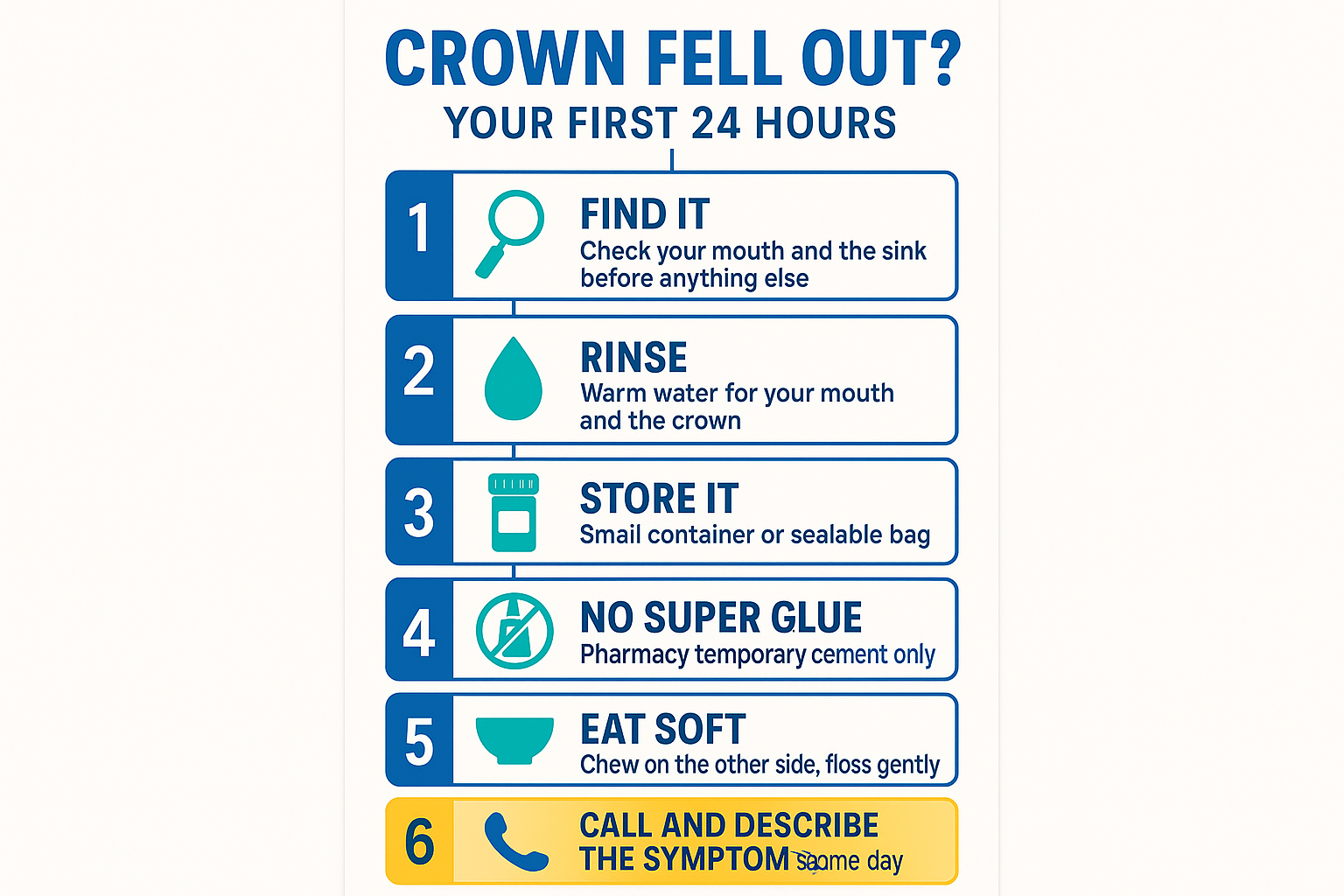
The First 24 Hours at a Glance
Here is the whole sequence in one place, from the moment the crown comes off to the phone call.
Is This an Emergency or Just an Inconvenience?
This is the question almost everyone asks, and the honest answer is that it depends on what came off with the crown and how you feel right now.
A crown that popped off cleanly with no pain is not a crisis. But it still needs attention within a few days, not a few months. The tooth underneath was shaped down to hold that crown, so it has thin walls, it reacts to hot and cold, and it is wide open to new decay. Waiting also lets the neighboring teeth drift just enough that the old crown no longer fits.
Things change when you have any of these:
- Throbbing pain that does not settle with over the counter medication
- Facial swelling, or swelling near the jaw or under the eye
- Bleeding that will not stop
- A chunk of tooth that came off still stuck inside the crown
- A bad taste or drainage around the gum
That last one on the list changes what the fix involves, because if part of the tooth left with the crown, there is less structure to cement anything back onto.
When you call, describe the symptom out loud. Say “it came off clean and it does not hurt” or say “it is throbbing and my cheek is puffy.” That one sentence is what lets the front desk decide whether you need a slot this morning or a slot this week. If it happens after hours, it is worth knowing your real options for tooth pain on a weekend before you panic.
How Fast Should You Be Seen?
Use this as a rough guide when you are deciding whether to call now or in the morning.
| What you are experiencing | What it usually means | How soon to be seen |
|---|---|---|
| Crown off clean, no pain, tooth looks intact | Cement failure, tooth likely sound | Within a few days |
| Cold or air sensitivity only | Exposed dentin, normal after a crown comes off | Within a few days |
| Dark or soft spot visible on the tooth | Decay at the margin, likely needs a rebuild first | This week |
| Tooth piece attached to the crown | Fracture, repair plan changes | Same day or next morning |
| Throbbing pain, swelling, or drainage | Possible infection | Same day, call right away |
Why Crowns Come Loose, and What That Means for the Repair
The cause matters, because the cause decides the fix and the fix decides the cost.
Four things account for most of what I see:
- Cement wears out. Crowns are not permanent hardware. The cement layer breaks down over years of chewing, temperature swings, and acid.
- Decay at the margin. That is the seam where the crown meets the tooth. Decay there loosens the seal from underneath.
- Night grinding. Steady sideways force on a crown will work it loose eventually, and plenty of people grind without knowing it.
- Sticky food. November and December are busy months for this. Caramel, taffy, and toffee pull harder than you would guess.
If the tooth underneath is sound, re-cementing is the least involved path and the shortest visit. If there is decay or a fracture, the tooth may need to be rebuilt before anything goes back on, and sometimes a new crown is the only honest answer.
That is exactly why written estimates for the same problem vary so much between two people. I would rather see the tooth, take an X-ray, and hand you an itemized estimate before anything starts than quote a number over the phone that turns out to be wrong. If you do end up needing a new one, it helps to know how a crown gets made in a single visit and what the first two weeks with a new crown feel like.
If You Are a Winter Visitor and Your Dentist Is 2,000 Miles Away
Surprise fills up between October and March, and a lot of the people calling me about a loose crown had it placed in Minnesota, Michigan, or Alberta. The first thing they usually ask is whether they have to wait until April.
You do not. A crown placed somewhere else can still be cleaned and re-cemented here, and a tooth sitting bare for five months is a much bigger problem than a visit in January.
Before you call, round up what you can:
- The crown itself, in its container
- The name and city of the practice that placed it
- Roughly when it was done, even if it is just “about six years ago”
- Any recent X-rays, which your home office can almost always send electronically the same day
None of that is required to be seen, but it speeds things up and it helps us figure out whether this crown has a history of coming loose. If you are splitting the year between two states, it is worth reading up on how seasonal residents keep dental care on track and what happens to your old X-rays and records when you have two offices in the mix.
Frequently Asked Questions About a Crown That Fell Out
Can I just put the crown back in myself?
Sometimes, temporarily. If the crown is clean, undamaged, and slips back on without force, pharmacy temporary dental cement can hold it for a day or two. If you have to push hard to seat it, stop and leave it out. And never use super glue.
I swallowed my crown. Is that dangerous?
For most people it passes without trouble, though you should mention it when you call. The bigger issue is that you now need a new crown instead of a re-cement, so bring what details you have about when and where the original was placed.
How long can I leave the tooth uncovered?
A few days is reasonable. Weeks is not. The prepared tooth underneath has thin walls and no enamel protection on the chewing surface, so it is vulnerable to decay, cracking, and drifting neighbors. The longer it sits open, the more likely the old crown stops fitting.
Will I need a whole new crown, or can the old one go back on?
It comes down to what is underneath. If the tooth is sound and the crown is intact, re-cementing is usually the answer. If there is decay at the margin or a piece of tooth broke off with it, the tooth gets rebuilt first and a new crown may be needed. That is why the estimate has to come after the exam, not before.
Does dental insurance cover putting a crown back on?
Many plans do cover re-cementing, though it is often treated differently from a brand new crown, and some plans limit how often a crown can be replaced. Coverage varies a lot by plan, so it is worth asking the office to verify your benefits before treatment rather than guessing.
A Note on Getting Seen
Two things come up over and over in our reviews: getting in quickly, and crowns being made right here in the building instead of over two or three visits. As one patient put it, “They have a very cool machine that will make your Permanent crown in a little over an hour.”
Our weekday mornings start at 7 AM, Tuesday through Thursday we are here until 7 PM, and Saturday runs 8 AM to 3 PM, which means a crown that comes off on a Friday evening in Surprise does not have to sit until midweek. If you want to talk it through, our team at West Bell Dental Care is reachable at 480-795-2420 or at westbelldentalcare.com.