Direct Answer: In-network means the office has a contracted rate with your carrier. Out-of-network usually still pays something, just less. A third option exists too: the plan simply is not accepted.
You have the card in your hand. You are about to call a dental office, and you already know the first thing out of your mouth: “Do you take my insurance?” You do not want to waste the call, and you really do not want to sit in a chair and get surprised at checkout.
I hear that question constantly. It opens roughly 18% of our incoming calls, and our website messages arrive week after week naming a specific carrier: Delta Dental PPO, Blue Cross Blue Shield of Arizona, Cigna, GEHA, United Concordia, Mercy Care, AHCCCS.
Here is the part most people never think to ask about. That question has three possible answers, not two, and knowing which one applies to you changes everything about what you pay.
Why “Do You Take My Insurance?” Has Three Answers Instead of Two
Most callers assume it is a yes or no. It is closer to a yes, a maybe, and a no.
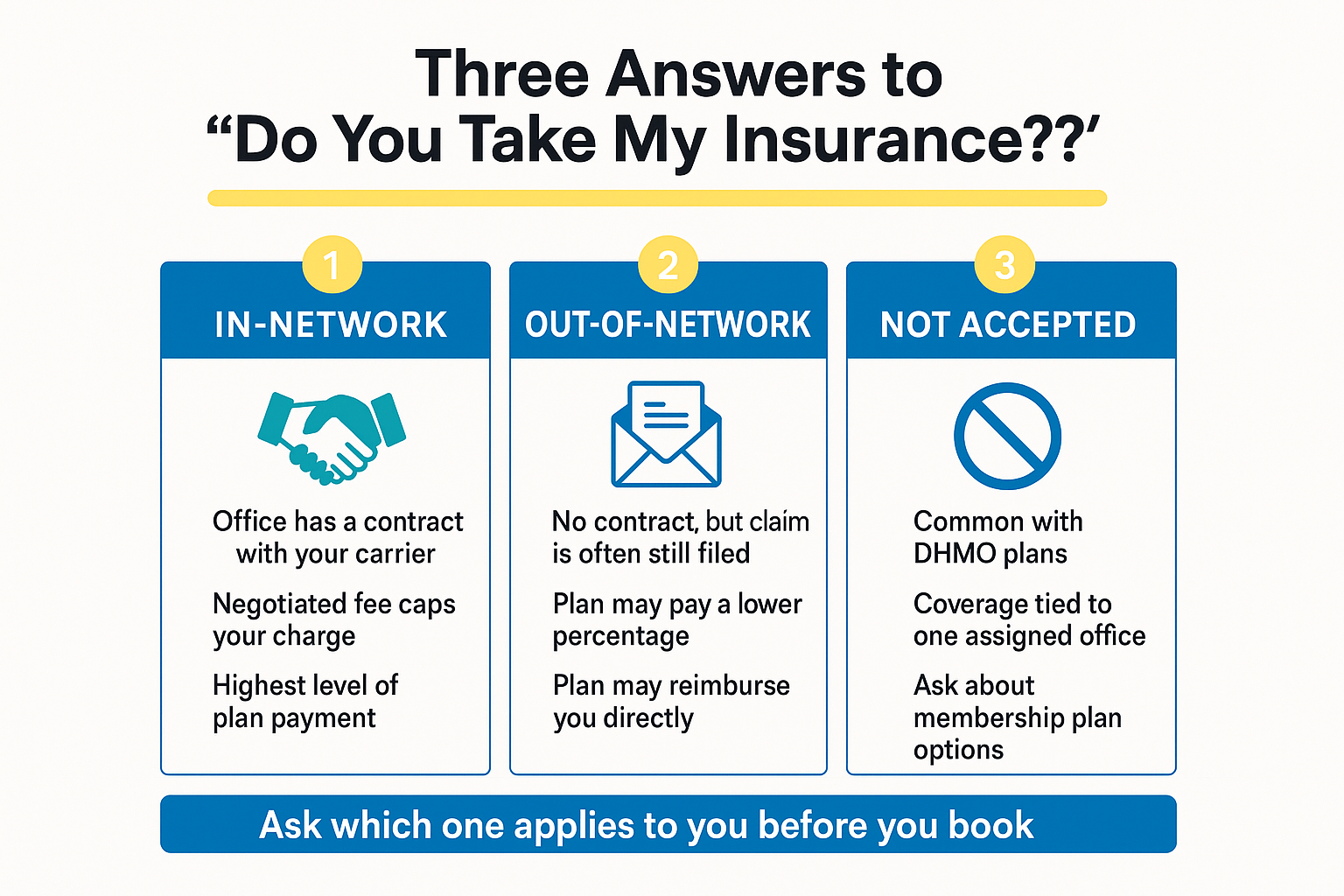
- In-network. The office has signed a contract with your carrier and agreed to a set fee schedule. That negotiated rate caps what you can be charged for a covered procedure, even if the office’s regular fee is higher.
- Out-of-network but the claim still gets filed. The office has no contract with your carrier, but they will still submit the claim on your behalf. Your plan may pay a lower percentage, or reimburse you directly instead of paying the office.
- Not accepted at all. Some plans, particularly certain DHMO and managed-care products, only pay when you are treated at the one office you were assigned to. If you are not assigned there, the plan pays nothing.
That middle answer is the one people miss. When a front desk says “we are not in-network with that plan,” a lot of callers hear “you get nothing here” and hang up.
Sometimes that is true. Often it is not. The right follow-up question is: are you out-of-network, or do you not accept this plan at all?

What Should I Have Ready Before I Call Any Dental Office?
A verification call takes about two minutes when you have the right information, and about three days of phone tag when you do not. Before you dial any office in the West Valley, pull the card out and have this in front of you:
- The carrier name exactly as printed, since carriers run many different products under one brand
- The plan or group number
- The subscriber’s date of birth, which is often a spouse or parent rather than the patient
- The plan type: PPO, DHMO, or a dental rider attached to a Medicare Advantage plan
That last one matters more than people expect. A PPO gives you freedom to pick an office and simply pays less if that office is out-of-network.
A DHMO usually requires you to be assigned to one specific office before any visit is covered. If you have not called your carrier and changed that assignment, you can walk into a wonderful office and still owe the full fee.
If your coverage rides along with a Medicare Advantage plan, the dental piece is a separate benefit with its own rules. I wrote more about how those benefits work in Medicare and Your Dental Bills: What Is Actually Covered in 2026.
How the Common Plan Types Actually Behave
This is a general breakdown of how these plan structures usually work in Arizona. Your specific plan document always wins over any summary.
| Plan type | How network status works | What usually trips people up |
|---|---|---|
| PPO | Pays a higher percentage in-network, a lower percentage out-of-network, and often still pays something either way | Assuming out-of-network means zero coverage |
| DHMO | Typically pays only at the one office you are assigned to | Not calling the carrier to change the assigned office first |
| Medicare Advantage dental rider | Varies widely by plan, with its own annual allowance separate from medical | Expecting original Medicare to cover routine dental, which it generally does not |
| Arizona Medicaid (AHCCCS), members 21 and older | Adult dental is limited to medically necessary emergency care | Assuming routine cleanings are included when the benefit is built around pain and infection |
The Plan Details That Surprise People After the Visit, Not Before
Network status gets all the attention. The four items below are what actually decide your bill.
- Annual maximum. Most plans cap what they will pay in a benefit year. Once you hit it, the rest is yours.
- Deductible. A set amount you pay before the plan starts contributing, often waived for preventive visits.
- Waiting periods. Many plans make you wait months before covering crowns, bridges, or dentures.
- Frequency limits. Two cleanings per benefit year is the common one. A third visit in the same year may be entirely out of pocket even though it is clinically reasonable.
Most dental plans run on a calendar benefit period that resets January 1, and unused benefit does not roll over. That is why fall turns into the practical planning window for anyone in Sun City Grand or Sun City who has been sitting on a crown or a bridge recommendation since spring.
Arizona’s Medicaid program runs on a different clock entirely. For AHCCCS members 21 and older, adult dental coverage is built around medically necessary emergency care, capped at $1,000 per member per contract year, with the year running October 1 through September 30 and no rollover of unused benefit, according to the AHCCCS emergency dental benefit guidance.
I mention that as general Arizona context, not as a statement about which plans any one office accepts. Always verify your own coverage directly.
The Three Answers, Side by Side
Here is the same three-answer framework laid out visually, so you know which follow-up question to ask on your next call.
What If I Have No Insurance at All, or the Plan Is Not Accepted?
This caller phones us every single day, and they are usually bracing for a number. One put it plainly: they just wanted a ballpark before booking so they would not come in and get surprised.
I respect that completely. So let me explain what actually drives the cost of a first visit instead of pretending there is one flat price:
- The exam itself, and whether it is a full new patient evaluation or a focused look at one problem tooth
- Digital X-rays, since a full series costs more than a couple of targeted images
- The type of cleaning, which nobody can determine until the gums are measured
That last point is the big one. A standard cleaning and a deeper periodontal cleaning are different procedures with different fees, and an honest office will not quote you the cheaper one sight unseen.
In-house membership plans exist as a different structure altogether. Generally they work as a monthly or yearly fee that includes preventive care and applies a discount to other treatment, with no deductible and no waiting period. I broke down who that actually helps in What a Dental Membership Plan Is and Who It Actually Helps, and walked through the broader math in No Dental Insurance in Surprise? Here Is How the Costs Actually Work.
For an exact figure, call the office with your situation. Every plan and every mouth is different, and a real number beats a guessed one.
I Just Moved to Surprise. Does My Old Plan Follow Me?
“We just moved to the area and need a new dentist for the whole family” is a phrase I read over and over, whether it comes from a family settling into Marley Park or a couple who spent twenty years with the same dentist in another state.
Here is the general pattern with coverage:
- A national PPO often follows you across state lines without much trouble
- A state-specific or employer-regional plan may not travel at all
- Coverage tiers and in-network lists can change the moment your ZIP code does, even under the same carrier name
So call your carrier and confirm your new-address network before you assume anything. Ten minutes on that call saves a lot of frustration later.
The step almost everyone forgets is records. Request your chart and recent X-rays from your previous office in writing, since a new office can often work from images taken within the past year instead of retaking everything.
That saves you time in the chair and, in many cases, saves a chunk of benefit you would rather spend on treatment. If you want to know what that first appointment looks like start to finish, Your First Visit as a New Patient: A Plain-Language Walkthrough covers it.
What Good Insurance Verification Feels Like From the Patient Side
Verification can be treated as a front desk formality, or it can be treated as part of care. The difference shows up in whether anyone explains your choices to you.
What I think good looks like: someone checks your benefits before you sit down, tells you what the plan is likely to cover, tells you what it will not, and then lays out more than one path forward when there is more than one reasonable path.
One of our patients described the pattern better than I can: “They explained everything in detail and went through all my options instead of pushing something on me because that’s what they wanted.” That is Danielle W., and it is the standard I want every coverage conversation here to meet.
Sorting out benefits also takes time you may not have during a workday. Our weekday hours run into the evening midweek, up to 7 p.m., and Saturday appointments run 8 a.m. to 3 p.m., which gives working patients in Surprise Farms or Ashton Ranch a window to handle coverage questions without burning a vacation day.
Frequently Asked Questions About Dental Insurance Networks
If a dentist is out-of-network, does that mean I pay the whole bill myself?
Usually not. With most PPO plans, out-of-network still means the plan pays something, just a lower percentage, and many offices will file the claim for you anyway. The exception is a DHMO, where coverage is often tied to one assigned office and there may be no payment at all outside it. Ask the office which of those two situations you are in.
Why does my plan reset in January when my neighbor’s resets in the fall?
Most dental plans run on a calendar benefit year that resets January 1. Some employer plans and government programs use different cycles. Arizona’s Medicaid contract year for the adult emergency dental benefit, for example, runs October 1 through September 30. Check which cycle your plan uses, because unused benefit almost never rolls over.
Can I use my dental benefits at more than one office in the same year?
With a PPO, generally yes, though your annual maximum and frequency limits are shared across every office you visit. Two cleanings per benefit year means two total, not two per dentist.
I have Medicare. Does that cover my cleanings?
Original Medicare generally does not include routine dental care. Some Medicare Advantage plans add a dental rider with its own yearly allowance and its own network rules, which is why two neighbors in Sun City Grand can have very different coverage. Read the rider details, not just the plan name.
What if I need treatment now but my plan has a waiting period on major work?
You have options worth talking through before you delay anything painful. Some patients phase treatment so the urgent part happens now and the rest waits for the benefit to open. Others use financing or a membership plan structure instead. Waiting on active infection is the one choice I would push back on, since it usually gets more expensive, not less.
Do I need to bring my insurance card to the first visit?
Bring the card or a clear photo of the front and back. Many offices can verify by phone ahead of time if you email or call in the carrier, plan number, and subscriber date of birth a day or two early, which means fewer surprises when you arrive.
Still Not Sure Where Your Plan Lands?
If you are in Surprise or anywhere in the West Valley and you would rather have someone read your benefits with you than guess at them, our team is happy to check before you commit to anything. Reach us at 480-795-2420 or at westbelldentalcare.com, including evenings midweek and Saturday mornings. No pressure either way, just a clear answer about what your plan does and does not cover.