Direct Answer: Original Medicare does not cover routine dental care in 2026. Cleanings, fillings, crowns, dentures, and implants are excluded from Parts A and B. Dental benefits come only through some Medicare Advantage plans.
Every fall I have close to the same conversation a dozen times. Someone who just retired sits down, hands over a brand new red, white, and blue card, and asks how much of their cleaning it will cover.
The answer surprises people. Original Medicare does not pay for routine dental care, and that has not changed heading into 2026. For a city where more than 22 percent of residents are 65 or older, including a lot of my patients in Sun City Grand, Sun City, and Arizona Traditions, that gap catches a fresh group off guard every single year.
So let me walk through what Medicare actually does and does not pay for in 2026, how Medicare Advantage dental benefits really work, and what your options look like if you have no dental coverage at all.
What Original Medicare Does Not Pay For in 2026
Parts A and B were built around hospital and medical care. Dental was carved out from the start, and Congress has talked about adding it many times without passing a broad expansion.
As of 2026, Medicare still excludes most dental services from Parts A and B. That means you are paying out of pocket for:
- Cleanings, exams, and digital X-rays
- Fillings
- Crowns and bridges
- Full and partial dentures, including relines
- Tooth extractions
- Dental implants
There are narrow exceptions, and they are genuinely narrow. If a dental service is tied directly to a covered medical procedure, such as a dental exam required before certain heart valve surgeries or organ transplants, Part B may pay a share.
I have had patients arrive from cardiology at a West Valley hospital with paperwork asking for a dental clearance. That situation can fall under Part B. A sore molar on a Tuesday does not.
One more thing worth knowing: roughly half of all Medicare beneficiaries nationwide have no dental coverage of any kind. If that is you, you are not behind the curve. You are in the biggest group.
Medicare Advantage Dental Benefits: Two Very Different Things
Most retirees who have any dental coverage get it through a Medicare Advantage plan (Part C). Those plans are sold by private insurers and the dental piece varies a lot from one to the next.
Here is the split that trips people up. Plans generally fall into one of two buckets:
- Preventive-only dental. Covers cleanings, exams, and X-rays, often at 100 percent, and usually nothing else. No fillings, no crowns, no dentures.
- Broader dental benefits. Adds restorative work like fillings, crowns, bridges, and sometimes dentures, typically with a coinsurance share you pay and an annual dollar cap.
Most people do not know which one they have until they need something beyond a cleaning. I see it at the treatment plan conversation, and it is a hard moment.
If your plan does include restorative coverage, pay attention to the annual benefit maximum. Across the market these caps commonly land somewhere in the range of $1,000 to $2,000 per year, though your plan documents are the only accurate source for your number.
That cap goes further than people expect on cleanings and fillings. It goes fast on bigger work. A single crown plus the exam and X-rays around it can eat a meaningful chunk of a $1,500 cap, and unused benefits do not roll over on December 31.
This is also why it helps to work with a front office that reads these plans daily. I wrote more about that in does your dentist know how to work with Medicare Advantage.
Who Typically Pays for What in 2026
This is a general reference, not a promise about your specific plan. Your own plan booklet and a benefits check at the office are what confirm your numbers.
| Service | Original Medicare (A & B) | Preventive-Only Advantage Plan | Advantage Plan With Restorative Benefits |
|---|---|---|---|
| Cleaning and exam | Not covered | Often covered in full, usually 2 per year | Usually covered, may have a small share |
| Digital X-rays | Not covered | Commonly covered | Commonly covered |
| Tooth-colored filling | Not covered | Not covered | Partial coverage, patient pays a share |
| Crown or bridge | Not covered | Not covered | Partial coverage, counts against annual cap |
| Dentures or partials | Not covered | Not covered | Sometimes covered, varies widely by plan |
| Dental implants | Not covered | Not covered | Rarely covered, often excluded outright |
| Dental clearance before covered surgery | Sometimes covered under Part B | Handled through medical side | Handled through medical side |
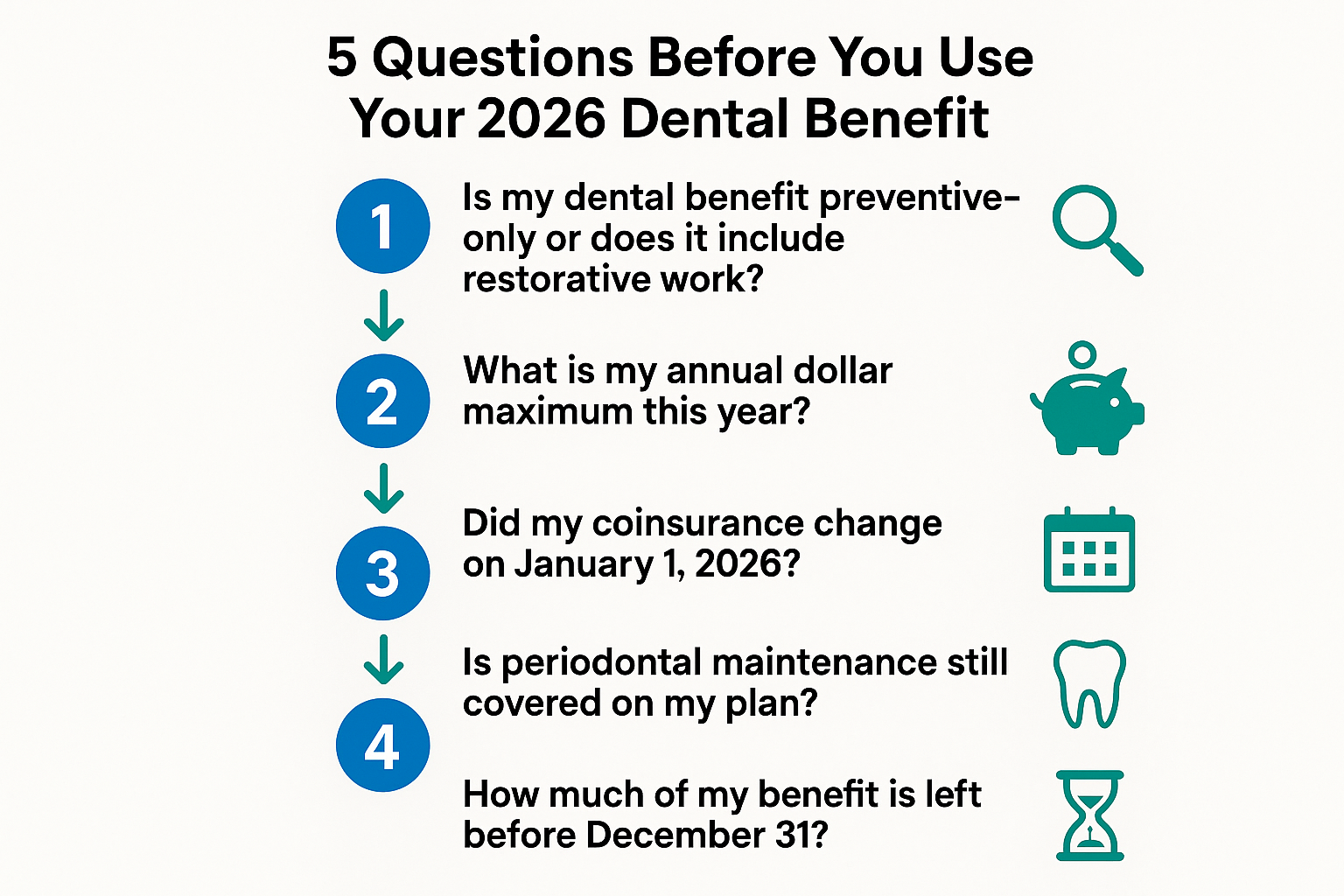
Five Questions to Ask Before You Use Your 2026 Dental Benefit
I hand people a version of this list when they are trying to figure out what their plan will actually do for them this year.
The 2026 Plan Changes People Did Not See Coming
Plans get adjusted every January, and 2026 brought real changes for some enrollees in the West Valley.
A few patterns I have watched play out this year:
- Some UnitedHealthcare Medicare Advantage plans added new coinsurance to non-preventive services effective January 1, 2026. Work that was covered at one level in 2025 now leaves a patient share.
- Certain preventive-only plans dropped coverage for some periodontal maintenance procedures. That hits patients who have been on a three or four month gum cleaning schedule for years.
- Annual maximums and networks shifted on some plans without the member noticing, because the change lives deep in an Annual Notice of Change letter that arrives in a fall mailbox stuffed with other plan mail.
None of this means your plan got bad. It means the plan you bought in 2023 is not automatically the plan you have in 2026.
My honest advice: before you schedule anything larger than a cleaning, ask the office to run a fresh benefits check. Not last year’s numbers. This year’s.
What to Do If You Have Medicare and No Dental Coverage
This is the most common situation I see, and it usually shows up one of two ways. Either someone chose Original Medicare with no supplement, or they aged off an employer plan and never replaced the dental piece.
A couple who had just moved into Arizona Traditions reached out to us last year with exactly that question. They had Medicare, no Advantage plan, no dental insurance, and they wanted to know what a cleaning would run for the two of them.
It is a completely fair question, and there is no shame in asking it. A few paths are worth understanding:
- Pay as you go. Straightforward and predictable if your teeth are in good shape and you just need two cleanings and an exam each year. Costs vary by office and by what you actually need, so ask for a written estimate before you commit.
- An in-house dental membership plan. A flat monthly or yearly fee that covers preventive visits and discounts other treatment, with no deductibles and no waiting periods. It is not insurance and it does not cover everything, but for someone with no coverage at all it turns an unknown into a known. I broke down the details in what a dental membership plan is and who it actually helps.
- Third-party financing. Options like CareCredit spread larger treatment over months. Useful for a crown or a denture, not something you need for a routine cleaning.
And if you are weighing whether to add a plan at all, timing matters. The Medicare Annual Enrollment Period runs October 15 through December 7, which is the window to compare dental benefits for the following year.
For a broader look at how self-pay pricing works around here, I also wrote about dental care without insurance in Surprise.
Frequently Asked Questions About Medicare and Dental Care
Will Medicare ever pay for a tooth extraction?
Only in narrow situations. If the extraction is medically necessary as part of a covered procedure, such as clearance before certain heart surgeries or radiation treatment to the jaw, Part B may cover a portion. A painful or broken tooth on its own is not covered.
My plan paid my cleanings in full last year. Why do I owe something now?
Plan benefits reset and get revised every January. Several 2026 plans added coinsurance or trimmed which procedures count as preventive, and periodontal maintenance was one of the categories that changed on some plans. Your Annual Notice of Change letter spells out what shifted.
We just moved to Surprise with Medicare and no dental insurance. What will a cleaning cost for two people?
That depends on what you need. A first visit for a new patient usually includes an exam and X-rays alongside the cleaning, and if there is tartar below the gumline the recommended cleaning may be different from a routine one. Ask for a written estimate up front so there are no surprises, and ask whether a membership plan would cost less than paying visit by visit.
Do unused Medicare Advantage dental benefits carry over to next year?
No. Almost every plan resets the annual maximum on January 1 and unused dollars disappear. If you have treatment already planned and benefit dollars left in December, it is worth asking whether the timing can be arranged to use them.
Can I add dental coverage outside the fall enrollment window?
For Medicare Advantage, generally no, outside of a special enrollment situation like a move or a plan leaving your area. Standalone dental insurance and in-house membership plans are not tied to the Medicare calendar, so those can start at any point in the year.
Sorting Out Your 2026 Dental Coverage
If you live in Surprise or anywhere across the West Valley and you are not sure what your Medicare or Advantage plan actually covers this year, a benefits check is a reasonable first step before you make any decisions. Our team at West Bell Dental Care can look at your plan details and put a written estimate in your hands, and we keep early morning, evening, and Saturday hours for people who would rather not give up a whole weekday. The office number is 480-795-2420, or you can read more at westbelldentalcare.com.