
Direct Answer: Yes. Most people with sensitive teeth can whiten safely. The sensitivity is usually temporary and fades within 24 to 48 hours, and a dentist can adjust strength and timing to reduce it.
You already wince when you sip ice water at a patio lunch in old town Surprise. So the idea of putting a bleaching gel on your teeth for two weeks sounds like a bad plan.
I hear this question more than almost any other in whitening conversations. And the honest answer surprises people: sensitive teeth and whitening are compatible for most patients. The approach is what makes the difference.
Below I’ll walk through what whitening sensitivity actually feels like, why it happens, how to tell it apart from a deeper issue that should be looked at first, and what you can realistically expect during and after treatment.
Yes, Most People With Sensitive Teeth Can Still Whiten
I have whitened teeth for plenty of people who told me they hadn’t had a cold drink without flinching in years. Retirees in Sun City Grand who gave up iced tea. Parents in Marley Park who brush one side of their mouth gently because the other side complains.
Almost none of them had to skip whitening. What changed was how we did it.
A few things we can adjust that a box of strips cannot:
- Gel strength. A lower peroxide percentage worn longer often gets the same result with far less zing.
- Wear time. Thirty minutes a day instead of two hours changes the experience completely.
- Spacing. Whitening every other day, or taking a three-day break mid-treatment, lets the teeth settle.
- Desensitizing agents. We can apply potassium nitrate or fluoride before and after, which is not something you can buy off a pharmacy shelf and use the same way.
The goal is not to power through discomfort. It’s to build a plan you can actually finish, because a whitening plan you abandon on day three does nothing for you.
Why Whitening Makes Teeth Zing in the First Place
Enamel looks solid, but it isn’t sealed. Underneath it sits dentin, and dentin is full of microscopic channels that run toward the nerve.
Peroxide passes through enamel to break apart stain molecules inside the tooth. While it’s working, those channels are temporarily more open than usual. Cold air, ice water, and cold drinks reach the nerve faster and you get a short, sharp zing that lasts a second or two.
That is a temporary response, not damage. The American Dental Association notes that tooth sensitivity from whitening is common and typically resolves after treatment ends.
What that means in practice:
- Zingers usually show up during treatment and in the hours after, not weeks later.
- Most people feel it settle within 24 to 48 hours of the last application.
- It tends to be random and brief, not a constant ache in one spot.
Understanding that distinction matters, because it changes the decision. If you know the sensation is temporary and adjustable, you can pick a gentler option instead of writing off whitening entirely. Our patient’s guide to dental whitening covers how in-office and take-home treatments differ.
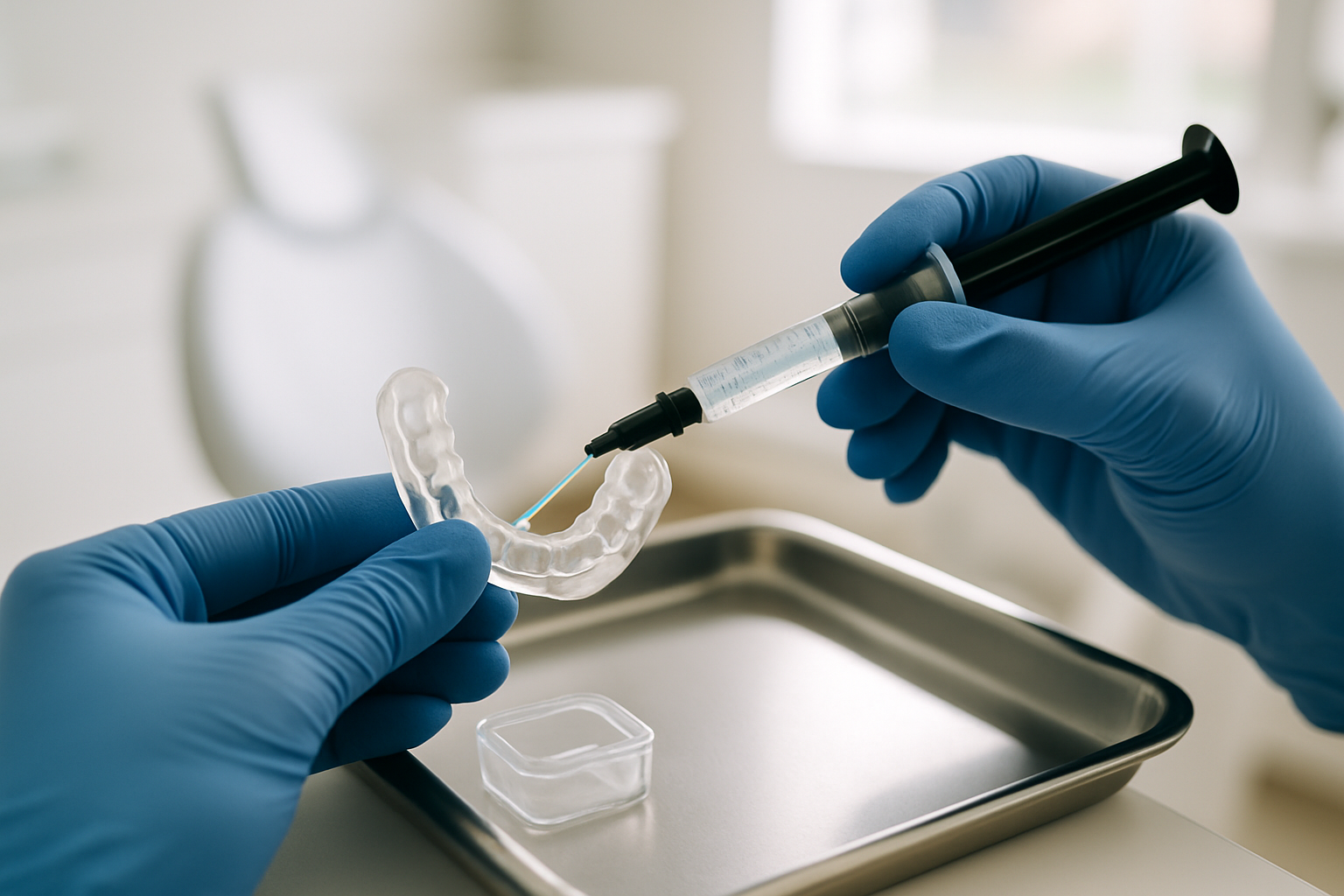
Normal Whitening Sensitivity vs. Something That Needs a Look First
This is the part I care about most. Whitening sensitivity is manageable. But whitening does not cause a problem out of nowhere, and it can make an existing one loud.
Before whitening, I want to know whether the sensitivity you already live with is coming from something that deserves attention on its own. Common culprits include:
- Gum recession exposing root surface, which has no enamel over it at all
- Worn enamel from grinding, which is common and often happens overnight without you knowing
- A cracked tooth or a failing old filling with a gap under the margin
- A cavity that hasn’t started hurting yet
A cracked tooth usually hurts on release when you bite. A cavity often lingers after the cold goes away. Recession tends to be in one clear band along the gumline. Those are different signals than a random zing.
Grinding is worth ruling out because it drives both wear and decay risk. We wrote about that connection in can teeth grinding cause cavities, and early decay is covered in early cavities don’t always hurt.
Telling the Two Apart
Here’s the quick comparison I use when a patient describes what they’re feeling.
| What you feel | Sounds like whitening sensitivity | Worth checking before you whiten |
|---|---|---|
| Short zing, random teeth, lasts seconds | Yes | No |
| Pain in one specific tooth every time | No | Yes |
| Ache that lingers a minute after cold | No | Yes |
| Sharp pain when you bite and release | No | Yes |
| Discomfort that fades 1-2 days after finishing | Yes | No |
| Cold sensitivity in a band along the gumline | Sometimes | Yes |
A Lower-Sensitivity Whitening Plan, Step by Step
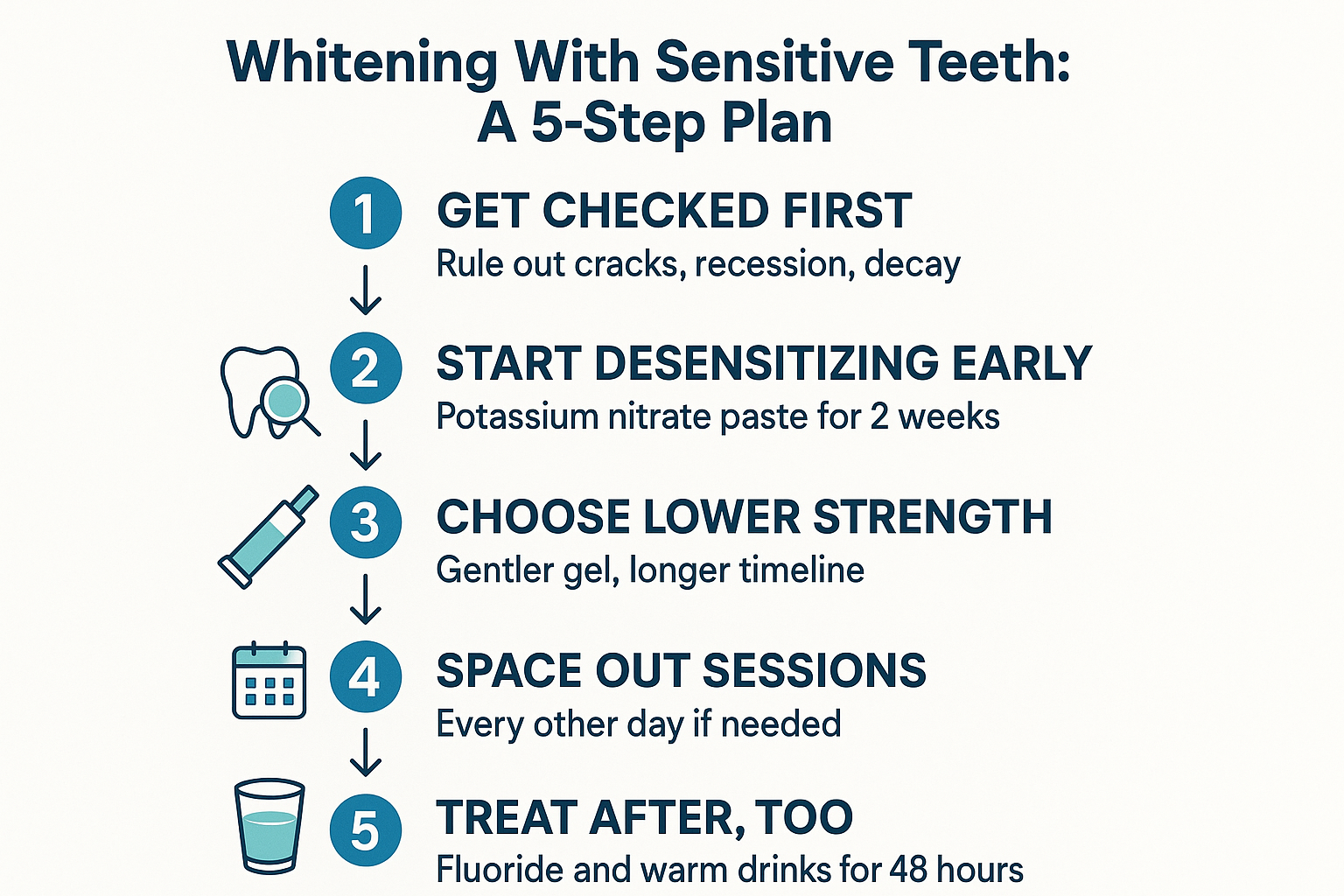
This is the general sequence I follow with patients who already have sensitive teeth.
What Professional Whitening Controls That Strips Can’t
I am not against drugstore whitening for everyone. But if you’re sensitive, the functional differences are real.
Strips come in one strength, one shape, and one set of instructions. They sit against your gums as much as your teeth, and gum tissue does not enjoy peroxide. There’s no way to dial anything back except stopping.
With professional whitening we can:
- Take an impression so the tray hugs the teeth and keeps gel off the gums
- Change the concentration between visits based on what you actually felt
- Apply a desensitizer directly to the teeth before and after treatment
- Isolate sensitive spots and skip an area that’s already unhappy
- Stop and reassess if something isn’t behaving the way it should
We also see what happens shade by shade. If you want a sense of realistic outcomes, teeth whitening before and after shows what change actually looks like.
On cost: whitening prices in the West Valley vary quite a bit depending on whether you go in-office, take-home, or a combination of both. Take-home trays are generally the lower-cost route, and an exact number depends on your teeth and your goals, so it’s worth asking for a written estimate before you commit.
Frequently Asked Questions About Whitening Sensitive Teeth
How long does whitening sensitivity last?
For most people, 24 to 48 hours after the last application. If it’s still going strong after a week, that’s worth a call rather than a wait.
Should I use sensitivity toothpaste before I start?
Yes, and start earlier than you think. Potassium nitrate pastes work best when used consistently for about two weeks before whitening begins. It gives the nerve a head start.
My teeth got sensitive after a deep cleaning. Is that the same thing?
Different cause, similar feeling. After scaling and root planing, newly cleaned root surfaces are briefly exposed to temperature in a way they weren’t before. We cover that separately in our article on sensitive teeth after a deep cleaning.
Can I whiten if I have crowns or fillings on my front teeth?
You can whiten your natural teeth, but crowns, veneers, and tooth-colored fillings will not change shade. That’s a real planning conversation, because whitening around older restorations can make them stand out. We usually map that out before starting.
What if the sensitivity gets bad partway through?
Stop and let us know. Nine times out of ten we drop the strength, cut the wear time, or add a rest day and you finish fine. Pushing through is rarely necessary.
Thinking About Whitening but Worried About the Zing?
If your teeth are already sensitive, the useful first step is figuring out why, then deciding whether whitening makes sense for you. Our team in Surprise sees patients from Sun City Grand, Surprise Farms, and across the West Valley, with early morning, evening, and Saturday appointments for people who can’t step away midday. You can reach us at 480-795-2420 or at westbelldentalcare.com whenever you want to talk it through.