
Direct Answer: Wisdom tooth extraction in Surprise, AZ varies in cost based on eruption status, sedation, and insurance. Most patients recover in three to four days. Sedation options are available for anxious patients.
We hear some version of the same message at least a few times a month: persistent pain in the back of the jaw, both bottom wisdom teeth coming in at once, and a flood of questions — is extraction really necessary, and how much is this going to cost? Those two questions almost always arrive together, and both of them deserve a real answer.
Wisdom tooth situations are rarely black and white. Some teeth can be watched for a while. Others genuinely need to come out soon, and waiting makes things more complicated. Knowing which situation you’re in is what the evaluation is for.
This article walks through the signs that move a wisdom tooth from “let’s monitor it” to “this needs to come out,” explains your sedation options if you’re anxious about the procedure, and gives you a clear picture of what healing actually looks like — so nothing catches you off guard.
When Is Wisdom Tooth Pain Actually a Problem?
Not every twinge in the back of your mouth means you need an extraction this week. A tooth that’s just beginning to emerge can cause some aching as it pushes through gum tissue — and that soreness can come and go for weeks.
But there are specific signs that tell us the situation has moved past “watch and wait”:
- Persistent pain lasting more than a day or two — occasional discomfort is one thing; constant throbbing that doesn’t let up is another
- Swelling in the gum tissue behind your last molar — this is often the first visible sign that something is actively wrong
- A partially erupted tooth that’s trapping food — the flap of gum tissue left over a partially erupted tooth (called an operculum) is nearly impossible to keep clean and becomes a recurring infection site
- Signs of infection — throbbing pain, a foul taste in your mouth, or difficulty opening your jaw fully are warning signs that need attention quickly
- Impaction — when the tooth is blocked by bone or the adjacent molar and simply cannot fully emerge on its own
Impaction is the one that surprises people most. The tooth might not feel dramatically painful at first, but it shows up clearly on an X-ray — and it will not resolve on its own. Left alone, an impacted wisdom tooth can damage the roots of the tooth next to it, which creates a much bigger and more expensive problem down the road.
Patients in communities like Marley Park and Sun City Grand who have been managing occasional wisdom tooth discomfort for months sometimes come in assuming it’s normal. Sometimes it is. But a quick X-ray review is the only way to know for sure what’s actually happening under the gum line.

Sedation Options for Anxious Patients — You Have Real Choices
One of the most common things I see in our form submissions is a patient describing themselves as “very nervous” and asking, almost apologetically, whether sedation is an option. The answer is yes — and there’s nothing to apologize for.
Dental anxiety is real, it’s common, and it doesn’t have to mean white-knuckling through a procedure. Here’s what we actually offer:
Nitrous oxide (laughing gas)
This is the most frequently used option for wisdom tooth extractions. You breathe it through a small mask during the procedure. It reduces anxiety, makes the whole experience feel calmer and faster, and wears off within minutes after the mask comes off. Most patients drive themselves home afterward. For someone who’s nervous but not terrified, nitrous is usually enough.
Oral conscious sedation
For patients with significant anxiety — or for more involved extractions — oral sedation is a stronger option. You take a prescribed medication before your appointment. You’ll be awake but deeply relaxed, and most patients remember very little of the procedure. You will need a driver — the medication stays in your system for several hours — but the trade-off is a much gentler experience for people who have real fear around dental work.
One patient described it as finally feeling like they could “just get through it” without dreading the appointment for weeks. That’s exactly what sedation is for.
If you’re in Ashton Ranch, Greer Ranch North, or anywhere else in the West Valley and you’ve been putting off a wisdom tooth issue because of fear, please know that the conversation about sedation happens before anything else. You won’t be pushed into a procedure you’re not comfortable with.
What Actually Determines the Cost of Wisdom Tooth Removal
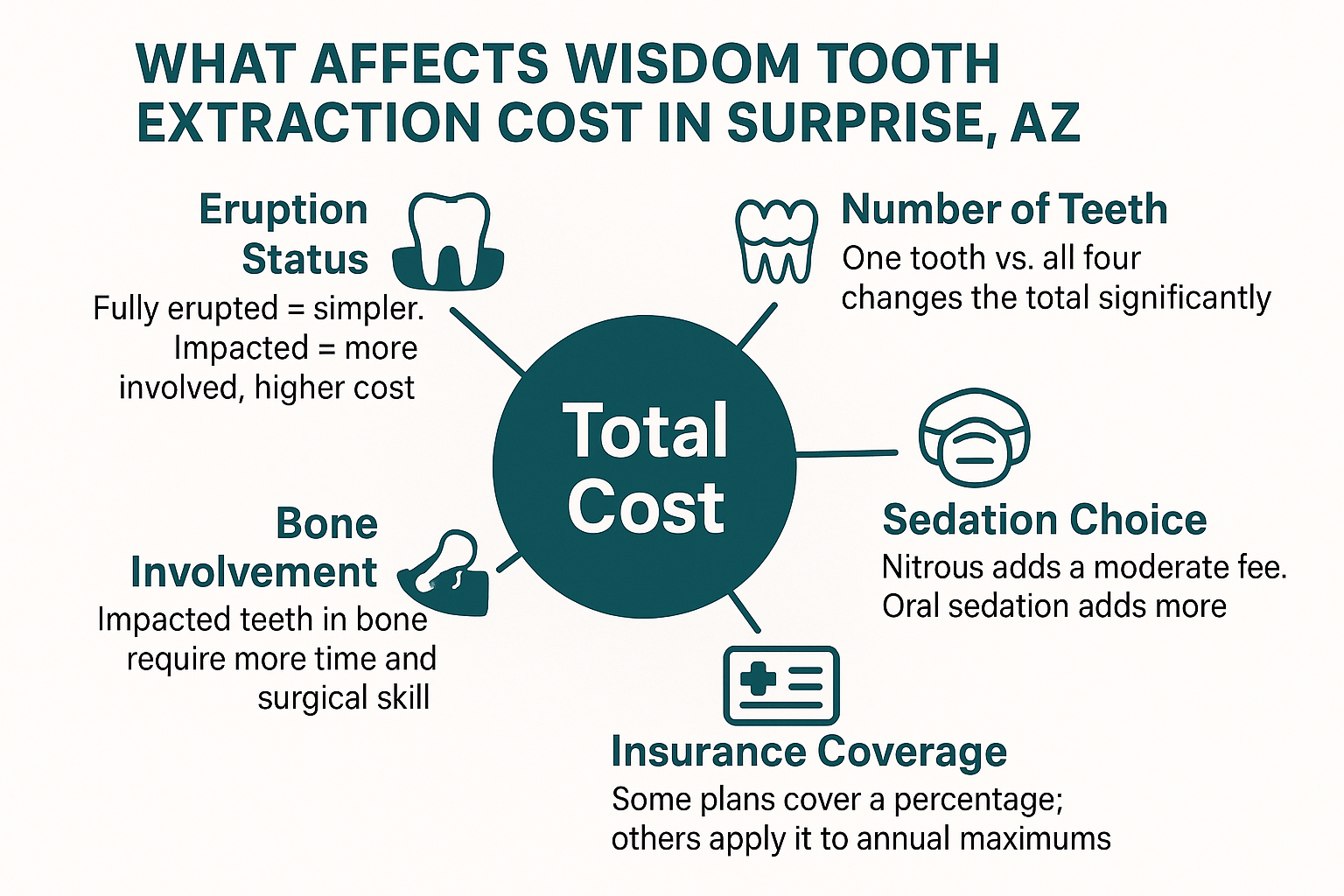
Several factors combine to determine what you’ll pay for a wisdom tooth extraction. This breakdown shows what drives the number up or down before you ever call for an estimate.
What Wisdom Tooth Extraction Actually Costs — and Why the Number Varies
Cost is the question people ask in real time — often in the same breath as describing their pain. I want to give you something useful here, which means being honest about why a single number doesn’t exist.
The factors that move the price up or down:
- Eruption status — a fully erupted wisdom tooth that has broken through the gum cleanly is a straightforward extraction. A tooth that’s partially erupted or fully impacted in bone takes more time and specialized technique, and costs more as a result
- Number of teeth being removed — extracting one symptomatic tooth is different from removing all four at once
- Whether sedation is added — nitrous and oral conscious sedation each carry their own fee on top of the extraction itself
- Insurance coverage — some plans cover a percentage of oral surgery, others apply extractions toward your annual maximum, and some patients have no dental coverage at all
For patients in Surprise and the surrounding West Valley, a consultation that includes an X-ray review will give you an actual cost breakdown before you commit to anything. That’s the only way to get a number that’s specific to your tooth, your situation, and your insurance.
One thing worth knowing: patients who ask about payment plans alongside their pain questions are asking the right question at the right time. Financial arrangements are part of the conversation — not something you have to figure out on your own before you can get care.
Watch It vs. Act Now — A Quick Reference
Not sure where your situation falls? This table summarizes the key differences between wisdom tooth situations that can be monitored and those that call for prompt attention.
| Situation | Likely Approach | Why It Matters |
|---|---|---|
| Occasional mild soreness, tooth erupting normally | Monitor with check-up and X-ray | May resolve on its own as tooth finishes emerging |
| Persistent pain for more than 1-2 days | Evaluation needed soon | Could signal infection or impaction beginning |
| Partially erupted tooth trapping food | Extraction often recommended | Recurring infection risk — difficult to keep clean |
| Swelling, throbbing, foul taste, limited jaw opening | Same-day or urgent care | Active infection signs — can spread if untreated |
| Impaction confirmed on X-ray | Extraction typically necessary | Will not resolve; risk of damage to adjacent tooth roots |
What Healing Looks Like — Day by Day
I think one of the reasons people delay extractions is that they don’t know what to expect afterward. When the recovery feels like a mystery, it’s easy to imagine the worst.
Here’s the honest version:
The first 24 hours are the most important for healing. A blood clot forms in the socket — this is the foundation of your recovery. Protecting that clot means no straws, no spitting forcefully, and no smoking. Dislodging it leads to a condition called dry socket, which is uncomfortable but treatable.
Days two through four are usually when swelling peaks and then starts to subside. Soft foods — think scrambled eggs, yogurt, smoothies eaten with a spoon — are your best friends. Gentle rinsing with warm salt water after meals (starting the day after surgery) keeps the site clean.
Most patients in straightforward extractions are back to normal activity within three to four days. A more involved impaction removal might mean a few extra days of taking it easy.
Dry socket, while it sounds alarming, affects a relatively small percentage of patients and is something we can treat directly if it happens. Knowing that it’s manageable — not a crisis — takes away some of its power as a reason to delay care.
Families in Surprise Farms and Desert Oasis with busy schedules often ask about timing. For most simple extractions, scheduling toward the end of the week gives you the weekend to rest, and many patients are functional by Monday.
Frequently Asked Questions About Wisdom Tooth Extraction in Surprise, AZ
I’ve had constant pain in my wisdom tooth for two days. Does that mean it needs to come out?
Persistent pain for more than a day or two is one of the clearest signals that the situation has moved past something you should just wait out. It doesn’t automatically mean surgery — but it does mean an evaluation and X-ray are the right next step. The only way to know what’s actually happening is to look at the tooth and the bone around it.
Can I get my wisdom tooth removed under sedation if I’m a nervous patient?
Yes. Nitrous oxide (laughing gas) is available for most extractions and wears off quickly enough that many patients drive themselves home. For patients with more significant anxiety, oral conscious sedation is a stronger option — you’ll need a driver, but most patients remember very little of the procedure. Neither option requires you to be “brave” — that’s exactly what sedation is designed for.
What does wisdom tooth removal cost in Surprise, AZ?
There’s no honest single answer because the cost depends on several things: whether the tooth is fully erupted or impacted, how many teeth are being removed, whether you add sedation, and what your insurance covers. A consultation that includes an X-ray review will give you a real cost breakdown before you make any decisions. Call the practice directly for an estimate specific to your situation.
Do you offer payment plans for extractions?
Financial options are part of the conversation at the practice. Asking about payment arrangements alongside your clinical questions is completely normal — we hear it all the time. The best way to find out what’s available for your specific case is to call and ask directly.
How long is the recovery after a wisdom tooth extraction?
For a straightforward extraction, most patients feel close to normal within three to four days. The first 24 hours are the most active healing period. Avoid straws, stick to soft foods, and rinse gently after the first day. An impacted tooth requiring bone removal may add a few extra days of recovery. Dry socket is possible but uncommon — and it’s treatable.
My wisdom tooth isn’t causing much pain. Can I just leave it?
Sometimes, yes — especially if it has fully erupted, is easy to clean, and X-rays show no impaction or pressure on adjacent teeth. But “not painful right now” doesn’t always mean “fine.” Impacted teeth in particular can cause slow, invisible damage to neighboring tooth roots before they cause dramatic pain. A periodic X-ray review is the only way to know whether watching it is a safe long-term plan.
Suggested Internal Links — add real URLs before publishing:
- sedation dentistry for anxious patients — Overview of nitrous oxide and oral conscious sedation options available at the practice — what each involves, who it’s right for, and how to prepare
- same-day emergency dental care in Surprise — Emergency dental appointments available at the practice — what qualifies as a dental emergency, how quickly patients can be seen, and what to do while waiting
- tooth extractions at West Bell Dental Care — Service page covering the extraction process, what patients can expect, and the types of extractions performed at the practice
- dental exams and digital X-rays — What a new patient exam includes, how digital X-rays work, and why an X-ray review is the starting point for any treatment decision
- patient financing and payment options — Information about how the practice works with patients on cost — insurance, payment plans, and options for uninsured patients
Ready to Get a Clear Answer About Your Wisdom Tooth?
If you’ve been managing wisdom tooth pain in Surprise — or anywhere in the West Valley from Sun City Grand to Rancho Gabriela — and you’re not sure whether to act or wait, the right move is a conversation and an X-ray. West Bell Dental Care sees patients six days a week, including Saturdays, and can walk you through your options, your sedation choices, and your actual cost before you commit to anything. Call us at 480-795-2420 or visit westbelldentalcare.com to get started.