

Getting a dental implant is a great choice for rebuilding your smile. But it's normal to wonder, "What happens now?" Knowing what to expect after implant surgery helps you feel prepared and confident as you heal.
You can expect a few days of healing with some mild discomfort and swelling. After that, there's a longer period of 3-6 months where the implant fuses with your jawbone. This guide will walk you through the dental implant recovery timeline.
Your Dental Implant Recovery Timeline
Understanding what's next helps you feel ready. Think of it as a journey, not just a one-day event. It starts the moment you leave our Surprise, AZ, office and continues for several months.
The first few days are the most noticeable part of recovery. During this time, the goal is to manage temporary symptoms like swelling and soreness.
After that, the most important work happens under the gums. This is called osseointegration. It's the process where the titanium implant post and your jawbone naturally grow together. This creates a permanent, stable base that can last a lifetime.
This image gives you a simple visual of the key milestones in your healing journey.
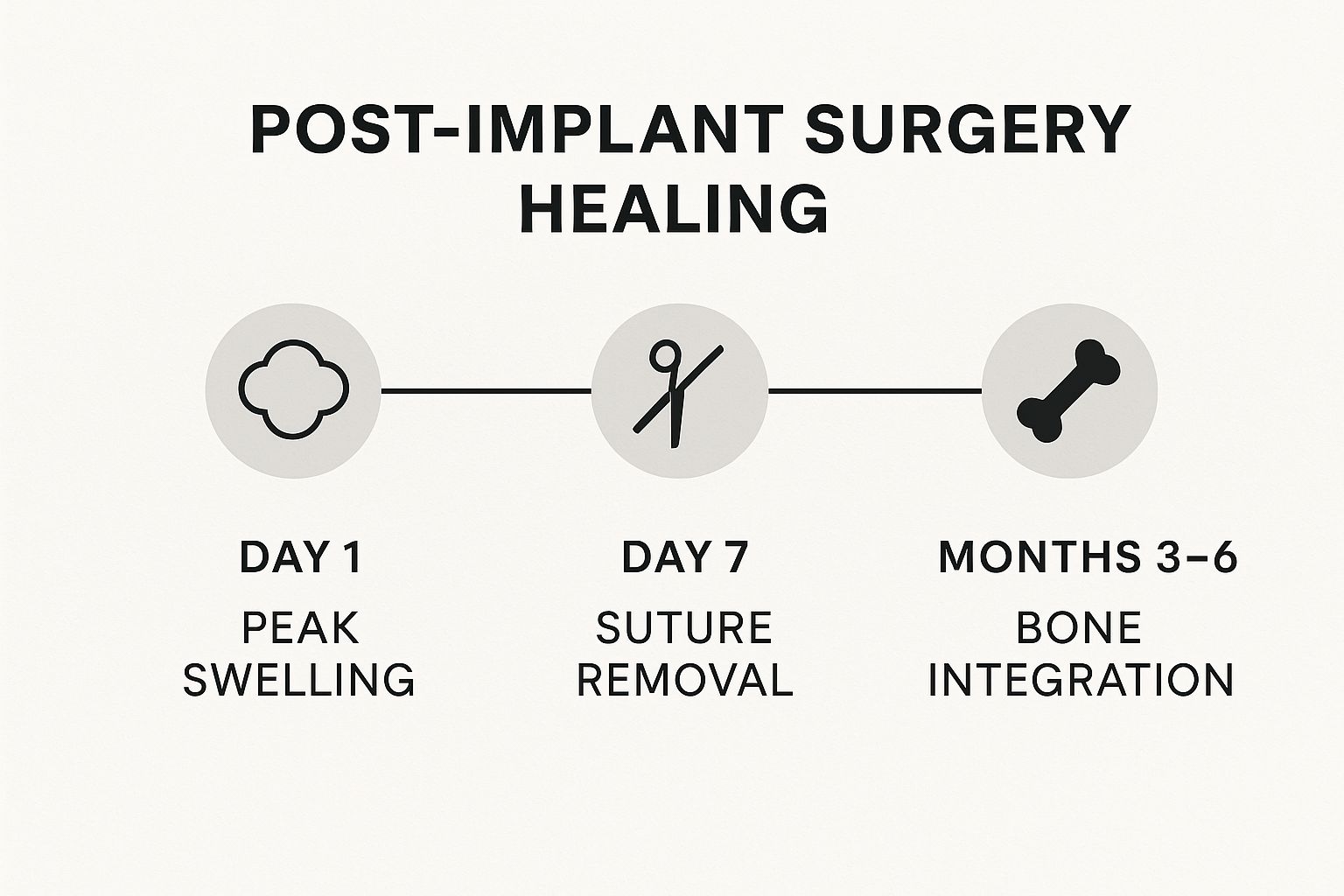
As you can see, the major events happen over time. The bone integration takes the longest, but it’s what ensures a successful, lifelong result.
The Phases of Healing
Your recovery has different phases. The first healing phase, where you'll notice the most changes, lasts about 3 to 4 days for most people. Swelling and discomfort get much better during this time.
The full process, however, takes a few months. This is when the implant truly becomes a permanent part of your jaw. It's a quiet but crucial stage.
To give you a clearer picture, here’s a quick summary of what your recovery looks like from start to finish.
Dental Implant Recovery At a Glance
This table breaks down the key stages of your healing journey, what to expect, and the primary self-care tips for each phase.
| Recovery Stage | Typical Duration | What to Expect | Key Self-Care Action |
|---|---|---|---|
| Immediate Post-Op | First 24 Hours | Gauze placement, mild bleeding, numbness from anesthesia wearing off. | Rest completely. Avoid rinsing or spitting. Stick to liquid or very soft foods. |
| Initial Healing | Days 2-4 | Peak swelling and bruising, manageable soreness. | Use cold compresses, take pain medication as directed, eat soft foods. |
| First Week | Days 5-7 | Swelling and discomfort noticeably decrease. Stitches may begin to dissolve. | Gently rinse with saltwater. Slowly reintroduce softer solid foods. |
| Osseointegration | 2 Weeks to 6 Months | No major symptoms; healing is happening below the gums. The implant is fusing to the bone. | Maintain excellent oral hygiene, avoiding the implant site. Follow diet guidelines. |
| Final Restoration | After 3-6 Months | The implant is stable. Ready for the abutment and permanent crown placement. | Continue good oral hygiene and prepare for your final appointment! |
Each step is a move toward your final, beautiful new smile. Following the care instructions for each phase is the best way to ensure a smooth and successful outcome.
At West Bell Dental Care, we provide you with detailed, personalized instructions. Knowing what the surgery involves can also make understanding the recovery process clearer. For more on the procedure, check out our guide to dental implants in Surprise.
Our team is always here to support you, from your first visit to your final follow-up appointment.
Navigating the First 48 Hours Post-Surgery

The first two days after your dental implant surgery are the most important for a smooth recovery. Your body is working hard to heal, so your main job is to rest and manage the normal side effects.
Knowing what to expect after implant surgery is the best way to ease any worries. You'll likely have some swelling, a little bleeding, and general discomfort. These are all good signs that your body is doing what it's supposed to do.
Our team at West Bell Dental Care, proudly serving patients from Surprise to Sun City, wants you to feel completely prepared. We'll give you detailed instructions to get you through this initial period with confidence.
Managing Swelling and Discomfort
Swelling is your body’s natural reaction to surgery. It usually peaks around the second or third day. The best tool you have against it is a simple cold compress.
- How to Use an Ice Pack: Grab an ice pack or a bag of frozen peas, wrap it in a towel, and hold it on your cheek near the implant site.
- Timing is Key: Keep a rhythm of 20 minutes on, then 20 minutes off. Repeat this cycle as much as you can for the first 24-48 hours.
This simple routine helps reduce both swelling and bruising. For any soreness, we will recommend or prescribe pain medication. It's a good idea to take it as directed to stay ahead of the discomfort.
Patient Care Tip: Resting with your head propped up on a couple of pillows can also help keep swelling down while you sleep. Lying flat can sometimes let fluid gather in your head and neck area.
What to Do About Minor Bleeding
It’s normal to see a little bit of pink in your saliva for the first 24 hours. Don't be alarmed! After your procedure, we’ll have you bite down gently on a gauze pad for about 30-60 minutes. This helps a blood clot form, which is essential for healing.
If bleeding continues at home, repeat the process with fresh gauze. The most important thing is to avoid rinsing, spitting, or drinking through a straw. These actions can dislodge the clot and slow down your healing.
These early steps are crucial for the long-term success of your implant. To see how implants compare to other options, we've broken down the differences between dentures, bridges, or implants.
Eating and Cleaning During the First Two Weeks

The first two weeks after your implant surgery are very important for healing. What you eat and how you keep your mouth clean will shape how well you recover. You want to create the perfect environment for your body to do its repair work.
Good nutrition is key, but you have to stick to soft foods to avoid disturbing the implant site. The right foods can speed up your recovery, while the wrong ones can lead to pain.
Your Post-Surgery Diet Guide
For the first week or two, your diet will be all about foods that are easy to eat and full of nutrients. You’ll need to avoid anything hot, spicy, crunchy, or chewy that might irritate your gums.
Here are some go-to options that our patients in Surprise, AZ, find helpful:
- Smoothies and Protein Shakes: Perfect for getting fruits, veggies, and protein without any chewing.
- Yogurt and Applesauce: These are incredibly gentle on your mouth.
- Soups and Broths: Just make sure they’re lukewarm, not hot. They're hydrating and nourishing.
- Mashed Potatoes or Avocado: A great way to get healthy carbs and fats without stress on your new implant.
- Scrambled Eggs and Soft Fish: Once you feel ready, these are fantastic protein sources that are easy to eat.
Whatever you do, drink plenty of water but do not use a straw. The suction can dislodge the blood clot that is essential for proper healing.
Keeping Your Mouth Clean Without Disturbing the Implant
Your diet is half the battle; proper oral hygiene is the other. Keeping your mouth clean is your best defense against infection. The key word here is gentle.
For the first 24 hours, avoid rinsing your mouth. After that, you can start using gentle saltwater rinses.
A warm saltwater rinse—just half a teaspoon of salt in a glass of warm water—is one of the best things you can do. It keeps the area clean and reduces bacteria. Gently swish it around two to three times a day, especially after you eat.
When it comes to brushing, you should continue to brush your other teeth normally. Just be extremely careful to stay away from the implant area. Don’t try to brush the implant until we give you the green light.
For more helpful advice on post-operative care, our guide on how to care for your mouth after a tooth extraction has similar tips. For more in-depth strategies, check out these expert oral health tips, including insights on mouthwash use.
Understanding the Long-Term Healing Process
Once you’re past the first couple of weeks, the most noticeable part of your recovery is done. Now, the real magic starts happening quietly beneath the surface. This is when your body forms a permanent bond with your new dental implant.
The main event is a process called osseointegration. It’s the natural process where your jawbone grows around and fuses with the titanium implant post.
Think of it like a tree putting down deep roots. As those roots grow, the tree becomes incredibly stable. Osseointegration works the same way, creating a solid foundation that makes your implant as strong as a natural tooth.
The Science Behind Your New Smile
This fusion process is why modern dental implants are so successful. It doesn’t happen overnight—it usually takes three to six months. During this time, you probably won't feel a thing, but your body is working hard.
This healing period is why dental implants are a top solution in tooth replacement. They become a true part of your jaw. This is a core idea in restorative dentistry, which is all about rebuilding the function and look of your smile.
This process gives dental implant surgery high long-term success rates. A major study looking at over 50,000 implants found survival rates of over 98% after many years. (Source: PubMed Central). Most rare failures happened within the first four months, showing how important this quiet healing phase is.
Your Follow-Up Appointments at West Bell Dental Care
You won’t go through this healing phase alone. We’ll schedule a few follow-up appointments at our Surprise, AZ, office to check on your progress.
These appointments are usually quick and easy. What can you expect?
- A visual check: We'll look at the gum tissue around the implant to ensure it looks healthy.
- A quick X-ray: An X-ray lets us see how the bone is growing around the implant.
- Answering your questions: This is the perfect time to ask any questions you have about your recovery.
These check-ins are vital. They allow us to spot any potential issues early and confirm your implant is integrating properly. This sets you up for the final, exciting step: getting your beautiful, custom-made crown.
Once we confirm osseointegration is complete, we can move on to the final restoration. This is when we attach the abutment and your permanent crown. Here at West Bell Dental Care, we’re with you every step of the way.
Recognizing Warning Signs and When to Call Us

Most dental implant recoveries go smoothly. But it's important to know which symptoms are normal and which are not. Knowing the warning signs tells you when it’s time to call our Surprise office.
Most discomfort and swelling should start getting better after the first three days. If things get worse instead of better, that’s a signal to check in with us. Your health is our top priority at West Bell Dental Care, and we want every patient from El Mirage to Peoria to feel comfortable calling with any concerns.
Key Symptoms to Watch For
A little soreness is expected, but some symptoms need our immediate attention. Please contact us if you experience any of the following:
- Pain that is severe or gets worse after the first few days.
- Swelling that increases after day three.
- Bleeding that continues beyond 48 hours or is heavy.
- Signs of infection, like a fever, a bad taste or smell from the implant site, or pus.
- Numbness or tingling in your teeth, gums, lips, or chin that lasts for more than a few hours after surgery.
Your body is your best guide. If something feels wrong or you're worried about how you're healing, it is always better to call us. There is no such thing as a silly question when it comes to your health.
Globally, dental implants have a fantastic track record. Studies show an impressive average long-term survival rate of about 94.6% after more than a decade. (Source: PubMed Central). Still, complications can happen. That's why letting us know about any concerns right away is so important.
Our team is here to support you through your entire recovery. For a closer look at the procedure, feel free to check out our page on dental implants in Surprise.
Frequently Asked Questions
When can I return to work after dental implant surgery?
This depends on your job. If you have a desk job, you can likely return to work within 1 to 2 days. If your job involves heavy lifting or is physically demanding, we suggest taking an extra day or two to rest. This allows your body to focus on healing.
Is it normal for my gums to be bruised after surgery?
Yes, some bruising on your gums or cheek is completely normal. This is from minor bleeding under the skin during the procedure. The bruising may look blue, purple, or yellow as it heals and should fade within about a week.
Can I smoke after my implant surgery?
We strongly advise against smoking for at least a week after surgery, but longer is better. Smoking restricts blood flow, which slows down healing and increases the risk of infection and implant failure. To protect your new smile, it's critical to avoid smoking.
How long until I get my final crown?
You can get your final crown after the implant has fully fused to your jawbone. This process, called osseointegration, usually takes about 3 to 6 months. This waiting period ensures your implant has a rock-solid foundation that can last a lifetime.
What follow-up appointments are needed in Surprise, AZ?
Your first follow-up visit at our Surprise office is typically about two weeks after your surgery. We'll check your healing and remove any stitches. After the 3-to-6-month healing period, we'll see you again to confirm the implant is ready for your permanent crown.
Your journey to a restored smile is a partnership. Our team at West Bell Dental Care is here to support you at every stage. If you have more questions about what to expect after implant surgery or are ready to schedule a consultation, please contact our friendly team in Surprise, AZ, today.
Visit us online at https://westbelldentalcare.com to book your appointment.