
Direct Answer: There is no safe or effective way to tighten a loose adult tooth at home. A dental evaluation is the only way to find out whether the tooth can still be saved, and the sooner you go, the more options you have.
If you found this article by searching how to tighten a loose tooth at home, I want to give you a straight answer right up front: there is no home method that will actually do that. No rinse, no taping, no vitamin, no pressure technique. I know that is not what you were hoping to read, but knowing it now is better than spending weeks trying things that won’t work while the situation quietly gets worse.
A loose adult tooth is almost always a signal that something is happening beneath the gumline, bone loss, an infection, or damage that a mirror cannot show you. The encouraging part is that when people come in early, we often have real options to stabilize the tooth and keep it. When they wait six months hoping it settles on its own, those options shrink.
This article focuses specifically on what happens next: the actual treatment paths that exist for a loose adult tooth, who they work for, and what drives the decision between saving a tooth and replacing it. If you are also looking for an explanation of the underlying causes, we cover that separately in a companion article. This one is for the reader who already knows something is wrong and wants to know what a dentist can actually do about it.
Why ‘Waiting to See’ Usually Costs You More
The most common thing I hear from patients who come in with a loose tooth is some version of: “I noticed it a few months ago and I was hoping it would tighten back up on its own.” I understand that instinct completely, nobody wants a dental problem, and wishful waiting feels like a reasonable first move.
Here is what actually happens during that waiting period. When the most common cause, gum disease (periodontitis), is driving the looseness, bacteria are actively eroding the bone and ligament that hold the tooth in place. That process does not pause while you wait. Every week of delay is a week of bone loss that cannot be undone.
There is one partial exception worth knowing about. Some teeth feel noticeably looser during a period of active gum inflammation, and after a thorough professional cleaning removes the bacterial buildup, the inflammation drops and the tooth can feel more stable. That improvement is real but it is not a cure. The underlying bone damage is still there, and without treating the disease itself, the looseness will return and worsen.
The practical takeaway: a dental evaluation does not automatically mean losing the tooth. It means finding out where things actually stand. In many cases, patients come in expecting the worst and leave with a treatment plan that gives the tooth a real chance. In other cases, the evaluation confirms that waiting longer would have closed that window entirely.
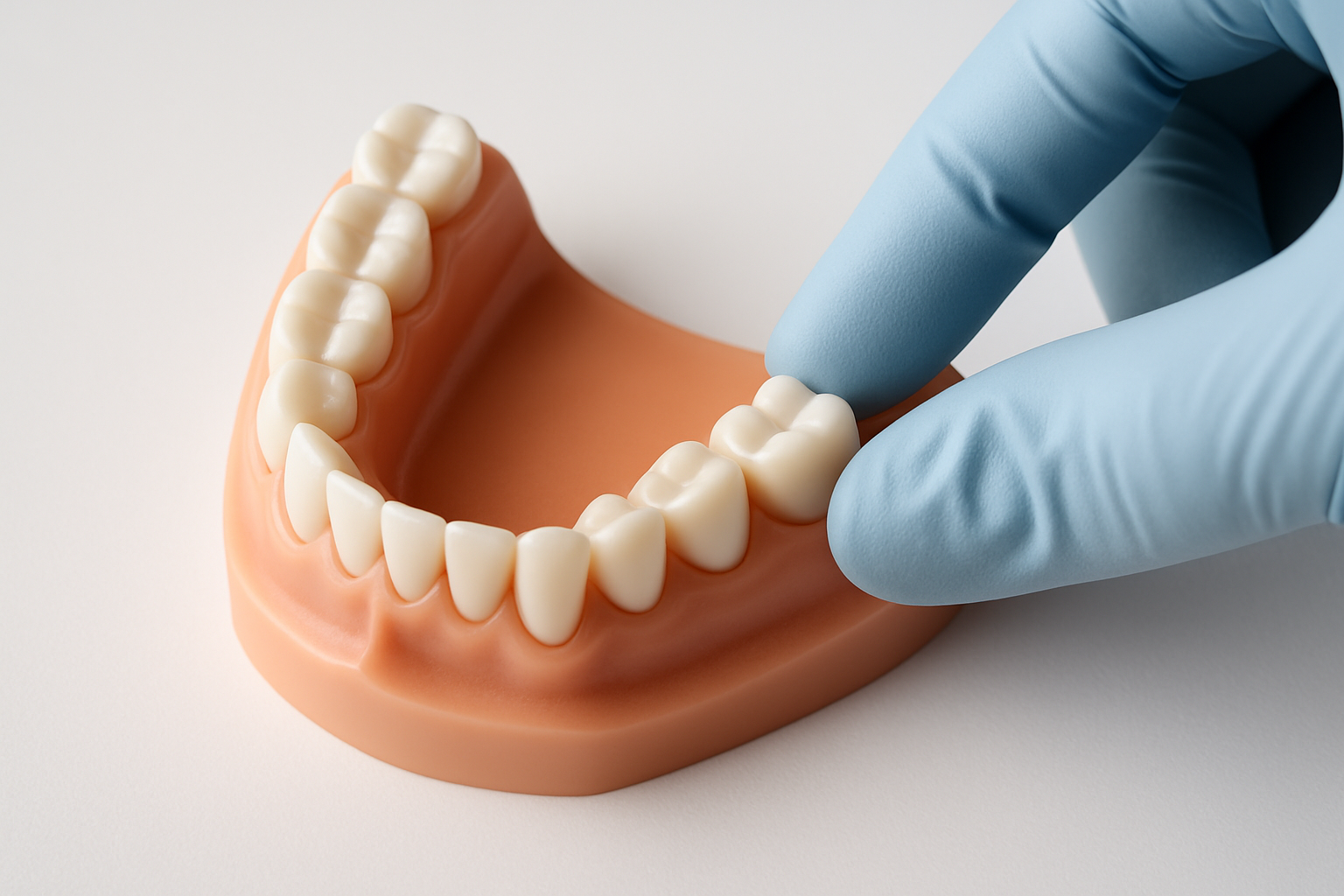
The Three Realistic Treatment Paths for a Loose Adult Tooth
Once we evaluate a loose tooth, the path forward depends on how much bone support is still present and what caused the looseness in the first place. There is no single answer that fits every situation, but the options generally fall into three categories.
1. Deep Cleaning (Scaling and Root Planing)
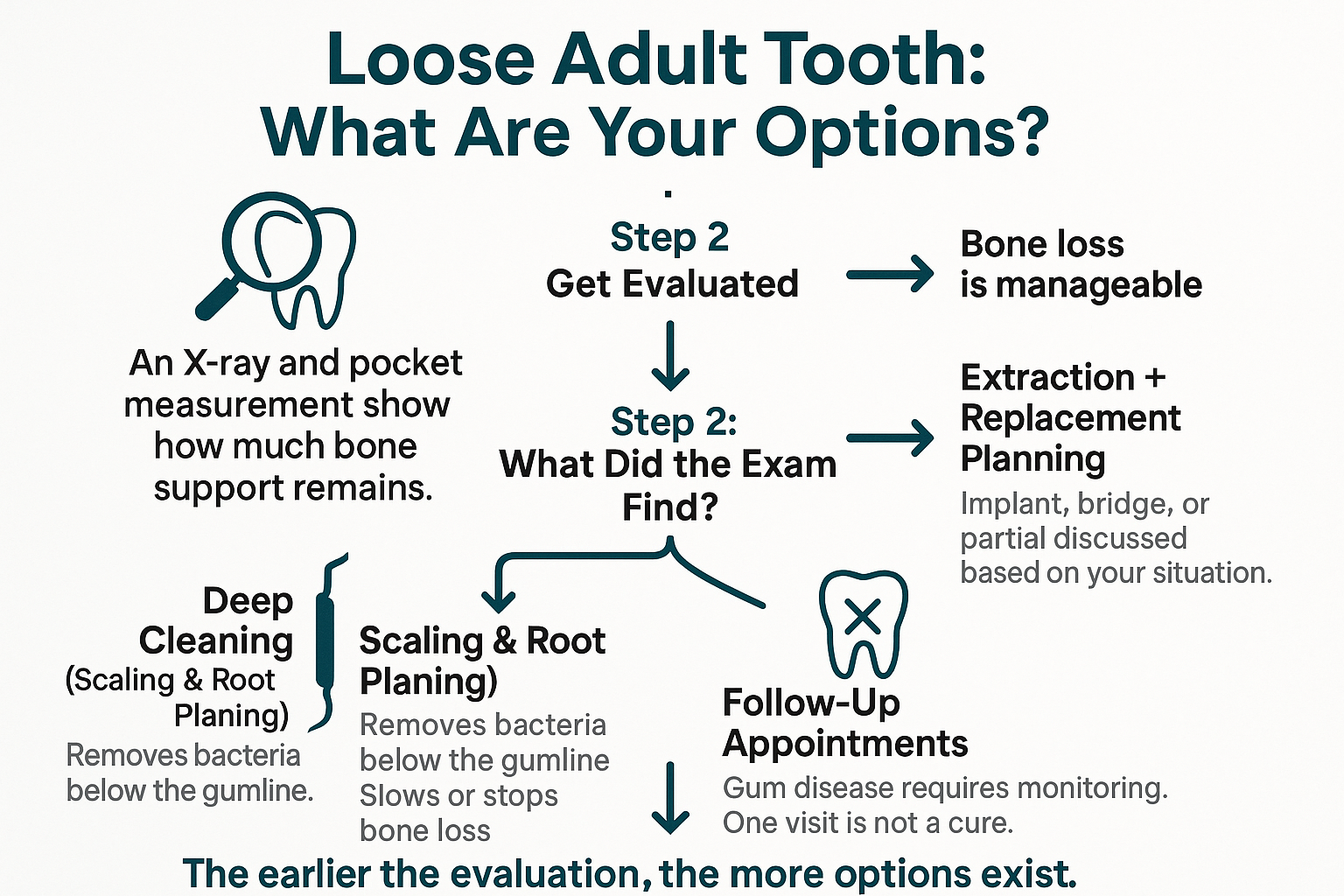
This is the most common starting point when gum disease is the cause. It is a thorough cleaning that goes below the gumline to remove the bacterial deposits that are driving bone loss. It takes two appointments, one side of the mouth at a time, and for many patients it genuinely changes the trajectory of the tooth. The gums tighten, inflammation drops, and bone loss slows or stops. This is not a cosmetic cleaning; it is a medical treatment for an active infection.
2. Splinting
If the tooth has meaningful mobility but the bone levels are still workable, splinting is sometimes used to stabilize it temporarily or permanently. A thin wire or composite material bonds the loose tooth to the adjacent stable teeth, spreading force across the arch and giving the supporting tissues time to respond to treatment. Our team evaluates whether this makes sense case by case, it is not appropriate for every situation, but for the right patient it can be an important part of the plan.
3. Extraction and Replacement
Sometimes the honest answer is that the bone loss has progressed too far for the tooth to remain a long-term asset. In those cases, keeping a tooth that cannot be stabilized often causes more problems, it accelerates bone loss in the surrounding area and can affect neighboring teeth. When extraction is the right call, the conversation shifts to what comes next: a dental implant, a bridge, or a partial denture. We discuss all of those options in detail so patients can make a decision that fits their situation and their budget.
One cause that does not get talked about enough is bone loss from a neighboring tooth that was extracted and never replaced. When a tooth is removed and the gap is left open, the surrounding bone gradually shrinks because it no longer has the stimulation of a tooth root. That can slowly undermine the stability of adjacent teeth over time. It is another reason why replacing a missing tooth matters beyond the cosmetic concern.
Loose Adult Tooth: What Comes Next
This infographic walks through the decision points from noticing a loose tooth to the most likely treatment path.
The Systemic Health Connection You Should Know About
Gum disease is not just a mouth problem, and I think this is one of the most important things to understand if you are dealing with a loose tooth and considering waiting it out.
Research has documented a connection between untreated periodontal disease and increased cardiovascular risk. The relationship is not fully understood and no one claims gum disease directly causes heart disease, but the association is consistent enough across studies that the medical and dental communities take it seriously. Adults over 65 are disproportionately affected by both untreated gum disease and its downstream health consequences.
In Surprise, where more than 22% of the population is 65 or older, including residents of Sun City Grand, The Grand, and the surrounding active adult communities, this connection is directly relevant to a large share of the people reading this. If you are also managing blood pressure, have a history of heart issues, or are a recent heart surgery patient, your dentist needs to know that context before any treatment, and it absolutely affects how urgently gum disease should be addressed.
This is also why some patients who come in after a long gap in dental care are surprised that we talk about their overall health history before we talk about their teeth. Those conversations are not box-checking. They shape the treatment plan in real ways.
Treatment Options for a Loose Adult Tooth at a Glance
This table gives a plain-language summary of the main treatment paths, what each involves, and when it typically applies. Actual recommendations always depend on your specific exam findings.
| Treatment | What It Involves | Best Suited For |
|---|---|---|
| Deep Cleaning (Scaling & Root Planing) | Two-appointment procedure cleaning below the gumline to stop active gum disease | Loose teeth caused by gum disease with workable bone levels |
| Tooth Splinting | Bonding the loose tooth to adjacent stable teeth to reduce movement | Teeth with mobility but adequate remaining bone support |
| Extraction + Implant | Removing the tooth, allowing healing, then placing a titanium implant and crown | Teeth where bone loss is too advanced for retention |
| Extraction + Bridge | Removing the tooth and anchoring a fixed prosthetic to neighboring teeth | Patients who prefer not to pursue implants or have bone loss in the implant site |
| Extraction + Partial Denture | A removable appliance that replaces one or more missing teeth | Patients replacing multiple teeth or managing costs over time |
What Trauma and Grinding Do That Most People Don’t Expect
Not every loose tooth comes from gum disease. Two other causes are worth knowing about, especially because they are easy to overlook.
Direct trauma, a fall, a sports impact, a car accident, can loosen a tooth by damaging the periodontal ligament that connects the root to the bone. Depending on the severity, the tooth may restabilize with time and monitoring, or it may need splinting to give the ligament a chance to heal. The important thing is getting it evaluated quickly rather than assuming it will be fine.
Bruxism, or chronic teeth grinding, is a slower and subtler cause. Over months and years, the repetitive lateral force that grinding puts on the roots gradually wears down the supporting structures. Many people who grind do not know they are doing it, it often happens during sleep. If grinding is contributing to looseness, treating the looseness without addressing the grinding is like patching a leak without turning off the water. A night guard is a simple, inexpensive way to protect the work that has been done and prevent the situation from recurring.
For patients in Surprise Farms, Marley Park, or Copper Canyon Ranch who are grinding due to stress or sleep issues and have started to notice tooth sensitivity or morning jaw soreness, that combination of symptoms is worth mentioning at your next visit. It often shows up years before a tooth becomes visibly loose, and catching it early means less damage to manage later.
Frequently Asked Questions About a Loose Tooth in Adults
Can a loose tooth tighten back up on its own?
Occasionally a tooth that felt loose during a period of active gum inflammation will feel more stable after a professional cleaning reduces that inflammation. But that is not the same as the tooth actually tightening. The underlying bone damage is still present, and without treating the cause, the looseness returns. A loose tooth in an adult does not self-correct the way a child’s loose baby tooth does.
Is a loose tooth always a sign of gum disease?
Gum disease is the most common cause, but not the only one. Direct trauma, chronic grinding (bruxism), and bone loss from a neighboring tooth that was extracted and never replaced can all contribute. An X-ray and a periodontal exam are the only way to know which one you are dealing with, and that matters because the treatment is different for each.
How much does treatment for a loose tooth cost?
It depends entirely on what is causing the problem and what the exam finds. A deep cleaning (scaling and root planing) is a different cost than a tooth extraction followed by an implant. Dental insurance often covers a portion of gum disease treatment, though coverage varies by plan. The most accurate thing I can tell you is to call us and ask, we can give you real numbers once we know what you are actually dealing with, and we will walk through your options without surprising you at the end.
I have not been to the dentist in years. Will I be judged for waiting this long?
No. This is genuinely one of the most common things we hear, and it is one of the reasons we work hard to keep the environment judgment-free. People avoid the dentist for all kinds of reasons, cost, fear, life getting in the way, and the goal when you come in is to figure out where things stand and build a plan from there, not to make you feel bad about the gap. We have more than 1,700 five-star reviews from patients who came to us nervous or embarrassed and left feeling like they found a place they could trust.
What if I cannot afford treatment right now?
Talk to us before you decide it is out of reach. Several callers ask about cost before they even book, and we understand that concern completely. We can discuss which treatment is most urgent, how to phase care over time, and what financing options are available. The worst outcome is delaying a treatable situation until it becomes a more expensive one.
Can a loose tooth be splinted permanently?
Sometimes, yes. For certain patients whose bone levels are stable but whose tooth has persistent mobility, often due to grinding or a history of gum disease that is now under control, permanent splinting to adjacent teeth can be a long-term solution. Whether it is the right call depends on the health of the neighboring teeth and other factors we assess at the exam.
Suggested Internal Links — add real URLs before publishing:
- what causes a loose tooth in adults — Companion article explaining the causes of loose adult teeth, gum disease, trauma, bruxism, and bone loss from missing teeth
- scaling and root planing at West Bell Dental Care — Service page describing the deep cleaning process, what to expect, and who it is for
- dental implants in Surprise, AZ — Service page explaining the implant process, timeline, and candidacy factors
- sedation dentistry for anxious patients — Service page covering sedation options available for patients with dental anxiety or complex treatment needs
- same-day emergency dental care in Surprise — Emergency dental service page for patients with urgent tooth pain, lost crowns, or sudden dental problems
Ready to Find Out Whether Your Tooth Can Still Be Saved?
If you have a tooth that feels loose, the single most useful thing you can do today is get it evaluated before the window for treatment narrows. Our team at West Bell Dental Care sees patients from Sun City Grand, Marley Park, Surprise Farms, and across the West Valley, including Saturdays for patients who cannot get away during the week. You can reach us at 480-795-2420 or visit westbelldentalcare.com to request an appointment. The sooner we know what is going on, the more we can do about it.