
Direct Answer: The right replacement for a missing tooth depends on your jawbone health, how many teeth are missing, and your long-term goals — not just upfront cost. Implants, bridges, and dentures each solve the problem differently.
We hear versions of the same question almost every week. Someone writes in asking about the cost of implant-supported dentures — upper and lower. Someone else wants to know about a broken tooth, a possible bone graft, and whether two implants make sense. Another person is waiting on an emailed treatment plan that includes a partial crown and an implant and just wants to understand what they’re agreeing to. The details are different every time, but the underlying question is always the same: What are my options, and how do I figure out which one is right for me?
This article isn’t going to push you toward any single path. What I want to do is give you enough vocabulary and context to have a genuinely useful conversation with your dentist — one where you understand the tradeoffs, not just the price tag.
The three main replacement options for a missing tooth are a dental implant, a dental bridge, and dentures (full or partial). Each one solves the problem differently. And the right answer for you depends on factors that go well beyond what shows up on a treatment estimate.
What Each Option Actually Does
It helps to understand the mechanics before you compare anything else.
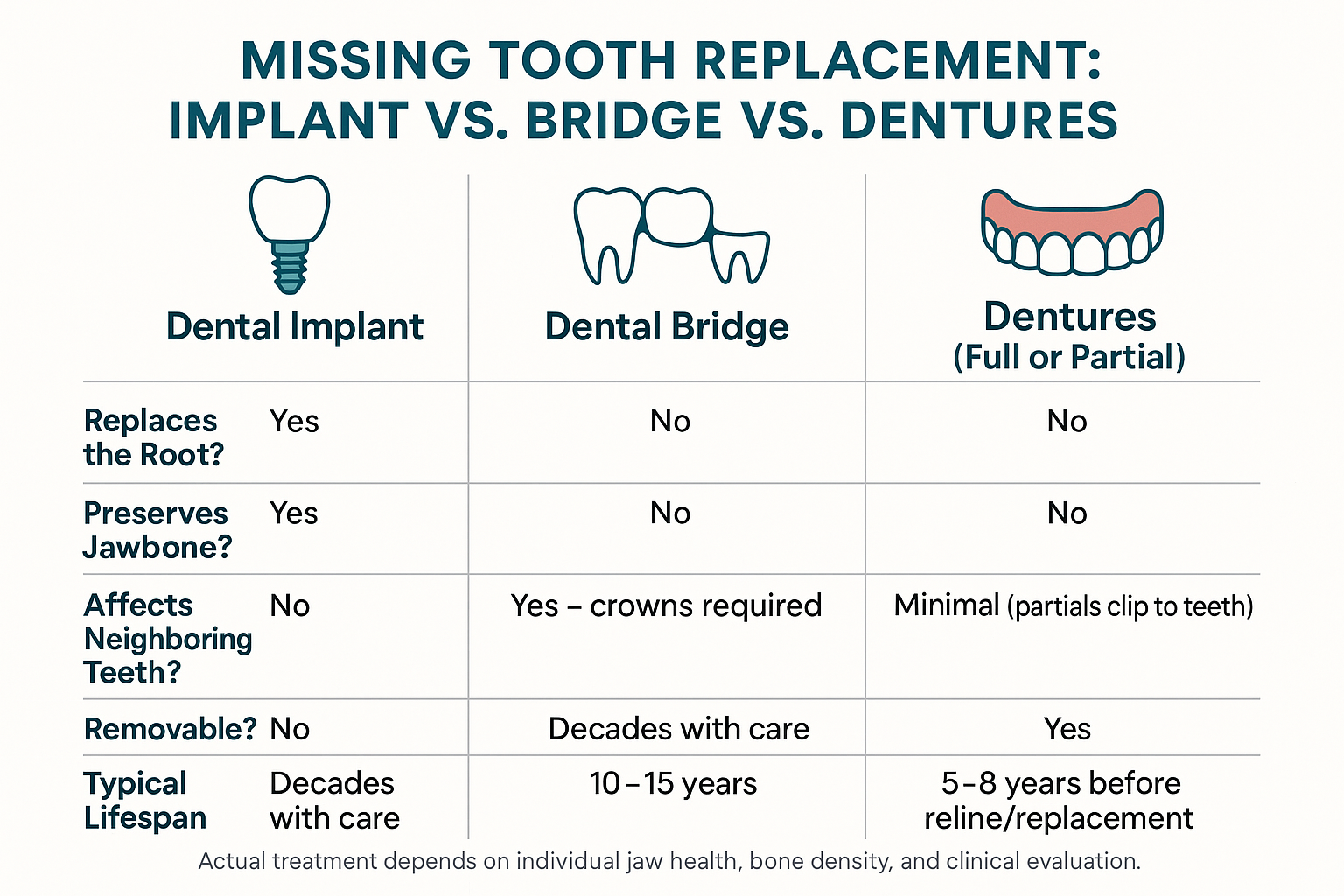
A dental implant is a small titanium post placed directly into the jawbone where your tooth root used to be. Over the next few months — typically three to six months — the post fuses with the surrounding bone through a process called osseointegration. Once that’s complete, a crown is attached on top. The finished result looks, feels, and functions like a natural tooth. It’s the only option that actually replaces the root.
A dental bridge doesn’t go into the bone at all. Instead, it spans the gap by anchoring an artificial tooth (called a pontic) to the two natural teeth on either side. Those neighboring teeth are filed down and crowned as part of the process — permanently, regardless of how healthy they were before. The bridge sits fixed in place and isn’t removed for cleaning.
Dentures — whether full or partial — are removable appliances that replace multiple missing teeth at once. A partial denture clips onto remaining teeth. A full denture rests on the gum ridge. Some dentures are supported by implants for added stability, which is what patients are usually asking about when they mention implant-supported dentures.
Each option has a real place in restorative dentistry. None of them is a compromise. But they do work differently, and that difference matters more than most people realize when they’re first comparing costs.

The Cost Question — and Why Upfront Price Isn’t the Whole Story
I’m not going to give you a single number here, because the honest answer is that pricing depends on too many variables: the materials used, whether a bone graft is needed first, your insurance coverage, and the complexity of your specific case. What I can tell you is how the options generally compare in terms of where the cost lands and — more importantly — how the math shifts over time.
In general, implants carry a higher upfront cost than bridges, and bridges typically cost more than a basic partial or denture. But that framing is incomplete if you stop there.
Here’s what changes the long-term picture:
- Bridges often need replacement. Most bridges are designed to last 10 to 15 years. After that, you’re looking at the cost of replacing the entire restoration — plus the fact that the two adjacent teeth were already permanently altered when the bridge was placed.
- Crowning healthy neighbors isn’t free. When a bridge requires crowning two teeth that had no existing problems, you’ve added two restorations to teeth that didn’t need them. Those teeth now carry their own long-term maintenance story.
- Implants are designed to last. With proper care, a well-placed implant can function for decades. The crown on top may eventually need replacing, but the implant itself typically doesn’t.
I think about this as a 20-year decision, not a one-year decision. Patients who choose based only on what they’ll pay in the next 12 months sometimes find themselves spending more over a decade than they would have if they’d chosen differently from the start. That’s not an argument for implants in every situation — it’s an argument for making sure you understand what you’re actually comparing.
Implant vs. Bridge vs. Dentures at a Glance
Here’s a quick side-by-side of how the three options compare on the factors that matter most when you’re making this decision.
What Happens to Your Jaw When a Tooth Is Gone
This is the part most patients don’t know about until someone explains it — and it genuinely changes how you think about the timing of your decision.
When a tooth is lost, the root goes with it. And the jawbone in that area depends on the stimulation from the root to stay dense and healthy. Without it, the bone begins to resorb — meaning it slowly breaks down and shrinks. This process can start within the first few months after a tooth is lost.
Over time, that bone loss can change the shape of your face, affect how neighboring teeth sit, and — if you’re considering an implant later — may require a bone graft before the implant can even be placed. Bone grafts add both time and cost to the process.
The implant is the only option that addresses this directly, because it physically replaces the root and continues stimulating the bone the way a natural tooth would. Bridges and dentures restore what’s visible above the gumline, but neither one stops the resorption happening underneath.
We’ve written more about this process separately, but the short version is: waiting longer to replace a missing tooth rarely makes the decision easier. It often makes it more complicated. If you’re weighing your options, getting an evaluation sooner gives you more choices, not fewer.
A Honest Word About Dentures
Dentures are a legitimate, widely used solution — and I don’t want anything in this article to suggest otherwise. For patients missing several adjacent teeth, for those whose jawbone health makes implant surgery difficult, or for those who need a solution that works within a specific budget right now, dentures absolutely have a place.
What’s worth knowing honestly is what day-to-day life looks like with them:
- Dentures need to be removed and cleaned daily
- As the jaw changes shape over time, dentures may need periodic relining to maintain a proper fit — and yes, we do perform denture relines
- Some wearers notice shifting during meals, particularly with full lower dentures, where suction is harder to maintain
- Implant-supported dentures address a lot of these issues by anchoring the appliance to posts in the jaw — that’s what patients are usually asking about when they ask about upper and lower implants with dentures
A patient who asks specifically about denture relines is thinking like someone who already understands that fit and maintenance are ongoing — not a one-time event. That’s the right way to think about it. If you’re already wearing dentures and noticing that your fit has changed, that’s worth addressing sooner rather than later, because an ill-fitting denture can accelerate the very bone loss we described above.
According to the American College of Prosthodontists, more than 36 million Americans are missing all of their teeth, and many more are missing multiple teeth — making denture care one of the most common long-term considerations in adult dentistry.
Factors That Shape Your Decision
No single option is right for everyone. These are the key variables that your dentist will weigh when helping you build a treatment plan.
| Factor | Why It Matters | How It Affects Your Options |
|---|---|---|
| Number of missing teeth | One tooth vs. several changes the math entirely | Single tooth: implant or bridge. Multiple adjacent: bridge or dentures. Full arch: dentures or implant-supported dentures. |
| Jawbone density | Implants require sufficient bone to fuse properly | Low bone density may require a graft before implant placement — adding time and cost |
| Health of neighboring teeth | Bridges crown the adjacent teeth permanently | If neighbors are already crowned or damaged, a bridge may make more sense. If they’re healthy, crowning them is a real tradeoff. |
| Medical history | Certain conditions affect healing and implant candidacy | Uncontrolled diabetes, blood thinners, and some medications are factors your dentist evaluates during consultation |
| Long-term goals | Whether you want a permanent solution or a more flexible one | Implants prioritize longevity. Dentures offer flexibility and lower upfront cost. Bridges sit in between. |
| Insurance coverage | Coverage varies significantly by plan and procedure | Some plans cover bridges more generously than implants. Always confirm your specific benefits before assuming. |
Why Having Everything Under One Roof Changes the Experience
A treatment path that involves an implant, a bone graft, and a crown is a multi-stage process that can span several months. When that work is spread across multiple providers — a general dentist here, an oral surgeon there, a prosthodontist somewhere else — the patient ends up doing a lot of coordination on their own. Things fall through the cracks. Records don’t transfer cleanly. Follow-up questions don’t have a clear home.
Our team handles implants, bridges, crowns, and dentures without sending patients out for referrals. When you start a multi-step restorative plan here, the same team walks you through each stage, follows up after major procedures, and answers questions in plain language — not in a way that assumes you’ve already memorized the treatment timeline.
Patients have told us in reviews that what they appreciated most wasn’t just the clinical outcome — it was that someone explained the plan clearly, checked in afterward, and didn’t make them feel like a number in a queue. For something as layered as an implant-supported restoration, that continuity genuinely matters.
Frequently Asked Questions About Replacing a Missing Tooth
How long does the implant process take from start to finish?
It varies, but most patients should plan for three to six months between the placement of the implant post and the final crown. If a bone graft is needed first, that adds additional healing time before the implant can even be placed. The total process can run six months to over a year in more complex cases. Your dentist will walk through a realistic timeline during your consultation once your bone health has been evaluated.
Do you do denture relines at your office?
Yes. If your denture fit has changed — which is common as the jawbone naturally shifts over time — a reline adjusts the base of the denture to match your current gum and bone contour. It’s a routine procedure and worth addressing rather than tolerating a loose fit.
Is a bridge a bad idea if the neighboring teeth are healthy?
It’s not a bad idea — it’s a tradeoff worth understanding clearly. Placing a bridge means those neighboring teeth get permanently crowned, which involves removing some of their natural structure. If those teeth were healthy and untouched before, that’s an irreversible change. Some patients are comfortable with that tradeoff given the cost or timeline. Others, once they understand it fully, decide an implant makes more sense. There’s no universal right answer — but you should make the choice knowing what it involves.
Will my insurance cover a dental implant?
It depends entirely on your plan. Some dental insurance covers a portion of implant placement; others classify it as cosmetic or elective and provide nothing. Many plans have annual maximums that don’t stretch far for implant work. Bridges are more commonly covered, which is part of why patients choose them. The best move is to call your insurance provider with the specific procedure codes from your treatment plan — your dental office can give you those codes before you commit to anything.
What if I’ve already lost bone where the tooth was?
You may still be a candidate for an implant — bone grafting can rebuild the area before the implant is placed. The graft typically uses bone material that integrates with your existing jaw over a few months. It adds time and cost to the process, but it doesn’t automatically rule out an implant. A CBCT scan (a type of 3D X-ray) gives your dentist a clear picture of what’s actually there and what’s needed.
Can a partial denture eventually be replaced by an implant later?
In many cases, yes. Some patients start with a partial denture as a shorter-term solution and transition to implants when their circumstances — financial, medical, or otherwise — make that possible. The key is preserving enough bone in the meantime. Your dentist can factor that into how your partial is designed and monitored over time.
Suggested Internal Links — add real URLs before publishing:
- What Happens to Your Jaw When a Tooth Goes Missing — Educational article explaining jawbone resorption after tooth loss and why timing matters
- Dental Implants at West Bell Dental Care — Service page describing the implant placement process, candidacy, and what patients can expect
- Dentures and Partials — What to Expect — Service or educational page covering full and partial denture options, maintenance, and relining
- Sedation Dentistry for Anxious Patients — Page explaining sedation options available for patients with dental anxiety or complex procedures
- Same-Day Emergency Dental Care in Surprise, AZ — Emergency care page for patients with sudden tooth pain, broken teeth, or urgent dental needs
Ready to Talk Through Your Options?
If you’re weighing an implant, a bridge, or dentures — or trying to make sense of a treatment plan that’s already sitting in your inbox — the best next step is a conversation with someone who can look at your actual X-rays and bone health, not just answer in general terms. Our team at West Bell Dental Care sees patients from across Surprise, Sun City Grand, Marley Park, and the broader West Valley, and we’re happy to walk you through your options in plain language with no pressure. You can reach us at 480-795-2420 or visit westbelldentalcare.com to request a time that works for you — including Saturdays.