
Direct Answer: Before you call, have the plan name, member ID, and whether the card says PPO or HMO. Then send the medication list and treating doctor’s contact ahead of the first visit.
You are standing in your parent’s kitchen holding two insurance cards and your phone. Maybe a crown came loose, maybe a cleaning is two years overdue, and now you are the one making the call.
The first thing most people get stuck on is not the dentistry. It is whether the plan is even accepted, because a no on the insurance can end the conversation before anyone talks about teeth.
I take these calls constantly here in Surprise. Roughly one in five calls we get is somebody asking about coverage first, and a good share of those are adult children or spouses asking on behalf of someone else. Here is what to line up so one phone call settles it instead of three.
Start With the Card, Not the Phone Call
Pick up the actual card before you dial. Almost every dead-end call I hear starts with a caller who only knows the carrier name and nothing else.
There are really three outcomes, and the card usually tells you which one you are headed for:
- A plan that pays at any office. Out-of-network benefits still apply. You may owe more, but the office can bill it.
- A plan that only pays in network. The card often says it outright, something like in-network only. If the office is not contracted, the plan pays nothing.
- A plan the office cannot bill at all. State plans and many Medicare and Medicaid variants fall here. Around Surprise, that includes several HMO and state-funded products.
Have these four things in front of you:
- The plan name exactly as printed, not just the carrier logo
- The member ID number
- Whether it says PPO, HMO, or SNP
- Any line about in-network only or a network name
One caller summed up the whole thing in a single sentence: do you accept my mother’s Medicare Advantage plan? With the card in hand, that is a sixty second answer instead of a callback. If the plan types confuse you, this breakdown of in-network versus out-of-network coverage is worth five minutes before you call.
And a no on the plan is not automatically a no on the care. Self-pay rates exist, and many offices around the West Valley run an in-house membership plan with no deductible or waiting period. Ask what a self-pay exam with X-rays runs before you assume it is out of reach.
What to Read Off the Card Before You Dial
This is the short version I wish every caller had taped to the fridge.
| What to find | Where it usually is | Why the office needs it |
|---|---|---|
| Plan name in full | Front of card, under the carrier logo | Carriers run dozens of plans with different networks |
| Member ID | Front of card, largest number | Lets the office verify benefits same day |
| PPO, HMO, or SNP | Front of card, often top right | HMO and SNP plans frequently cannot be billed out of network |
| In-network only language | Front or back, small print | Tells you up front whether out-of-network benefits exist |
| Payer phone number | Back of card | The office may need it to confirm remaining annual benefits |
The Health Handoff Matters More Than the Insurance
Once coverage is sorted, this is the part that actually protects your parent. A dental team needs a clear picture of an older patient’s health before anyone touches a tooth.
Send or call in these ahead of the first visit:
- The full medication list, including over-the-counter and supplements
- Any blood thinners, which change how bleeding is managed during extractions or deep cleanings
- Any bisphosphonates or bone density drugs, which affect how the jawbone heals after surgery
- Recent surgeries or cardiac procedures, including stents, valve work, and joint replacements
- Whether a physician has advised antibiotic premedication before dental work
- The name and phone number of the treating doctor, so the dental team can call if a question comes up
When a dental team asks a lot of health questions, that is not red tape. One reviewer in his late seventies, a recent heart surgery patient, wrote this about the visit before a crown replacement: “He discussed in detail my premeds and present health.” That conversation is the safety step.
The medication list matters for a second reason too. The American Dental Association notes that dry mouth affects about 30% of patients over 65, and it is most often a side effect of prescriptions rather than aging itself. Dry mouth drives cavities fast in older adults, and a dentist who sees the full list can spot the cause instead of just filling the hole.
Call it in a day or two early. Nobody should spend the first appointment rebuilding a medication list from memory.

The Pre-Visit Checklist
Everything worth gathering before the first appointment, grouped into three piles.
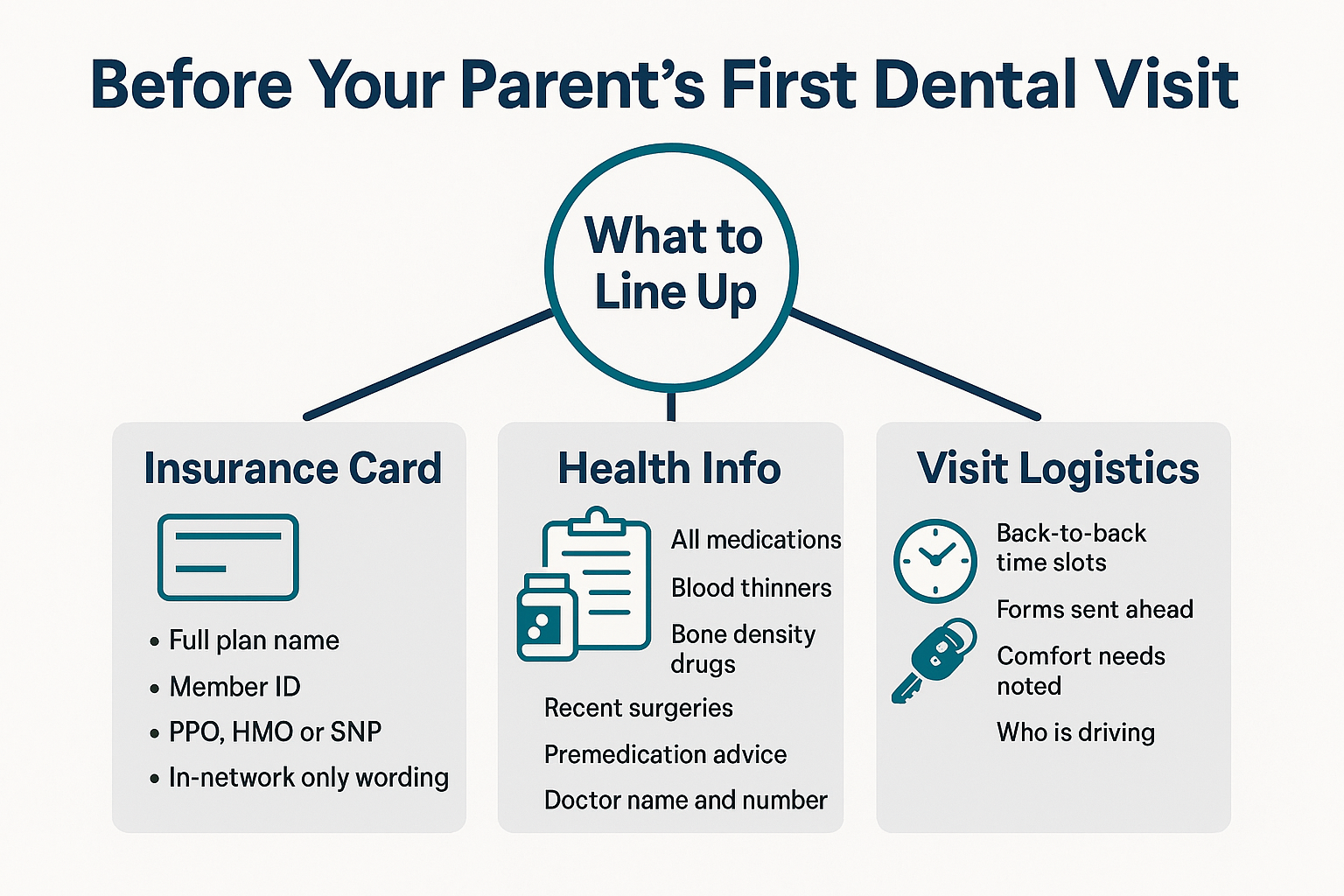
Turning Three Errands Into One Trip
If you are the driver, the real question is whether this takes one afternoon or three. About one in twelve calls we get is somebody booking for a spouse, a child, or a parent, and the scheduling is usually the hard part.
You can ask for more than most people realize:
- Two chairs at the same hour. If you need care too, ask for consecutive or side-by-side slots in one call. A good front office will set it up without you calling twice.
- Forms sent ahead for each person. An 84-year-old filling out a clipboard in a waiting room is slow and stressful. Paperwork emailed or texted in advance fixes that.
- Hours that fit around a job. Weekday mornings starting at 7 a.m., evenings until 7 p.m. Tuesday through Thursday, and Saturday 8 a.m. to 3 p.m. change the math completely when you cannot take a workday off.
Saturday comes up in our calls over and over. One new patient told us plainly that the office being open six days a week was what made it work for her schedule.
Ask one more question while you are on the phone: what gets handled in this building versus sent across town? Crowns, root canals, extractions, dentures, and implants under one roof means your parent is not making four separate trips to four addresses. That matters a lot more at 78 than it did at 38.
If Your Parent Is on Medicare Advantage, Fall Is the Window
The dental piece of a Medicare Advantage plan can change on January 1, and plenty of families find out the hard way in February.
Here is the calendar worth marking:
- By September 30, plans must mail the Annual Notice of Change
- October 1, next year’s plan details publish
- October 15 to December 7, Annual Enrollment runs
- January 1, any change takes effect
In the notice, find the summary of benefits page and look for the dental line. You want the annual dental allowance, what counts as preventive versus major, and whether the plan is still in network with the office your parent uses.
Industry reporting this year found that close to 70% of surveyed health plan leaders expected less generous benefit packages for the coming year, with dental named as a common target. That is not a reason to panic. It is a reason to read the letter instead of filing it.
Two practical moves. Call the office before enrollment closes, not after, and ask whether recommended work should start this year or wait for the reset. Around here, front offices field this question constantly, since roughly 22% of Surprise residents are 65 or older. For the broader picture, what Medicare actually covers for dental in 2026 is a useful companion read.
When Your Parent Has Already Said No
This is the part nobody writes about. Some parents are not resisting the dentist, they are resisting a memory of one from 1994.
Tell the office in advance. Something like: my mom has not been in about eight years, she is embarrassed about it, and she is nervous. That one sentence changes how the whole appointment is set up.
Then ask what comfort options exist. Blankets, headphones, dark sunglasses against the overhead light, an assistant who narrates each step, and sedation options for patients who need them are all normal requests.
Frame the first visit to your parent as a look and a conversation, not a day of drilling. An exam, X-rays, and a plan is a complete first appointment. Nothing has to be treated that day.
Anxiety is the loudest single theme in our review data, and it usually sounds like one patient’s note: “I went 10 years without going to the dentist.” She has made both cleanings this year. A team that hands over a blanket before you ask tends to explain the bill before you ask too.
Frequently Asked Questions About Dental Care for an Aging Parent
What if the office does not take my parent’s plan?
Ask two follow-up questions before you hang up. What does a self-pay exam with X-rays run, and is there a membership plan? Many West Valley offices quote self-pay new patient visits somewhere in the low hundreds depending on how many X-rays are needed, and in-house membership plans often land around $29 a month with no deductible or waiting period. Costs vary by office and by what the exam finds, so get the number directly.
Can I sit in the room with my parent during the appointment?
Usually yes, and it helps. If your parent has memory issues or hearing loss, say so when you book so the team can slow down and repeat the plan with you in the room.
Does my parent need antibiotics before dental work?
That call belongs to the physician or cardiologist, not the dental office. If a doctor has ever told your parent to premedicate before dental visits, bring that instruction in writing or give the office the doctor’s number so they can confirm it before any cleaning or extraction.
My parent needs a lot of work. Does it all have to happen at once?
No. Most treatment plans for someone who has been away a while get split into stages, with urgent and painful items first, then function, then cosmetic. Spreading work across two benefit years is a common and reasonable strategy, especially when an annual maximum is involved.
How do I get my parent’s old X-rays sent over?
The previous office can transfer records with a signed release, and most send them electronically within a few business days. Call the old office first, because X-rays under a year old often do not need to be retaken.
Looking for a Dental Home for Your Parent in Surprise?
When you are screening offices for an older parent, look for a multi-doctor team, most care handled in one building, real comfort options for nervous patients, and a front office that will answer the insurance question straight. Families across Sun City Grand, The Grand, Sun City, and Marley Park have left more than 1,700 five-star reviews describing exactly that experience with our team. If you want to talk through coverage, scheduling two people at once, or what a first visit looks like, westbelldentalcare.com has the details and the office can be reached at 480-795-2420, including Saturdays.