Direct Answer: Whether you need a bone graft before a dental implant depends on how much healthy bone remains in your jaw at the implant site. If there is not enough volume for the post to fuse securely, a graft adds that foundation first.
We hear some version of this question a lot: someone gets a dental implant quote, sees a number that is higher than what they found advertised online, and calls us to find out why. In most cases, the answer comes back to the same thing, the jawbone underneath the missing tooth is not in a condition where an implant can be placed directly. A bone graft needs to happen first, and that adds both cost and time to the process.
The implant post itself is just one part of the picture. What the bone looks like under the surface is what actually determines the path forward. Until a dentist reviews your imaging, neither you nor anyone else can say with certainty whether a graft is part of your treatment or not.
This article focuses on two things: why bone loss happens in the first place, and what it actually means for your implant timeline and cost. If you have been putting off asking about implants because the numbers felt confusing, this should help clarify what is driving them.
Why the Jaw Loses Bone After a Tooth Is Gone
Most people do not realize that the bone surrounding a tooth root is only there because the tooth root exists. When a tooth is lost or extracted, that bone no longer receives the stimulation it needs to maintain its density and volume. The shrinkage process can begin within weeks of extraction and continues over months and years.
How much bone remains by the time someone pursues an implant depends on a few factors:
- How long the tooth has been gone, the longer the gap, the more significant the bone loss tends to be
- Whether gum disease was involved, periodontal disease actively destroys the bone and tissue supporting teeth, often leaving less structure behind even before extraction
- Overall bone density, this naturally decreases with age, which is one reason older adults are more likely to need grafting
Surprise has a large and growing population of active retirees, particularly in communities like Sun City Grand and Sun City. More than 22 percent of Surprise residents are 65 or older, and many in that group have had missing teeth for years before pursuing a permanent replacement. That longer gap between loss and treatment is a real factor in why bone grafting comes up more often in implant consultations here than people expect.
This is not a criticism of waiting, life gets busy, costs pile up, and implants are not always the first thing on the list. But understanding the biology helps explain why two people asking the same question can get very different treatment plans.
What a Bone Graft Actually Does
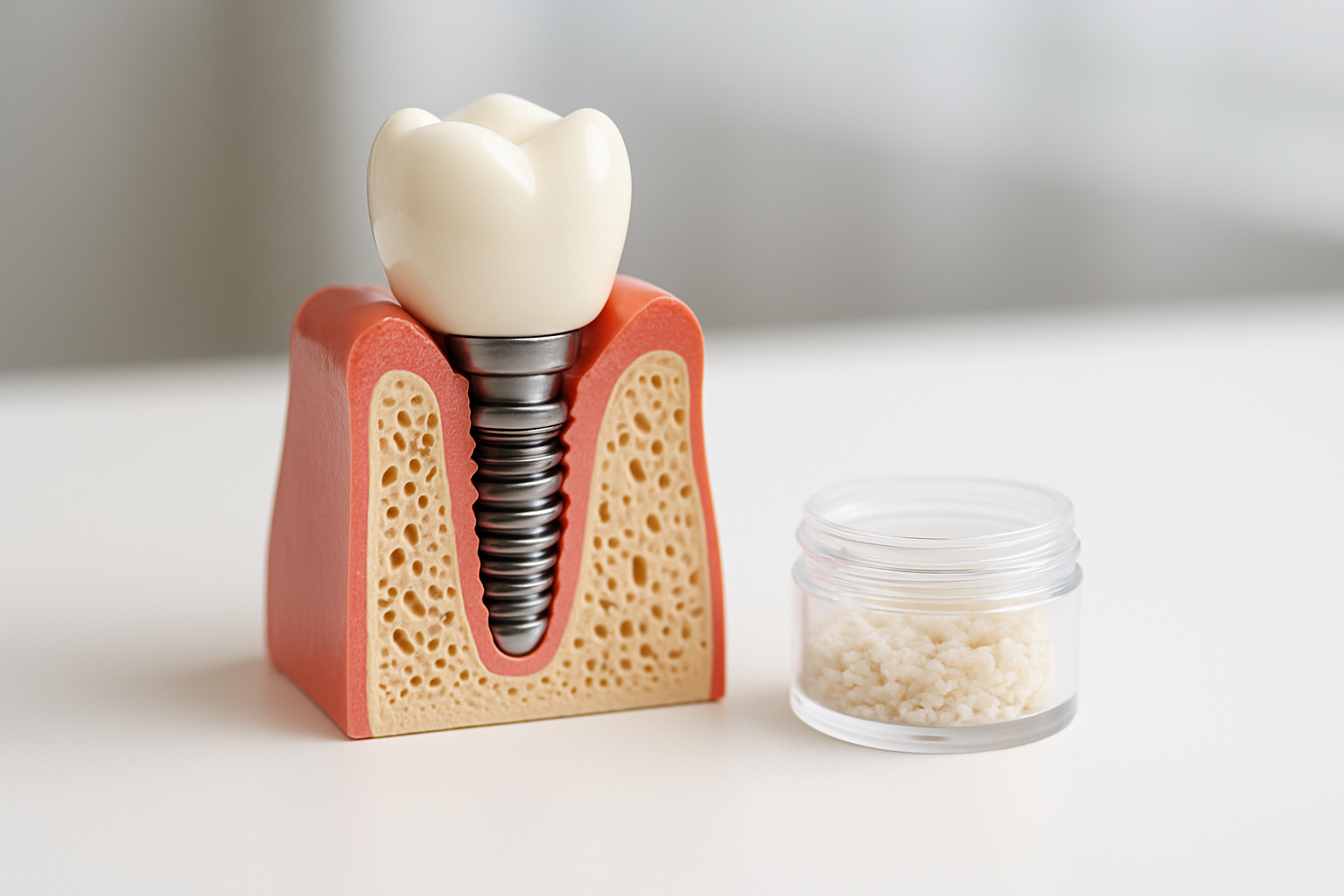
A bone graft restores volume to the area where bone has been lost. The goal is to give the implant post enough material to fuse with through a process called osseointegration, the biological bonding between the titanium post and your living bone tissue. If there is not enough bone to surround and stabilize the post, the implant cannot integrate properly, and the procedure fails.
The graft material itself can come from a few different sources. None of these is universally better than the others, the right choice depends on the individual case, the amount of volume needed, and other health factors your dentist will review.
- Autograft, bone taken from your own body, often from another area of the jaw. This is considered highly compatible but requires an additional surgical site.
- Allograft, processed donor bone from a bone bank. It is sterilized and screened carefully. This avoids a second surgical site for the patient.
- Xenograft, bone material derived from an animal source, most commonly bovine (cow). It has a long track record in dental applications.
- Alloplast, a fully synthetic option made from biocompatible materials. No human or animal tissue involved.
Each option has a different healing timeline before the implant post can be placed. In many cases, you are looking at several months of healing after a graft before the site is ready for the next step. That extended timeline is one of the main reasons people are surprised when they realize a dental implant is not always a quick procedure.
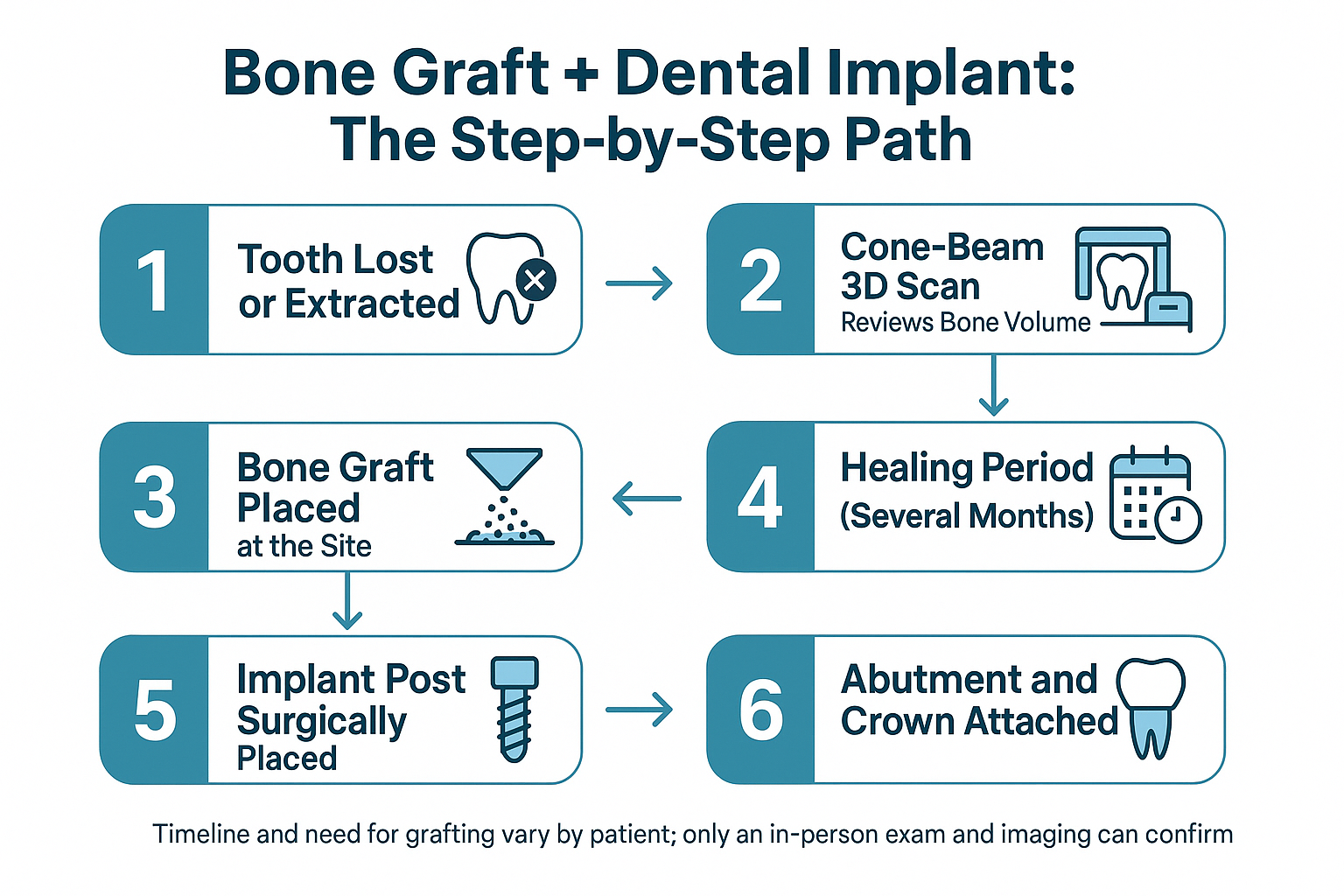
The Bone Graft and Implant Process at a Glance
This overview shows the typical sequence of steps when a bone graft is needed before dental implant placement.
Why the Cost Varies So Much Between Patients
We have had patients submit questions through our website asking for a cost estimate on a bone graft combined with an implant, and the honest answer is that there is no single number that fits everyone. The cost reflects the complexity of what is actually required, not an arbitrary markup.
Here is what drives the price range:
- Whether a graft is needed at all, patients with strong, healthy bone volume at the implant site may not need one, which significantly reduces cost and treatment time
- The size and type of graft, rebuilding a larger area requires more material and more surgical time than a small localized graft
- Which graft material is used, autografts that require harvesting from another site involve more procedure time than using processed donor or synthetic material
- Whether a tooth still needs to be extracted, some patients come in with a tooth that needs to come out first, then a graft placed at the same time, which adds a step
- The number of implants, a single implant is a very different investment than multiple implants or an implant-supported restoration
General market context suggests that a single dental implant in the Phoenix West Valley area can range broadly, with bone grafting adding a meaningful cost depending on the scope. What I can tell you with confidence is that transparent treatment planning, where every line item is explained before you agree to anything, is how we approach this at our practice. Nobody should leave a consultation confused about what they are paying for.
For residents in communities like Marley Park or Ashton Ranch comparing quotes from multiple offices, the most useful question to ask is not just the total number, it is what exactly is included in that number and why.
Factors That Affect Whether You Need a Bone Graft Before an Implant
These are the main variables a dentist evaluates when reviewing whether grafting is part of your implant plan.
| Factor | What It Means for Your Case | Why It Matters |
|---|---|---|
| Time since tooth loss | Longer gaps mean more bone has resorbed | More volume loss often means a larger graft is needed |
| History of gum disease | Periodontal disease erodes supporting bone actively | May leave less bone behind even before extraction occurs |
| Patient age and bone density | Density naturally decreases over time | Older adults may have less bone volume at the implant site |
| Prior extractions in the same area | Adjacent bone may have been affected | The condition is not always visible without imaging |
| Existing crowns or bridges in the area | The bone underneath may not have been assessed recently | Only a cone-beam scan reveals current bone structure |
| Overall health and healing ability | Conditions like diabetes or smoking affect healing timelines | May influence graft material choice and recovery expectations |
What an Implant Consultation Actually Covers
One thing I want to address directly: several patients who have come in asking about implants were surprised to learn that we needed to take imaging before we could give them a real treatment plan. That is not us stalling, it is the only honest way to do this.
A cone-beam CT scan, also called a 3D scan, shows the actual volume, density, and shape of the bone at the implant site. It also reveals the position of nerves, sinus cavities, and adjacent tooth roots that affect where and how an implant can be placed. You cannot get that information from a standard two-dimensional X-ray alone.
Patients with existing crowns, bridges, or areas where teeth were extracted years ago often have no idea what the bone underneath looks like today. The scan is what answers that question. According to the American Academy of Implant Dentistry, proper pre-surgical planning, including three-dimensional imaging, is considered a standard of care for implant placement, and for good reason.
An implant consultation is not a sales pitch. It is the step that lets us tell you honestly whether you need a graft, how large it needs to be, what your timeline looks like, and what the full cost of treatment will be before you commit to anything. For patients in Rancho Gabriela, Greer Ranch North, or anywhere else in the West Valley who have been putting this off because the process felt unclear, the consultation is genuinely just about getting you real information.
Frequently Asked Questions About Bone Grafts and Dental Implants
Can I get an implant without a bone graft?
Yes, if you have sufficient bone volume at the implant site. Many patients do not need a graft at all. The only way to know is through a thorough exam and imaging. Patients who had an extraction recently and moved forward quickly with an implant sometimes still have enough bone for direct placement.
How long does a bone graft add to the overall implant timeline?
A bone graft typically adds several months to the process before the implant post can be placed. The exact healing period depends on the size of the graft, the material used, and how your body heals. Once the graft has integrated and the site is ready, implant placement proceeds from there. The full journey from graft to final crown can take anywhere from six months to well over a year in some cases.
Why was my implant quote higher than what I saw advertised?
Advertised implant prices almost always reflect the implant post alone under ideal conditions, with no extractions, grafts, or complex placement factored in. When your specific case requires additional steps, the cost reflects that added treatment. It is not a bait-and-switch, it is the reality that no two mouths are the same. Ask any office you consult with to break down exactly what is and is not included in their quoted price.
Does a bone graft hurt?
The procedure itself is done with local anesthetic, so you should not feel pain during the graft. Post-procedure soreness is normal and typically managed with over-the-counter pain relief or a prescription if needed. Sedation options are available for patients who are anxious about any part of the process.
I had a tooth pulled years ago. Is it too late to get an implant?
It is rarely too late, but the longer a tooth has been missing, the more likely a bone graft will be part of your treatment plan. The good news is that grafting can restore enough volume to make implant placement possible in many cases. An imaging review will show exactly where things stand.
Will my insurance cover the bone graft?
Coverage varies significantly by plan. Some dental insurance plans cover a portion of bone grafting when it is considered medically necessary, while others treat it as a separate line item with its own limitations. We recommend bringing your current insurance information to your consultation so we can help you understand what is likely to be covered before you commit to treatment.
Ready to Find Out What Your Jawbone Actually Looks Like?
If you have been sitting on the idea of a dental implant because the process felt confusing or the quotes did not add up, an in-person consultation is the straightforward next step. Our team reviews your imaging, explains exactly what your bone structure looks like, and walks you through what treatment would realistically involve before you make any decisions. West Bell Dental Care offers extended hours including Saturday appointments at our Surprise office, making it easier to fit that first visit into a busy week. You can reach us at 480-795-2420 or visit westbelldentalcare.com to request a consultation.