
Direct Answer: Often yes. A small chip in healthy enamel is usually smoothed or rebuilt with tooth-colored composite the same day. Deeper chips, cracks, or heavy bite damage typically need an exam plus a second visit.
You chipped a front tooth. And the question running through your head probably is not “can this be fixed.” It’s “will it get fixed at the appointment I book, or am I driving back out to Bell Road a second time?”
That’s a fair thing to want to know before you pick up the phone. I get asked some version of it almost every week, often by someone who has already called two other offices that morning.
So let me answer it plainly first, then walk you through what we’re actually looking at when we examine that tooth. By the end you should have a decent idea of which path yours is on.
One Visit or Two: What Actually Decides It
Here is the honest split.
Often a single visit:
– A small nick or rough edge on a tooth with healthy enamel around it
– A chip we can polish smooth in a few minutes
– A chip we can rebuild with tooth-colored composite, shaped and cured right in the chair
Usually two visits or more:
– A chip that goes past enamel into the inner layer, or exposes the nerve
– A chip that turns out to be the visible edge of a crack running down the tooth
– Damage on a tooth that already has a large old filling holding it together
– Anything that needs a lab-made restoration like a porcelain veneer or crown, because an outside lab has to build it
There’s also a middle path people don’t expect. Sometimes the front tooth looks fine structurally but the chip is sitting next to a tooth that’s already darker or worn, and matching one shade of composite to a mismatched neighbor is its own conversation. If that sounds like you, this piece on one front tooth being darker than the rest covers what color correction can and cannot do.
We can’t promise the one-visit path over the phone before anyone has looked at the tooth. But in my experience, small edge chips on otherwise healthy front teeth go home fixed more often than not.
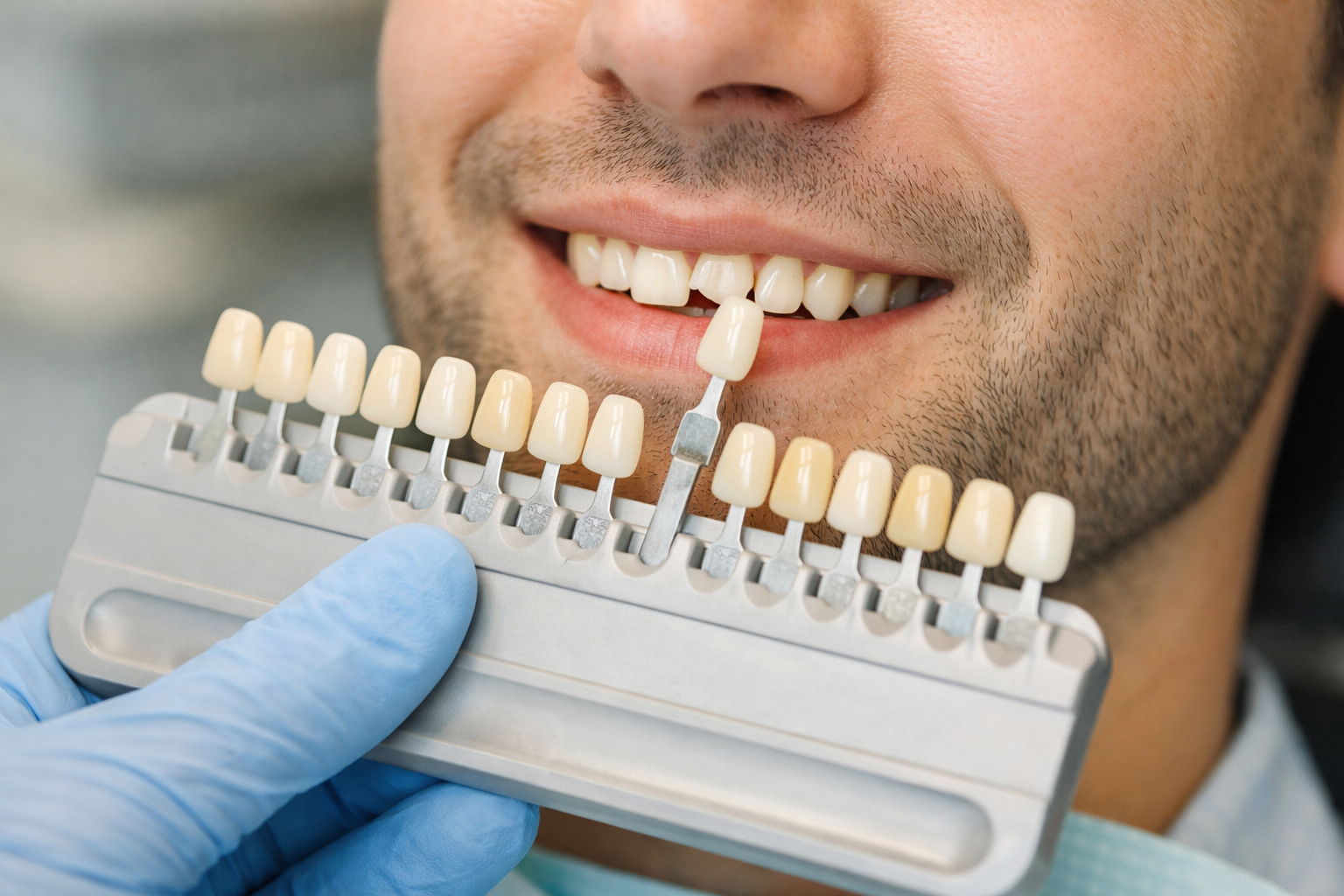
What I’m Measuring When I Look at That Tooth
When you sit down and open, I’m not deciding between bonding and a crown based on how the chip looks from across the room. There are five specific things I’m checking.
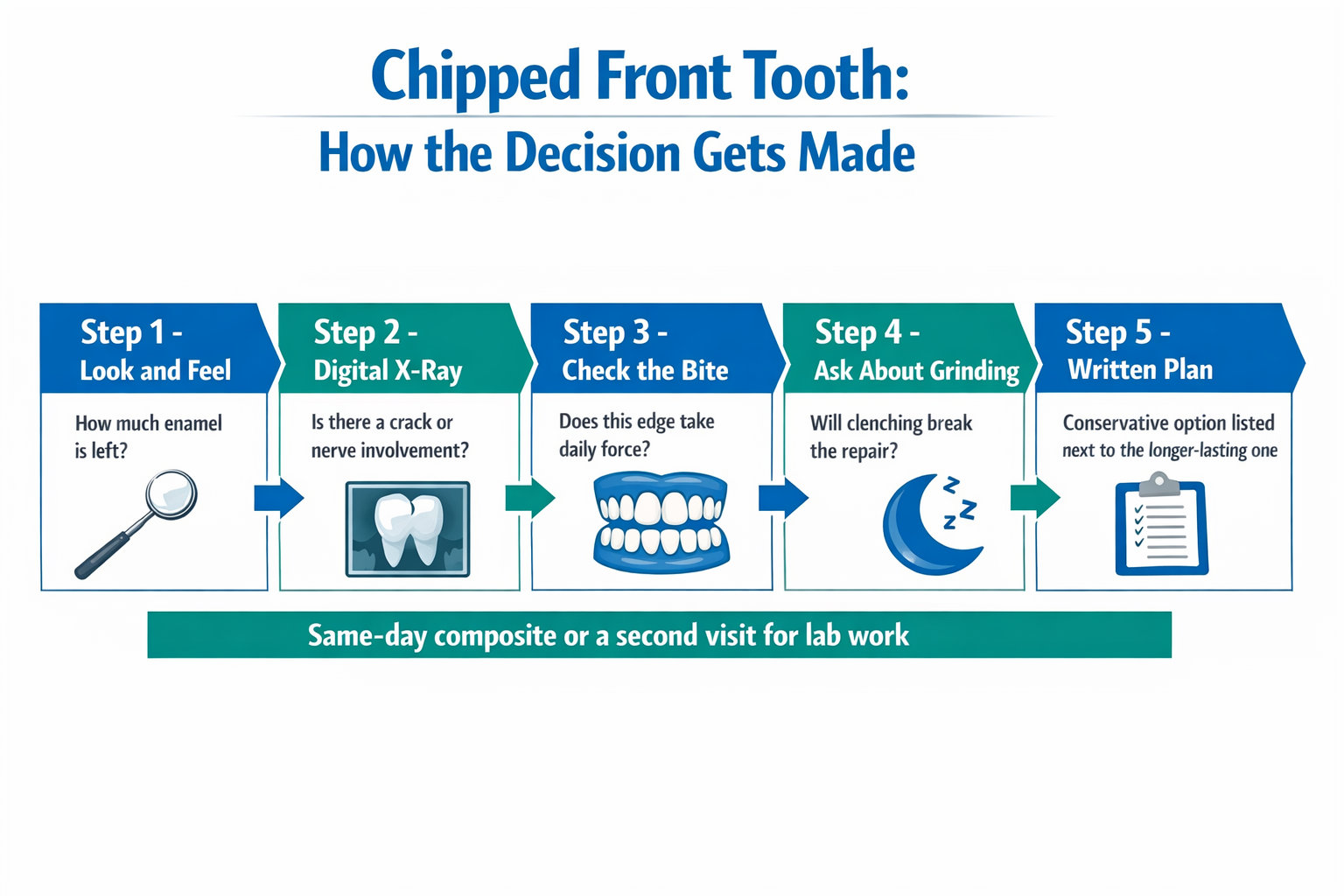
1. How much enamel is left. Enamel is the hard outer shell, and bonding sticks to it beautifully. Once a chip runs past enamel into the softer dentin underneath, a thin composite repair has less to hold onto.
2. Where the chip sits on the bite. The incisal edge of an upper front tooth takes force every single time you bite into something. A chip on that edge gets stressed daily. A chip on the corner, away from where your teeth meet, lives an easier life.
3. Whether the nerve is involved. If the inner layers are exposed, you’ll usually feel it with cold air or water. That changes the plan, and sometimes means root canal therapy before anything cosmetic happens.
4. Whether there’s a crack behind the chip. This is the one people miss. A clean nick can be purely cosmetic, or it can be the top of a line running down the tooth. Digital X-rays and a close look under magnification tell us which.
5. Whether you clench or grind at night. If you do, a repair on a front edge will keep breaking off until the grinding is addressed. That’s why we sometimes talk about a night guard in the same visit as the chip. It isn’t an upsell. It’s the reason the fix lasts.
Chipped Front Tooth Repair Options at a Glance
Here’s a plain comparison of the four repairs that come up most for a single front tooth.
| Repair | Best suited for | Typical visits | What drives the cost |
|---|---|---|---|
| Smoothing and polishing | A rough edge with no real tooth loss | One, often quick | Usually the least involved option |
| Composite bonding | Small to moderate chips with healthy enamel left | One | Size of the chip, time in the chair, no lab fee |
| Porcelain veneer | Larger chips, or when the whole front surface needs work | Two, with weeks between | Lab fabrication and the porcelain itself |
| Crown | A tooth with a crack or very little structure left | Two, sometimes after a root canal | Lab work plus any treatment needed first |
The Decision Path, Start to Finish
This is roughly the order the exam follows, from the first look to the plan you take home.
A Chip That Doesn’t Hurt Is Still Worth a Look
Plenty of people live with a chipped front tooth for months because it doesn’t hurt. I understand that completely, and nobody here is going to lecture you about how long you waited.
But pain is a late signal, not an early one. The ADA’s patient guidance on cracked teeth makes the same point: damage can spread under the surface well before you feel anything.
The practical reason to come in sooner is simple. A small chip caught early usually means a small repair, and less of your natural tooth has to be touched. The same chip left alone for a year can become a crack that takes the tooth from a bonding case to a crown case.
This is the same pattern we see with cavities, which also tend to stay quiet until they aren’t. If you want the longer version of that idea, early cavities don’t always hurt either.
What a First Visit Costs, and Why I Won’t Print a Number
There’s a quiet worry behind a lot of these calls, and I’d rather name it than dance around it. People ask about one chipped tooth and brace for a quote on a full set of veneers.
A first visit for a chip normally includes an exam, images of the tooth and the teeth around it, and a written plan. That plan should list the conservative option alongside the longer-lasting one, with what each involves. It is completely fair to say out loud: “show me the smallest repair that will hold.” We hear that often and it’s a reasonable request.
On cost, I’m not going to print a figure here, because the number genuinely moves based on three things:
– The size of the chip and how much time it takes to rebuild
– The material used, since composite and porcelain are different animals
– Whether a dental lab is involved, which adds fabrication cost and calendar time
Insurance adds its own variable, and for patients without it we have an in-house membership option that covers preventive care and discounts other services. For an actual figure on your tooth, call and ask. One of our reviewers put it better than I can: “Friendly knowledge staff who take care of my teeth without inflating my care.” That’s the standard we’re aiming at.
If you’re coming from another office with a big treatment plan in hand, here’s how a second opinion visit works.
Working Backward From the Date on Your Calendar
Almost every chipped front tooth is attached to a date. A holiday photo. A granddaughter’s wedding. A flight home in April.
So do the math honestly. A same-visit composite repair can be handled in one appointment. Anything lab-made means an appointment to prepare and record the tooth, a stretch of a couple of weeks while the lab builds it, then a second appointment to seat it.
That matters most for our seasonal residents. Folks arriving in Sun City Grand and Sun City in October are working inside a four to six month window, and starting a crown in late February is tighter than starting one in November.
On scheduling, our hours are 7 AM to 7 PM Monday through Thursday, 7 AM to 5 PM Friday, and 8 AM to 3 PM Saturday. Working parents in Marley Park and Surprise Farms tend to take the 7 AM slot before the school run. Retirees usually take mid-morning. And if your tooth starts acting up on a Sunday, here’s what your real options are.
Frequently Asked Questions About Chipped Front Tooth Repair
Can you really fix it at my first appointment as a new patient?
Often, yes. If it’s a small edge chip with healthy enamel around it, composite bonding is usually done the same visit. We still do the exam and images first, because that’s what tells us whether a quick fix is the right fix. If we find a crack or nerve involvement, we’ll tell you before anyone picks up a drill.
Does fixing a chipped tooth hurt?
Most small bonding repairs need little or no numbing at all. If the chip is deeper, we numb the area first. And if you’re someone who tenses up just walking through the door, say so when you book. Sedation options exist, and this walkthrough of a first visit with dental anxiety explains what we do differently.
Will the bonding match my other teeth?
That’s the goal, and we shade-match before we start. Worth knowing: composite doesn’t lighten with whitening the way natural enamel does. So if you’re planning to whiten, it’s usually better to whiten first and match the repair to the new shade.
Why do I need X-rays if I just want the chip fixed?
Because the part you can see is not the whole story. A chip on the surface can sit above a crack or a nerve problem that only shows on an image. Here’s the fuller explanation of why a first visit includes X-rays and an exam.
How long does a composite repair on a front tooth last?
It varies more than people expect. Chips on a corner tend to hold a long time. Chips on the biting edge take force every day, and if you grind at night they take more. Good home care and a night guard, if you need one, make the biggest difference.
Do you have Saturday appointments?
Yes, Saturday 8 AM to 3 PM, plus 7 AM weekday openings and evenings until 7 Monday through Thursday. It’s the most common scheduling question we get from working patients in the West Valley.
Thinking About That Chipped Front Tooth?
The exam, the imaging, the same-day composite work, and the lab-made options are all handled by our multi-doctor team in the one office on West Bell Road, so a chipped front tooth doesn’t get split across referrals. Patients from Marley Park, Surprise Farms, and Sun City Grand tell us the part they value most is being told what’s happening before it happens. Appointments, including Saturdays, are available at westbelldentalcare.com or by calling 480-795-2420.