
Direct Answer: Most patients feel mild soreness and some temperature sensitivity for a few days after a permanent crown is placed. Discomfort should steadily decrease each day and largely resolve within one to two weeks.
Most of the questions I hear after a crown procedure don’t happen in the chair. They happen two days later, at home, when someone bites down on their food and thinks, “Is this supposed to feel like this?” That uncertainty is completely normal, and it’s exactly what I want to address here.
We place a lot of crowns for patients across Surprise, from families in Marley Park to retirees in Sun City Grand, and the post-procedure experience is one of the most commonly misunderstood parts of the whole process. Not because anything goes wrong, but because nobody told the patient what to expect once they walked out the door.
This article focuses on the subjective experience of crown recovery, day by day, so you know what’s normal, what’s worth a quick phone call, and what actually needs attention.
The First 48 Hours: What Normal Actually Feels Like
The first 24 to 48 hours after a permanent crown is cemented are where most patient confusion happens. The tooth has been worked on, the gum tissue around it is mildly irritated, and the anesthetic that kept you comfortable during the procedure has now fully worn off. Some discomfort during this window is expected.
Here’s what we typically see in those first two days:
- Sensitivity to cold and heat, this is very common and doesn’t mean anything is wrong with the crown
- Tenderness when biting down, especially on the first day, the tooth may feel “aware” of pressure in a way it didn’t before
- Mild gum soreness around the base of the crown where the margin meets the tissue
- A slight awareness of the crown itself, it can feel like a new presence in your mouth, which is normal
None of these sensations mean the crown was placed incorrectly. One of our patients described the crown procedure as “fast and painless” and noted that our team “made sure I was not having any problems” throughout. That care continues after you leave, the recovery period is part of the process, not separate from it.
Sensitivity should decrease steadily each day. If it’s getting noticeably worse after the third or fourth day instead of better, that’s worth calling about.
The Bite Issue Nobody Warns You About
This is the part I wish every crown patient heard before they left the office. If your crown feels even slightly high when you bite down, like your teeth aren’t coming together the same way they used to, please call us rather than waiting to see if it settles.
A lot of patients assume a slightly off bite will adjust on its own. In most cases, it won’t. And when the bite stays even a little elevated, your jaw muscles compensate by working harder than they should. Within a few days, that can turn into:
- Jaw soreness or fatigue when chewing
- Referred pain to nearby teeth that weren’t involved in the procedure
- Headaches from the muscle tension
The fix is simple. A quick in-office adjustment, which usually takes only a few minutes, resolves the issue immediately. The dentist uses thin marking paper to identify exactly where the crown is making early contact and removes a tiny amount of material from that spot. You leave feeling like everything clicks together the way it should.
This is not a complaint call. It’s a routine adjustment, and we expect some patients will need it. Bite correction after a crown is a completely normal part of the process. Don’t wait it out.
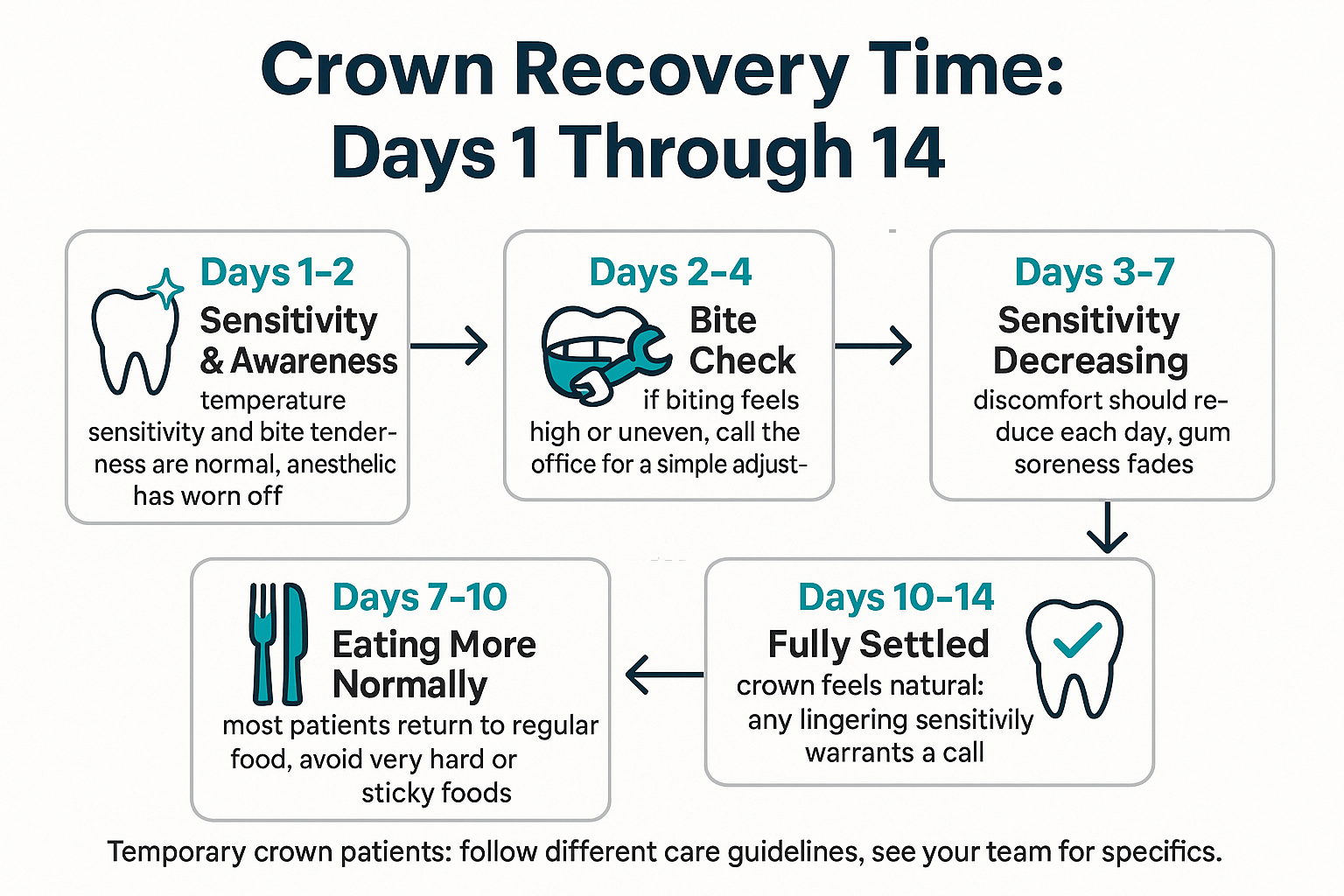
Crown Recovery at a Glance: Days 1 Through 14
Here’s a simple look at what the two-week recovery window typically involves, so you can gauge where you are in the process.
If You Have a Temporary Crown First
Not every crown goes in the same day. Depending on the material chosen and the lab process involved, some patients wear a temporary crown for two to six weeks while the permanent one is being made. That temporary period comes with its own set of questions.
Temporary crowns are made from a different material than your final restoration, and they’re secured with a lighter cement on purpose, so the permanent crown can be placed without difficulty later. That means they behave differently:
- Avoid sticky foods like caramel, gum, or chewy candy, these can pull a temporary loose
- Avoid very hard foods on that side of the mouth
- Chew on the opposite side when possible
- If the temporary comes loose, call us right away, don’t leave it out, because the surrounding teeth can shift and the exposed tooth can become sensitive
The temporary may also feel slightly different from your final crown in terms of texture and bite. That’s expected. It’s a placeholder, not the finished product.
Some practices now offer same-day permanent crowns using in-office milling technology, which cuts the crown from a ceramic block right in the practice and eliminates the temporary altogether. The American College of Prosthodontists has published guidance on crown materials and processes that can help patients understand what their specific restoration involves. If you’re not sure which type of crown process you’re having, ask your dentist before the appointment, it changes how you plan the following few weeks.
Normal Discomfort vs. When to Call: A Quick Reference
Use this as a guide for the most common post-crown sensations and whether they need attention.
| What You’re Feeling | Normal or Not? | What to Do |
|---|---|---|
| Cold or heat sensitivity for a few days | Normal | Monitor, should decrease each day |
| Mild bite tenderness on day 1 or 2 | Normal | Soft foods, monitor progress |
| Crown feels high when biting | Needs attention | Call the office for a bite adjustment |
| Gum soreness around the crown edge | Normal for first week | Gentle brushing, salt water rinse |
| Sharp pain when biting, not improving | Not normal | Call the office, may need evaluation |
| Temporary crown comes loose | Needs attention | Call same day, do not leave it out |
| Sensitivity still strong after 10+ days | Warrants a call | Contact us to rule out other causes |
Frequently Asked Questions About Crown Recovery Time
How long does soreness after a crown typically last?
For most patients, the main soreness fades within three to five days. Sensitivity to temperature can linger a bit longer, sometimes up to two weeks, especially if the tooth had a deep cavity or significant damage before the crown was placed. If you’re still uncomfortable after ten days without improvement, give us a call.
Is it normal for my crown to feel different from my natural tooth?
Yes, at first. Your mouth is very sensitive to changes, and a new crown can feel slightly unfamiliar even when it’s sized correctly. Most patients stop noticing the crown within one to two weeks as the sensation becomes routine.
Can I eat normally right after getting a permanent crown?
We suggest sticking to softer foods for the first 24 hours. After that, most people can eat fairly normally, but it’s worth avoiding very hard foods, ice chewing, or sticky candy for the first week. If biting causes significant pain, that’s a sign to call about a bite adjustment rather than powering through it.
What if my temporary crown falls off on a weekend?
Call us. We have Saturday hours from 8 AM to 3 PM, so weekend issues don’t have to wait until Monday. Leaving a temporary crown out for more than a few hours can cause sensitivity and tooth shifting, so we want to see you quickly.
Does sensitivity after a crown mean the root canal failed or the crown is wrong?
Not usually. Sensitivity in the first week is almost always normal inflammation from the procedure itself. It becomes a concern if the pain is sharp, throbbing, or getting worse over time rather than better. In that case, an evaluation will tell us whether there’s something deeper going on.
Suggested Internal Links — add real URLs before publishing:
- dental crown healing timeline — Clinical timeline for how a crown heals at the tissue and bone level, complements this article’s day-by-day patient experience focus
- dental crowns and bridges — Overview of the crown and bridge process, materials, and what patients can expect from each restoration type
- sedation dentistry options — Information on sedation options for anxious patients undergoing crown procedures or other restorative work
- same-day emergency dental care — What qualifies as a dental emergency and how the practice handles urgent situations like lost temporaries or crown-related pain
Questions About Your Crown Recovery?
If you’re in the middle of crown recovery and something doesn’t feel right, or you just want to make sure what you’re experiencing is normal, we’re easy to reach. Our team at West Bell Dental Care is available Monday through Saturday, including extended evening hours Tuesday through Thursday, so you don’t have to wait. Call us at 480-795-2420 or visit westbelldentalcare.com to connect with our team.