
Direct Answer: Early cavities on front teeth often appear as white or chalky spots on the enamel, or as a brown spot near the gumline. They usually don’t hurt until decay reaches deeper layers.
Most people assume a cavity will announce itself with pain. It usually doesn’t, at least not at first. By the time a front tooth actually hurts, the decay has often moved past the point where a simple filling solves it.
I see this pattern regularly in our Surprise practice. Patients come in after spotting something in the mirror, a spot that’s been there for months, and they’ve been waiting to see if it would hurt before making an appointment. Sometimes the window for a quick, affordable fix has already closed.
This article breaks down what early, mid-stage, and advanced cavities actually look like on front teeth, why pain is a poor warning system, and what gets caught on an X-ray that your mirror will never show you.
What Does a Cavity Look Like on a Front Tooth?
This is one of the most common things people search for before calling us, and I understand why. Front teeth are visible. If something looks off, you want to know whether it’s a stain or something that needs attention.
Here’s how decay tends to progress visually, from earliest to most advanced:
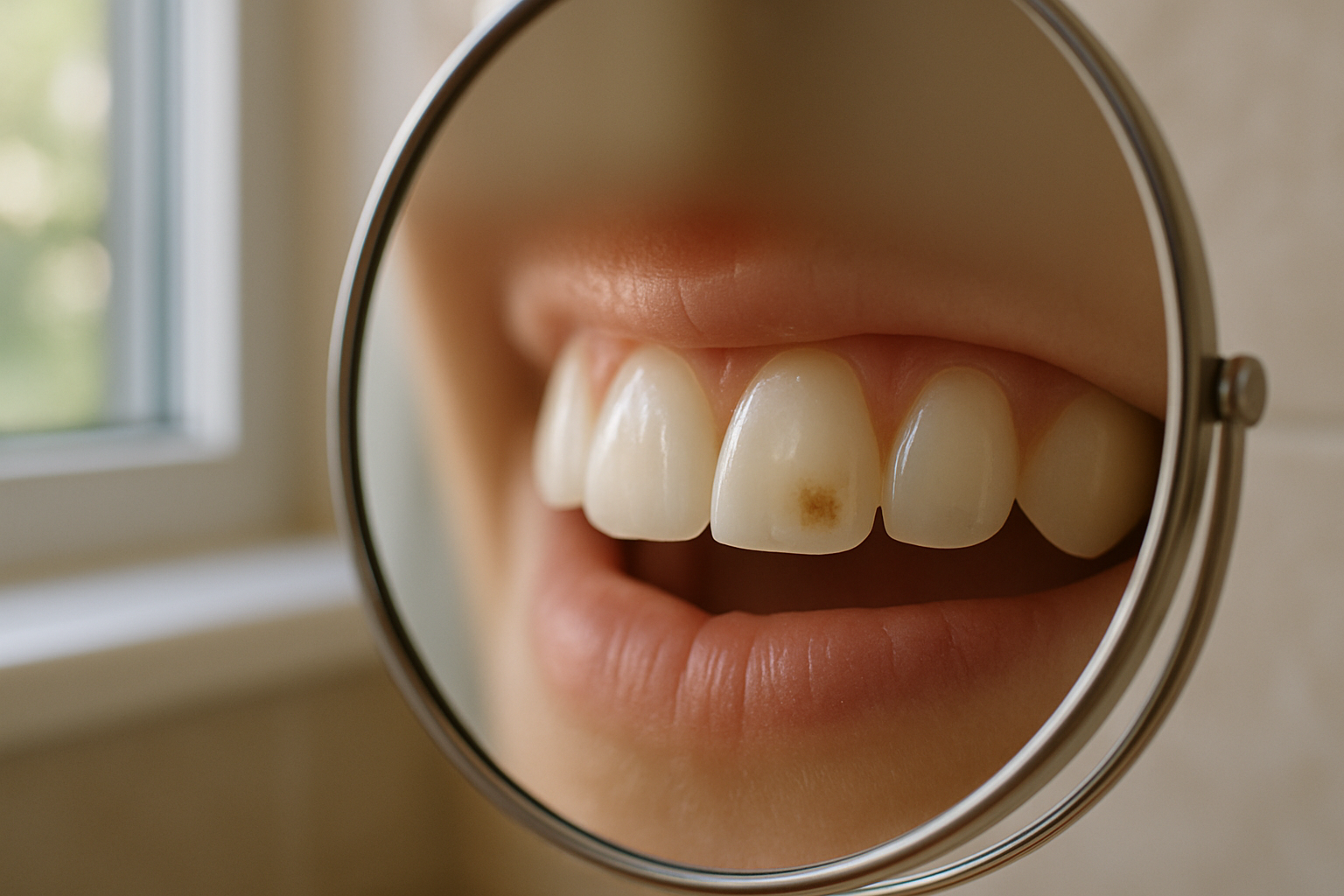
- White or chalky spot on the enamel surface, This is the earliest stage, called demineralization. The enamel is losing minerals but hasn’t broken down into a hole yet. It can look almost like a dull patch compared to the shinier surrounding tooth. Many people mistake this for a bleaching streak or a natural variation in their teeth.
- Yellow or light brown discoloration, As decay progresses, that chalky area starts to pick up color. The spot darkens because bacteria are actively breaking down the enamel structure beneath the surface.
- Brown spot near the gumline or between two front teeth, This is one of the most common presentations I see. The area where two front teeth meet, just above the gumline, collects plaque and is harder to clean thoroughly. A brown shadow or spot in that zone is worth getting looked at.
- Dark brown or black spot with visible pitting, At this stage, there’s a physical hole in the enamel. The tooth surface is no longer intact. This is advanced decay, and treatment is more involved.
The tricky part is that a white spot and a black pit can both be cavities, they just represent very different stages of the same problem.
Why Cavities Don’t Hurt Until They’re Already a Bigger Problem
Pain is a poor early warning system when it comes to cavities. The outer layer of a tooth, the enamel, has no nerve endings. So when decay is working through that outer shell, you feel nothing.
Pain typically starts when decay reaches the dentin, the softer layer underneath the enamel. Dentin is much closer to the nerve, and that’s when sensitivity to cold, sweets, or pressure can begin. By that point, the cavity has been developing for a while.
We had one patient describe two days of steady tooth pain from what turned out to be a wisdom tooth issue, but that level of discomfort usually means something has progressed well beyond the early stage. Front tooth decay specifically tends to be completely silent in its early window, which is exactly when it’s easiest and least expensive to treat.
The practical math on this matters, especially for patients in the Surprise area who are on fixed incomes or between insurance plans. A small filling is a fraction of the cost of a crown. And a crown is still far less than a root canal and crown combined. Every stage of progression adds cost and complexity, not because dentists want that, but because that’s how decay works biologically.
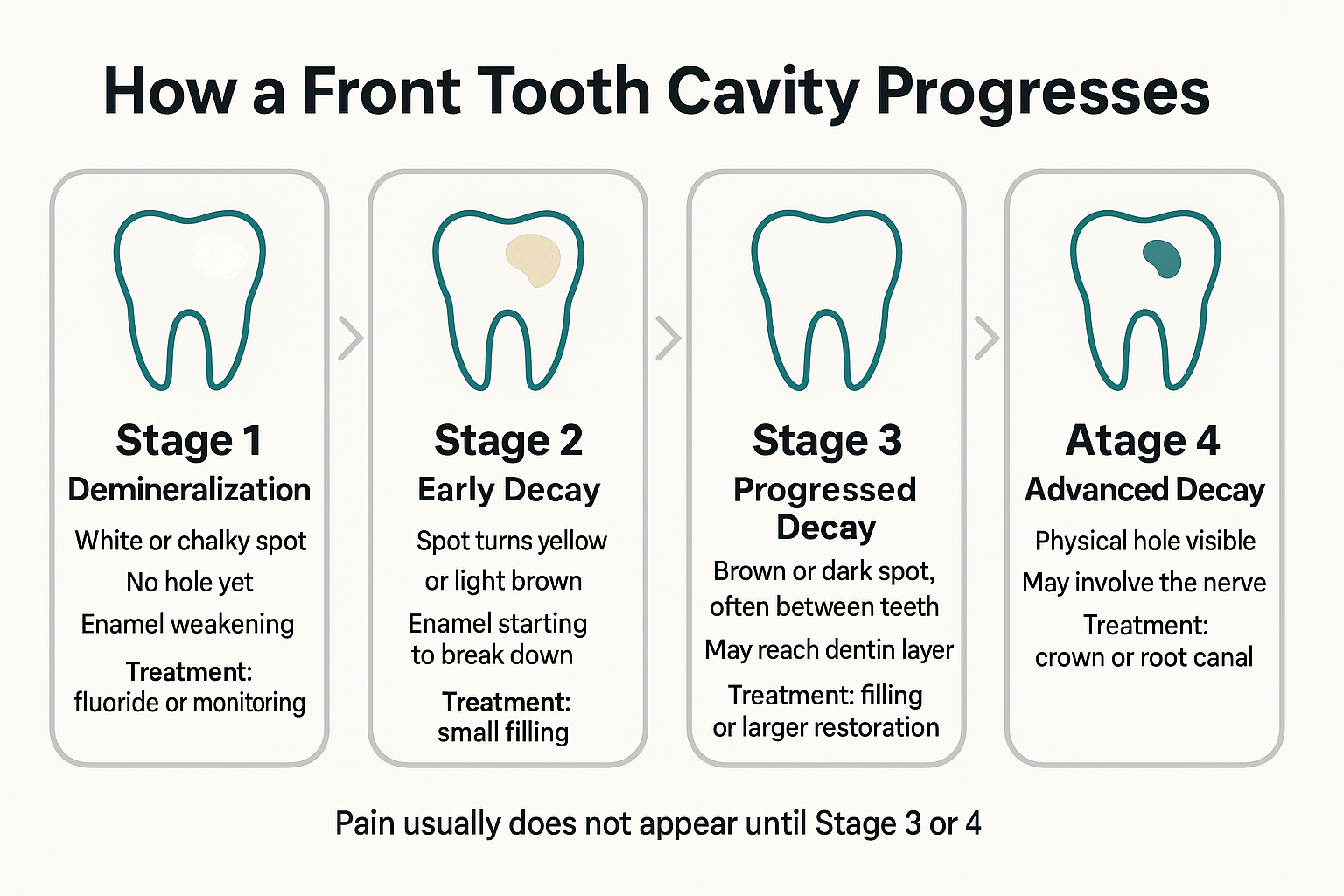
The Four Stages of a Front Tooth Cavity
This shows how a cavity on a front tooth changes from a barely-visible white spot to a visible hole, and what your treatment options look like at each stage.
What an X-Ray Catches That Your Mirror Never Will
One of the most common questions I hear is whether X-rays are actually necessary at a routine checkup. I get it, for patients managing costs carefully, every line item on a dental bill gets scrutinized.
But here’s what digital X-rays actually do that a visual exam can’t: they show decay forming between teeth or beneath the enamel surface before it’s visible from the outside. A front tooth can look perfectly clean to the eye while harboring early decay in the contact point between two teeth.
According to the American Dental Association’s evidence-based recommendations on radiographs, the frequency of X-rays should be based on each patient’s individual risk level, not a blanket schedule. For patients with a history of cavities, or those who’ve gone several years between cleanings, more frequent imaging makes clinical sense.
We already see a lot of interest in this topic from our patients, questions like “what shows up on a dental X-ray” and “how do I read my X-rays” come up regularly. The short answer: an X-ray can reveal a cavity between your two front teeth that looks completely normal in a mirror. Catching it at that stage means a quick filling at a routine appointment, not a crown six months later.
Cavity Stages at a Glance, What You See vs. What It Means
Use this as a quick reference when you’re trying to figure out what you’re looking at in the mirror, and what it typically means for treatment.
| What You See | What It Means | Typical Treatment |
|---|---|---|
| White or chalky spot | Enamel demineralization, earliest stage, no hole yet | Fluoride treatment or monitoring |
| Yellow or light brown patch | Early decay working through enamel | Small filling, usually quick and affordable |
| Brown spot near gumline or between teeth | Decay has progressed, possibly reaching dentin | Filling, possibly larger restoration |
| Dark brown or black spot with visible pitting | Advanced decay, physical hole in the tooth | Crown or root canal depending on depth |
| No visible change, but sensitivity to cold | Decay may be between teeth or below enamel | X-ray needed to confirm location and extent |
Front Teeth Are Actually Caught Earlier, Here’s Why
There’s one genuine advantage to having a cavity on a front tooth rather than a molar: people tend to find them sooner. You see your front teeth in the mirror every day. And during a routine exam, your dentist has a direct line of sight to every surface of those teeth without any of the angles that make back molars harder to inspect.
That visibility is real, and it works in your favor, but only if you’re actually coming in for regular checkups. For patients in communities like Sun City Grand or Marley Park who’ve skipped a year or two of cleanings, the front teeth are often where we first spot something that can still be handled simply.
Front tooth cavities tend to cause more anxiety precisely because they’re visible. Patients from Rancho Gabriela and Surprise Farms mention this when they come in, they’ve noticed something and been quietly worried about it for weeks. The good news is that anxiety is usually worse than the actual treatment. A small front tooth filling at our office can often be completed in a single visit, and the tooth-colored composite material we use matches the surrounding enamel closely enough that most people can’t tell a filling is there.
If you’ve been sitting on something you noticed in the mirror, a routine exam is genuinely the lowest-stakes way to find out what it actually is.
Frequently Asked Questions About Cavities on Front Teeth
Can a white spot on my tooth go away on its own?
Sometimes, if it’s caught very early. White spots caused by demineralization, enamel losing minerals before a true hole forms, can occasionally stabilize or partially remineralize with fluoride treatments and improved home care. But they don’t always reverse, and they never improve without some kind of intervention. The only way to know whether a spot is stable or progressing is to have it monitored at a checkup.
I don’t have any tooth pain. Could I still have a cavity?
Yes, and this is exactly why pain is such an unreliable signal. Early-stage cavities work through the outer enamel layer, which has no nerve endings. You typically won’t feel anything until decay reaches the dentin or approaches the nerve, which means a pain-free tooth can still have active decay. Waiting for pain before scheduling an appointment means you’re often waiting until the problem has gotten bigger.
What’s the difference between a cavity and a stain on a front tooth?
Stains from coffee, tea, or tobacco tend to appear as a thin film along the gumline or in the grooves of the teeth, they sit on the surface and don’t change the texture of the enamel. A cavity typically involves a spot that looks slightly different in texture or depth compared to the surrounding tooth, may have a chalky or dull appearance, and doesn’t wipe away. When in doubt, a visual exam and X-ray can tell the difference definitively.
Is a filling on a front tooth visible?
With tooth-colored composite filling material, front tooth fillings are designed to blend with the surrounding enamel. We shade-match the material to your natural tooth color. Most patients are genuinely surprised by how natural the result looks, it’s not the silver filling people picture from years ago.
I haven’t been to the dentist in a few years. Should I be embarrassed about a cavity?
No. Genuinely. We see patients all the time who’ve gone two, four, or even ten years between visits, sometimes because life got busy, sometimes because of anxiety, sometimes because of cost concerns. Our team doesn’t judge that. What matters is what we can do now. Most patients who come in after a long gap are relieved to find that a lot of what they imagined is fixable, and often more affordable than they expected.
How much does a front tooth filling typically cost?
Costs vary based on the size of the cavity, the materials used, and your insurance coverage. Generally speaking, a small filling is significantly less expensive than a crown, which in turn is less expensive than a root canal and crown combined. The earlier decay is caught, the simpler and less costly the fix. For specific pricing based on your situation, the best step is to come in for an exam, we can give you an honest estimate before any treatment begins.
Suggested Internal Links — add real URLs before publishing:
- how to read your dental X-rays — Educational guide explaining what different dental X-ray findings mean, already a top-performing page on the site, ranked position 5 with strong impressions
- tooth-colored fillings at West Bell Dental Care — Service page describing composite filling materials, the process, and what patients can expect at the appointment
- dental exams and cleanings — Preventive care service page covering what happens at a routine checkup, why X-rays are taken, and how early decay is detected
- sedation dentistry options for anxious patients — Page explaining sedation options available at the practice for patients with dental anxiety, relevant for readers who’ve been avoiding the dentist
- same-day emergency dental care in Surprise — Emergency dental care page for patients with acute tooth pain, lost crowns, or suspected infections needing prompt attention
Noticed Something on a Front Tooth?
If you’ve spotted a white spot, a brown edge, or anything that doesn’t look quite right, the straightforward move is to get it checked while it’s still small. Our team at West Bell Dental Care sees patients from across the Surprise area, including families in Marley Park, retirees in Sun City Grand, and working adults throughout the West Valley, and we offer Saturday appointments for people who can’t take time off during the week. You can reach us at 480-795-2420 or visit westbelldentalcare.com to request an appointment, no pressure, just an honest look at what’s going on and what your options are.