Direct Answer: Nitrous oxide wears off in minutes and lets you drive home. Oral sedation produces deeper drowsiness that lingers for hours and requires a driver — but both options are used for routine care, not just major procedures.
A September 2025 study published in the Journal of the American Dental Association found that nearly 73% of U.S. adults report some level of dental fear — including roughly 27% with extreme fear. Earlier estimates had that number at around 25%. So if sitting in a dental chair makes your stomach drop, you are not unusual. You are the majority.
Most people who avoid the dentist for years aren’t being dramatic. They’ve had a painful experience, a rushed appointment where nobody explained anything, or just a deep, hard-to-name dread that builds every time they think about calling. We see this every week in Surprise — patients from Sun City Grand, Marley Park, and Rancho Gabriela who haven’t had a cleaning in years, not because they don’t care about their teeth, but because anxiety has been standing in the doorway.
This article is about what sedation actually feels like — before you ever walk in. We’ll cover the two options most practices offer, nitrous oxide and oral conscious sedation, explain what’s happening in your body during each one, and help you figure out which fits your situation.
How Nitrous Oxide Actually Works
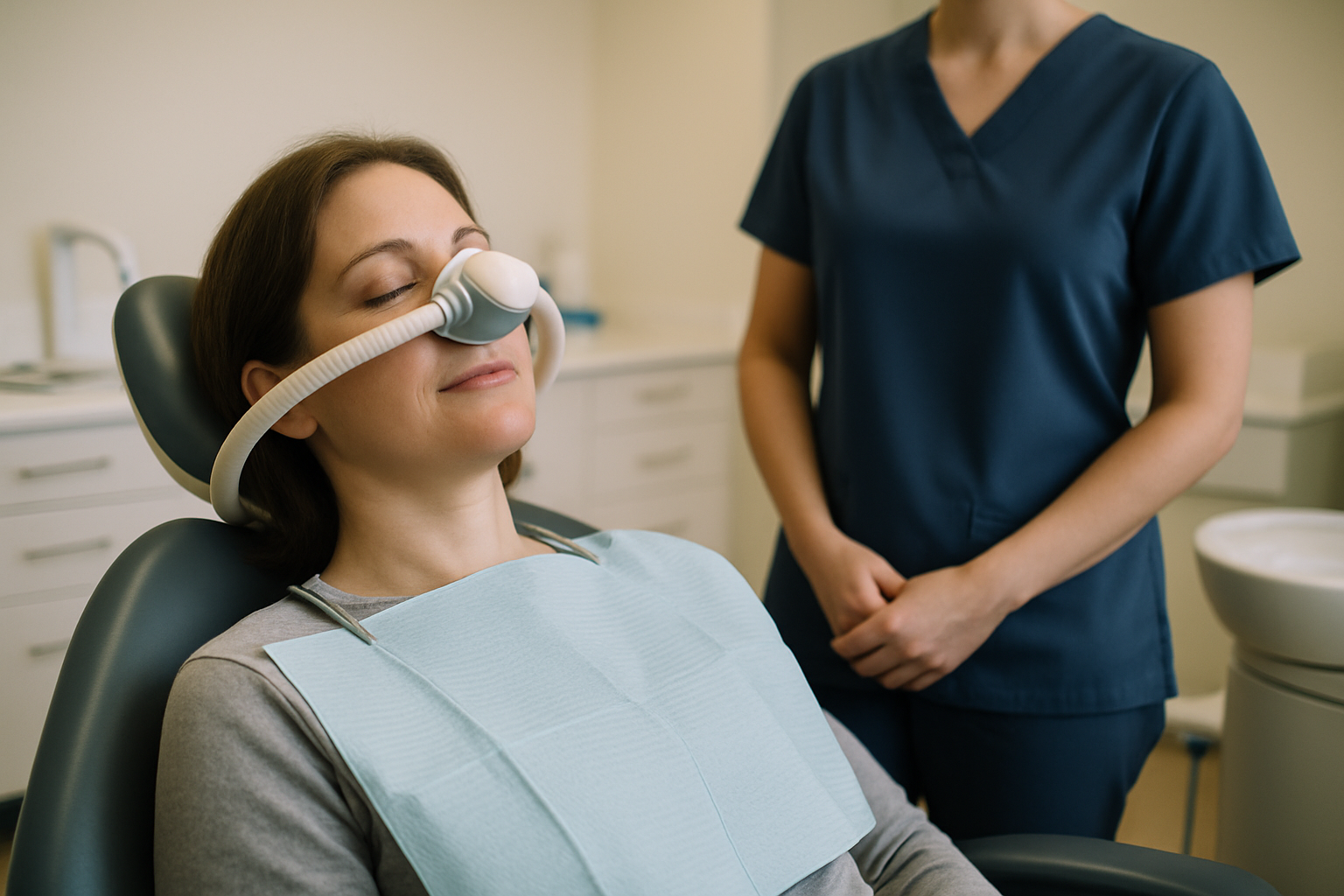
Nitrous oxide — sometimes called laughing gas — is inhaled through a small soft mask that sits over your nose. It doesn’t knock you out. What it does is produce a warm, floaty calm within a few minutes of breathing it in. Most patients describe feeling relaxed, slightly tingly in the hands, and noticeably less bothered by what’s happening around them.
You’re completely awake. You can hear us talking, answer questions, and tell us if something is uncomfortable. The gas just turns the volume down on the anxiety.
The biggest practical advantage is how quickly it leaves your system. When we remove the mask, we have you breathe pure oxygen for a few minutes, and the effects clear up fast — usually within 5 to 10 minutes. That means you can drive yourself home after the appointment without a second thought. For patients in Ashton Ranch or Surprise Farms who are coming in on a lunch break or after dropping kids at school, that matters a lot.
Nitrous works well for:
– Routine cleanings and exams where anxiety is the main barrier
– Fillings and minor restorative work
– Patients who want a little relief but don’t need deep sedation
– Anyone who has a meeting or errand right after their appointment
What Oral Conscious Sedation Feels Like
Oral sedation is a different experience altogether — and the difference is worth understanding before you choose.
With oral conscious sedation, you take a prescribed anti-anxiety pill (typically a benzodiazepine) about an hour before your appointment. By the time you’re in the chair, most patients feel deeply drowsy, heavy-limbed, and genuinely calm. You remain conscious — you can respond if we ask you something — but the experience feels muted and distant. Many patients remember very little of the appointment afterward. Some feel like they blinked and it was over.
Because the medication stays in your system for several hours after the appointment ends, you cannot drive yourself home. You’ll need someone to bring you and take you back. Plan to rest for the remainder of the day.
Oral sedation is a good fit for:
– Patients with moderate to severe dental anxiety
– Anyone who has avoided care for a long time and needs to get through a longer appointment
– People who gag easily or have a hard time sitting still
– Patients who want to remember as little of the procedure as possible
– Those who need multiple things addressed in a single visit and want to reduce the number of appointments overall
One patient who reached out to our team described exactly this situation — they needed a molar extracted, were a self-described “very nervous patient,” and wanted to know if the extraction and any follow-up bridge work could happen in the same visit under sedation. That question captures something real. For people with anxiety, fewer appointments isn’t just convenient — it’s the difference between following through on treatment and quietly canceling every time.
Nitrous Oxide vs. Oral Sedation — Side-by-Side
Here’s a quick visual comparison of both options so you can see the key differences at a glance.
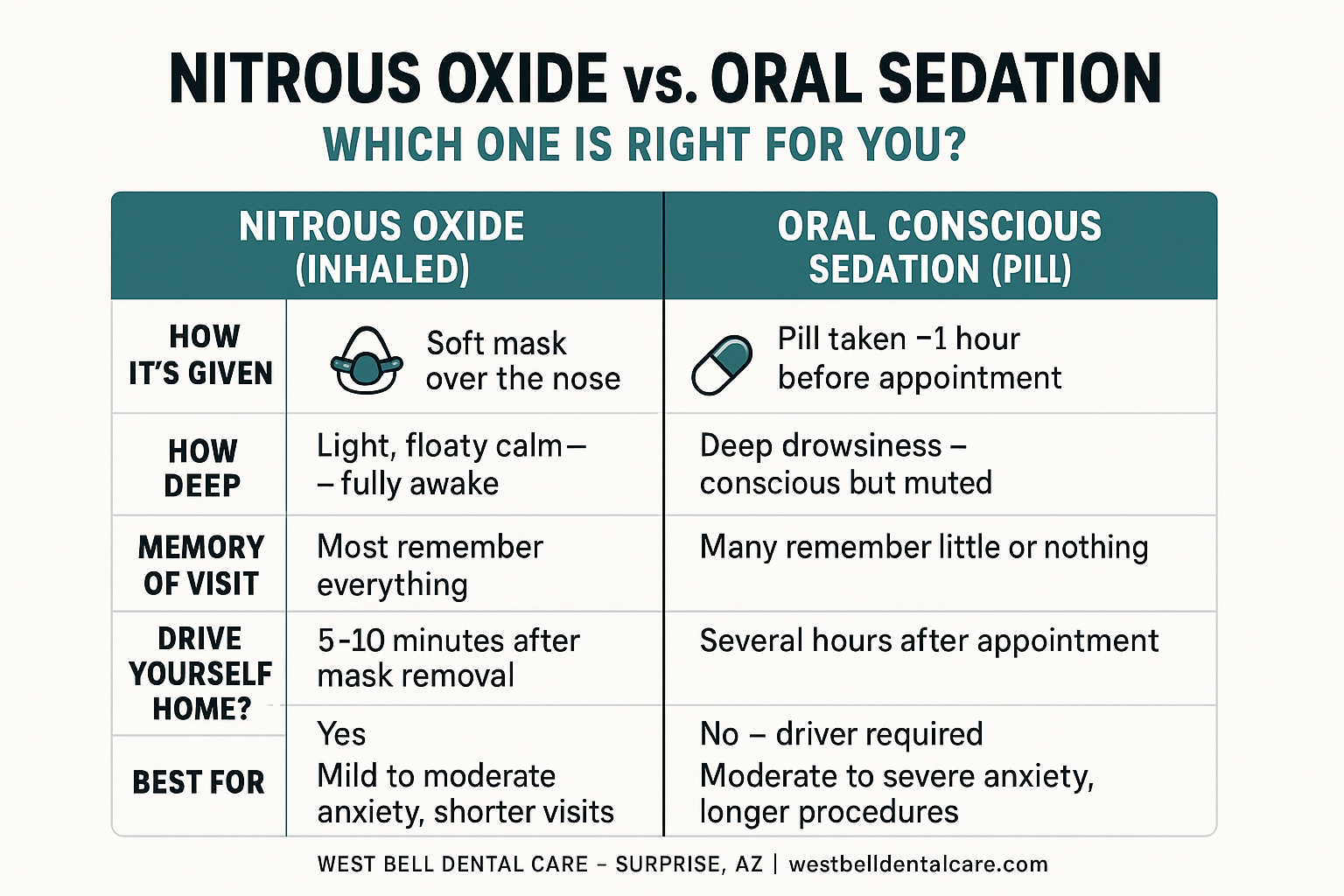
Quick Comparison: Nitrous Oxide vs. Oral Sedation
Use this table as a fast reference when you’re trying to decide which option makes sense for your appointment.
| Factor | Nitrous Oxide | Oral Conscious Sedation |
|---|---|---|
| How it’s taken | Inhaled through nose mask | Pill taken ~1 hour before |
| Sedation depth | Light — relaxed but alert | Deeper — drowsy, calm |
| Memory of visit | Usually remembers everything | Often remembers very little |
| Wears off | 5–10 min after mask removed | Several hours post-appointment |
| Can drive home? | Yes | No — driver required |
| Best for | Mild/moderate anxiety, short visits | Moderate/severe anxiety, longer or complex visits |
| Works for routine cleanings? | Yes | Yes |
Sedation Isn’t Just for Extractions — It’s for Anything Anxiety Makes Hard
One of the most persistent misconceptions I hear is that sedation is only for “big” procedures — root canals, extractions, implants. Patients with moderate anxiety sometimes feel like they don’t “qualify” for it.
That’s not how it works. Both nitrous oxide and oral sedation are regularly used for routine cleanings and fillings. The question isn’t what procedure you’re having. It’s whether anxiety is getting in the way of you finishing treatment.
We had a patient describe walking in after years away from the dentist, feeling so nervous she’d almost talked herself out of the appointment three times. What she found instead was a team that offered her a blanket, dark sunglasses to soften the overhead lights, and the option to put on Netflix during the cleaning. The team narrated every step before doing it — not as a script, but because they actually wanted her to know what was coming.
Those comfort measures and sedation aren’t either/or. Someone with significant anxiety might want nitrous gas and the sunglasses and the blanket. That’s completely reasonable, and nobody here is going to make you feel like you’re being difficult for asking.
If You Have a Complex Medical History, Here’s What to Know
Patients with heart conditions, high blood pressure that spikes under stress, or medications that interact with sedatives sometimes wonder whether sedation is even safe for them. It’s a fair question, and the honest answer is: it depends on the individual — which is exactly why we do a thorough medical history review before any sedation is prescribed or administered.
That review isn’t a formality. It’s how we catch the situations where one option is safer than another, or where we adjust the dose, or where we coordinate with your physician first. Ronnie T., a patient who left a review after his first visit, put it simply: he’d lived in fear of dentists for nearly 80 years, had recently survived heart surgery, and wrote that our doctor “discussed in detail my premeds and present health” before any treatment started. He described it as feeling like he’d “landed in a safe place.”
That’s what the intake process is designed to do. If you’re managing a health condition and wondering whether sedation is an option for you, the right move is to bring it up when you call or at your first appointment — not to assume the answer is no.
Frequently Asked Questions About Sedation Dentistry in Surprise, AZ
Can I get sedation for just a cleaning, or does it have to be a bigger procedure?
You can absolutely request sedation for a routine cleaning. If anxiety is the reason you’ve been putting off care, that’s a legitimate clinical reason to use it — the procedure type doesn’t determine eligibility. Talk to our team when you schedule and we’ll help you figure out which option makes sense.
What does nitrous oxide actually feel like? I’ve never had it.
Most patients describe a warm, slightly tingly feeling that starts within a minute or two of breathing through the mask. It’s not disorienting — you’re fully awake and aware of what’s happening, but the edge comes off the anxiety. Some people laugh a little (hence the nickname), but most just feel noticeably calmer. When the mask comes off and you breathe regular air, the feeling fades quickly.
I’ve avoided the dentist for over 10 years because of fear. Is that going to be a problem?
No — and you’re not alone in that. We see patients regularly who haven’t been in years, sometimes much longer. Nobody here is going to make you feel embarrassed about the gap. The first visit is about understanding where things stand and making a plan together. Sedation is one of the tools that can make it easier to get through that first appointment.
I take blood pressure medication. Is oral sedation safe for me?
That’s exactly the kind of question we want to know about before your appointment. A full medical history review happens before any sedation is prescribed — specifically to catch interactions and conditions that affect what’s appropriate for you. Don’t assume it’s off the table; bring it up when you call and we can go through it with you.
How much does sedation dentistry cost in Surprise, AZ?
Costs vary depending on which type of sedation is used, the length of the appointment, and whether your insurance covers any portion of it. Nitrous oxide tends to be less expensive than oral sedation, and some dental insurance plans cover a portion of sedation fees when it’s medically warranted. The best way to get an accurate number is to call the office directly — we can review your insurance and give you a clear picture of what to expect before your appointment.
Do I need someone to drive me home after oral sedation?
Yes — this is non-negotiable. The medication used for oral conscious sedation stays in your system for several hours after the appointment. You’ll need a trusted person to drive you to the office and take you home, and you should plan to rest for the rest of the day. Nitrous oxide does not require a driver — the effects clear within minutes after the mask is removed.
Suggested Internal Links — add real URLs before publishing:
- sedation dentistry options at West Bell Dental Care — Service page covering sedation dentistry, including nitrous oxide and oral conscious sedation options offered at the practice
- same-day emergency dental care in Surprise — Emergency dental care page covering same-day appointments, pain relief, and urgent treatment options
- dental crowns and bridges explained — Educational or service page on dental crowns and bridges — relevant for patients researching restorative work after extractions
- tooth extractions at West Bell Dental Care — Service page or educational page on tooth extractions, including what to expect before, during, and after the procedure
- new patient information and appointment scheduling — New patient page covering first-visit process, forms, insurance, and how to book an appointment
Ready to Make Your Next Appointment One You’ll Actually Keep?
If dental anxiety has been keeping you out of the chair — whether it’s been two years or twenty — our team at West Bell Dental Care is here without judgment. We’re happy to talk through sedation options before you even book, so you know exactly what to expect. You can reach us at 480-795-2420 or visit westbelldentalcare.com to request an appointment — including Saturday availability for patients in Surprise, Sun City Grand, and across the West Valley.