Direct Answer: PRF facial rejuvenation uses your own blood to stimulate natural collagen growth. It can be done as a standalone treatment — no dental procedure required — and results build gradually over several weeks.
We get a lot of questions about PRF — and most of them sound exactly the same. One patient who has been coming to us for a while reached out recently asking whether PRF lip treatment could be done on its own, without pairing it with veneers or any other dental work. Her words stuck with me: she wanted to fill lips naturally and just needed to know if it was a standalone option.
It is. And I suspect she’s not the only one wondering.
This article is my attempt to answer the questions I actually see coming in — not a general overview of every aesthetic treatment we offer, but a real explanation of what PRF is, how it works differently from traditional fillers, who it’s genuinely a good fit for, and what to expect in terms of downtime and results. If you’re somewhere in Surprise, Sun City Grand, or Marley Park and you’ve been quietly curious, keep reading.
What PRF Actually Is — Starting From the Beginning
PRF stands for Platelet-Rich Fibrin. I know that acronym means very little on its own, so here’s the plain version.
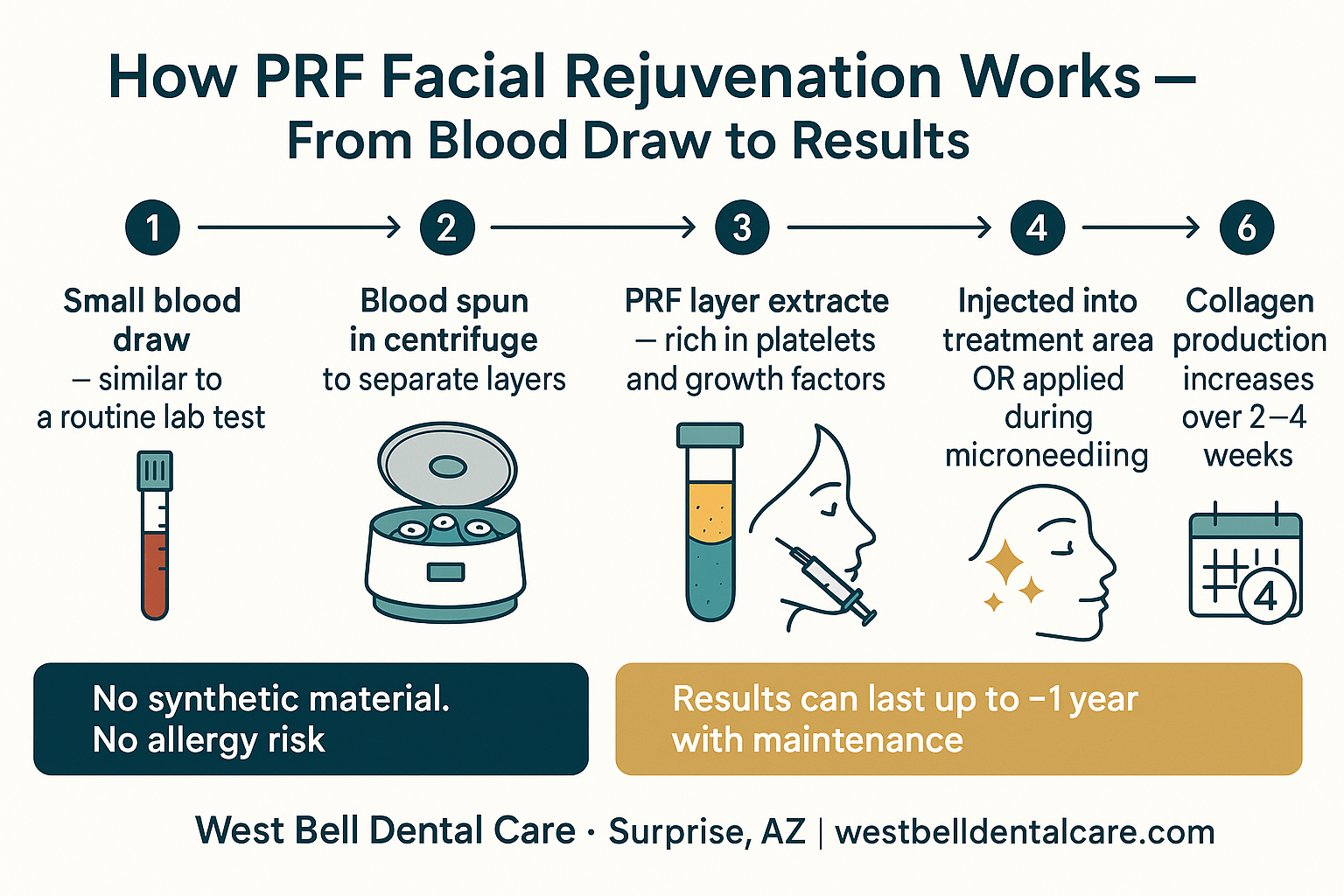
We draw a small amount of your blood — about the same as a routine lab draw — and place it in a centrifuge. The centrifuge spins it down and separates the layers. We extract the fibrin-rich middle layer, which is packed with growth factors and platelets your body uses to heal and regenerate tissue.
That concentrated layer is then either injected into the treatment area or applied topically during a microneedling session. Because the material comes entirely from your own body, there’s no synthetic filler involved and no risk of allergic reaction to a foreign substance.
The results don’t appear the next morning. What happens instead is that your body’s own healing response kicks in — collagen production increases over the following two to four weeks, and the improvement builds gradually. That gradual quality is actually what makes PRF appealing to a lot of patients right now. The dominant aesthetic trend heading into 2026 is subtlety: people want to look refreshed, not visibly altered. PRF fits that directly.
Can PRF Be Done on Its Own — Without Any Dental Work?
Yes, absolutely. I want to answer this directly because I’ve seen the confusion firsthand.
On our website and in some of our patient conversations, PRF has come up in the context of post-procedure recovery — for example, PRF applied after an extraction or implant placement to support healing. That’s a legitimate use. But it’s not the only use, and it’s not a requirement.
PRF facial rejuvenation is a standalone aesthetic service. You don’t need to be in the middle of any dental treatment to book it. You don’t need veneers first. You don’t need to have any dental work pending at all.
And here’s the part that I think actually matters about getting this done at a dental office rather than a med spa: our providers already have deep training in facial anatomy and injection technique. That’s not a small thing. The lips, the perioral area around the mouth, and the cheeks involve complex anatomy with nerves and vasculature that require precision. Dentists work in and around this anatomy every single day. The skill set transfers directly.
If you’re in Sun City or Ashton Ranch and you’ve been eyeing PRF treatments at a med spa, I’d genuinely encourage you to consider whether the provider’s anatomy background matches what the procedure actually requires.
PRF vs. Traditional Dermal Fillers — What’s the Real Difference?
This is worth talking about honestly, because not every patient is the right fit for PRF — and I’d rather you know that upfront than feel misled after a consultation.
Here’s how the two approaches compare in practical terms:
- Traditional fillers (like hyaluronic acid products) deliver immediate, visible volume. You see the result the same day. They’re well-suited for patients who want significant correction — deeper folds, pronounced volume loss, or a more dramatic change in lip shape.
- PRF injections build results over two to four weeks as collagen increases. The change is subtler and more gradual. For someone wanting a natural refresh — lips that look slightly fuller but not obviously treated — this is often the better match.
- Longevity differs too. Traditional hyaluronic acid fillers typically last six to twelve months depending on the area and product. PRF results with proper maintenance can persist closer to a year, per published aesthetic medicine literature.
- Composition is the fundamental difference: fillers are synthetic; PRF is derived entirely from your own blood.
We had a patient come in for a consultation expecting traditional dermal fillers. After evaluating her concerns — deeper marionette lines that needed significant volume correction — it became clear that PRF alone wasn’t the right tool for what she was hoping to achieve. That’s an honest conversation worth having before treatment, not after.
If your goal is a gradual, natural result with minimal downtime and no synthetic material, PRF is likely a strong fit. If you want immediate, significant volume correction, that’s a different conversation — and the right provider should tell you so plainly.
PRF vs. Traditional Fillers at a Glance
Here’s a side-by-side look at the practical differences most patients want to know before choosing between the two options.
| Factor | PRF (Platelet-Rich Fibrin) | Traditional Hyaluronic Acid Fillers |
|---|---|---|
| Material source | Your own blood — no synthetic ingredients | Synthetic gel (hyaluronic acid) |
| When results appear | Gradually over 2–4 weeks | Immediately after treatment |
| Result character | Subtle, natural-looking refresh | More immediate, visible volume change |
| Allergy risk | None — autologous (from your own body) | Rare but possible with synthetic products |
| Typical longevity | Up to approximately 1 year with maintenance | Approximately 6–12 months depending on area |
| Best fit for | Patients wanting gradual, natural improvement | Patients wanting significant or immediate correction |
| Downtime | Mild redness/swelling 24–48 hrs (microneedling); mild bruising possible (injectable) | Similar mild bruising or swelling at injection sites |
How a PRF Treatment Session Works — Step by Step
For patients who’ve never had PRF before, this is what a typical appointment actually looks like from start to finish.
Downtime and Recovery — What to Actually Expect
Downtime is one of the first practical questions I hear, and it deserves a straight answer.
For injectable PRF, expect mild bruising or swelling at the injection sites for a day or two. It’s the kind of thing most people manage with a bit of concealer or by scheduling the appointment before a low-key weekend.
For PRF microneedling, the treated skin typically looks red and feels slightly swollen for 24 to 48 hours. Think of it as a mild sunburn. Neither approach requires extended recovery or keeping you out of your normal routine.
That shorter recovery window is part of why we’re seeing increased interest in PRF heading into fall. Patients in Surprise who want to look refreshed before holiday gatherings or fall events in the West Valley can schedule without building in a long healing window. Compared to more involved procedures, the recovery ask here is genuinely minimal.
One practical note: plan to avoid intense sun exposure, heavy exercise, and active exfoliants for the 48 hours after treatment. Beyond that, most patients feel fully back to normal within two days.
Frequently Asked Questions About PRF Facial Rejuvenation
Do I have to be a dental patient to get PRF treatments at your office?
No. PRF facial rejuvenation is available as a standalone aesthetic service — you don’t need to have any dental work done or any dental treatment pending. Many patients come in specifically for the aesthetic services without connecting it to dental care at all.
Will PRF work for lip filling specifically?
PRF can be used to add subtle volume and improve texture around the lips. The results are gradual and natural-looking — you won’t see dramatic volume the next day. For someone wanting lips that look fuller in a way that doesn’t read as ‘obviously done,’ PRF is often a strong option. If the goal is significant, immediate correction, that’s a different conversation worth having during a consultation.
How much does PRF treatment cost in Surprise, AZ?
Pricing varies based on the treatment area, whether it’s injectable PRF or PRF microneedling, and how many sessions are recommended. I’d encourage you to contact us directly for current pricing — aesthetic treatment costs in the West Valley vary enough that a general range wouldn’t give you an accurate picture of what your specific plan would look like.
How does PRF compare to Botox?
They do different things. Botox (a neuromodulator) relaxes specific muscles to reduce dynamic lines — like the ones that appear when you squint or frown. It typically lasts three to four months. PRF works by stimulating your body’s own collagen production and is better suited for adding volume, improving skin texture, and refreshing overall appearance. Some patients benefit from both, depending on their goals — and that’s exactly the kind of conversation a consultation is for.
Is PRF safe? Could I have a reaction to it?
Because PRF is derived entirely from your own blood, there’s no foreign material being introduced to your body. That eliminates the allergic reaction risk that can exist with synthetic fillers. As with any injection, there’s always a small risk of localized bruising or swelling, but an adverse immune response to the PRF material itself is not a concern.
How many PRF sessions will I need?
That depends on your starting point and what you’re hoping to achieve. Some patients see meaningful improvement after a single session; others benefit from a series of two or three treatments spaced several weeks apart. Maintenance appointments can help extend results. A consultation is the honest way to set realistic expectations for your specific situation.
Suggested Internal Links — add real URLs before publishing:
- Botox and facial aesthetics at our Surprise office — Overview of neuromodulator (Botox) treatments offered at West Bell Dental Care, including what it treats and how it differs from filler options
- Dermal fillers — what we offer and who qualifies — Service page or explainer covering dermal filler options at West Bell Dental Care, candidacy criteria, and scope of treatment
- Smile makeovers and cosmetic dentistry in Surprise, AZ — Cosmetic dentistry overview page covering veneers, bonding, whitening, and how they can be combined with aesthetic facial treatments
- Sedation dentistry for anxious patients — Sedation options at West Bell Dental Care for patients with dental anxiety — relevant to patients who may be nervous about any in-office procedure
Have More Questions About PRF in Surprise, AZ?
If you’ve been curious about PRF facial rejuvenation — whether it’s for lip volume, skin texture, or just a gradual refresh before the holidays — the best next step is a conversation. Our team at West Bell Dental Care is happy to answer questions and help you figure out whether it’s a good fit for what you’re actually hoping to achieve. You can reach us at 480-795-2420 or visit westbelldentalcare.com to learn more about our aesthetic services and current availability, including Saturday appointments.