
Direct Answer: A same-day dental crown uses an in-office milling machine to design and build your permanent crown in about an hour or two — no temporary, no second visit, done the same day.
Most people who need a crown have heard the old version of the story: two appointments, a goopy impression, a temporary crown that may or may not stay put for two or three weeks, and then coming back to finally get the real thing placed. It’s not a great experience, and for anyone with a packed schedule or a little dental anxiety, that second appointment is the one they dread most.
The good news is that process isn’t how we do it here in Surprise. We mill crowns in the office, the same day, using digital scanning and a ceramic milling machine that produces a permanent restoration while you wait. And based on the questions we hear — and the reaction from patients who didn’t know this was possible — it’s worth explaining exactly what that looks like before you sit down for it.
This article walks through what actually happens during a same-day dental crown appointment, why the technology produces a result that’s both durable and well-fitted, and what the first few days of healing look like afterward. If you’ve been putting off a crown because the process felt like too much, this might change your thinking.
What the Traditional Crown Process Actually Involved
Before explaining what same-day crowns replace, it helps to understand what the old process looked like — because most people’s fears are based on that experience, or stories they’ve heard from someone who went through it years ago.
The traditional workflow went like this:
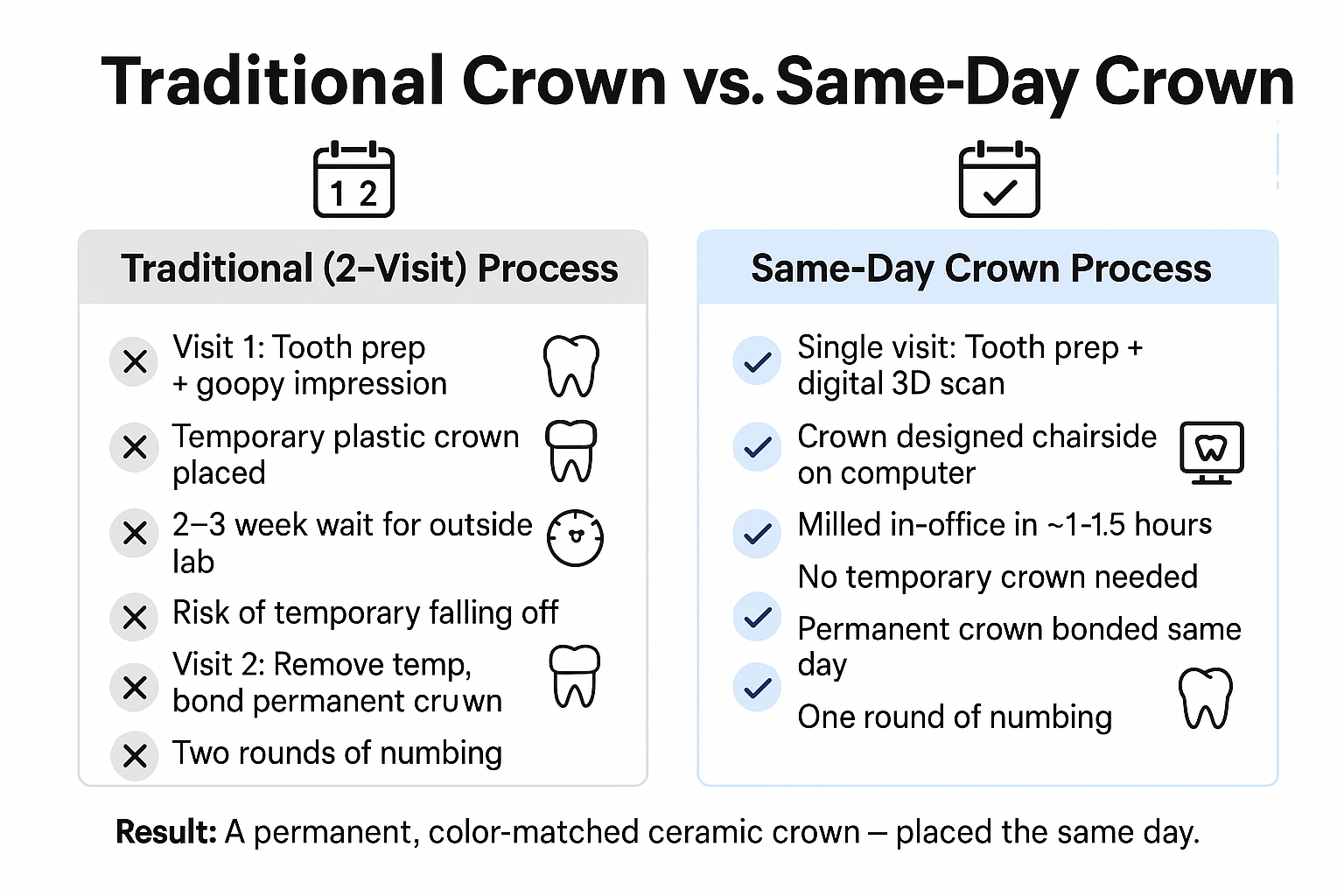
- Appointment one: The dentist prepared the tooth (trimming it down to fit a crown), then pressed a tray of impression material into your mouth to capture the shape. That impression got shipped to an outside dental lab.
- The wait: Two to three weeks, typically, while the lab fabricated the crown. During that time, you wore a plastic temporary crown — cemented in place, but not permanently. Temporaries can feel rough, fit imperfectly, and occasionally come loose at inconvenient times.
- Appointment two: You came back, the temporary was removed, and the permanent crown was bonded in — assuming the fit was right. If something was off from the lab, there could be additional adjustments or another wait.
Every hand-off in that chain introduced a chance for small errors. The impression could distort slightly. The lab technician was working from a physical mold, not a direct scan. Shipping and handling added variables. None of these are catastrophic problems, but they’re real ones that more precise technology has made avoidable.
For patients with dental anxiety, the two-appointment model also meant two separate rounds of numbing, two days blocked off, and two separate stretches of anticipating the chair.
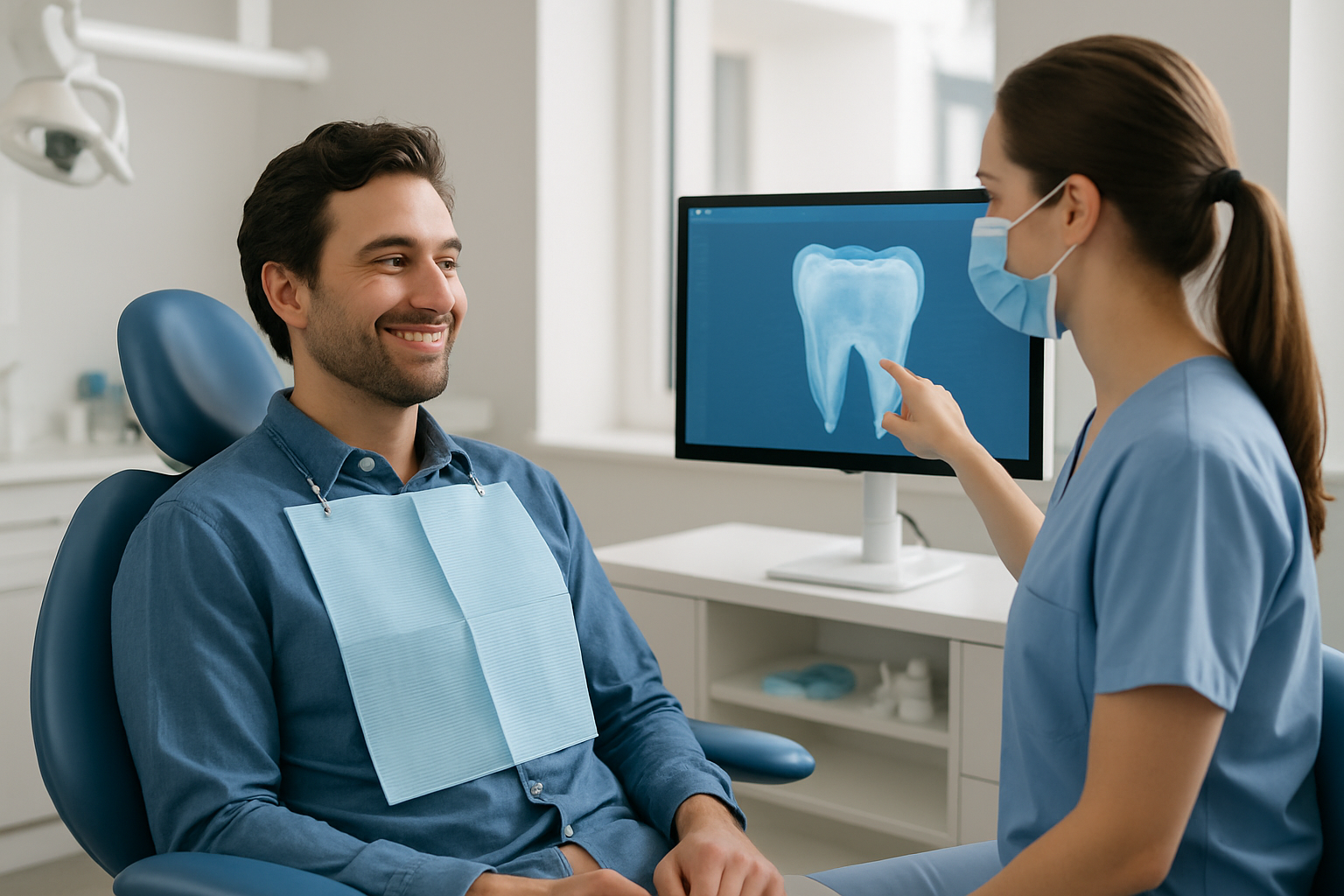
How a Same-Day Crown in Surprise Actually Gets Made
The same-day process starts the same way any crown does — with the dentist preparing the tooth. That part doesn’t change. What changes is everything that happens after.
Instead of impression material, we use a digital scanner to capture an accurate, detailed 3D image of the prepared tooth and the surrounding teeth. No trays, no goop, no waiting for material to set. The scan takes a few minutes and sends the data directly to design software at the chairside computer.
From there, the crown is designed digitally — shaped to fit your bite and match the contours of your surrounding teeth. Then that design file goes to the in-office milling machine, which carves the crown from a ceramic block. The whole milling process typically takes about an hour to an hour and a half.
The ceramic used isn’t a compromise material. It’s selected to match the color and translucency of your natural tooth, so the result looks like it belongs there. One of our patients who has spent more than 50 years working in the dental field put it simply after seeing the machine in action: “They have a very cool machine that will make your Permanent crown in a little over an hour.” That reaction comes up again and again — people expect the technology to feel like a shortcut, and instead it feels like an upgrade.
Once the crown is milled and checked for fit, it’s bonded in permanently. You leave with a finished restoration, not a temporary. There’s no second appointment to dread, no second round of numbing, and no temporary crown to worry about for the next few weeks.
Traditional Crown vs. Same-Day Crown: Side by Side
Here’s a quick visual comparison of the two processes so you can see exactly what’s eliminated with the same-day approach.
What Changes (and What Doesn’t) With Same-Day Crowns
Patients sometimes wonder whether faster means less thorough. This table breaks down what the same-day process actually changes compared to the traditional approach.
| Step | Traditional Crown | Same-Day Crown |
|---|---|---|
| Tooth preparation | Same as always | Same as always |
| Impression method | Physical tray with impression material | Digital 3D intraoral scan |
| Crown fabrication | Outside dental lab, 2–3 week turnaround | In-office milling machine, ~1–1.5 hours |
| Temporary crown | Required for weeks | Not needed |
| Number of appointments | Two (minimum) | One |
| Crown material | Porcelain-fused or ceramic (lab-selected) | Ceramic block, color-matched in office |
| Fit variables | Impression + lab translation + shipping | Digital file, fewer hand-offs |
| Second numbing session | Yes | No |
Why This Matters Most for Anxious Patients and Busy Schedules
I’ve seen two groups of patients respond to the same-day option with the most visible relief: people dealing with dental anxiety, and people who genuinely cannot afford to block off two separate mornings in the same month.
For patients with anxiety, the second appointment carries its own weight. You go home after the first visit, you manage a temporary crown for weeks, and then you have to build yourself back up again for round two. Removing that loop matters more than it might sound. There’s no second round of numbing, no second pre-appointment tension, and no temporary crown to monitor in the meantime.
For working families in Surprise Farms, Marley Park, or Rancho Gabriela — or professionals who used up their flexibility getting to the first appointment — the single-visit format is genuinely practical. One morning off instead of two. One conversation with a supervisor or a school instead of two. That’s not a small thing.
We’ve had patients tell us they’d been putting off a crown they clearly needed for months, mostly because the process felt like too much to fit into their life. The same-day format doesn’t eliminate the dental work, but it does remove one of the most cited reasons people delay it.
And for our patients in Sun City Grand and Sun City who may be managing multiple medical appointments already, keeping dental care to a single efficient visit is just easier on the calendar and the body.
What Healing Looks Like After a Same-Day Crown
The crown itself is permanent when you leave. But the tooth and surrounding gum tissue have still been through a procedure, and it’s worth knowing what the next few days feel like so you’re not caught off guard.
Here’s what’s normal in the first 24 to 72 hours:
- Some sensitivity to temperature, pressure, or air — especially if the tooth had existing decay or damage
- Mild gum soreness around the prep area, similar to what you’d feel after any dental work
- A slightly different bite feel as your mouth adjusts to the new crown’s shape
Most patients are eating normally within 24 hours. We usually suggest avoiding very hard or very sticky foods on that side for the first day, mostly out of caution while the bonding fully sets.
Bite adjustments are the one thing worth paying attention to. If something feels noticeably off after a day or two — like the crown is hitting before your other teeth do — that’s easy to correct. A quick follow-up to adjust the bite takes only a few minutes and makes a real difference in comfort. It doesn’t mean anything went wrong; occlusion adjustments are a routine part of crown placement.
By the end of the first week, most patients aren’t thinking about the crown at all. That’s the goal — a restoration that settles in and feels like it’s always been there.
Frequently Asked Questions About Same-Day Dental Crowns
Is a same-day crown as strong and durable as a lab-made crown?
Yes. The ceramic used in in-office milling is a high-quality dental material designed to hold up to normal biting force. And because the crown is designed from a precise digital scan rather than a physical impression, it often fits with fewer translation errors than a lab-made crown. Faster to make doesn’t mean lower quality — in this case, it means fewer variables between the tooth and the finished restoration.
How long does the appointment actually take?
Plan for roughly 2 to 3 hours from start to finish. That includes the prep, the digital scan, the design step, the milling time (about an hour to an hour and a half), and the final bonding and fit check. It’s a longer single appointment than a traditional prep visit, but you’re walking out with a finished permanent crown instead of a temporary.
Will my insurance cover a same-day crown?
Most dental insurance plans that cover crowns cover them based on the type of restoration, not the method used to make it. That said, every plan is different — coverage amounts, waiting periods, and annual maximums vary. It’s worth calling your insurance company or asking our front desk team to help you understand your specific benefits before the appointment.
What if my bite feels off after the crown is placed?
This is one of the most common things patients ask about, and it’s completely normal to experience some bite unevenness in the first day or two. If it doesn’t settle on its own, a quick follow-up to adjust the bite takes just a few minutes. Don’t ignore it — biting incorrectly on a new crown can cause soreness — but also don’t worry that something went wrong. It’s a routine adjustment.
Can I eat right after a same-day crown appointment?
Most patients eat normally within 24 hours. On the day of the procedure, it’s smart to wait until any anesthetic has fully worn off before eating, and to stay away from very hard or very sticky foods on that side for the rest of that first day. After that, you should be able to eat normally without restriction.
Are same-day crowns available for all teeth, including back molars?
In most cases, yes. Same-day milled crowns work well for both front and back teeth. The ceramic material is durable enough for molars, which take the most chewing force. Your dentist will assess your specific situation — the condition of the tooth, the amount of remaining structure, and the bite forces involved — and let you know if the same-day option is the right fit for your case.
Suggested Internal Links — add real URLs before publishing:
- dental crown healing timeline — What patients can expect day by day after a crown procedure — sensitivity, bite feel, eating, and when symptoms should resolve
- dental crowns at West Bell Dental Care — Service page covering crown indications, materials, and what patients can expect at the practice
- sedation dentistry for anxious patients — Overview of sedation options available at the practice for patients with dental anxiety or complex treatment needs
- same-day emergency dental care in Surprise — Information on emergency appointments, when a crown failure or broken tooth qualifies as urgent, and how to get seen quickly
- dental financing and payment options — Cost and payment information for patients managing out-of-pocket dental expenses or navigating insurance coverage
Ready to Skip the Temporary and Just Get It Done?
If you’ve been sitting on a crown recommendation — or you’ve had a dentist tell you that you need one and you keep putting it off — West Bell Dental Care offers same-day crown appointments for patients across Surprise and the surrounding West Valley. You can reach our team at 480-795-2420, or visit westbelldentalcare.com to learn more or request an appointment. We have extended hours including Saturdays, which makes it a lot easier to fit this into a real schedule.