
Direct Answer: You can’t meaningfully tighten a loose adult tooth at home. What you can do is figure out why it’s loose — that tells you exactly how fast you need to act.
You noticed it while eating dinner, or maybe while brushing your teeth before bed. One of your teeth has a little give to it that wasn’t there before. Now you’re online at midnight trying to figure out whether this is something that can wait until next week or something that needs attention tomorrow.
This is one of the most common things people Google late at night — and for good reason. A loose adult tooth is not normal, and it’s not something that fixes itself. But it also doesn’t always mean you’re about to lose the tooth. What the looseness feels like, how long it’s been going on, and whether you have any other symptoms are what tell you how urgent the situation actually is.
This article walks through the three most common reasons adult teeth loosen, what home remedies can and can’t realistically do, and a plain-language decision tree to help you figure out what to do next.
Why Adult Teeth Loosen: The Three Most Likely Causes
Unlike baby teeth, adult teeth don’t have a biological reason to come out. When one starts moving, something is breaking down the system that holds it in place. That system includes the bone surrounding the root, the periodontal ligament connecting the root to the bone, and the gum tissue itself.
Almost every case of a loose adult tooth comes back to one of three things:
- Gum disease (periodontitis) — This is by far the most common cause. When gum disease progresses past the early stage, bacteria attack the bone beneath the gumline. Over time, that bone loss means the tooth has less and less structure anchoring it. The loosening often happens slowly, over months or years, which is part of why people are surprised when they finally notice it.
- Trauma or grinding (bruxism) — A tooth that shifted after a fall, a hit, or an accident is a different situation than one that’s been drifting for months. Heavy nighttime grinding can also stress the periodontal ligament over time, creating subtle mobility that slowly worsens. These cases often involve soreness in the jaw or face along with the loose tooth.
- Systemic factors affecting bone density — Less common, but worth knowing: conditions like osteoporosis or poorly controlled diabetes can affect the bone that supports teeth. This is rarely the first explanation, but it’s something a dentist will consider if gum disease and trauma don’t explain the picture.
Knowing which category you’re in matters because the urgency and treatment path are completely different depending on the cause.

The Difference Between a Slow Drift and a Sudden Shift
One of the most useful things you can do before calling a dentist is think back honestly: how long has this been going on?
A tooth that has been gradually loosening over several months — with no recent injury, no pain, maybe some bleeding when you brush — points strongly toward gum disease and bone loss. This is a serious situation, but it’s not a same-day emergency unless you’re also dealing with swelling or infection. You have a window to act, and acting within that window genuinely preserves more of the tooth structure that’s left.
A tooth that shifted noticeably after an impact — a fall, a collision, biting down hard on something unexpected — is a different story. The ligament may be stretched or partially torn. That kind of mobility can sometimes stabilize on its own if the tooth isn’t badly displaced, but it needs to be evaluated quickly, typically within a day or two, to make sure the root isn’t fractured and the tooth is worth saving.
Among adults in communities like Sun City Grand and Sun City here in the West Valley — where the population skews older — slow-onset gum-disease-related loosening is by far the more common scenario. CDC data show that nearly 70% of adults 65 and older have some form of periodontal disease. This isn’t a reason to panic. It is a reason to take the symptom seriously and not assume it will stabilize on its own.
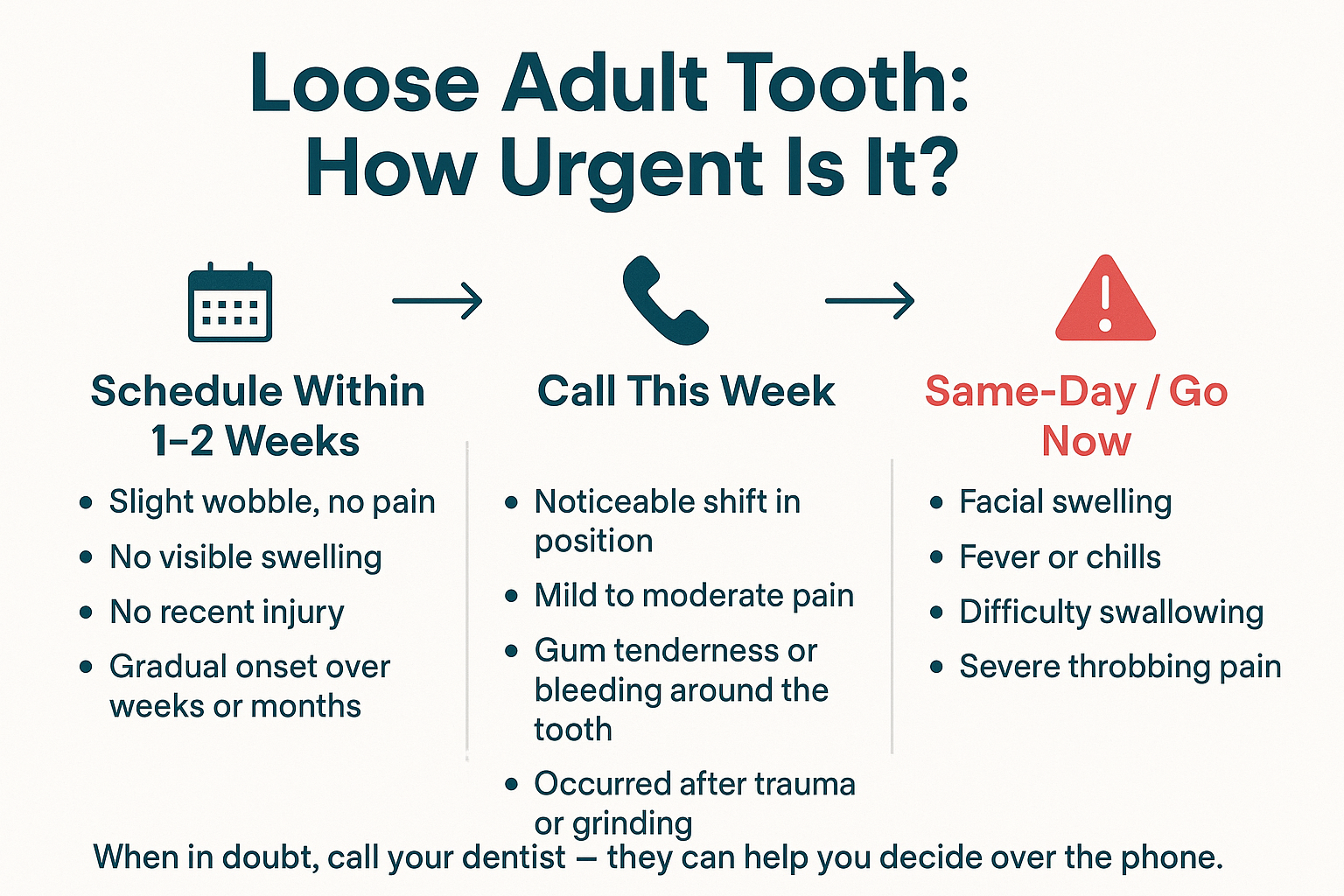
How Urgent Is a Loose Adult Tooth? A Quick Decision Guide
Use this framework to figure out whether you’re looking at a same-day situation, a same-week call, or a regular appointment.
What Home Remedies Can Actually Do (And What They Can’t)
If you’ve already tried a saltwater rinse, oil pulling, or a turmeric paste you found online — you’re not alone, and there’s nothing to be embarrassed about. People reach for home remedies when they’re anxious about what a dentist might tell them, or when cost is a real concern. That makes complete sense.
Here’s an honest breakdown of what these approaches actually do:
- Saltwater rinses — Genuinely useful as a short-term supportive measure. Warm salt water reduces inflammation in the gum tissue around the tooth and can slow bacterial activity near the surface. It won’t reverse bone loss or reattach a ligament, but it’s not doing nothing either. Rinsing two to three times a day with a teaspoon of salt in warm water is reasonable while you wait for your appointment.
- Oil pulling — No clinical evidence supports this as a treatment for tooth mobility or bone loss. It may have some mild antibacterial effect in the mouth generally, but it won’t address the structural problem causing the looseness.
- Turmeric paste and other topical remedies — Similar story. Some anti-inflammatory properties exist, but applying something to the gumline surface doesn’t reach the bone level where the real problem is happening.
The bottom line: home remedies can make things slightly more comfortable and reduce surface-level inflammation. They cannot tighten a tooth, rebuild lost bone, or stop the progression of gum disease. They’re a bridge, not a solution — and the longer that bridge stretches, the more structure may be lost while waiting.
Home Remedies vs. Professional Treatment: What Each One Actually Addresses
This comparison covers the most common things people try before calling a dentist — and what professional treatment can realistically accomplish that home care cannot.
| Approach | What It Can Do | What It Cannot Do |
|---|---|---|
| Saltwater rinse | Reduce gum inflammation, slow surface bacteria | Reverse bone loss, reattach ligament, stop disease progression |
| Oil pulling | Mild general antibacterial effect | Treat bone loss, stabilize a mobile tooth |
| Turmeric / topical paste | Minor surface anti-inflammatory effect | Reach bone level, address structural cause |
| Professional deep cleaning (scaling & root planing) | Remove bacteria below gumline, slow disease | Regenerate lost bone without additional treatment |
| Splinting (dental procedure) | Stabilize a mobile tooth by bonding it to neighbors | Replace lost bone; works best when bone loss is caught early |
| Dental implant (if tooth is lost) | Replace a lost tooth with a stable, long-term option | Preserve the original tooth once it is gone |
What a Dentist Is Actually Looking For — and Why Early Matters
When you come in with a loose tooth, the first thing the clinical team does is take X-rays to see how much bone remains around the root. That single piece of information shapes everything that comes next.
If there’s still a meaningful amount of bone present, a deep cleaning — called scaling and root planing — can remove the bacterial deposits below the gumline that are driving the bone loss. Many teeth that feel noticeably mobile at the start of treatment stabilize significantly once that bacterial load is gone and the tissue heals. It’s not guaranteed, and the outcome depends on how much bone has already been lost, but it’s genuinely effective when the problem is caught early enough.
If the bone loss is severe, the conversation shifts toward whether the tooth is worth saving or whether treatment energy is better directed toward a longer-term solution like a dental implant. That’s a harder conversation, but it’s an honest one — and having it sooner rather than later almost always means more options, not fewer.
Patients who come in after ignoring a slow-moving loose tooth for a year often have significantly fewer options than they would have had six months earlier. One patient described it well in a recent review, noting that the team here “made the care plan easy to understand and not feel so overwhelming” — which is exactly the kind of clarity that helps people make good decisions about their own teeth.
If dental anxiety has kept you from coming in sooner, that’s a conversation worth having too. Sedation options are available for patients who need them, and there’s no judgment attached to having avoided the dentist for a while. Many patients in Surprise and across the West Valley have been in exactly that situation.
Frequently Asked Questions About Loose Adult Teeth
Can a loose adult tooth tighten back up on its own?
Occasionally, a tooth that shifted very slightly after minor trauma will stabilize on its own if the ligament wasn’t severely damaged. But this is the exception, not the rule. A tooth that is loose because of bone loss from gum disease will not tighten without professional treatment — the bone doesn’t grow back on its own, and the bacterial cause of the loss continues if nothing is done.
How do I know if my loose tooth is an emergency?
If you have facial swelling, a fever, or any difficulty swallowing, treat it as same-day urgent — those signs can indicate a spreading infection. If there’s significant pain or the tooth has visibly shifted, aim to be seen within a few days. A tooth that feels slightly wobbly but isn’t painful and hasn’t shifted noticeably can usually wait one to two weeks for a non-emergency appointment.
I’m in my 60s and I’ve had some bleeding when I brush. Is my loose tooth related?
Almost certainly, yes. Bleeding gums are one of the earliest signs of gum disease, and gum disease that goes untreated for years is the most common reason adult teeth loosen. This is extremely common in adults over 60 — CDC data put the rate of some form of periodontal disease at nearly 70% of adults 65 and older. Common doesn’t mean you have to accept it. Caught at the right stage, it responds well to treatment.
Is a loose tooth after grinding something that can be fixed?
Yes, often. If grinding (bruxism) is the primary cause and the bone loss isn’t severe, addressing the grinding — typically with a nightguard — removes the mechanical stress on the ligament and allows it to recover. The tooth may restabilize over several weeks once the force is gone. Your dentist will want X-rays to confirm how much bone is involved before giving you a realistic picture of what to expect.
What does treatment for a loose tooth actually cost?
It depends heavily on what’s causing the problem. A deep cleaning to address gum disease is a different cost than splinting a traumatized tooth, which is different again from implant treatment if the tooth ultimately can’t be saved. Dental insurance often covers a portion of periodontal treatment, though coverage varies by plan. The best way to get an accurate number is to come in for an exam — the team can review your specific situation and walk through what your insurance covers and what the out-of-pocket picture looks like.
I’ve avoided the dentist for a few years because I was nervous. Will I be judged for waiting?
No. A meaningful portion of the patients we see have been in that exact situation — sometimes for years. The focus when you come in is on figuring out where things stand now and what the most practical path forward looks like. Extended hours including Saturday appointments are available for patients who have a hard time getting away during the week.
Not Sure How Serious It Is? Start With a Phone Call.
If something feels off with one of your teeth, the team at West Bell Dental Care can often help you figure out urgency just from a quick conversation. Patients across Surprise, Sun City Grand, Marley Park, and the surrounding West Valley are welcome to call 480-795-2420 or visit westbelldentalcare.com to request an appointment — including Saturday availability for those who can’t get away during the week.