Direct Answer: The right choice depends on whether the tooth is still there, how healthy your jawbone is, and what fits your budget. A dentist exam is the only way to know for sure.
Most patients don’t walk into a dental office already knowing what they need. They walk in with a broken tooth, a gap where a tooth used to be, or a crown that finally gave out after 15 years — and they want to understand their options before anyone starts drilling.
The three most common solutions for damaged or missing teeth are dental crowns, bridges, and dental implants. Each one works differently, costs differently, and fits different situations. And the choice between them isn’t always obvious, even to people who’ve been to the dentist regularly for years.
This guide breaks down how each option works, what it actually costs in the Surprise and West Valley area, and what factors matter most when you’re trying to make the right call for your mouth and your budget.
What Each Option Actually Does
Before comparing costs or timelines, it helps to understand what these three treatments are solving for — because they’re not interchangeable.
A dental crown is a cap that fits over a tooth that’s still in your jaw. It’s used when a tooth is cracked, heavily decayed, or weakened after a root canal. The crown protects what’s left of the natural tooth and restores its shape and function. You still have your original root.
A dental bridge fills the space left by a missing tooth — but it does that by anchoring to the teeth on either side of the gap. Those neighboring teeth get crowned, and a false tooth (called a pontic) hangs between them. It’s a fixed solution that doesn’t come out, but it does require reshaping two healthy teeth to support the bridge.
A dental implant replaces both the tooth and the root. A small titanium post gets placed into the jawbone, and once it fuses with the bone over several months, a crown is attached on top. It’s the closest thing to a natural tooth in terms of function and longevity — but it takes longer and costs more upfront.
The key difference:
– Crown — tooth is still present, just damaged
– Bridge — tooth is gone, but neighboring teeth are healthy enough to anchor to
– Implant — tooth is gone and you want a standalone replacement that doesn’t involve adjacent teeth

What It Costs in the Surprise and West Valley Area
Cost is almost always part of the conversation — and being honest about what these treatments run in the West Valley helps patients plan without surprises.
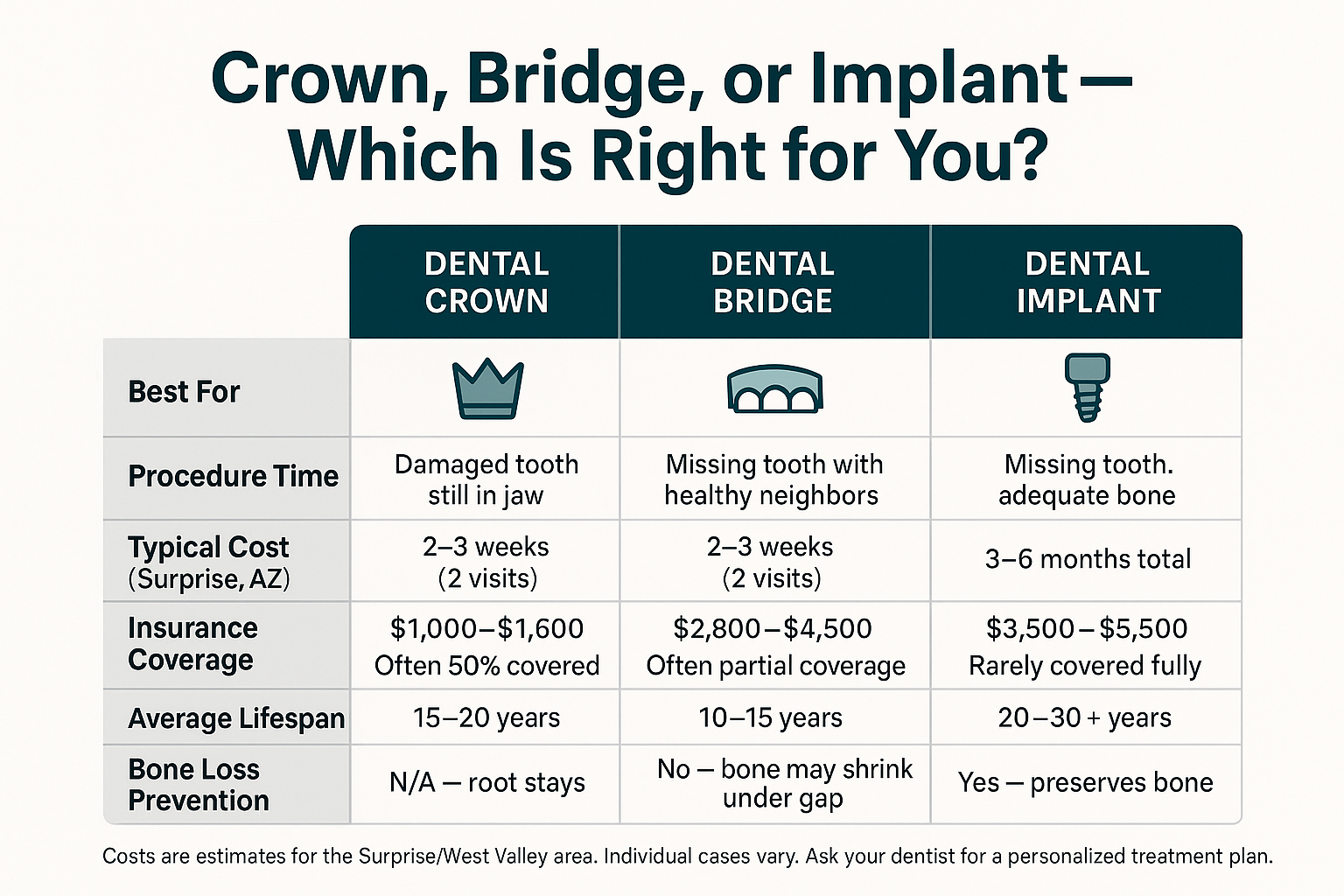
Dental crowns in the Surprise area typically range from $1,000 to $1,600 per tooth, depending on the material (porcelain, zirconia, or porcelain-fused-to-metal) and whether a core buildup is needed before the crown goes on. Insurance often covers a portion — usually 50% — once you’ve met your annual deductible.
Bridges are priced per unit, and a standard three-unit bridge (two crowns plus one false tooth) runs $2,800 to $4,500 in most West Valley dental offices. Insurance coverage tends to be similar to crowns — partial coverage after deductible, subject to annual maximums. Many plans cap at $1,000 to $2,000 per year, so a bridge may require two benefit years to fully use your coverage.
Dental implants are the biggest upfront investment. In the Surprise area, a single implant — including the post, abutment, and crown — generally runs $3,500 to $5,500. Most dental insurance plans cover little to none of the implant itself, though some cover the crown portion. Patients in Sun City Grand and other active adult communities often use HSA accounts or in-office payment plans to manage the cost over time.
One thing worth knowing: a bridge may cost less now, but implants typically last 20 to 30 years or longer with good care, while bridges often need replacement after 10 to 15 years. The longer math sometimes favors implants for younger patients.
Crown vs. Bridge vs. Implant — Side-by-Side Comparison
Here’s a quick look at how the three options stack up across the factors patients ask about most.
The Factors That Actually Drive the Decision
Once patients understand what each option does and what it costs, the real decision usually comes down to three things: bone health, the condition of neighboring teeth, and how long the patient wants the solution to last.
Bone health matters most for implants. After a tooth is lost, the jawbone underneath it starts to shrink because there’s no root stimulating it anymore. Patients who’ve had a gap for several years — which is common among retirees in Sun City and Surprise Farms who’ve been putting off treatment — may not have enough bone density left to support an implant without a bone graft first. That adds cost and time.
Neighboring tooth health drives the bridge conversation. If the two teeth on either side of a gap are already crowned or have large fillings, reshaping them for a bridge makes sense — you’re not sacrificing healthy tooth structure. But if those neighboring teeth are perfectly intact, many dentists would rather not grind them down just to anchor a bridge. That’s when an implant becomes the more conservative long-term choice, even if it costs more now.
Timeline affects more decisions than patients expect. Families in Marley Park juggling school schedules and working professionals in Surprise who can’t take multiple afternoons off may lean toward a bridge simply because it’s done in two appointments over two to three weeks. An implant can take three to six months from placement to final crown, though most of that time is healing, not chair time.
There’s no universal right answer. A 68-year-old patient in Greer Ranch North with a missing molar and adequate bone will often hear a different recommendation than a 42-year-old in Ashton Ranch with the same gap. Age, bone density, budget, and what’s happening with the adjacent teeth all play a role.
Quick Decision Guide: When Each Option Makes the Most Sense
This isn’t a diagnosis — every situation is different. But these are the general patterns that tend to point patients toward one option over another.
| Your Situation | Likely Best Fit | Why |
|---|---|---|
| Tooth is cracked or heavily decayed but still in your jaw | Crown | Protects and restores without removing the tooth |
| Tooth is gone, neighbors are already crowned or filled | Bridge | Makes use of existing restorations, faster timeline |
| Tooth is gone, neighbors are healthy and intact | Implant | Avoids altering two good teeth for one missing one |
| Missing tooth for several years, bone loss suspected | Implant (possibly with bone graft) | Bone graft may be needed first — exam will confirm |
| Budget is a priority right now | Bridge or Crown | Lower upfront cost, though replacement may be needed later |
| You want the longest-lasting solution possible | Implant | Best lifespan and bone preservation of the three options |
Frequently Asked Questions About Crowns, Bridges, and Implants
Can I get a crown instead of an implant to avoid surgery?
A crown only works if you still have a natural tooth root in your jaw. If the tooth has been fully extracted or fell out, there’s nothing left to put a crown on. In that case, a bridge or implant is what fills the gap — not a crown on its own.
Does getting an implant hurt?
The procedure itself is done under local anesthesia, so most patients feel pressure but not pain during placement. Soreness and mild swelling for a few days after is normal. Most patients manage it with over-the-counter pain relievers. Patients who are nervous about the procedure can ask about sedation options — many practices including ours offer that.
My dentist said I need a bone graft before an implant. Is that common?
More common than most people expect, especially if a tooth has been missing for a year or more. When there’s no root in the bone, the body stops maintaining that bone and it slowly shrinks. A graft rebuilds it so there’s enough density to hold the implant post. It adds 3 to 4 months to the overall timeline and $500 to $1,500 or more to the cost, depending on the extent of bone loss.
Will insurance cover any of this?
Crowns and bridges get at least partial coverage under most dental plans — typically 50% after your deductible, subject to your annual maximum. Implants are where coverage gets tricky. Some plans cover the crown that goes on top of the implant but not the post or abutment. It’s worth calling your insurance carrier before treatment to ask specifically what’s covered. Our front office team can also help you understand your benefits before you commit to a treatment plan.
How long does a bridge actually last?
With good home care and regular cleanings, 10 to 15 years is a realistic lifespan for a dental bridge. Some last longer. The weak point is usually the gum and bone under the false tooth (the pontic) — that area can be harder to clean and is prone to bone loss over time. Floss threaders or a water flosser help a lot.
I’ve had a gap for years and kept putting it off. Is it too late for an implant?
Probably not too late — but an exam and X-rays are needed to check the bone. Long gaps are manageable in a lot of cases, sometimes with a bone graft first. Patients in Surprise who’ve been avoiding the conversation for years are surprised by how many options are still on the table once they sit down and talk it through.
Ready to Talk Through Your Options?
If you’re sitting with a broken tooth, a gap you’ve been ignoring, or an old crown that’s finally due for replacement, the best next step is a straightforward exam and an honest conversation about what makes sense for your situation. West Bell Dental Care sees patients from across the West Valley — Surprise, Sun City Grand, Marley Park, Ashton Ranch, and beyond — with Saturday appointments available for those who can’t take time off during the week. Call us at 480-795-2420 or visit westbelldentalcare.com to schedule.