Direct Answer: The right choice depends on how many teeth are missing, the health of your surrounding teeth and jaw bone, and your budget. A dentist exam is the only way to know for certain what will work for your mouth.
You’re missing a tooth — or maybe a few — and you’ve been told you have options. Implant. Bridge. Denture. Three different words, three very different price tags, and nobody has really sat down and explained what makes each one right or wrong for a specific situation.
That confusion is the most common thing we hear from patients in Surprise and across the West Valley who come in after putting this decision off for months or even years. They’re not sure which option is worth the investment, and they don’t want to make the wrong call.
This guide is meant to cut through the noise. We’ll focus on the two or three things that actually drive the decision — bone health, how many teeth are missing, and long-term cost — so you can walk into your next appointment knowing what questions to ask.
Why the Number of Missing Teeth Changes Everything
One missing tooth is a completely different problem than four missing teeth. The replacement option that makes clinical sense — and financial sense — shifts significantly depending on the scope of the gap.
One missing tooth is where a dental implant tends to shine. The implant replaces the root and the visible tooth independently, without touching your neighboring healthy teeth. A bridge can also work here, but it requires grinding down the two teeth on either side to anchor the restoration — those are healthy teeth you’re permanently altering.
Multiple missing teeth in a row is where a bridge or a partial denture becomes a more realistic conversation. Implants are still possible, but the cost adds up quickly if you’re replacing three or four adjacent teeth.
Most or all teeth missing is the category where full dentures or implant-supported dentures enter the picture. A full arch of implants exists as an option, but it’s a significant surgical and financial commitment.
Here’s a quick breakdown by tooth count:
- 1 tooth missing — implant or single-tooth bridge
- 2–4 adjacent teeth missing — implant-supported bridge or partial denture
- Most teeth on an arch missing — full denture or implant-retained denture
- All teeth missing — full denture, or implant-supported full arch
The number of missing teeth is your first filter. Everything else — bone, budget, health — layers on top of that.
Bone Loss Is the Factor Most Patients Don’t Know to Ask About
When a tooth is extracted or falls out, the jaw bone underneath it starts to shrink. This process is called bone resorption, and it happens faster than most people expect — noticeable changes can begin within six months of losing a tooth.
Why does this matter for your replacement decision? Because dental implants require enough healthy bone to anchor the titanium post. If too much bone has already been lost, an implant isn’t immediately possible without a separate bone graft procedure first — which adds time and cost to the process.
Bridges and dentures don’t require the same bone depth, which is one reason they’re sometimes the more practical choice for patients who waited a while before seeking treatment. Retirees in Sun City Grand who’ve had a missing tooth for several years are often surprised to learn this is why their implant consultation includes a bone evaluation before any other conversation.
A few things to know about bone loss and your options:
- Digital X-rays and 3D imaging show exactly how much bone is present before any plan is made
- Bone grafts can rebuild density in many cases, but they add 3–6 months to the overall timeline
- Dentures don’t stop bone loss — they sit on top of the gum, so the jaw continues to shrink underneath them over time
- Implants actually help preserve bone by stimulating the jaw the way a natural root does
This is one of the clearest arguments for acting sooner rather than later on a missing tooth. The longer the wait, the fewer straightforward options remain.
The Three Options at a Glance
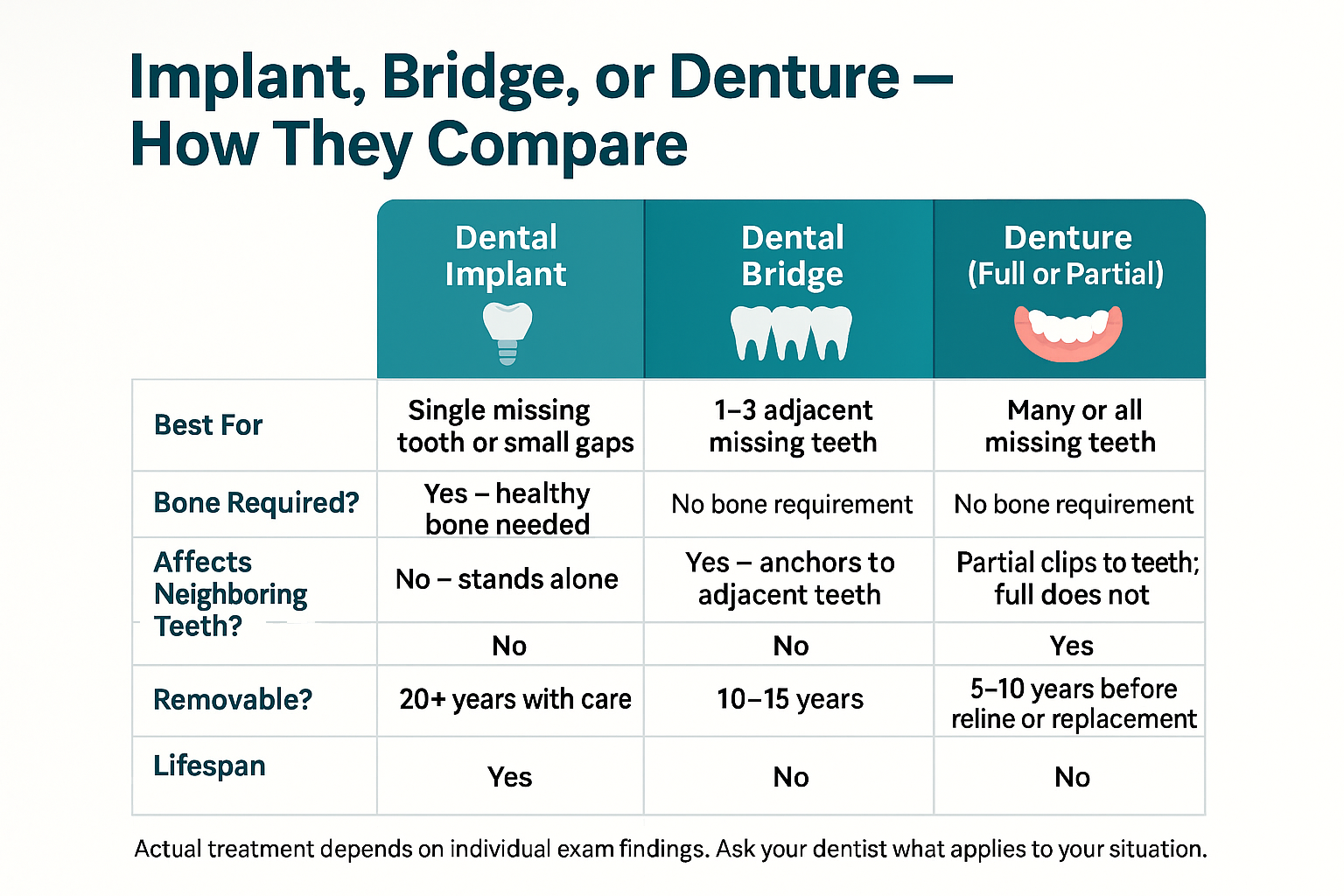
This infographic lays out the core differences between implants, bridges, and dentures across the factors that matter most to patients making this decision.
What These Options Actually Cost in the Surprise Area
Cost is the question everyone has but often feels awkward asking. So let’s just talk about it directly.
General price ranges in the Surprise and West Valley market as of 2024:
- Single dental implant (implant + abutment + crown): $3,500–$5,500 per tooth depending on whether bone grafting is needed
- Three-unit dental bridge: $2,500–$4,500 total, covering the crown on each anchor tooth plus the false tooth in between
- Full denture (one arch): $1,500–$3,000 depending on the materials and fit
- Partial denture: $1,000–$2,500 depending on how many teeth are involved
- Bone graft (if needed before implant): $500–$3,000 depending on size and complexity
Those numbers look very different on paper. But the math shifts when you factor in lifespan. A bridge that costs $3,500 and lasts 12 years might end up costing more over a lifetime than an implant at $4,500 that lasts 25 years and never needs to be replaced.
Dentures are the most accessible entry point for patients on fixed incomes — which is a real consideration for many of our patients in communities like Sun City and The Grand. But they do require maintenance, periodic relining, and eventual replacement as the jaw shape changes.
Most dental insurance plans cover a portion of bridges and dentures as restorative care. Implants are still categorized as elective by many insurers, though coverage is improving. Flexible payment plans can make implants more accessible than the sticker price suggests.
Side-by-Side Cost and Longevity Comparison
Here’s a quick reference table covering typical costs, lifespan, and insurance coverage patterns for each option in the Surprise, Arizona market.
| Option | Typical Cost Range | Average Lifespan | Insurance Coverage |
|---|---|---|---|
| Dental Implant | $3,500–$5,500 per tooth | 20–25+ years | Limited; improving with some plans |
| Dental Bridge | $2,500–$4,500 (3-unit) | 10–15 years | Partially covered as restorative care |
| Full Denture | $1,500–$3,000 per arch | 5–10 years | Often covered in part by major plans |
| Partial Denture | $1,000–$2,500 | 5–10 years | Often covered in part by major plans |
| Bone Graft (add-on) | $500–$3,000 | One-time procedure | Covered in some cases; varies by plan |
How to Know Which One Is Actually Right for You
There’s no universal right answer here. Every situation involves a combination of clinical factors — your bone density, the health of the teeth around the gap, your overall gum health, and any medical conditions that affect healing.
That said, a few patterns hold up pretty consistently:
Choose an implant if: you’re missing one tooth, your bone is healthy, you want the most natural-feeling long-term result, and you’re in a position to invest upfront for a solution that won’t need to be redone.
Choose a bridge if: you need to replace a tooth relatively quickly, the neighboring teeth already need crowns anyway, bone loss has ruled out an implant, or the cost difference matters significantly in your budget.
Choose a denture if: you’re missing most or all of your teeth, you need an immediate solution, or you want to start with a more affordable baseline and potentially upgrade to implant-supported dentures later.
Families in Marley Park dealing with a teenager’s knocked-out permanent tooth face a different calculation than a 68-year-old in Ashton Ranch who’s had three teeth slowly fail over a decade. The option that makes sense clinically — and practically — varies that much.
What doesn’t vary is the starting point: a thorough exam with digital X-rays and an honest conversation about your bone health and overall oral health. Without that, any recommendation — including ours — is just a guess.
Frequently Asked Questions About Tooth Replacement Options
Can I get an implant even if I’ve had a missing tooth for years?
Possibly, but it depends on how much bone remains. When a tooth has been missing for several years, the jaw bone beneath it shrinks — sometimes significantly. A 3D scan or digital X-ray can show exactly what’s there. If bone loss is moderate, a bone graft can often rebuild enough density to support an implant. If the loss is severe, a bridge or denture may be the more realistic path. Either way, the only way to know is an exam.
Does getting a dental implant hurt?
The procedure itself is done under local anesthesia, so you shouldn’t feel pain during placement. Most patients describe post-procedure soreness similar to a tooth extraction — manageable with over-the-counter pain relievers for a few days. Patients who have significant anxiety about the process can ask about sedation options, which make the whole experience much more comfortable.
How long does it take to get a dental implant from start to finish?
The full process typically takes 3–6 months if no bone graft is needed. The implant post is placed and then given time to fuse with the jaw bone — a process called osseointegration — before the final crown is attached. If a bone graft is required first, add another 3–6 months before implant placement. It’s not a quick fix, but the result is meant to last decades.
Will a bridge or denture look natural?
Modern dental bridges and dentures look far more natural than what most people picture from older generations. Tooth-colored materials and careful shade matching mean a well-made bridge is nearly impossible to distinguish from natural teeth. Dentures have also improved significantly in fit and appearance. The key is working with a dentist who takes the time to get the aesthetics right.
Do dentures affect what you can eat?
Yes, to some degree — especially in the first months while you’re adjusting. Sticky foods, very hard foods, and anything that requires significant biting force can be challenging with traditional dentures. Implant-supported dentures significantly reduce this limitation because they don’t shift or slip. Many patients adjust well over time, but it’s an honest trade-off worth knowing about before you choose.
Does dental insurance cover any of these options?
Bridges and dentures are typically classified as restorative care and receive partial coverage under most major dental plans — often 50% after the deductible and waiting period. Implants are still listed as elective by many insurers, though some plans have begun adding limited implant coverage. Checking your specific plan’s annual maximum and coverage category before committing to a treatment plan is always worth the phone call.
Ready to Figure Out Which Option Fits Your Situation?
The best next step is a straightforward exam — one that looks at your bone health, your existing teeth, and your goals, and gives you an honest picture of what will actually work. West Bell Dental Care offers extended hours including Saturday appointments, which means you don’t have to rearrange your week to get answers. Give us a call at 480-795-2420 or visit westbelldentalcare.com to schedule — we’re happy to walk through your options without pressure.