
Direct Answer: Most healthy adults need a cleaning every 6 months. But if you have gum disease, diabetes, or a history of cavities, every 3-4 months is often the smarter schedule.
Most people grew up hearing the same thing: go to the dentist twice a year. But that advice was never meant to fit every mouth — it was a general starting point, not a prescription. Depending on your gum health, medical history, and how well your home care routine is holding up, the right schedule for you might look pretty different.
For patients in Surprise and across the West Valley — from Sun City Grand to Marley Park — the question we hear a lot is: ‘Do I really need to come in that often, or is my dentist just trying to fill the schedule?’ It’s a fair question, and it deserves a straight answer.
This article breaks down what actually determines your cleaning frequency, what happens when the interval is wrong, and how to figure out where you personally fall on that spectrum.
The ‘Twice a Year’ Rule — Where It Came From and When It Holds Up
The every-6-months recommendation has been around since the 1950s and was largely popularized by toothpaste advertising — not a clinical study. That said, it’s a reasonable baseline for adults with healthy gums, low cavity risk, and a consistent brushing and flossing routine.
If your last few cleanings came back with no new cavities, no gum bleeding, and minimal buildup, a 6-month interval probably works well for you. Your hygienist removes the tartar that your toothbrush can’t touch, checks for anything developing, and sends you home. That cycle keeps things stable.
But for a meaningful portion of adults — especially those over 40 — ‘every 6 months’ is actually too infrequent. The signs that you may need more frequent visits include:
- Bleeding gums when you brush or floss
- A history of gum disease (periodontitis or gingivitis)
- Diabetes, which slows healing and increases gum infection risk
- Dry mouth from medications — common among retirees in Sun City
- Heavy tartar buildup noted at previous cleanings
- Smoking or tobacco use
- A weakened immune system
If two or more of those apply to you, your dentist may recommend moving to a 3- or 4-month cleaning schedule. That’s not upselling — that’s evidence-based care.
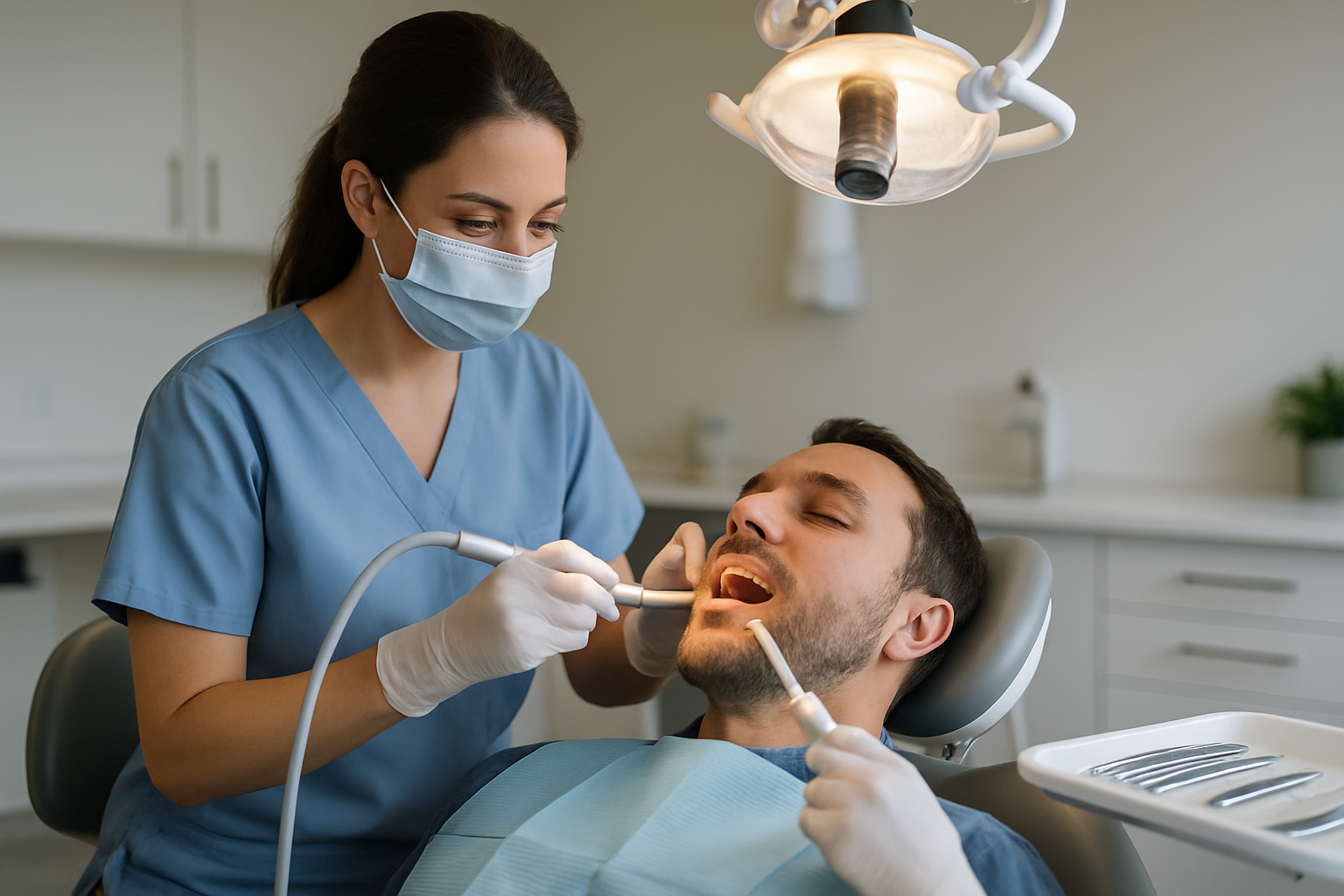
What a Cleaning Actually Does (and Why the Interval Matters)
A professional dental cleaning — called a prophylaxis, or ‘prophy’ for short — removes calculus (hardened tartar) that builds up below and along the gumline. No amount of brushing removes calculus once it forms. Only a hygienist’s instruments do.
When calculus sits on teeth and under the gum for too long, it becomes a breeding ground for the bacteria that cause gum disease. Early gum disease (gingivitis) is reversible. More advanced gum disease (periodontitis) is not — it permanently damages the bone and tissue holding your teeth in place.
The reason the cleaning interval matters so much is that calculus accumulation rates vary widely between people. Some patients build up significant deposits in 3 months. Others stay relatively clean for 9 months. Your hygienist tracks this at every visit, and their recommendation on timing should be based on what they actually see — not a calendar default.
For a standard adult cleaning in the Surprise area, expect to pay somewhere in the range of $100–$200 out of pocket if you have no insurance. Most PPO dental plans cover two cleanings per year at 100%, but if your provider recommends a 4-month interval (three cleanings per year), the third visit may only be covered partially or require a medical necessity code. It’s worth calling your insurance before assuming it’s fully covered.
Cleaning Frequency by Patient Type — A Quick Reference
This infographic shows how cleaning frequency changes based on a patient’s health profile and risk level.

The 3-Month Schedule — Who It’s Really For
If your dentist or hygienist has recommended coming in every 3 months, that’s called periodontal maintenance — and it’s a different procedure than a standard cleaning. It typically involves more time, deeper scaling along the gumline, and a more detailed assessment of your pocket depths (the space between your gums and teeth).
Periodontal maintenance is not a punishment or a sign that something went badly wrong. It’s a management strategy for a condition that doesn’t go away on its own.
Patients in Sun City and Sun City Grand often come to us after years with a previous dentist who either didn’t catch gum disease early or didn’t explain the maintenance schedule clearly. Some of them have been going every 6 months for years thinking everything was fine, and they’re surprised when we show them what’s actually happening below the gumline.
The honest truth about 3-month cleanings:
- They prevent tooth loss — advanced gum disease is the leading cause of tooth loss in adults over 50
- They’re covered differently by insurance — often billed as D4910 instead of a standard D1110 prophy code, which affects what you pay
- Staying on the schedule matters — even one skipped appointment can allow bacteria to re-colonize and undo months of progress
- Costs typically run $150–$300 per visit in the West Valley depending on your provider and insurance
If you’ve been told you need more frequent cleanings but you’ve been putting it off, you’re not alone — and it’s not too late to get back on track.
Cleaning Types, Frequencies, and What to Expect
This table breaks down the three main cleaning types most adult patients encounter, so you know what you’re getting and roughly what to expect to pay.
| Cleaning Type | Who It’s For | Typical Frequency | Avg. Cost (No Insurance) |
|---|---|---|---|
| Prophylaxis (Standard Cleaning) | Healthy adults with no active gum disease | Every 6 months | $100–$200 |
| Periodontal Maintenance | Patients with a history of gum disease | Every 3–4 months | $150–$300 |
| Full Mouth Debridement | Patients with heavy buildup who haven’t been seen in years | One-time, before regular cleanings begin | $150–$250 |
| Scaling & Root Planing (Deep Cleaning) | Active moderate-to-severe gum disease | One or two visits, then maintenance begins | $200–$400 per quadrant |
What Happens If You Skip or Stretch the Interval
Life gets busy. Between work, family, and everything else on the calendar, a dental cleaning is easy to push back — especially when nothing hurts. But the problem with gum disease and early decay is that they rarely hurt until they’ve already caused damage.
Skipping a cleaning for 12–18 months doesn’t just mean more tartar. It can mean a small cavity becomes a large one that now needs a crown instead of a filling. It can mean gingivitis progresses to periodontitis. It can mean that by the time you do come in, there’s more to address and more out-of-pocket cost to cover.
A crown in Surprise typically runs $1,000–$1,500. A filling runs $150–$300. Catching a cavity early is almost always the cheaper, faster, and less uncomfortable path.
For patients who’ve been away from the dentist for several years — something we see regularly, especially among working professionals in Rancho Gabriela and Ashton Ranch who’ve been putting it off — the first appointment back often isn’t as overwhelming as they expected. We see it all the time, and there’s no judgment in how we approach it. Getting back on a regular schedule is what matters.
Frequently Asked Questions About Dental Cleaning Frequency
My previous dentist said every 6 months, but my new dentist wants me in every 4 months. Which one is right?
Both could be right based on what each dentist observed. Cleaning frequency should be based on your current gum health, tartar buildup rate, and any medical conditions — not a blanket policy. If your new dentist recommends a different interval, ask them to explain what they’re seeing in your chart. A good dentist will show you your pocket depth measurements or point to the buildup they observed, so you understand the reason behind the recommendation.
Does dental insurance only cover two cleanings a year?
Most PPO plans cover two standard cleanings per year at 100%. If your dentist recommends a 3rd cleaning due to gum disease, it’s usually billed under periodontal maintenance (code D4910), which may have a different coverage level — often 50–80% depending on your plan. Call your insurance company before your third visit so you know what to expect.
I haven’t been to the dentist in over three years. Will a regular cleaning be enough?
Possibly, but not always. If there’s significant buildup, your hygienist may recommend a full mouth debridement first to clear heavy calculus, followed by a proper exam and then a standard cleaning at your next visit. It sounds like extra steps, but it actually gets you a more accurate picture of your gum health once the buildup is gone.
My gums bleed when I floss. Does that mean I need more frequent cleanings?
Bleeding gums are one of the earliest signs of gingivitis, and yes — it’s worth mentioning to your hygienist at your next visit. Consistent bleeding usually means bacteria and tartar are irritating the gum tissue. Whether that means more frequent cleanings depends on how far things have progressed, but catching it at the gingivitis stage means it’s still fully reversible.
Can kids follow the same every-6-months schedule as adults?
Generally, yes. Most children do well on a 6-month cleaning schedule, which also lines up with two insurance-covered visits per year. That said, kids with higher cavity risk — especially those who drink a lot of sugary drinks or have braces — may benefit from more frequent visits. Ask your hygienist at the next appointment and they’ll give you an honest answer based on what they see.
Ready to Get Back on a Schedule That Actually Works for You?
Whether you’re due for a routine cleaning or you’ve been away for a while and aren’t sure where to start, our team at West Bell Dental Care is here to make it straightforward — no judgment, no pressure, just a clear picture of where things stand and what makes sense next. We serve patients across Surprise, Sun City Grand, Marley Park, Ashton Ranch, and throughout the West Valley, with extended hours including Saturdays to fit around your schedule. You can reach us at 480-795-2420 or visit westbelldentalcare.com to request an appointment.