Direct Answer: Cavities, gum disease, and worn enamel are among the easiest dental problems to prevent with regular care — and among the most expensive to treat once they progress.
Most dental bills that catch people off guard didn’t have to happen. The problems that end up costing $1,500 to $4,000 or more — root canals, crowns, implants — almost always started as something small that could have been stopped at a routine cleaning.
We see this regularly at our practice here in Surprise. Patients come in after years away, sometimes embarrassed, often worried about what we’ll find. And what we find, more often than not, is that a few preventable issues quietly got out of hand while life got busy.
This article focuses on the dental problems that respond best to early attention — and what the bill looks like when they don’t get it. Families in Marley Park, retirees enjoying Sun City Grand, working professionals across the West Valley — if you’ve been putting off a dental visit, this is worth reading before the decision gets made for you.
Cavities: The Problem That Announces Itself Way Too Late
A cavity doesn’t hurt when it starts. That’s the part most people don’t realize. By the time a tooth is sensitive to cold or aching at night, the decay has already moved past the outer enamel layer and into the softer tissue underneath.
At the early stage — called incipient decay — a cavity can sometimes be reversed with fluoride treatment or monitored closely without drilling. That window is short, and you can’t see it yourself in the mirror. It shows up on a digital X-ray, which is exactly why that annual X-ray isn’t just a formality.
Here’s what the cost difference looks like depending on when decay gets caught:
- Early-stage cavity (small filling): roughly $150–$250 per tooth
- Moderate decay requiring a larger filling or buildup: $250–$500
- Decay that reaches the pulp, needing a root canal + crown: $1,800–$3,500 total
- Tooth lost to untreated decay, replaced with an implant: $3,500–$5,500 or more
None of those higher numbers are rare outcomes. They’re just what happens when a filling-sized problem gets a year or two of extra time. Patients in Surprise Farms and Ashton Ranch who come in every six months almost never end up in the root canal conversation — because we catch things before they get there.

Gum Disease: The One People Dismiss Until It’s Serious
Bleeding when you brush or floss is not normal. A lot of people assume it is — that they’re just brushing too hard or their gums are sensitive. But bleeding gums are almost always a sign of gingivitis, which is the earliest stage of gum disease.
Gingivitis is completely reversible with a professional cleaning and better home care. It costs a routine cleaning visit and maybe $20 in a better toothbrush. Left alone, it progresses to periodontitis — a bacterial infection that breaks down the bone and connective tissue holding your teeth in place.
At that stage, the standard cleaning isn’t enough. You’re looking at a procedure called scaling and root planing (a deep cleaning done in two appointments), which runs $800–$1,600 out of pocket depending on how many areas are involved. And periodontitis isn’t cured — it’s managed. You’re on a 3-to-4-month cleaning schedule from that point forward instead of twice a year.
For retirees in Sun City Grand and Sun City, this matters especially because gum disease has well-documented connections to systemic health — including heart disease, diabetes complications, and respiratory issues. It’s not just a mouth problem. Treating it early is about more than the dental bill.
Warning signs worth paying attention to:
- Gums that bleed during brushing or flossing
- Gums that look puffy, dark red, or receded
- Persistent bad breath that doesn’t go away with brushing
- Teeth that feel loose or like spacing has shifted
- Sensitivity near the gumline
What Preventable Problems Actually Cost Over Time
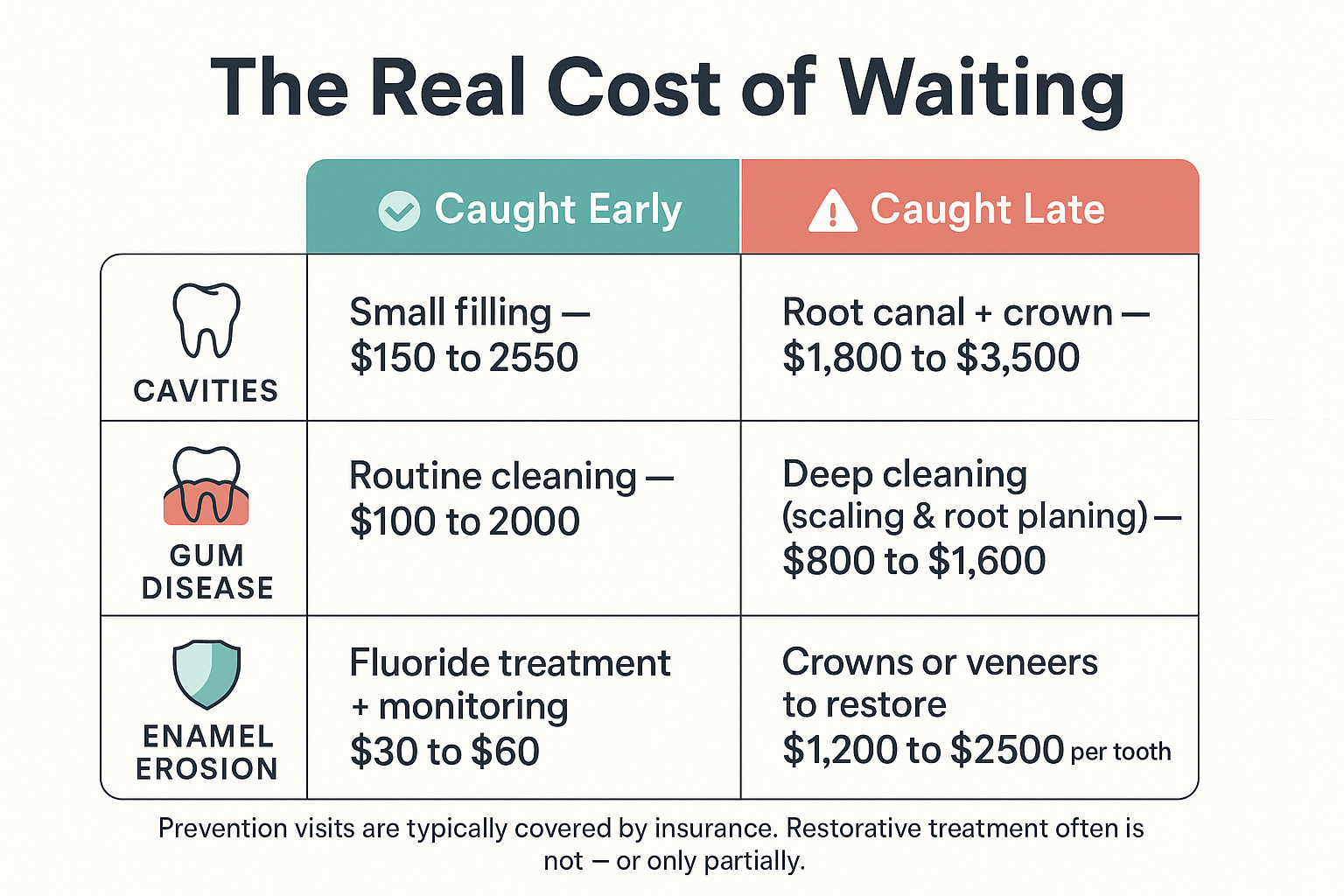
This infographic shows how early treatment compares to delayed treatment across three of the most common dental problems — in plain numbers.
Enamel Erosion: The Slow Problem Nobody Notices Until Something Breaks
Tooth enamel is the hardest substance in the human body, but it doesn’t grow back. Once it’s worn down, the only options are to slow the process or restore what’s lost — and restoration means crowns, veneers, or bonding, which adds up fast.
Erosion happens gradually from acid exposure — acidic foods and drinks, acid reflux, or dry mouth (a common side effect of many medications). Patients who drink a lot of sparkling water, citrus juice, or soda often don’t connect those habits to their dental bills. And patients managing acid reflux sometimes don’t realize the acid reaching their mouth is quietly dissolving enamel at night.
Dry mouth is worth calling out specifically because it’s extremely common among patients taking blood pressure medications, antidepressants, antihistamines, or diuretics. Saliva is your mouth’s natural defense against acid and bacteria. When saliva production drops, both decay and erosion accelerate. A lot of our patients in their 50s and 60s across Rancho Gabriela and Desert Oasis are managing multiple medications and don’t realize dry mouth is part of the picture.
The fix at early stages is simple:
- Fluoride treatments to strengthen remaining enamel (around $30–$60 per application at a dental visit)
- Prescription-strength fluoride toothpaste for home use
- Adjustments to diet timing — rinsing with water after acidic drinks instead of brushing immediately
- Prescription or OTC saliva substitutes if dry mouth is medication-related
When erosion has progressed to the point where tooth structure is compromised or teeth are visibly worn, short, or sensitive — the conversation shifts to crowns at $1,200–$2,000 per tooth or veneers in the cosmetic range. Preventive steps cost a fraction of that.
Prevention vs. Treatment: A Side-by-Side Look at Common Dental Problems
These cost ranges reflect typical out-of-pocket estimates in the Surprise, Arizona market. Insurance coverage varies — preventive services are most commonly covered at 80–100%, while restorative care is often subject to annual maximums and waiting periods.
| Problem | Prevention Cost | Treatment Cost (If Ignored) | Timeline Before It Gets Costly |
|---|---|---|---|
| Early cavity | $0 (caught at cleaning + X-ray) | $150–$3,500 depending on severity | 6–18 months without intervention |
| Gingivitis | Routine cleaning: $100–$200 | Deep cleaning: $800–$1,600 | 3–12 months to progress to periodontitis |
| Enamel erosion | Fluoride treatment: $30–$60 | Crowns or veneers: $1,200–$2,500/tooth | Years — but once structure is lost, it’s gone |
| Cracked tooth (undetected) | Exam + X-ray catches stress fractures early | Crown: $1,200–$2,000 / Extraction + implant: $3,500+ | Months — grinding or biting pressure accelerates it |
| Tooth infection (abscess) | Filling or crown prevents pulp exposure | Root canal + crown: $1,800–$3,500 | Weeks once infection sets in — can become urgent |
Why ‘It Doesn’t Hurt’ Doesn’t Mean ‘It’s Fine’
Dental problems are famously quiet in their early stages. Teeth don’t have the same kind of nerve sensitivity that soft tissue does — you can have a cavity developing for months or bone loss progressing slowly without any pain signal at all.
Pain is actually a late-stage symptom in most dental disease. By the time a tooth hurts consistently, you’re usually past the simple-fix window. This is the part of dentistry that trips people up most often — they skip appointments because nothing hurts, and then something hurts, and the bill reflects how long it’s been.
Digital X-rays let us see what’s happening between teeth, below the gumline, and inside a tooth’s structure before any symptoms show up. A full set takes a few minutes and exposes you to a fraction of the radiation of a standard medical X-ray. It’s one of the most cost-effective tools in dentistry.
For patients who’ve been away from the dentist for a few years — which describes a lot of people across the West Valley, whether due to cost concerns, anxiety, or just life getting in the way — getting back in doesn’t have to mean bracing for bad news. Most people who come back in after a gap find that things are more manageable than they expected. And the ones who wait longer than they should are almost always glad they finally came in.
Frequently Asked Questions About Preventable Dental Problems
How often do I actually need to come in if nothing is bothering me?
For most adults, twice a year is the standard recommendation — one cleaning and exam every six months. Some patients with a history of gum disease or high cavity risk may need to come in every three to four months. Your dentist can tell you which schedule makes sense based on what they see at your exam.
My gums bleed when I floss. Is that normal or should I be concerned?
It’s common, but it’s not normal in the way a lot of people assume. Bleeding gums almost always mean inflammation — usually gingivitis, which is reversible with a professional cleaning and consistent flossing. If it continues after two weeks of daily flossing, mention it at your next appointment. Don’t stop flossing because it bleeds — the bleeding usually goes away once the inflammation is under control.
I take a few medications and my mouth always feels dry. Does that matter dentally?
Yes, and it matters more than most people realize. Dry mouth dramatically increases your risk for cavities and enamel erosion because saliva is what neutralizes acid and rinses bacteria away. If you’re on blood pressure meds, antidepressants, antihistamines, or diuretics, mention it to your dentist — there are specific protective fluoride treatments and rinses that help. Staying well-hydrated and avoiding sugary or acidic drinks helps too.
I haven’t been to the dentist in a few years. What should I expect when I come back in?
Honestly, most people who come back after a gap find things aren’t as bad as they feared. We’ll start with a full exam, updated X-rays, and a cleaning. If there are any issues, we’ll go through them clearly — what they are, why they matter, and what the options are. Nobody gets pressured into treatment on the first visit. You leave with a clear picture of where things stand and a plan that makes sense for your situation.
Does dental insurance actually cover preventive visits, or will I get a bill?
Most dental insurance plans cover preventive care at 80–100% — that typically includes your cleaning, exam, and X-rays. What insurance often doesn’t cover well is restorative work like crowns, root canals, or deep cleanings. This is part of why staying current on preventive visits saves money even if you have insurance — you’re keeping yourself in the low-cost coverage tier instead of the high-cost restorative tier.
What if I genuinely can’t afford to get everything fixed at once?
That’s a real concern and one we hear often. Treatment planning in phases is completely normal — you prioritize what’s urgent, stabilize what’s active, and address cosmetic or elective work over time. We can also walk through financing options and help you understand what your insurance will cover before any treatment starts. The worst outcome is doing nothing because the full picture feels overwhelming.
Ready to Get Back on Track?
If it’s been a while since your last visit — or you’ve been watching a sensitivity or a bleeding gum and waiting to see if it goes away — our team at West Bell Dental Care is a good place to start. We see patients six days a week, including Saturdays, which makes it easier to fit into a real schedule. You can learn more at westbelldentalcare.com or call us at 480-795-2420 to ask questions or set up a new patient appointment.